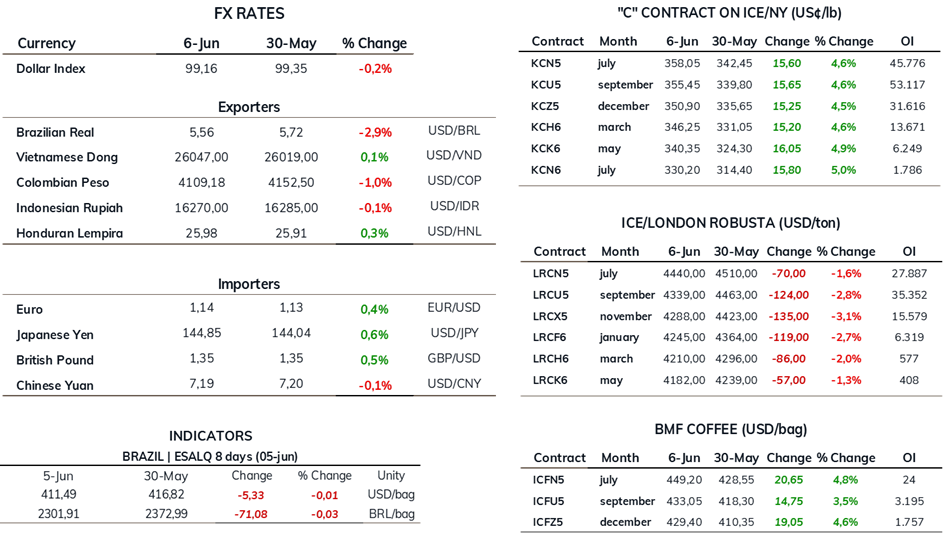
• New York: arabica up 4.6%, London: robusta down 2.8%
• The drop in the dollar supported arabica coffee futures prices
• Brazilian harvest advances, pressuring prices in short and medium term
• Weather remains in focus with frost risk during winter
• Domestic market sees price drop as harvest progresses
• Record exports in 2024 limited supply earlier this year
• 2025 harvest already reaches 31.8% of total crop
• Espírito Santo leads robusta harvest; Cerrado Mineiro lags behind
Without major changes in fundamentals, coffee futures ended last week with mixed results. Arabica coffee futures rose amid tight supply and increased industry buying. Another factor that contributed to the appreciation in New York was the sharp 2.9% drop in the dollar, which closed on Friday at USDBRL 5.56. On the other hand, prices fell in London, reflecting the progress of the robusta coffee harvest in Brazil and expectations of a production recovery in Vietnam.
At this moment, the market remains focused on the progress of the Brazilian harvest. Despite lower arabica production, the significant increase in robusta production has brought relief to short- and medium-term supply, exerting downward pressure on prices. Additionally, the market continues to monitor the weather, especially the potential arrival of cold fronts and the risk of frost during winter.
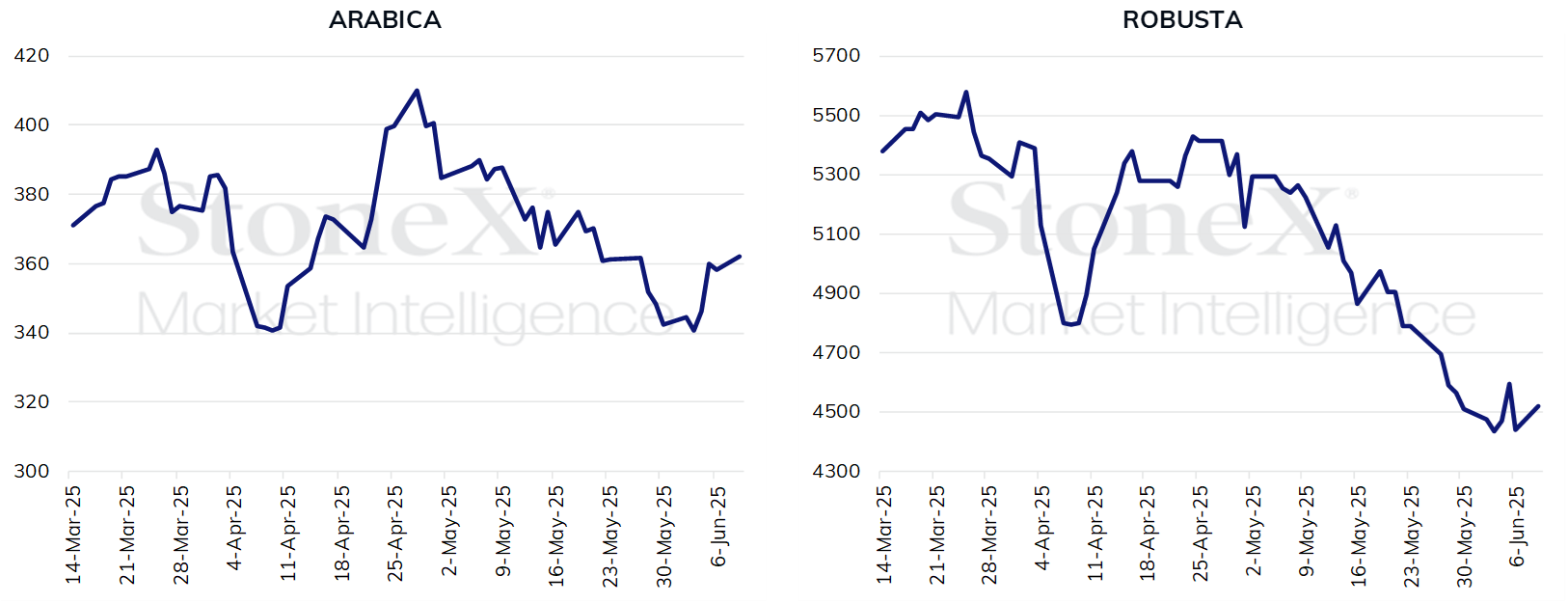
In New York, the most active contract for September rose by 1,565 points, a 4.6% increase, closing Friday, the 6th, at US¢ 355.45 per pound. Meanwhile, prices in London dropped by USD 124 per ton, a 2.8% decrease, to USD 4,339 per ton.
Arabica coffee futures prices (US¢/lb), robusta coffee (USD/ton)
In the Brazilian domestic market, prices continued to decline as the harvest progressed. The Cepea indicator for arabica coffee fell 0.8%, to just over R$ 2,316 per bag. The robusta coffee indicator dropped 2.2%, to just over R$ 1,366 per bag.
In Q1 2025, prices were strongly supported in the Brazilian market due to limited coffee supply and strong industry demand. Since 2021, the industry has operated under a Just-in-Time management model, characterized by minimal or no inventory levels.
In the first quarter, the industry needed to acquire coffee due to the Just-in-Time strategy, but availability was very limited, mainly due to underwhelming production and strong export volumes in 2024, which exceeded 50 million bags.
In Q2, with the start and progress of the harvest, the arrival of new coffee has brought short-term balance to supply and demand, helping to push down arabica and robusta prices in the domestic market.
The harvest began earlier than in 2024, but heavy rainfall in April delayed progress. However, during May and early June, the pace picked up and is expected to match last year's rhythm in the coming weeks. StoneX data shows that, as of June 9, Brazil had harvested 31.8% of its crop, totaling 20.5 million bags, based on StoneX’s estimate of 64.5 million bags.
The arabica harvest reached 26% by June 9, totaling 10 million bags. The robusta harvest surpassed 40%, totaling 10.5 million bags. This robusta harvest progress is a key factor putting pressure on prices. Robusta production is expected to reach a new record of 25.8 million bags in 2025, according to StoneX data.
Among producing regions, Espírito Santo leads robusta harvest with 41%; Bahia follows with 40%; Rondônia is slightly behind at 38%. For arabica regions, Matas de Minas stands out with 34% harvested, followed by Espírito Santo (arabica) with 29%. Then come Sul de Minas and Bahia with 26% harvested. The most delayed region is Cerrado Mineiro, at 17%.
Coffee harvest progress in Brazil
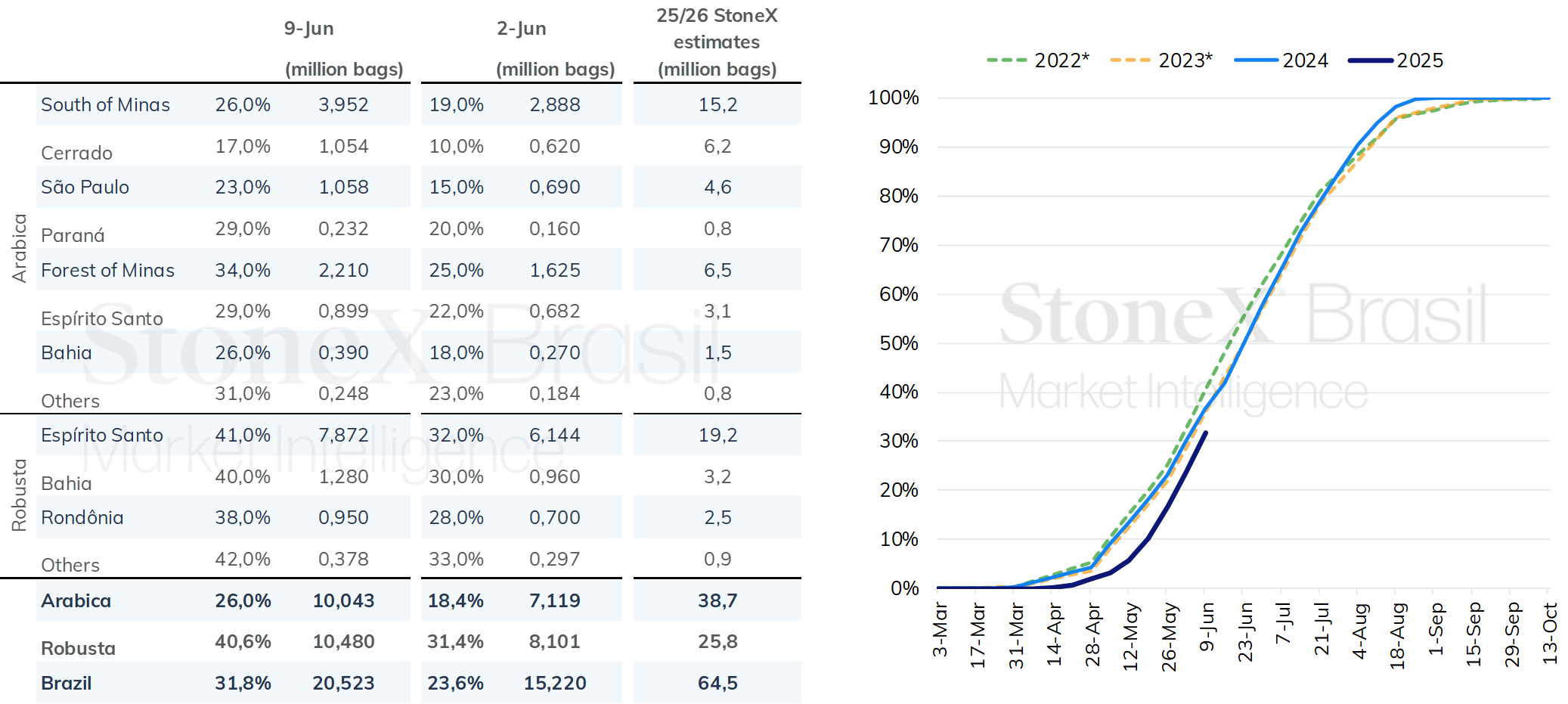
Source: StoneX.
Next week, prices will be influenced by technical and fundamental factors. The market will continue monitoring the harvest progress in Brazil, and increased availability is likely to keep prices under pressure. On the other hand, the market will closely watch weather forecasts and the risk of polar air masses or frost that could impact producing areas — potentially causing bullish reactions.
Additionally, technical issues such as the Index Funds Roll — the fund position rollover period — and the arabica options expiry will influence the market. Export data releases, especially from Brazil, will also be in focus. According to Cecafé, the export report for May will be released on the afternoon of Tuesday, the 10th.
INDICATORS