
Daily Coffee Report 8/4/26
Daily coffee report
StoneX Coffee Team
- Coffee
By: StoneX Intelligence Brazil, StoneX Intelligence Brazil

Translation generated by AI
• Coffee market rises with frost in Brazilian producing regions
• Low global stocks sustain coffee prices
• StoneX cuts estimates for Brazilian arabica crop
• US tariffs on Brazilian coffee push international prices higher
• Typhoon Kajiki threatens logistics and ports, but does not affect production
• Coffee inflation advances in the US
• Risk of La Niña and irregular rainfall threatens flowering
Coffee prices advanced sharply over the past week, supported by low global stocks, the occurrence of frost in Cerrado Mineiro, the continuation of tariffs on Brazilian coffee imports by the United States, lower-than-expected production in Brazil, and forecasts of dry weather during flowering. Together, these factors acted in a bullish manner, lifting quotations both in the international and the Brazilian domestic markets.
Not all of these factors are new, but they remain relevant. The scenario of reduced stocks had already been impacting the market and was the main driver behind the rallies observed in the first quarter of the year. Despite the recent update that further reduced the outlook for Brazilian arabica production, this information is not necessarily new, as there is already a consensus about the sharp decline in the crop. The truly new elements in this equation are the imposition of tariffs by the United States and the occurrence of frost in Cerrado Mineiro. The expectation of dry weather during coffee flowering is not exactly new either, as recent years of adverse climate had already raised similar concerns, but it nevertheless exerts considerable weight on coffee prices.
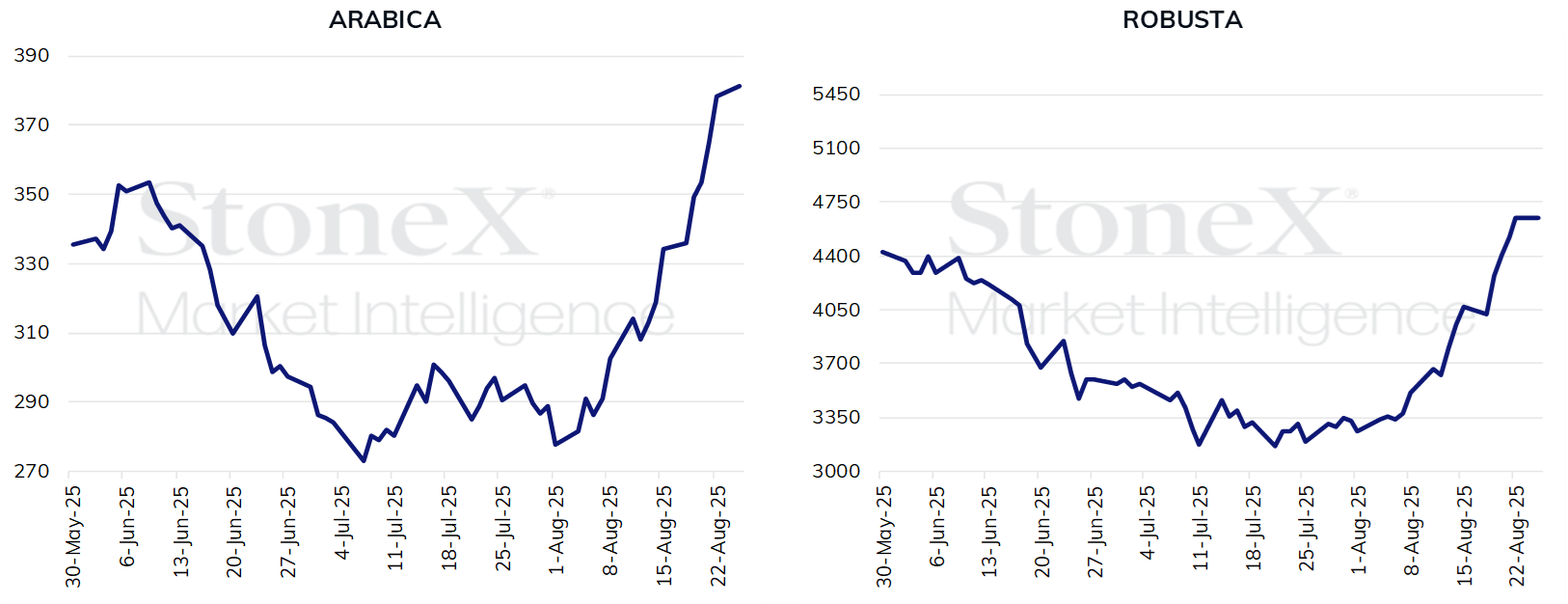
In New York, the most active contract closed the week up 13.2%, accumulating an increase of 36.3% in August. In London, robusta coffee registered a weekly rise of 14.3% and a monthly increase of 42.7%. In Brazil, arabica gained 14.7% during the week and 25.7% in August, while robusta advanced 18% in the week and accumulated a 41.1% increase over the month.
Arabica coffee futures prices (US¢/lb) Robusta coffee futures prices (USD/ton)
The progress of harvesting brought some short-term relief, but this effect proved limited. Despite the fast pace of the Brazilian harvest, global stocks had already been drawn down in recent years due to a succession of adverse weather events that reduced production. Thus, even with the entry of the new crop, global supply remains tight.
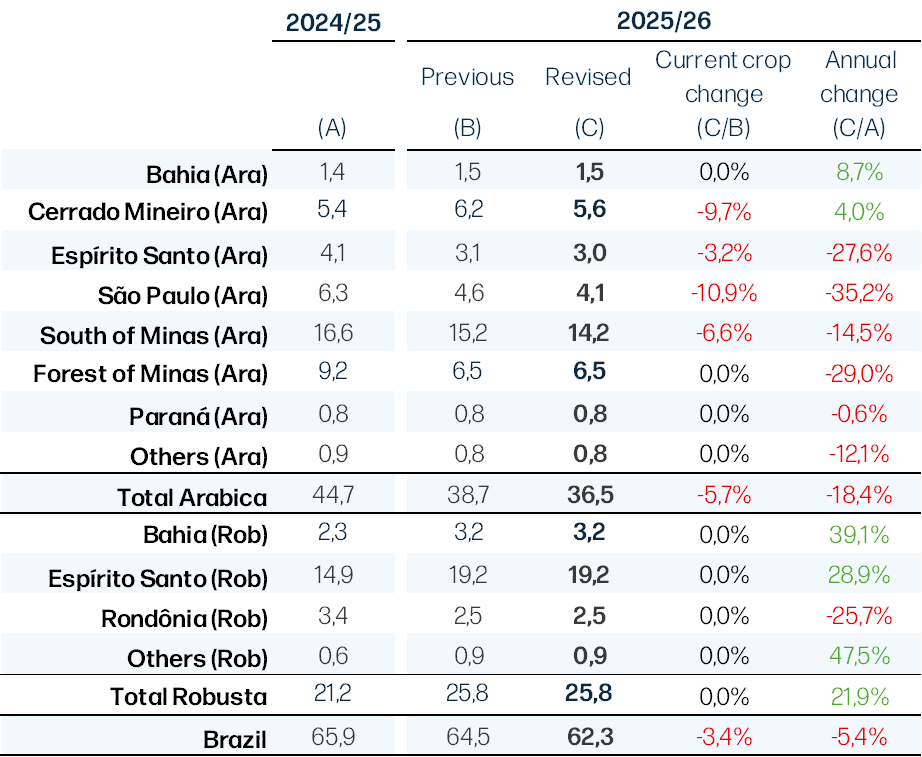
In Brazil, robusta production advanced, but arabica suffered significant losses. StoneX had already reduced its estimate by 13.5% in April and, in last week’s update, once again cut its projection for the crop that is now in its final harvesting stage. The downward revision reflected yields below expectations in Sul de Minas, Cerrado, Mogiana and southern Espírito Santo. The new estimate for arabica dropped from 38.7 million to 36.5 million bags, representing a 5.7% reduction compared to the previous estimate and an 18.4% drop relative to the 2024/25 crop. São Paulo was the negative highlight, with a 10.9% cut compared to the prior estimate and a 35.2% reduction versus last year. Cerrado Mineiro fell by 9.7% and Sul de Minas by 6.6%. Robusta, in turn, was maintained at 25.8 million bags.
Another relevant factor was the frost of August 11, which had not been anticipated by weather models. StoneX estimated that the event may have reduced the production potential of Cerrado Mineiro by around 424,000 bags. There is also the possibility of additional losses depending on the impact of the low temperatures on flower buds, something that can only be assessed after flowering begins.
Internationally, the approach of Typhoon Kajiki to Vietnam initially raised concerns about robusta production, given that the country is the second-largest coffee producer in the world and the leading producer of robusta. However, no direct impact on production is expected, as the phenomenon is occurring in regions without coffee plantations. The main producing areas, located in the Central Highlands, are not in the typhoon’s path, which removes significant risks to the Vietnamese crop. The major concern, in this case, lies in potential impacts on logistics and port infrastructure, which are critical for the country’s coffee exports.
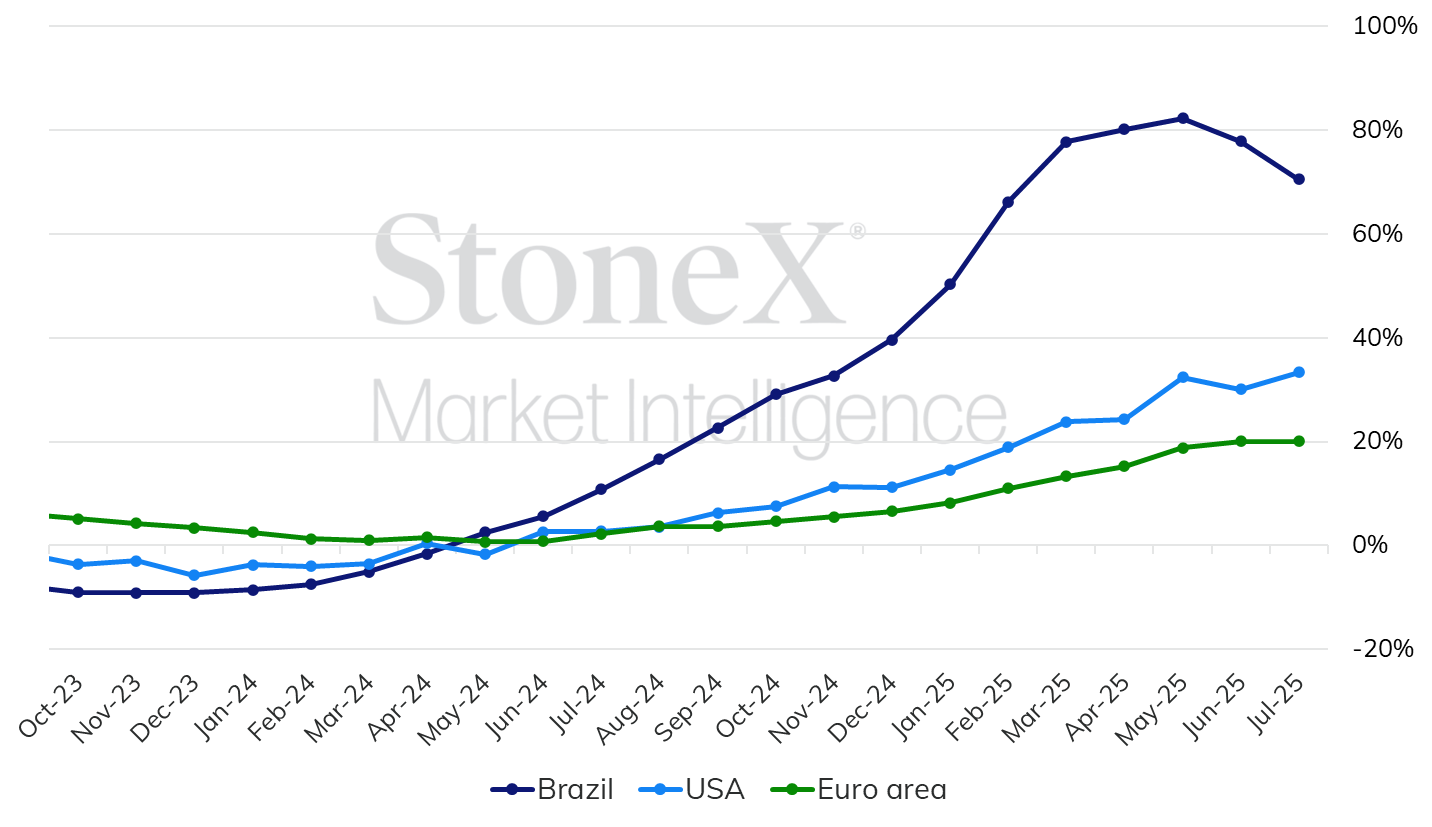
The 50% tariffs imposed by the United States on Brazilian coffee also exerted bullish pressure. The US is highly dependent on Brazil, which accounted for 35% of imports in 2024 and over 30% in the first half of 2025. This measure tends to tighten supply in the American market, at a time when coffee inflation is already rising. Consumer coffee prices in the US rose 33.4% through July, according to the BLS. By contrast, coffee inflation in Brazil lost strength, dropping from 82.2% in May to 70.5% in July, while in the European Union it stabilized at around 20%.
Inflation in roasted and ground coffee consumer prices
Furthermore, the imposition of tariffs is expected to trigger a reorganization of global trade flows. Arabica-producing countries such as Colombia, Guatemala and Honduras will likely redirect more volumes to the United States, attracted by higher prices. The markets left unattended by these exporters will open more space for Brazil to ship part of its production to these already established destinations, but with a greater share. The net effect will be a reallocation of trade flows, with impacts on volumes and global prices.
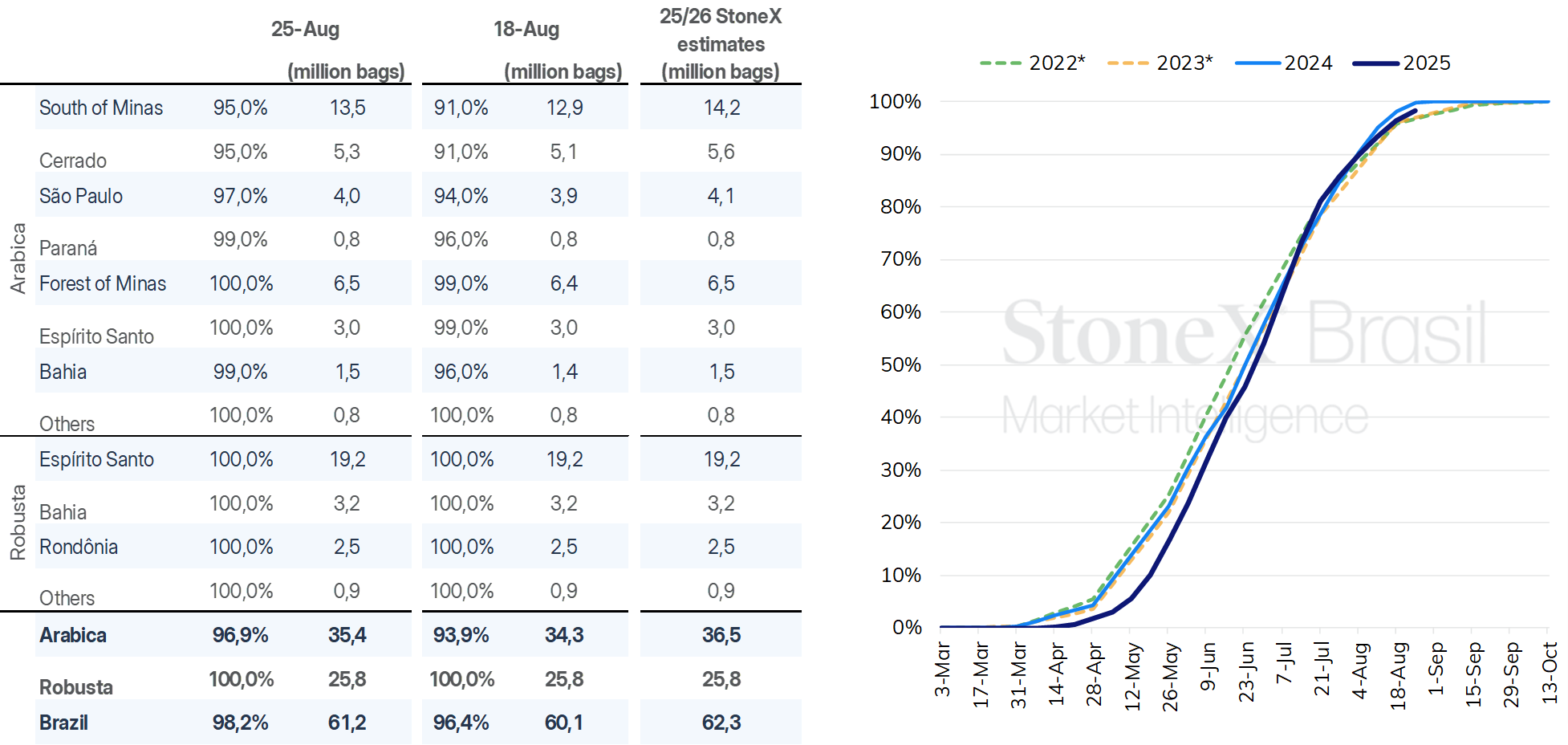
With the harvest practically concluded, at 98.2% overall (100% of robusta and 96.9% of arabica), attention now turns to weather conditions during flowering. Robusta flowering has already begun in Espírito Santo and Bahia, but arabica is still awaiting the more intense phase. Climate models indicate a risk of irregular rainfall and the possibility of La Niña until the end of the year, which could bring below-average precipitation in the coffee belt between September and October, normalizing only from the end of October. Heat waves are also on the radar. If this scenario materializes, flowering could be compromised, as was the case in 2024, further tightening global supply.
Coffee harvest pace in Brazil
Therefore, the coffee market remains supported by a combination of bullish factors: reduced stocks, frost in Cerrado, US tariffs, climate uncertainties during flowering, logistical risks in Vietnam and the reorganization of global trade. From now on, weather will be the main driver of prices, in a context where supply is already in a delicate situation.
INDICATORS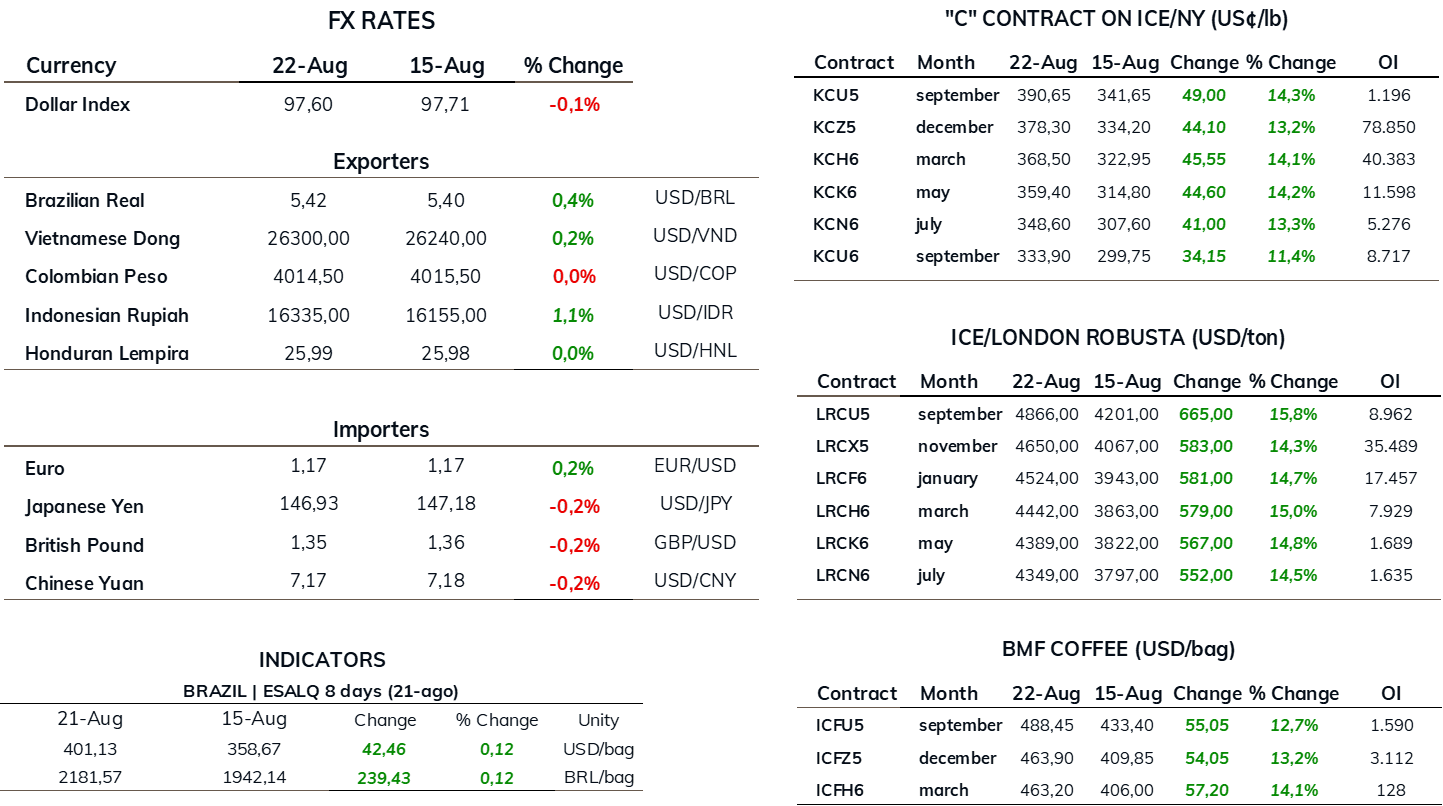
The StoneX Group Inc. group of companies provides financial services worldwide through its subsidiaries, including physical commodities, securities, exchange-traded and over-the-counter derivatives, risk management, global payments and foreign exchange products in accordance with applicable law in the jurisdictions where services are provided. References to over-the-counter (“OTC”) products or swaps are made on behalf of StoneX Markets LLC (“SXM”), a member of the National Futures Association (“NFA”) and provisionally registered with the U.S. Commodity Futures Trading Commission (“CFTC”) as a swap dealer. SXM’s products are designed only for individuals or firms who qualify under CFTC rules as an ‘Eligible Contract Participant’ (“ECP”) and who have been accepted as customers of SXM. StoneX Financial Inc. (“SFI”) is a member of FINRA/NFA/SIPC and registered with the MSRB. SFI is registered with the U.S. Securities and Exchange Commission (“SEC”) as a Broker-Dealer and with the CFTC as a Futures Commission Merchant and Commodity Trading Adviser. References to securities trading are made on behalf of the BD Division of SFI and are intended only for an audience of institutional clients as defined by FINRA Rule 4512(c). References to exchange-traded futures and options are made on behalf of the FCM Division of SFI . StoneX is a trading name of StoneX Financial Ltd (“SFL”). SFL is registered in England and Wales, Company No. 5616586. SFL is authorized and regulated by the Financial Conduct Authority [FRN 446717] to provide to professional and eligible customers including: arrangement, execution and, where required, clearing derivative transactions in exchange traded futures and options. SFL is also authorised to engage in the arrangement and execution of transactions in certain OTC products, certain securities trading, precious metals trading and payment services to eligible customers. SFL is authorised & regulated by the Financial Conduct Authority under the Payment Services Regulations 2017 for the provision of payment services. SFL is a category 1 ring-dealing member of the London Metal Exchange. In addition SFL also engages in other physically delivered commodities business and other general business activities which are unregulated and not required to be authorised by the Financial Conduct Authority. StoneX Group Inc. acts as agent for SFL in New York with respect to its payments services business. StoneX APAC Pte. Ltd. acts as agent for SFL in Singapore with respect to its payments services business. ‘StoneX’ is the trade name used by StoneX Group Inc. and all its associated entities and subsidiaries.
Trading swaps and over-the-counter derivatives, exchange-traded derivatives and options and securities involves substantial risk and is not suitable for all investors. Past performance of any futures or option is not indicative of future success. Indicators are not a trading system and are not published as a specific trade recommendation. The information herein is not a recommendation to trade nor investment research or an offer to buy or sell any derivative or security. It does not take into account your particular investment objectives, financial situation or needs and does not create a binding obligation on any of the StoneX group of companies to enter into any transaction with you. You are advised to perform an independent investigation of any transaction to determine whether any transaction is suitable for you. No part of this material may be copied, photocopied or duplicated in any form by any means or redistributed without the prior written consent of StoneX Group Inc.
© 2026 StoneX Group Inc. All Rights Reserved.
Our subscribers have access to comprehensive market analysis from StoneX spanning commodities, equities, currencies and more.
Daily coffee report

August 4 – The benchmark Dow Jones Industrial Average surged into the close yesterday to finish almost 700 points higher, at a record close of 53,178 points – easily clearing the previous top from almost a month ago. The S&P 500 is on the brink of its own record as well, while the NASDAQ index is short of June highs but working on a strong three-session rally. All three are pointing to positive openings today. Palantir (a U.S. software company) reported better-than-expected earnings yesterday afternoon post-close to boost the tech sector, though a host of other firms reported strong earnings as well. The ten-year note continues to retreat from Friday’s high, now at 4.67%, with the dollar on the high side of level-par, while the VIX index now under 16 shows reduced volatility.

Daily coffee report
Our market expertise, advanced platforms, global reach, culture of full transparency and commitment to our clients’ success all set us apart in the financial marketplace.
Reach
With access to 40+ derivatives exchanges, 180+ foreign exchange markets, nearly every global securities marketplace and numerous bilateral liquidity venues, StoneX’s digital network and deep relationships can take clients anywhere they want to go.
Transparency
As a publicly traded company meeting the highest standards of regulatory compliance in the markets we serve, our financials and track record are matters of public record. StoneX’s commitment to “doing the right thing over the easy thing” sets us apart in the industry and helps us build respect, client trust and new partnerships.
Expertise
From our proprietary Market Intelligence platform to “boots-on-the-ground” expertise from award-winning traders and professionals, we connect our clients directly to actionable insights they can use to make more informed decisions and achieve their goals in the global markets.