Amid extreme volatility coffee futures prices retreat with forecast of rains in Brazil
Translation generated by AI
• Biggest daily drop in 17 years, market retreats with climate relief
• Arabica in New York fell 7.6%, robusta in London lost 10%
• Climate models indicate significant rains in the coffee belt in September
• Arabica flowering still low, weather in coming weeks is crucial
• Conilon flowering already completed under favorable climatic conditions
• United States reduces imports from Brazil and increases purchases from Colombia
• US imports from Vietnam grow 198%
• Vietnam harvest in November may ease global robusta supply
Last week was marked by intense volatility in the coffee market. Futures prices started with strong gains, with the most active contract in New York rising 1,875 points on Monday (15), equivalent to a 4.9% increase. This movement reflected concerns about the weather in Brazil during the flowering period as well as the influence of exchange rates. The dollar showed a significant decline against the real, amid both external and domestic factors. In the United States, expectations were consolidating—later confirmed—of a cut in the Federal Reserve’s benchmark interest rate.
From the 16th onward, however, prices retreated sharply, especially on the 17th, when there was a drop of 3,325 points, equivalent to 8.5% in a single session. It was the largest daily depreciation in 17 years. The reversal came with the strengthening of the dollar against the real and, above all, with the prospect of rain returning to Brazil’s coffee belt. Weather models began to point to significant volumes of precipitation in arabica-producing areas in the midst of the flowering process. This relief eased climate concerns, leading to bearish adjustments. In addition, the increase in initial margins by the exchange contributed to the greater volatility.
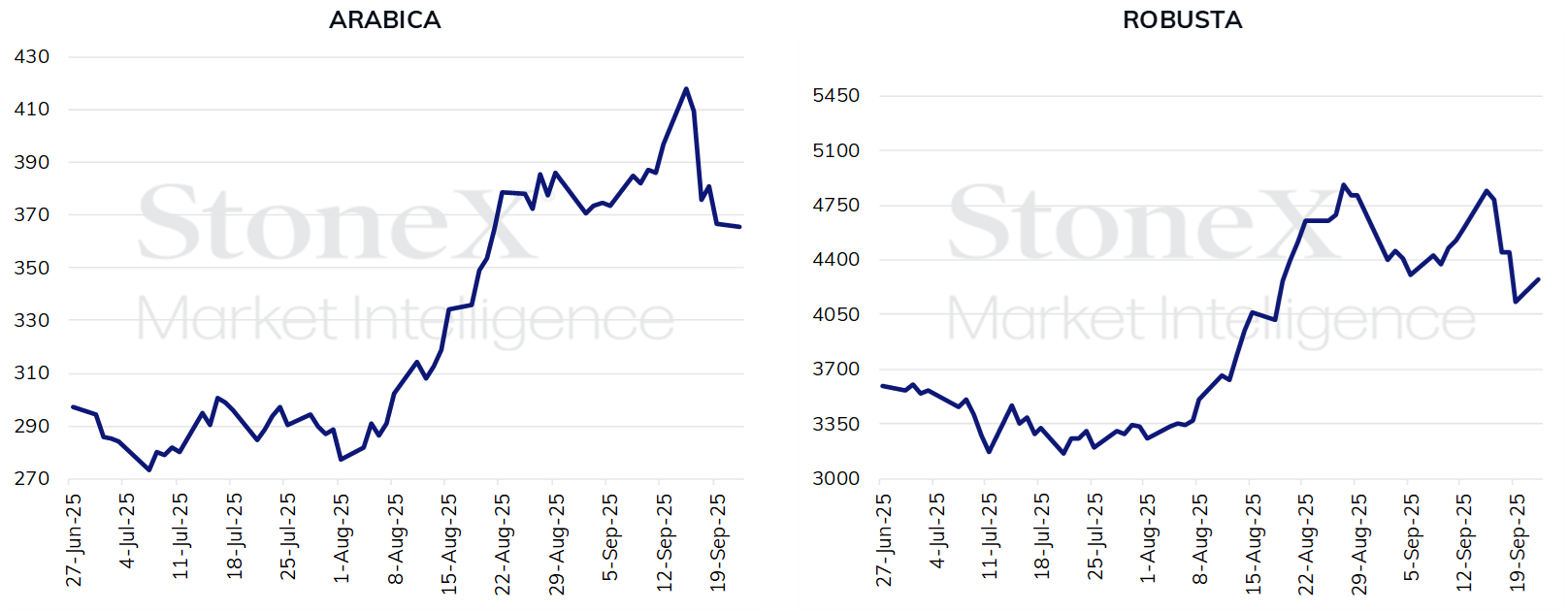
The December contract in New York ended the week with an accumulated drop of 3,035 points, or 7.6%, quoted at US¢ 366.50 per pound. In London, robusta fell by US\$ 466 per ton, a 10% loss, closing at US\$ 4,135 per ton. The dollar recorded a weekly decline of 0.6%, quoted at R\$ 5.32. This Monday (22), the market opened in slight recovery, with New York up 125 points, equivalent to 0.34%, to 367.75 cents per pound. In London, robusta rose by US\$ 145, or 3.5%, to US\$ 4,280 per ton.
Arabica coffee futures prices (US¢/lb) robusta coffee (USD/ton
Source: Cmdty View. Prepared by: StoneX.
In the Brazilian physical market, prices also fell last week. The Cepea indicator for arabica dropped 8.5%, to just over R\$ 2,147 per bag. Robusta registered a decline of 9.3%, being traded around R\$ 1,288 per bag.
Weather remains the main influencing factor in the market. Forecasts point to substantial rainfall in several producing regions over the next seven days. In the Cerrado Mineiro, several municipalities are expected to record accumulations between 19 and 41 millimeters. In southern Minas, estimates range from 16 to 56 millimeters, while in the Matas de Minas they range from 13 to 38 millimeters. In São Paulo, projected volumes are between 21 and 31 millimeters. Meanwhile, robusta-producing regions have received substantial rainfall in recent days, ensuring good conditions for flowering and fruit set.
The first weeks of September brought arabica flowering in southern Minas, São Paulo, and the Cerrado. However, intensity was low, with only 18%, 16%, and 10% of flowers opened, respectively. This was due to the low volume and irregularity of rains that preceded the flowering. In the Matas de Minas and southern Espírito Santo, where rainfall was heavier and better distributed, flowering was more homogeneous, with around 45% of flowers opened. In the conilon areas, flowering has already been practically completed under very favorable conditions. The challenge in these regions now is to ensure fruit set and development.
Attention remains focused on arabica, where the percentage of opened flowers is still low. Weather in the coming weeks will be decisive for proper development. Although projected volumes are still below historical averages, the 2025 scenario is better than 2024. Crops benefit from greater soil moisture and, unlike last year, have not faced excessive maximum temperatures, which had caused significant losses. This sustains the expectation of a larger 2026 harvest, which tends to exert bearish pressure on prices in the medium term.
Another factor being monitored by the market is the trade issue involving the United States. The tariffs imposed on Brazilian coffee are already affecting inflation in the country and reducing Brazilian exports. Data shows an 18% drop in U.S. imports of Brazilian coffee in July, while purchases from other suppliers increased. Imports from Colombia grew 16%, from Honduras 36%, from Guatemala 4.3%, and from Vietnam an impressive 198%. There were also increases from origins such as Mexico, Nicaragua, Ethiopia, Peru, Indonesia, and Costa Rica.
In the cumulative period through July, the United States imported just over 4 million bags from Brazil, a 3.7% drop compared to the same period in 2024. In contrast, purchases from Colombia reached 2.9 million bags, an increase of nearly 24%. This shift reflects a greater appetite for diversification of origins, while Brazil tends to redirect its supply to other destinations. There are, however, initiatives from the U.S. Congress and industry organizations seeking to remove the tariffs. Should this happen, the dynamics of international trade could change again. In the first seven months of the year, the U.S. imported just over 14 million bags, representing an increase of just over 10% compared to the same period in 2024.
The market is also monitoring the harvest in Vietnam, which is expected to begin in mid-November. Production is projected to recover by 6% after years of adverse weather impacts, mainly related to El Niño. This harvest is expected to ease the supply of robusta in the international market.
TABLE OF INDICATORS
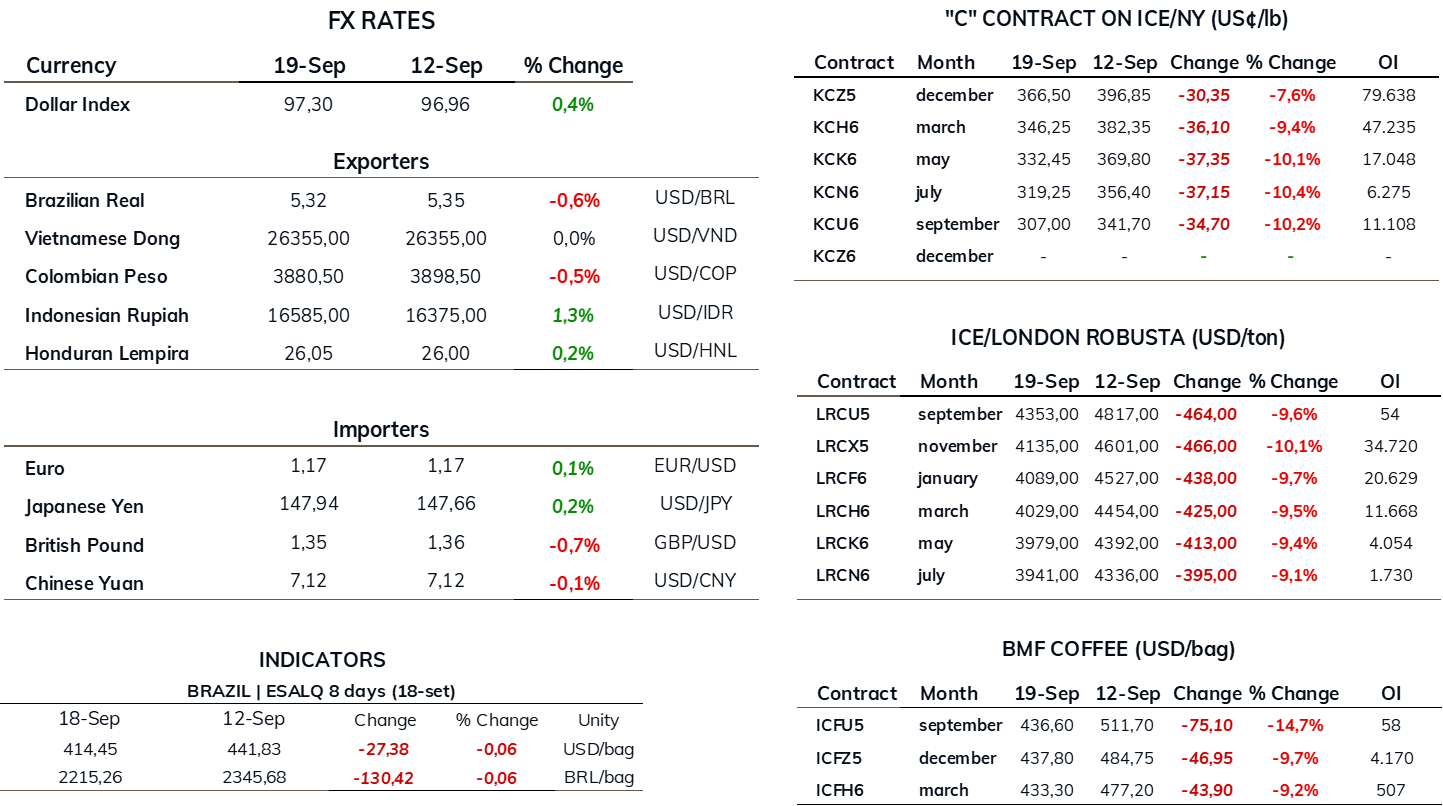
Sources: ICE/NY; ICE/EU; B3; Commodity Network Trader’s Pro.