Coffee market attentive to weather in Brazil and tariffs in the United States
Translation generated by AI
• Coffee ends week higher despite volatility in New York and London
• Market attentive to weather in Brazil and U.S. tariffs
• Trump signals dialogue and raises expectations of tariff removal
• U.S. Congress considers bill to exempt coffee from import tariffs
• U.S. inflation rises 40.6% in 12 months, pressuring consumption
• Arabica flowering remains uneven, main phase expected in October
• European Union considers delaying implementation of the Deforestation Law (EUDR)
• Brazilian retail coffee sales fall 5.4% in 2025
Amid strong volatility, coffee futures prices ended last week higher. The market, especially in the session on the 23rd, posted a sharp decline, with the most active contract in New York dropping 1,720 points, equivalent to almost 4.7%. This movement mainly reflected the signal from the U.S. government of opening a channel of dialogue with the Brazilian government. However, in the following session, on the 24th, prices rebounded, fully recovering the previous day’s loss.
On the weekly balance, New York closed with a gain of 1,155 points, or 3.2%, at 378.05 US¢ per pound. In London, the most active robusta coffee contract rose 1.6%, reaching USD 4,201.00 per ton. On Monday, however, the market fell again in New York: the December contract dropped 585 points, or 1.55%, while the March contract lost 335 points, equivalent to 0.9%. In London, declines were more modest, 0.36% for the November contract and 0.19% for the January contract.
Arabica coffee futures prices (US¢/lb) robusta coffee (USD/ton)
Source: Cmdty View. Prepared by StoneX.
From a fundamental perspective, there were no major changes last week. The market remains attentive to weather conditions in Brazil, a decisive factor for the productive potential of the 2026/27 crop. The tariff issue in the United States on Brazilian coffee imports also remains in focus. Last week’s market reaction was tied to President Donald Trump’s signal of openness to dialogue with the Brazilian president, which raised expectations of a possible tariff removal.
In addition, members of the U.S. House of Representatives announced a bill to exempt coffee from any tariffs, emphasizing that it is a product not produced in the country and that taxation only increases costs for consumers. The inflationary impact has been significant: in August, monthly inflation was 5.4% compared to July, with an annual increase of 40.6%, pressuring U.S. consumption.
Inflation on roasted and ground coffee prices
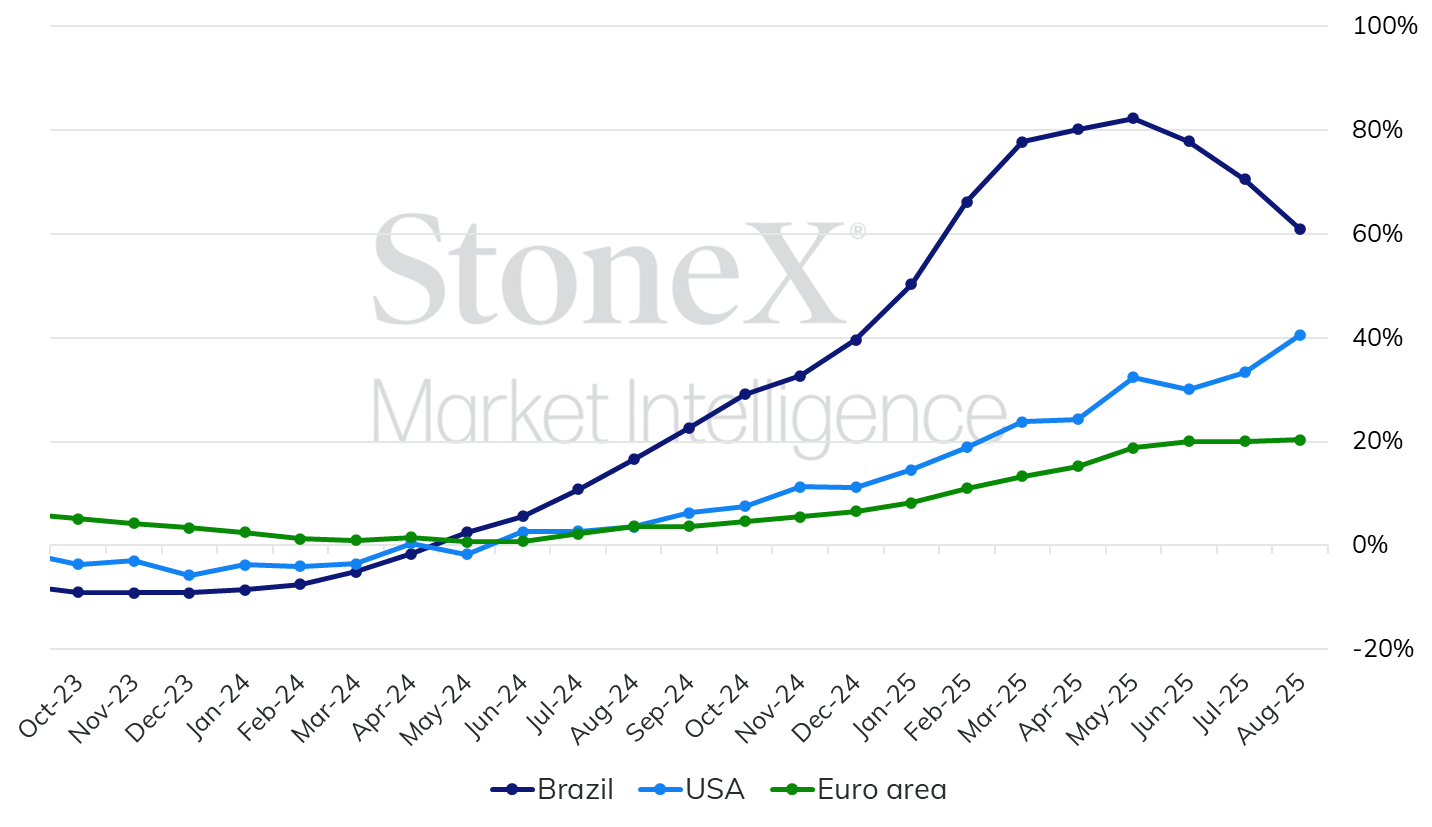
Sources: IBGE, BLS and Eurostat. Prepared by StoneX.
In terms of weather, the main robusta flowering has already occurred under favorable conditions, supported by the widespread use of irrigation, which reinforces expectations for a positive crop. In the case of arabica, flowering has started in some regions, but in an uneven manner, with the main flowering still expected in the coming weeks. Producing regions in Minas Gerais received significant rainfall, although still below average. Weather models had indicated continued precipitation, but forecasts have since been revised. Even so, current conditions are better than in the same period last year, thanks to higher soil moisture reserves and the absence of extreme temperatures like those seen in 2024. Despite expectations for good potential in the 2026 crop, weather developments over the next few weeks will be decisive in consolidating this outlook.
In the regulatory sphere, a proposal was released in the European Parliament to once again postpone the implementation of the Deforestation Law (EUDR) by one year, originally scheduled to take effect on December 30 of this year. If approved, the measure will bring relief to the market, which had already seen, particularly last year, importers in Europe advancing purchases in anticipation of the regulation.
In Brazil, the Brazilian Coffee Industry Association (ABIC) updated retail sales data. Between January and August 2025, 9.56 million bags were sold, a 5.4% decline compared to the same period of the previous year, reflecting higher consumer prices. In the annual comparison between August 2025 and August 2024, price increases were significant: soluble coffee rose 50.6%, specialty 32.4%, gourmet 46.4%, superior 20.3%, and traditional extra strong 48.6%. This price surge has reduced consumption, in line with StoneX’s outlook, which projects a 3% decline in global demand in 2025, directly influenced by coffee inflation at the consumer level.
In the coming weeks, the market will remain attentive to weather conditions in Brazil, which may determine the course of the 2026 crop. A wet and favorable scenario tends to reinforce expectations of higher production, pressuring prices downward, while delayed rains or excessive heat could support further increases. The unfolding of the tariff issue between the United States and Brazil will also stay at the center of attention, as well as export data. As of September 26, preliminary Cecafé figures showed shipments of 2.9 million bags, well below the 4.23 million exported in the same month of 2024, highlighting the impact of U.S. tariffs on Brazilian exports. This will remain a closely monitored issue for market participants.
INDICATORS TABLE
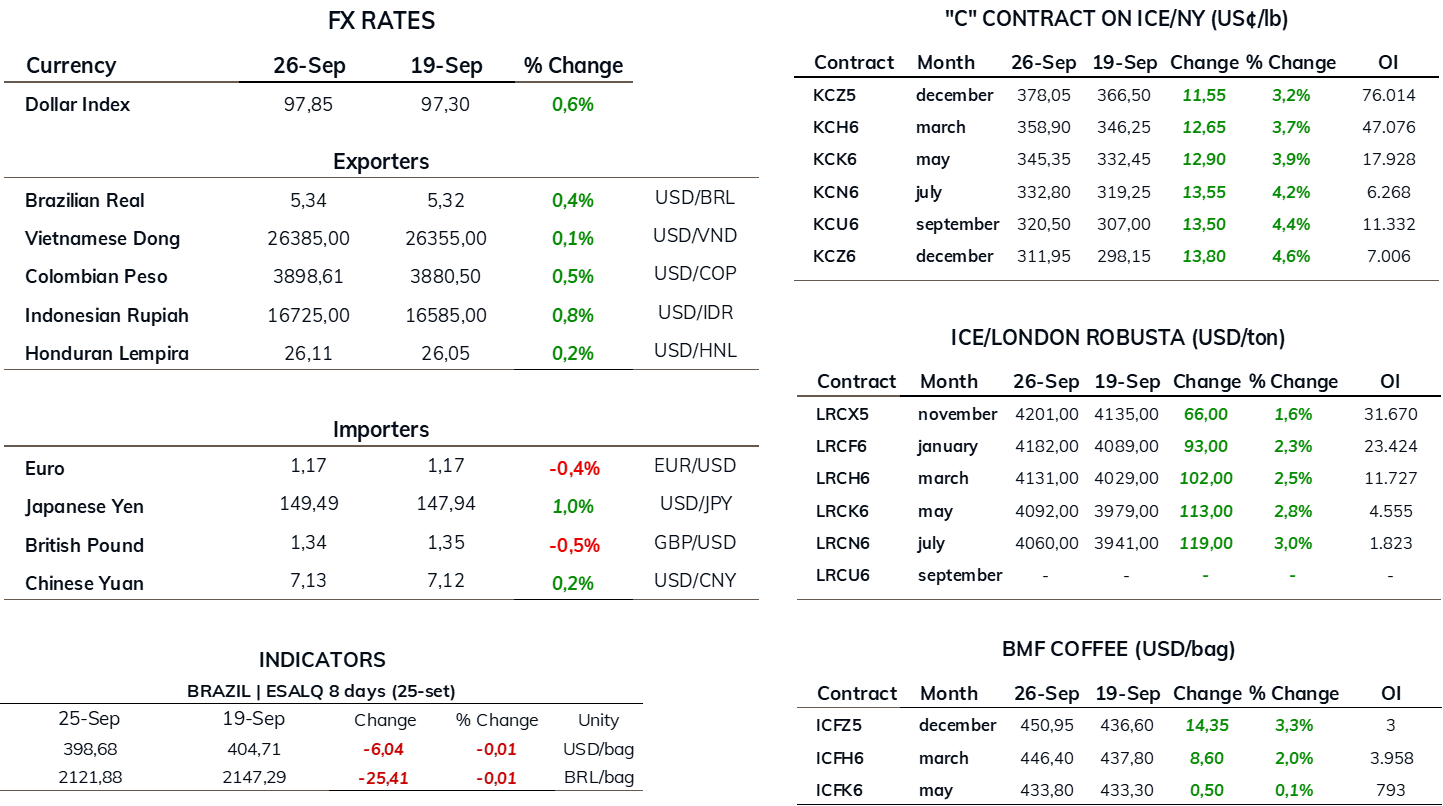
Sources: ICE/NY; ICE/EU; B3; Commodity Network Trader’s Pro.