Positive outlook for the flowering, uncertainties over tariffs and certified stocks set the tone for the coffee market
Translation generated by AI
• Coffee futures prices end the week higher
• Dollar declines and contributes to higher coffee prices
• Lula speaks with Trump and requests a 40% tariff reduction
• Flowering in Brazil shapes expectations for the 2026 crop
• Favorable weather conditions boost optimism in coffee fields
• Certified arabica stocks fall 17.7% in two weeks
• Secex: Brazilian coffee exports drop 28% in September
• Global coffee inflation pressures consumption and limits demand
Coffee futures prices ended last week higher. With no major changes from a fundamental standpoint, the market continued to closely monitor weather conditions in Brazil and the decline in certified coffee stocks. In addition, trading volumes were reduced as part of the market participants attended the 16th SCTA (Swiss Coffee Trade Association) Coffee Forum and Dinner, held on October 2–3 in Basel.
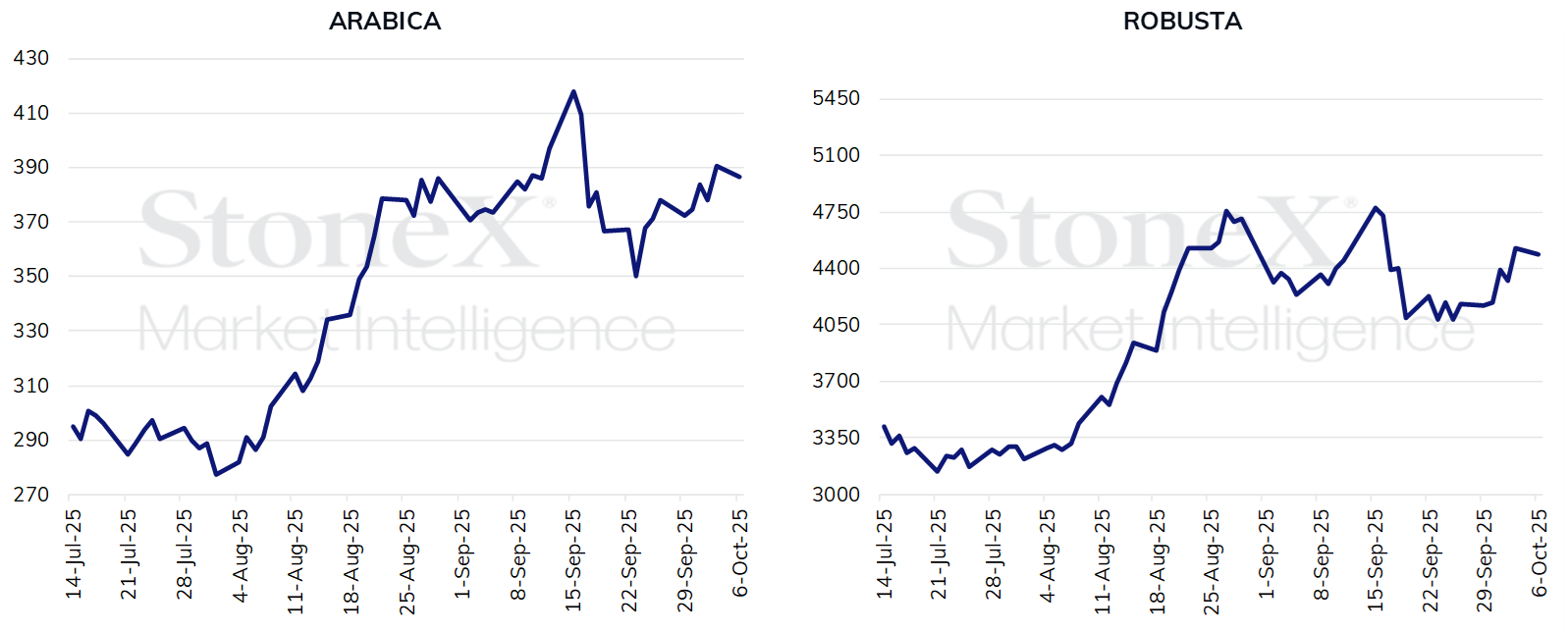
In New York, the most active arabica coffee contract rose 3.4%, or 1,270 points, closing Friday at US¢ 390.75 per pound. In London, the most traded contract, for November delivery, climbed 7.8%, ending the week at 4,527 dollars per ton. The depreciation of the U.S. dollar also contributed to the upward movement: the dollar index fell 0.4% over the week, closing Friday (3) at 97.41 points, while the dollar against the Brazilian real declined 0.1%, ending at R$ 5.34.
In the Brazilian domestic market, prices also moved higher. The Cepea indicator for arabica coffee rose 2.85% over the week, closing Friday at R$ 2,184.71 per 60-kg bag. The robusta indicator increased 5.16%, ending the week at R$ 1,389.41 per bag.
On Monday, October 6, prices showed a correction. The most active arabica contract in New York was down 1.52% at the time of writing, while the most active robusta contract in London declined 0.44%. The market remains focused on weather conditions in Brazil during the flowering period, the impact of tariffs on Brazilian coffee exports, and the continued decline in certified arabica coffee stocks.
Also on Monday (6), U.S. President Donald Trump and Brazilian President Luiz Inácio Lula da Silva spoke by phone. According to an official statement from the Brazilian government, the conversation was friendly. During the call, Lula requested a 40% reduction in tariffs and the easing of restrictive measures imposed on Brazilian officials. Trump appointed Secretary of State Marco Rubio to continue negotiations with Vice President Geraldo Alckmin and other members of the Brazilian government.
Arabica coffee futures prices (US¢/lb) and robusta coffee prices (USD/ton)
Source: Cmdty View. Prepared by StoneX.
From a fundamental standpoint, the scenario remains largely unchanged. Market participants continue to focus on weather conditions in Brazil, particularly during this critical flowering period, which will determine the productive potential of the 2026 crop. The StoneX team is already in the field conducting surveys for the first 2026 crop estimate, which is scheduled for release in November. Field visits are currently concentrated in robusta-producing regions, where flowering occurs earlier. So far, flowering has already begun under favorable weather conditions for flower setting and crop development. Milder temperatures compared to 2024 and substantial rainfall have benefited plantations, which also rely heavily on irrigation systems.
In arabica-producing regions, widespread flowering has yet to occur but is expected over the next few weeks. Although rainfall volumes remain below average, recent precipitation has improved field conditions, and forecasts point to significant volumes beginning around October 10. Southern Minas Gerais is expected to receive between 20 and 70 millimeters over the next seven days, with rainfall also anticipated in the Mogiana region of São Paulo and in Paraná. In Matas de Minas and the Cerrado, the most significant rainfall is projected for October 14–15. The anticipated arrival of these rains reinforces expectations for a healthy flowering process, which could exert downward pressure on coffee prices.
Read also: From Global to Regional: a Complementary Path for Rainfall Forecasts in Brazil
The market also reacted to the decline in certified arabica coffee stocks, which fell 6.6% last week, totaling 538,606 bags as of October 3. Over the past two weeks, the accumulated decrease reached 17.7%. This movement has been driven mainly by the withdrawal of Brazilian and Mexican coffees from certified inventories.
This week, in addition to monitoring weather conditions in Brazil, the market will follow the release of export data from Cecafé amid growing concerns about the impact of U.S. tariffs on Brazilian coffee exports. Preliminary data from Brazil’s Secretariat of Foreign Trade (Secex) through the fourth week of September show exports of just over 2.9 million bags of green coffee, a 28% decline compared to the same period last year. Part of this reduction reflects the smaller supply resulting from weather-related challenges affecting the 2025/26 crop, as well as the effects of U.S. government tariffs on imports from Brazil.
Overall, a combination of factors has been influencing the coffee market. On the bearish side, the return of rainfall and the prospect of a strong 2026 crop have brought optimism regarding production recovery, which exerts downward pressure on futures prices. Another significant bearish factor is coffee inflation’s impact on global consumption. In the United States, annual coffee inflation has surpassed 40% over the past twelve months; in Brazil, despite a slight decline, it still exceeds 60%; and in the European Union, it remains above 20%. This scenario has constrained global demand, and StoneX estimates a 3% drop in global coffee consumption for the 2025/26 season, adding further downside risk to prices.
On the other hand, several elements continue to support the market. Global coffee stocks remain low and are expected to stay that way until replenishment begins, likely in 2026, assuming favorable weather conditions. U.S. tariffs on Brazilian imports also add upward pressure, as they may create a supply shortage in the American market, reflected in New York prices. Furthermore, lower production in Brazil this season—resulting from adverse weather—has limited supply and contributed to price support. The market remains attentive to potential negotiations between the Brazilian and U.S. governments, as any sign of tariff relief could represent a bearish factor for New York prices.
INDICATOR TABLE
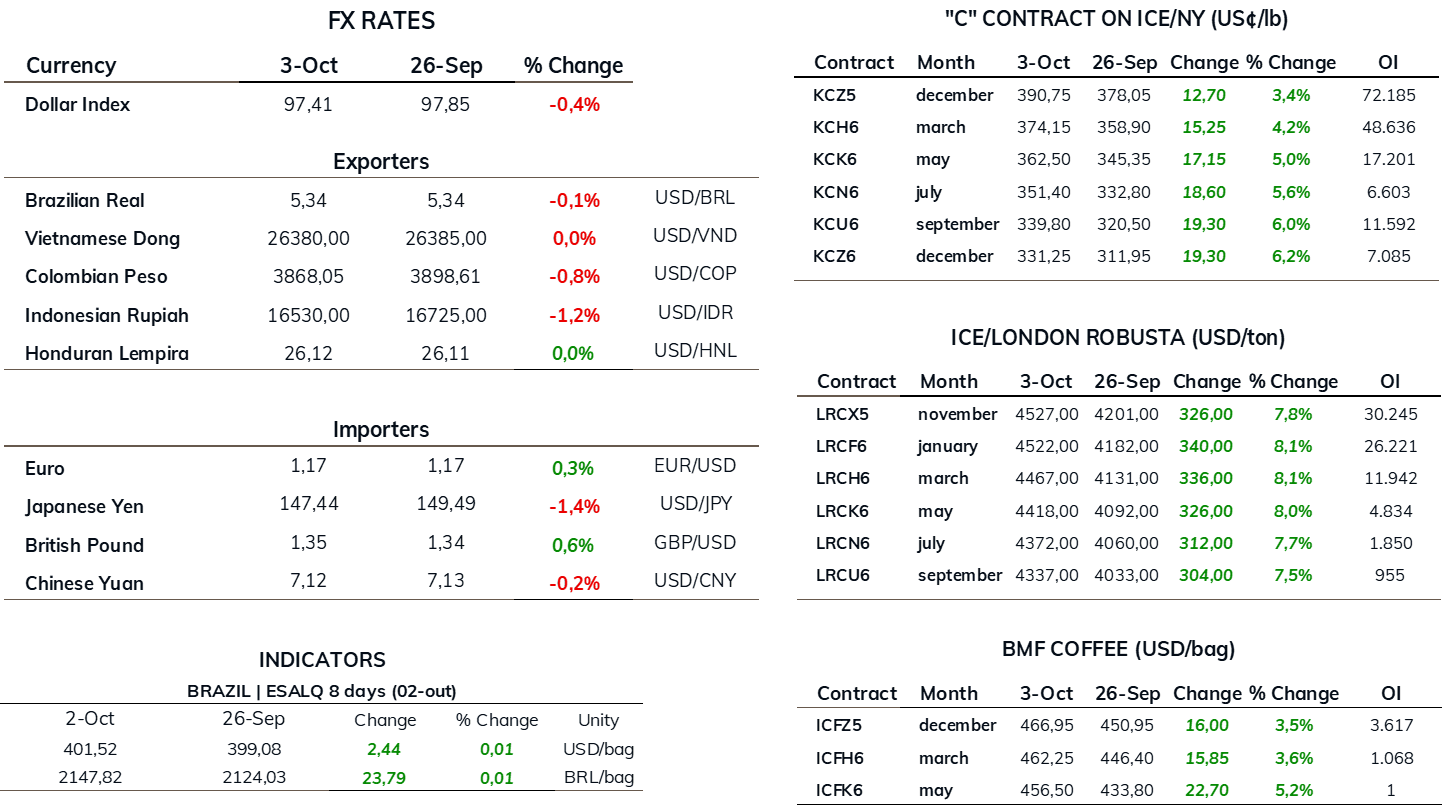
Sources: ICE/NY; ICE/EU; B3; Commodity Network Trader’s Pro.