Amid high volatility, the coffee market reacts to falling stocks, tariffs, and weather in Brazil
Translation generated by AI
• Coffee futures rose in New York and London amid high volatility
• Trump-Lula meeting and rains in Brazil impact the market
• Inverted structure indicates short-term supply tightness
• Certified stocks fall 26% reinforcing scarcity outlook
• Heavy rains improve prospects for the 2025/26 crop
• Vietnam’s harvest may pressure robusta prices
• Market closely monitors tariffs, weather, and Brazilian exports
Marked by significant volatility, the coffee futures market saw gains last week in New York and London. A set of factors contributed to this trend, with emphasis on concerns about crop development in Brazil, the limited supply scenario for arabica, the decline in certified stocks, and especially the uncertainties related to tariffs on imports into the U.S. from Brazil and the expectation of tariffs against Colombia amid the deterioration of relations between the United States and the South American country.
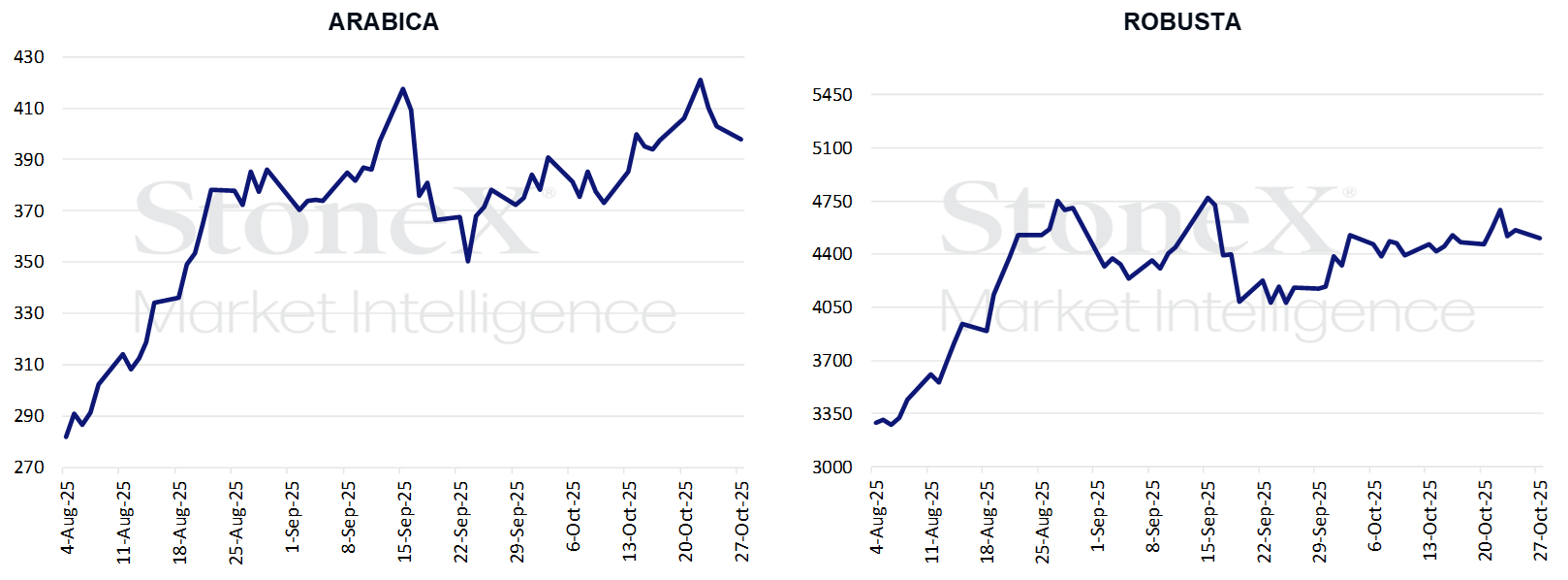
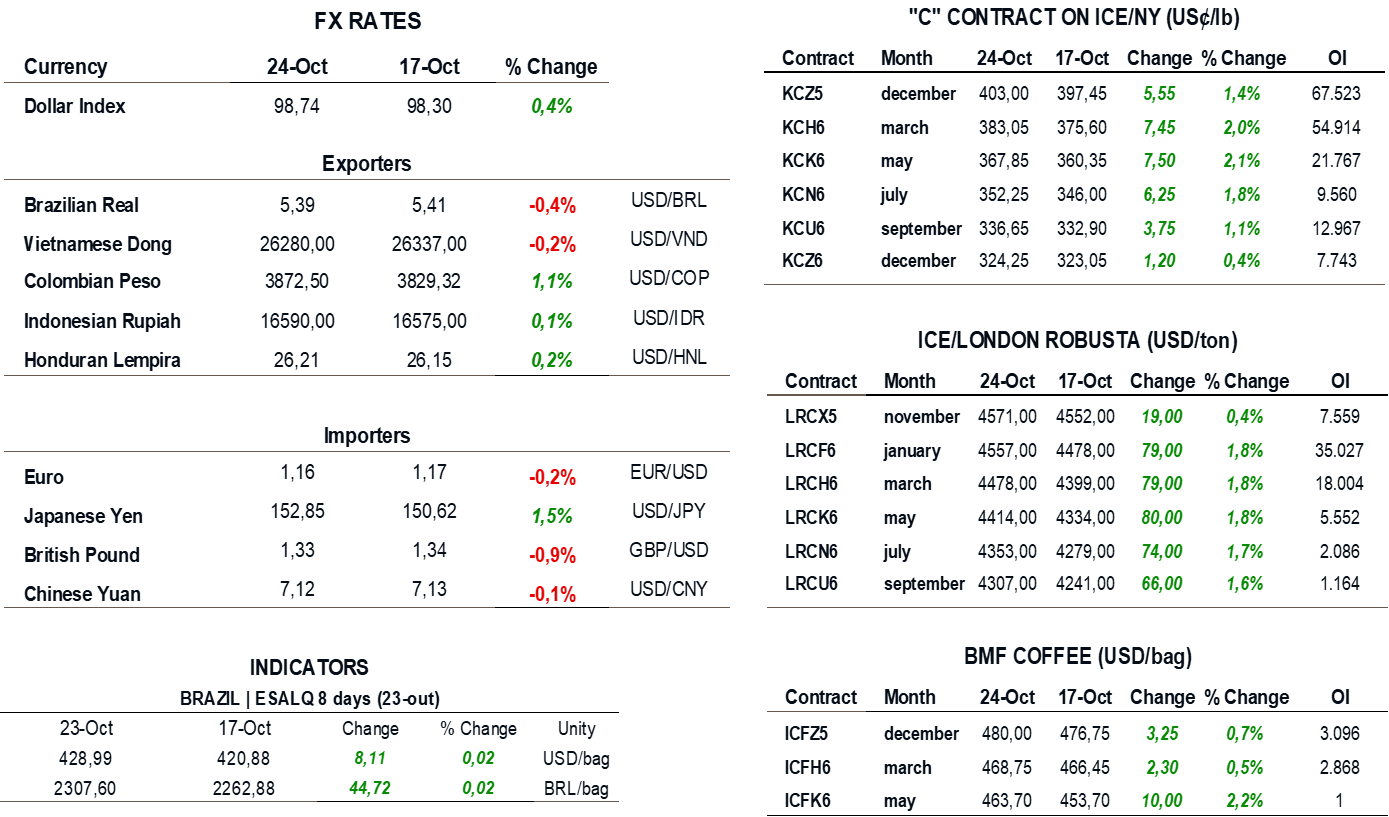
The week was characterized by strong volatility, especially on Thursday, the 23rd, when prices approached the historical highs seen in February of this year. On that day, prices reached US¢ 437.95 per pound but closed the session at US¢ 410.15/lb, with an amplitude of nearly 3,000 points between the low and the high. The Brazilian real appreciated 0.4% during the week, and the U.S. dollar ended quoted at R$ 5.39. The most active contract in New York recorded a weekly gain of 1.4%, closing at US¢ 403.00 per pound. In London, the movement was more moderate, up 0.4% to USD 4,571 per ton.
In the domestic market, the Cepea indicator for arabica coffee rose 1.2%, quoted at R$ 2,289.68 per 60-kg bag. Robusta remained practically stable, quoted at R$ 1,401.63 per bag.
Coffee futures started the week lower. On Monday, the 27th, at the time of writing this report, the December contract was down 2.67%, trading at US¢ 392.30 per pound in New York. In London, the January contract fell 1.91%, quoted at USD 4,470 per ton. The market was reacting to forecasts of rain in Brazil and to weekend news following the meeting between U.S. President Donald Trump and Brazilian President Luiz Inácio Lula da Silva in Kuala Lumpur, Malaysia.
Coffee futures prices for arabica (US¢/lb) and robusta (USD/ton)
Source: Cmdty View. Prepared by StoneX.
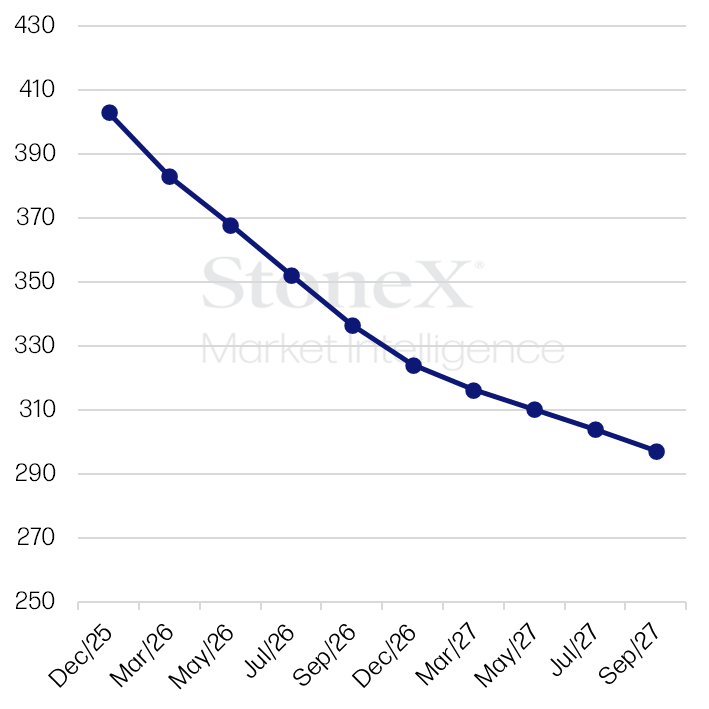
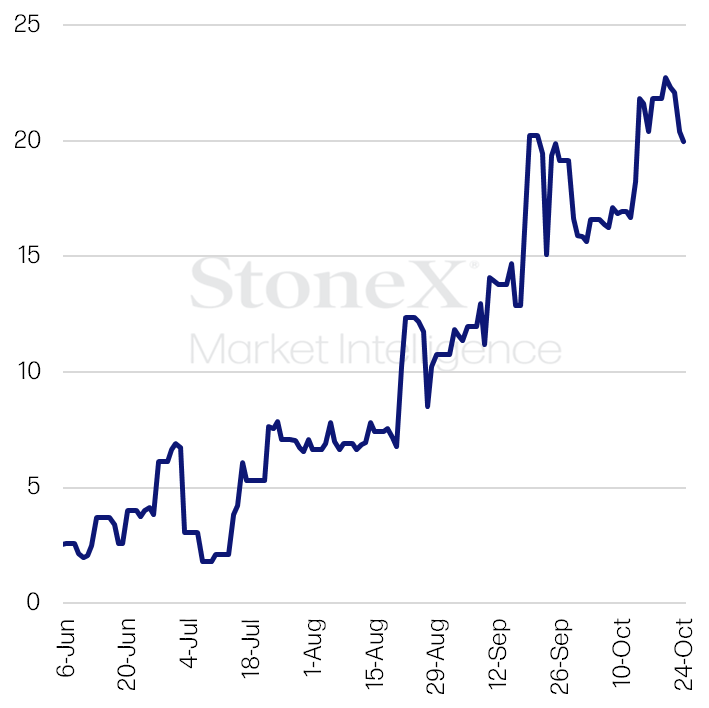
One of the main factors supporting prices at elevated levels is the lower short-term availability of coffee, reflected in the structure of futures prices. The market remains in a backwardation situation, with near-term contracts trading at higher prices than longer-term ones, indicating immediate supply tightness. In recent weeks, the difference between the first and second contracts in New York has increased significantly. While in early September the spread hovered around US¢ 11 per pound, by the end of October this difference had exceeded US¢ 22, reaching US¢ 22.75 in the session on October 20. This increase reflects the short-term supply restriction scenario, directly related to tariffs and the decline in certified stocks.
Future curve of arabica coffee prices on Oct 24th (left) and spread between the first two contracts December/25 and March/26 (right) - (US¢/lb)
Source: Cmdty View. Prepared by StoneX.
Source: Cmdty View. Prepared by StoneX.
Certified arabica coffee stocks have been showing a sharp decline. As of October 24, they totaled less than 450,000 bags, representing a drop of nearly 26% compared to the previous month. The decline is more pronounced for coffees of Brazilian origin. At the beginning of 2025, Brazil’s certified stocks reached 630,000 bags but currently stand at just over 26,000, a drastic reduction. This movement is linked to price differentials in the origins. At current levels, there is no economic incentive for producers or trading companies to certify coffee on international exchanges, which reinforces the tight supply scenario and pressures the nearby contract prices.
Weather conditions in Brazil have brought some relief to the market. Meteorological models indicate substantial rainfall across almost the entire coffee belt over the next two weeks. Accumulations of up to 130 mm are expected in Cerrado Mineiro, 125 mm in Matas de Minas, 180 mm in southern Minas Gerais, 184 mm in São Paulo, and 240 mm in Paraná. For robusta-producing regions, rainfall accumulations of up to 100 mm are expected in Rondônia and 70 mm in northern Espírito Santo. These rains help maintain a favorable outlook for the 2025/26 crop development. However, the weather factor will remain decisive, especially under the influence of the La Niña phenomenon.
In the coming weeks, the market will closely monitor discussions on tariffs. The meeting between the presidents of the United States and Brazil, held on the 26th, may represent the beginning of negotiations and signal progress toward a possible resolution. On the other hand, uncertainties persist regarding Colombia, which, along with Brazil, accounts for more than half of U.S. coffee imports, with 35% coming from Brazil and 20% from Colombia in 2024. In addition, market participants will monitor the release of Brazil’s export data. Given the continuation of tariffs, it is likely that October figures will indicate another decline in shipments to the United States.
Another point of attention is the start of Vietnam’s harvest, expected in November, which may act as a bearish factor on London prices, considering expectations of a crop approximately 7% larger than the previous cycle. This perspective increases the global supply of robusta and tends to put downward pressure on prices in that market. Weather conditions and certified stock levels will remain key factors. The continued reduction of these stocks tends to sustain a bullish bias in ICE coffee prices.
INDICATOR TABLE
Sources: ICE/NY; ICE/EU; B3; Commodity Network Trader’s Pro.