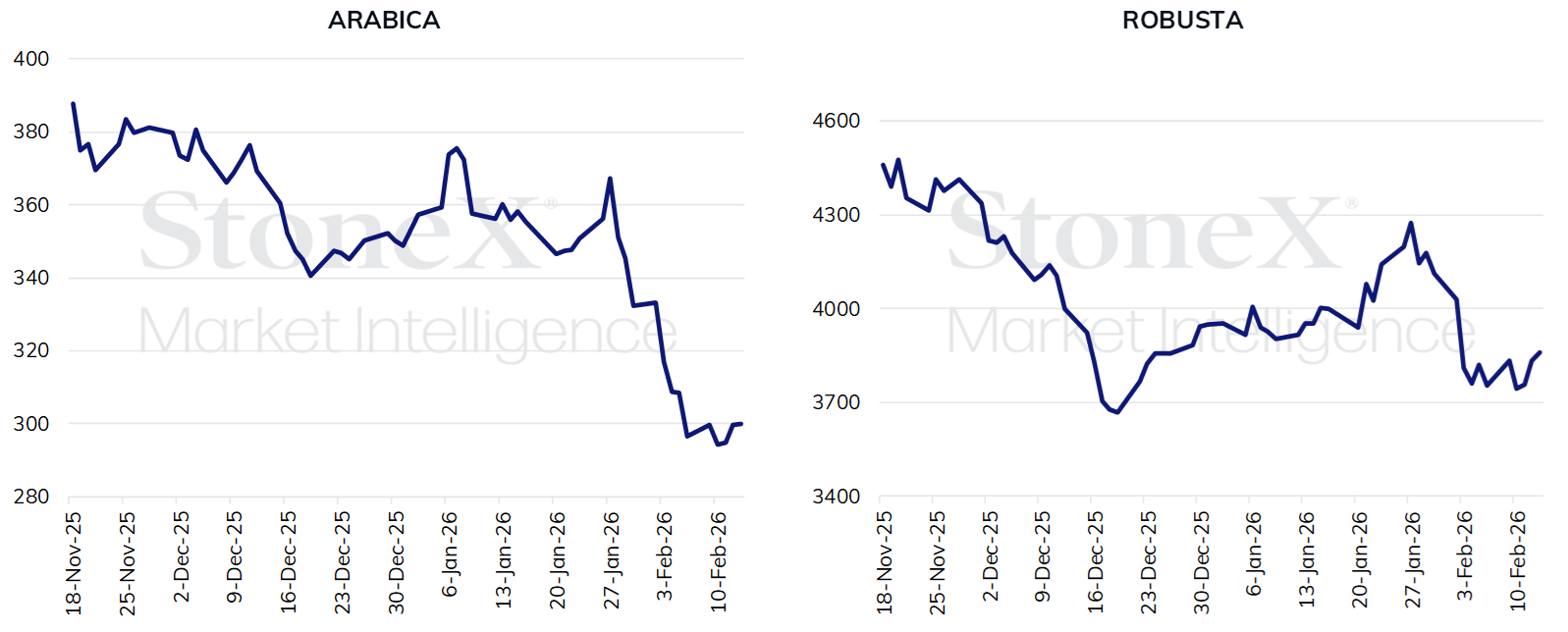
The past week saw a slight appreciation in coffee futures across major exchanges, following corrections after sharp declines in previous weeks, when prices hit six-month lows. Arabica coffee closed the week at USc 298.3/lb, up 3.1%. Meanwhile, robusta coffee ended at USD 3,800/t, a 3.6% increase.
Larger Supply in 2026: The primary bearish driver continues to be the favorable weather in Brazil and consensus around a large harvest in 2026, supported by various recent estimates. On the other hand, while robusta production in Brazil is expected to be slightly below forecasts due to anticipated reductions in Espírito Santo, Vietnam and Indonesia continue signaling strong supply levels.
The price stabilization last week indicates that much of this expectation has already been priced in during the sharp downward movement. The market is now seeking a new equilibrium level as it awaits fresh fundamental factors to guide upcoming decisions.
In this scenario, weather conditions in Brazil will remain crucial for the final development of coffee beans, while the market closely monitors indicators from other countries. Colombia remains a key focus following weak production results in January.
Monday’s Movements: In London, prices fluctuated between slight losses and gains, ending with a marginal drop of 0.1% for the session. International markets remain subdued due to the Presidents' Day holiday in the US, which kept the New York exchange closed — trading will resume as usual on Tuesday (17). Brazil’s Carnival holiday is also expected to slow down activity, with increased movement anticipated starting Wednesday (18).
Cecafé: Brazilian Exports Show Sharp Decline in January
Cecafé released official export data for January last week, showing a significant drop in shipments. A total of 2.528 million sacks of green coffee were sent abroad — an 11% decline compared to the previous month and a 31% drop from January 2025, marking the worst performance since July 2025.
Details:
- Arabica: 2.34 million sacks
→ Monthly decline of 11% and annual drop of 29%.
- Conilon: 181.5 thousand sacks
→ Monthly decline of 18% and annual drop of 46%, influenced by higher domestic demand and the competitiveness of Southeast Asian coffees, which are currently in peak harvest season.
- Soluble: 249.1 thousand sacks
→ Monthly decline of 9% and annual drop of 32%.
Soluble coffee remains the only product subject to the US-imposed 50% tariffs.
Why This Matters Although expectations of higher supply — especially for Arabica — have weighed on prices in recent weeks, Cecafé’s data reminds the market that Brazil has just harvested its smallest crop in four years and is currently in the off-season period, when volumes naturally decrease.
As a result, Brazil's tighter supply could act as a support factor for Arabica, especially if Colombian production continues to disappoint.
Monthly Green Coffee Exports from Brazil (millions of sacks)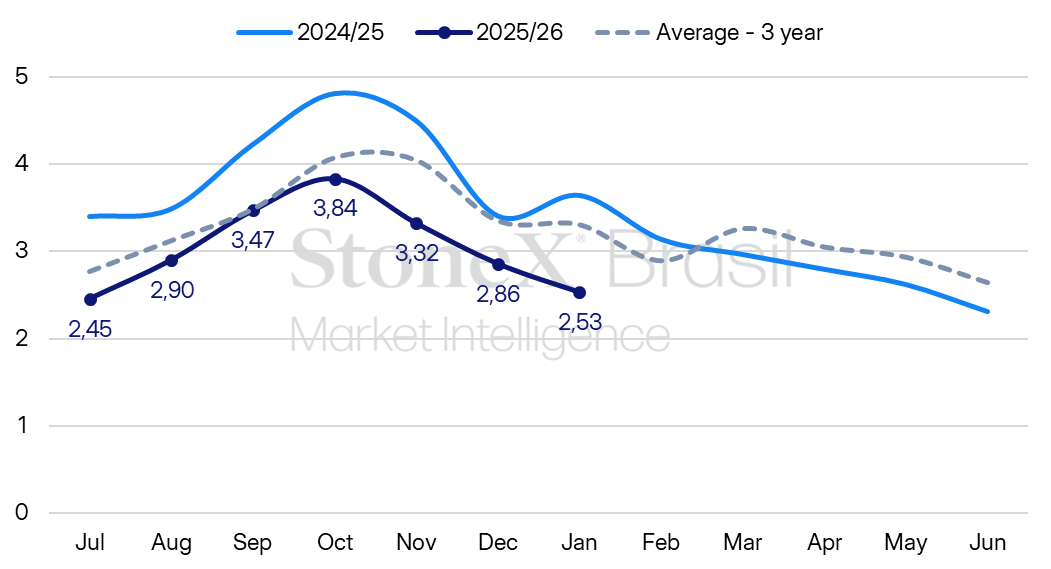
Source: Cecafé. Analysis: StoneX.
CFTC: Funds Continue Liquidating Positions
The latest Commitment of Traders (COT) report from the CFTC showed another round of liquidations by speculative funds, marking the second consecutive week.
Between February 3 and 10, funds reduced their net long position from 7,331 contracts to 2,866, the lowest level since October 2023.
Why This Matters: Fund positioning often signals the bias of these agents and indicates short-term trends, as they have considerable influence on price swings. With the current balance between long and short positions, new fundamentals could trigger repositioning, increasing volatility in the coffee market.
Net Position of Speculative Funds in Coffee on the New York Exchange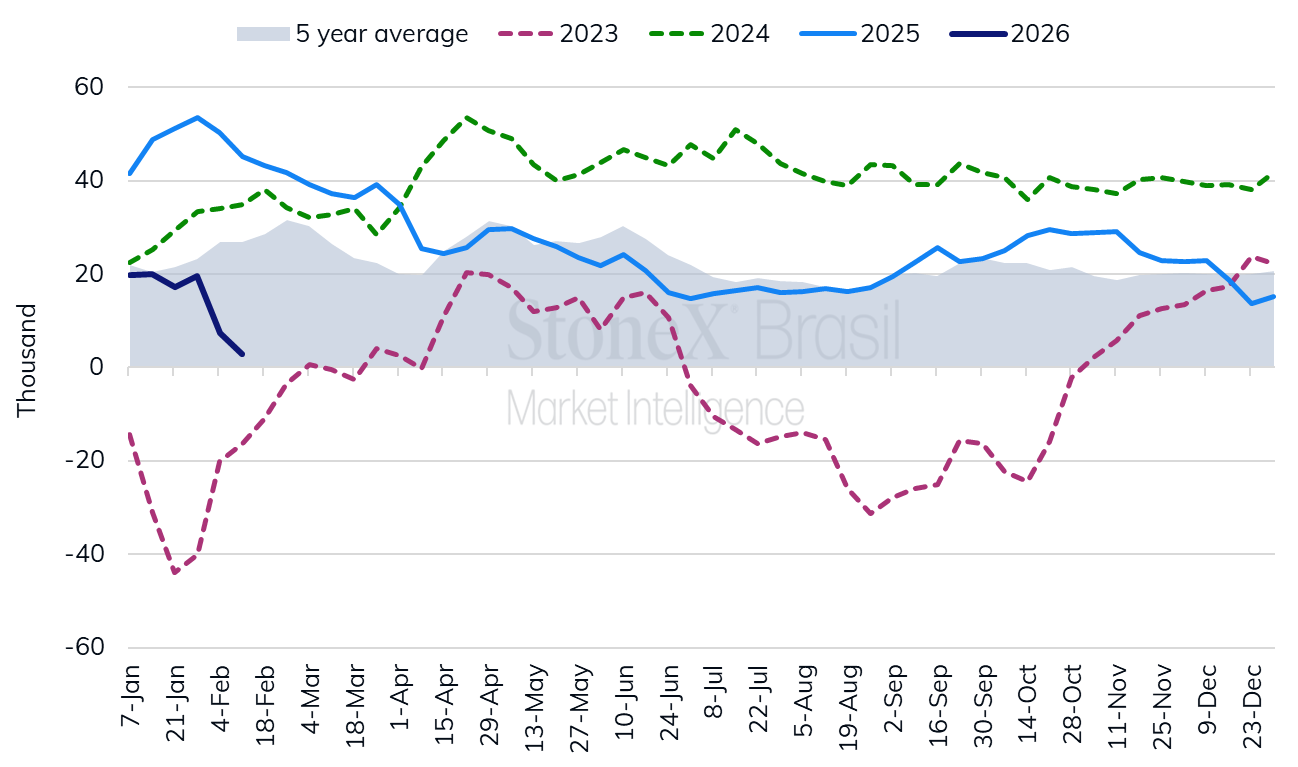
Source: CFTC. Analysis: StoneX.
Weather in Brazil
The beginning of this week suggests reduced rainfall volumes in the coffee belt. However, starting Wednesday (18), volumes are expected to gradually return to the crops.
Next week is likely to feature more favorable conditions.
According to the latest Weekly Weather and Climate Bulletin, which assesses forecasts for the next four weeks:
- Only the upcoming week is expected to see above-average rainfall in producing areas.
- The rest of the period, through March 10, indicates slightly below-average volumes.
- Espírito Santo and Zona da Mata may experience greater oscillations in rainfall patterns, remaining areas of concern.
Overall, expectations point to adequate weather, which may put renewed pressure on prices in the latter half of the week.
INDICATOR TABLE
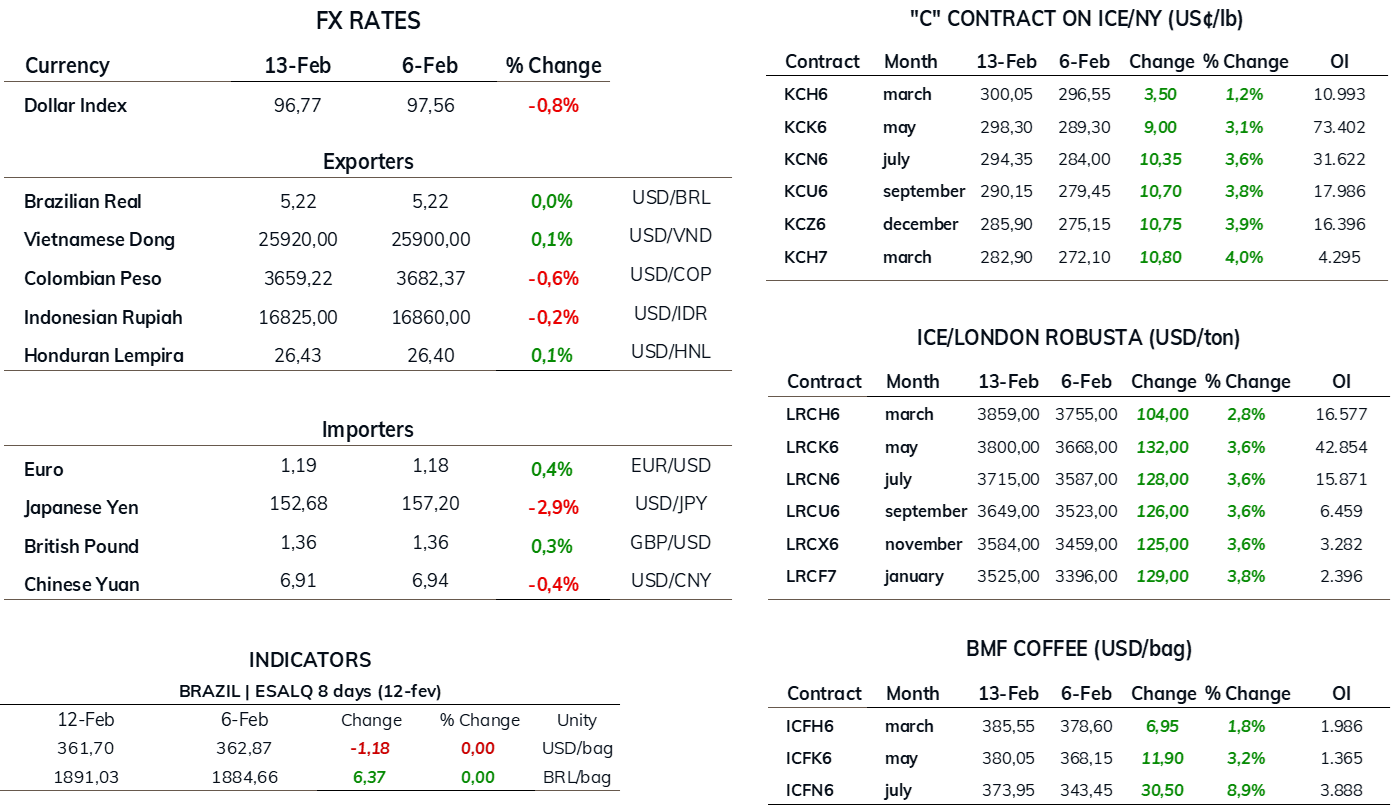
Sources: ICE/NY; ICE/EU; B3; Commodity Network Trader’s Pro.