Since the end of last year, one of the main issues that have taken center stage in the Brazilian corn market is the uncertainty regarding 2021/22's first corn crop. Even though it has had a very promising start, with good rainfall volumes throughout September and October and a rapid planting pace, the current perspectives are no longer optimistic for its production.
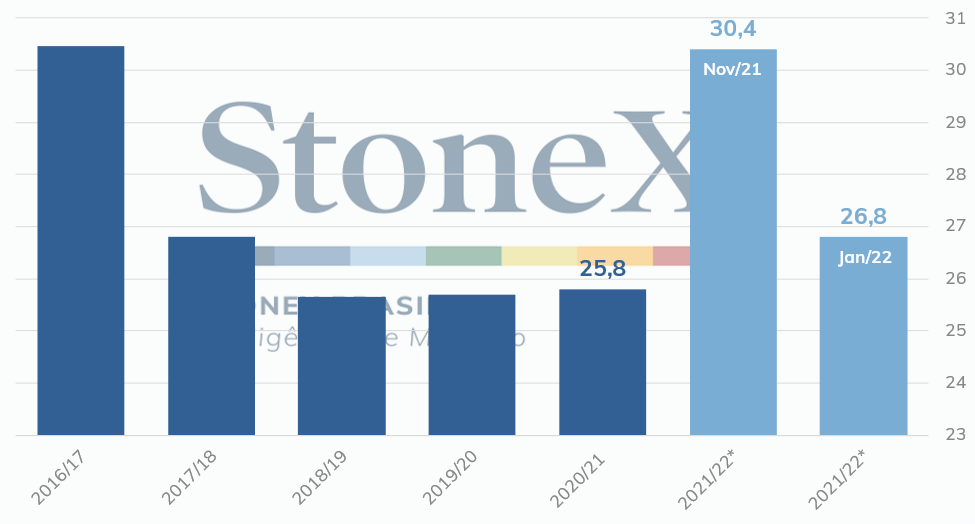
The low volume and irregularity of rainfall in Southern Brazil in the last two months of 2021, precisely at crucial moments for the development of the grain, considerably damaged the first crop in the region. Thus, after estimating summer crop production at 30.4 million tonnes in early November, StoneX reduced its figure to 26.8 million tonnes in early January, dropping 11.9% from the estimate before the drought problems.
First corn crop production – Brazil (MMT)
Source: StoneX and Conab. *StoneX estimate.
Even though the summer crop is much smaller compared to the winter crop, it is of great importance for corn supply in the first half of the year, especially after seasons marked by the safrinha crop failure, as was the 2020/21 crop, whose winter production reached 59.2 million tonnes, while the initial StoneX estimates pointed to a volume above 82 million tonnes.
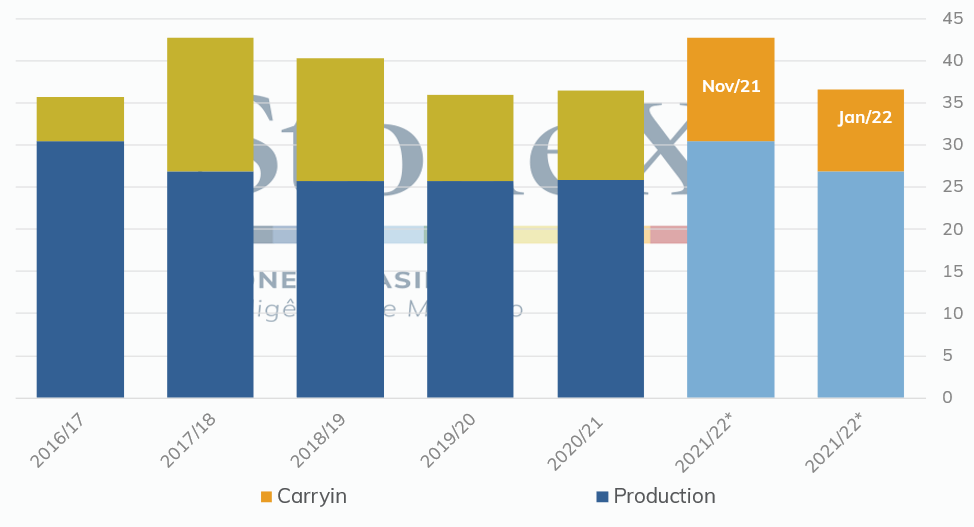
In the first half of the year, the corn supply is based on the carryin and the volume harvested in the first crop. Thus, corn supply was previously estimated at 42.7 million tonnes in the first half of 2022 (12.25 million of carryin from 2021/22 + 30.4 million from first crop production in 2021/22), it is currently estimated at 36.6 million tonnes (9.8 million + 26.8 million, respectively).
Let's compare the current situation with the one observed in the first half of 2021. One may even think that the scenario is slightly better today since the availability of the grain in the period is estimated at 36.4 million tonnes (10.6 million from 2020/21 carryin + 25.8 million from first crop production in 2020/21).
Brazil’s corn supply in the first half (MMT)
Source: StoneX and Conab. *StoneX estimate.
However, when we incorporate the demand side of the analysis, the tighter balance in this semester compared to the same period last year becomes more evident. Since Brazilian exports are concentrated in the second half of the year, when the harvested product enters the market, we will simplify and consider only domestic demand to illustrate the balance in the first half of the year.
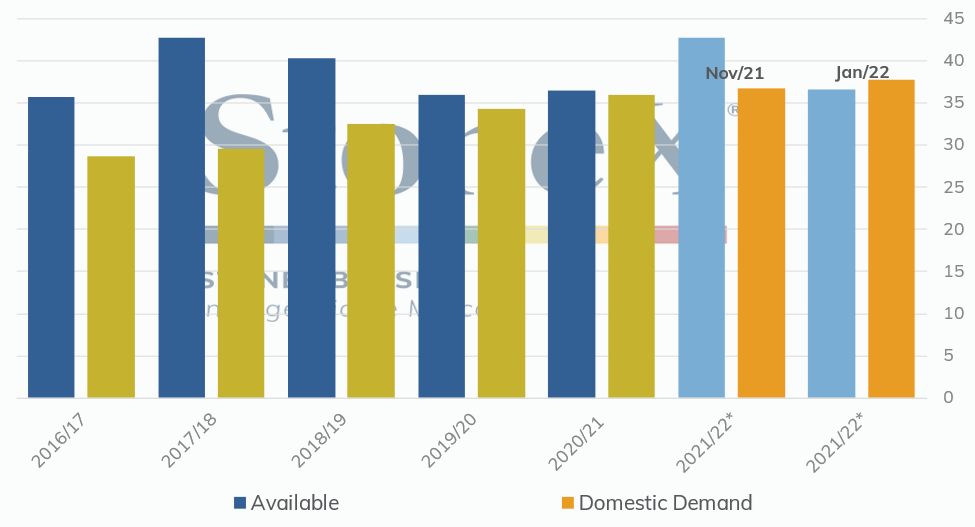
Assuming that domestic consumption is equal in both semesters, we would have consumption at 37.75 million tonnes in the first half of 2022 (considering StoneX's current estimate at 75.5 million for the 2021/22 season), against consumption at 35.75 million tonnes in the first half of 2021.
Thus, the difference between the cereal supply and domestic consumption in the first half of this year would be -1.1 million tonnes, while this difference was +0.6 million tonnes last year.
Brazil’s corn supply vs. demand in the first half (MMT)
Source: StoneX and Conab. *StoneX estimate.
Thus, amid the expectation of a less robust production – and new cuts are not out of the question, given the continuity of the dry weather in the South region throughout January – the tendency is for prices to remain supported in the country, at least until the next safrinha enters the market, which will only occur in the middle of the year.
Besides the impact on prices, this tighter supply and demand balance can also impact Brazilian imports. The uncertainty regarding summer crop production has raised questions about a greater need for grain imports in the coming months. In the first half of last year, Brazil imported 0.9 million tonnes, and it would be no surprise if the country recorded a higher purchase volume over the next few months.