- Growth perspective of the supply in South America;
- US exports in 23/24 are below the 5-year average;
- USDA projects an increase in US ending stocks for 24/25.
- USDA projects a reduction in corn acreage in the US in 24/25;
- Funds are exiting their short positions;
- Russian attacks may impact Ukrainian exports.
Overview
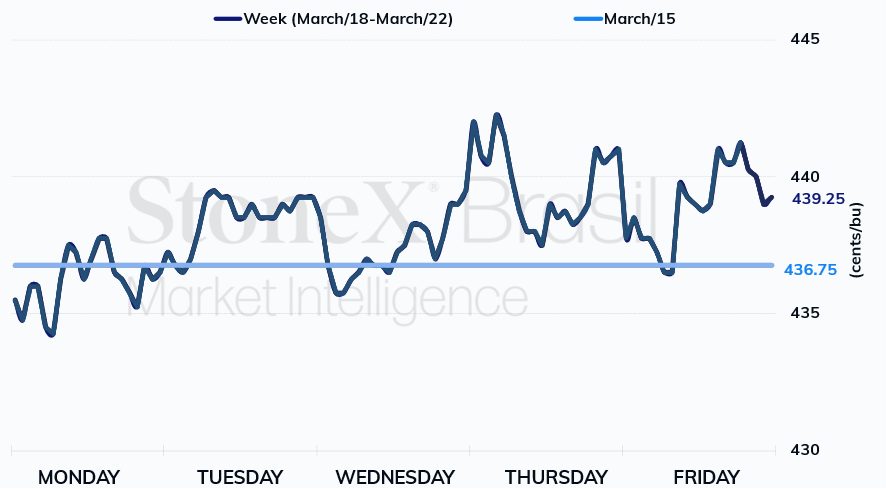
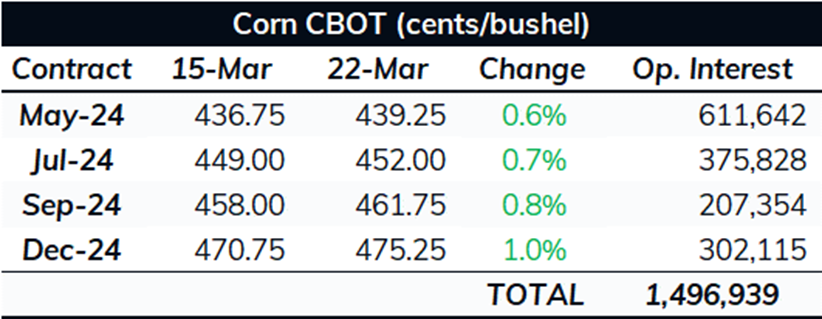
Last week, corn continued to trend higher—a pattern that has been evident since early March—and closed the period higher on the Chicago exchange. The May contract ended at 439.25 cents/bu, a weekly gain of 0.6%.
The main factor behind the gains was the funds’ rebalancing and other speculative agents operating in the corn market. This is because we are approaching critical periods for the Brazilian safrinha and American crops when their productivity will be defined. Despite the current positive outlook, it is impossible to foresee weather problems, which could boost corn if they occur. In this sense, the funds are exiting part of their short positions, adopting a more cautious stance in the face of future uncertainties. These operations have resulted in gains for corn.
In addition to future uncertainties, the repositioning of funds stems from another factor, albeit to a lesser extent: inflation prospects. Historically, funds prefer to be long in the commodities market during inflation, ensuring the profitability of their portfolios. At the moment, the data showing the heated American economy and the Federal Reserve's (US central bank) indication of interest rate cuts have led some agents to foresee an increase in inflation. Consequently, some funds have opted to buy corn in the futures market, a bullish factor for the grain.
The supply and demand fundamentals are bearish, as positive production outlooks and weakening consumption have indicated a loose balance between supply and demand. However, there were points of attention that also contributed to the appreciation of corn in Chicago.
First, the Buenos Aires Grain Exchange cut its estimate for the crop in Argentina due to problems with the leafhopper and the water stress the crops suffered in February. Secondly, an escalation of geopolitical tensions could impact Ukrainian exports. After the country started attacking Russian oil refining infrastructure, the Russians retaliated by attacking Ukrainian facilities in Odesa focused on grain exports.
Investors are expected to remain cautious in the coming weeks, waiting for more information on the Brazilian and North American crops before taking new positions. The points of attention are the Argentine crop and the Russo-Ukrainian war.
Intraday (15 min) May/24 contract - CBOT
United States
Funds are exiting their short positions - The latest CFTC report showed that the balance of funds in the corn market is 243 thousand short positions. This means that the figure of contracts in the hands of these agents with a bearish bias exceeds the number of contracts with a bullish bias by 243 thousand units. Although this indicates that funds are heavily betting on corn's depreciation, a broader analysis shows something a little different. That's because, four weeks ago, their short balance was 341 thousand units. In other words, since the beginning of March, many funds have stopped being bearish and exited their short positions.
The ethanol industry is demanding significant volumes of corn - In the week ending March 15, the United States produced 1.046 million barrels/day, 3.6% higher than the average of the last five years for the period. Indeed, in nine of the 11 weeks in 2024, production exceeded the average of the last five years, which indicates that the American ethanol sector is demanding significant volumes of corn.
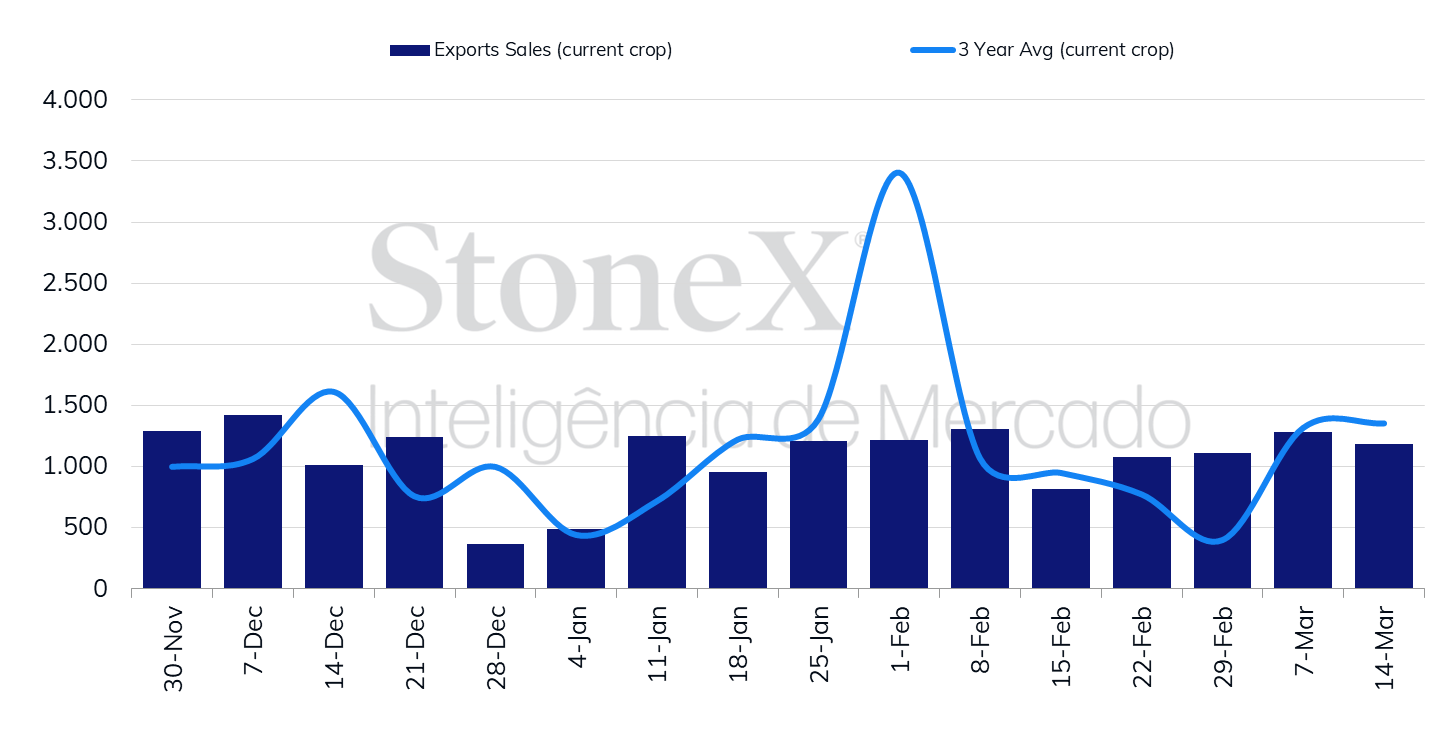
Export sales in the United States remain below the average of recent years - In the week ending on March 14, the net of U.S. export sales was 1.19 mmt, a significant volume but 12% lower than the average of the last three years for the period. In general, this week's sales indicate how American corn exports have been throughout the 23/24 crop: the volume is not negligible but weak compared to previous years, especially 20/21 and 21/22. In the aggregate of the crop year, the United States sold 41.6 million tonnes, compared to 46.2 million on average over the last three years. The main factor behind the decline in exports is China, which has been choosing Brazilian corn over American corn. More details on this will be brought up in the section on China.
Export sales from the United States (tmt)
Source: USDA. Design: StoneX.
Brazil
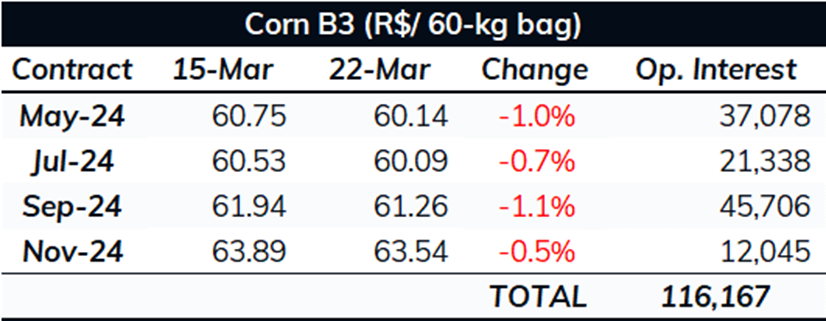
Corn depreciated on the B3, but traded higher in spot market - Unlike what happened in Chicago, corn depreciated on the B3 last week. At the end of Friday's session, the May contract quoted at BRL 60.75/bag, a weekly depreciation of 1.0%. Despite this setback, corn prices in the spot market appreciated in most locations, following the gains in Chicago. The appreciation was particularly significant in Rio Grande do Sul and Mato Grosso, with weekly gains exceeding 2%.
Progress of the summer corn harvest - As of last Friday (22), 58.6% of Brazilian summer corn crops had already been harvested, a percentage in tandem with the average of recent years. It is worth remembering that the harvest is quite advanced in the South and Southeast, but it is still in the early stages in states in the North and Northeast. In any case, the estimate assumes few changes in the summer corn crop production figures, consolidating the figure of 25.9 million tonnes.
Completion of the safrinha corn planting and approach of the critical period for the crops - The planting of the 2nd crop corn is finished or practically finished in Mato Grosso, Goiás, Mato Grosso do Sul and Paraná. The only regions with unsown crops are São Paulo and Minas Gerais, but the work should be completed in the next few weeks. With the planting season behind us, attention is now on the weather conditions. Although the planting happened within the ideal window, it is impossible to know how the weather will be in April, a crucial month for determining the productivity of the safrinha.
Intraday (15 min) May/24 contract - B3

Argentina
The Buenos Aires Grain Exchange reduced its estimate for the Argentine corn crop - Last Thursday (21), the Buenos Aires Cereals Exchange (BCBA) updated its agricultural production estimates for the 23/24 crop. For corn, the figure released was 54 million tonnes, a reduction of 2.5 million compared to the previous estimate. The justification for the cuts, according to BCBA, is the spread of the leafhopper in the provinces of Santa Fe and Entre Rios and the water stress suffered in February by the crops in the provinces of Buenos Aires and La Pampa. With the reduction, the expectation is no longer for a record crop since Argentina was able to produce 55 million tonnes in 2018/19. The country will still experience a significant rebound, with 54 million tonnes expected to represent an annual increase of 20 million tonnes.
Rain is delaying the harvest in Argentina - Once again, referring to the Buenos Aires Cereals Exchange, the estimate is that 3.7% of Argentina's corn crops had been harvested until last Wednesday (20), a weekly increase of only 0.5 percentage points. The reason for the slow progress was the abundant rains in a significant part of Argentina's agricultural area, which hindered the progress of the work. Now, the harvest is behind the average of the last five years.
China
China started 2024 by importing high volumes of corn - In the first two months of 2024, China imported 6.19 million tonnes of corn, a 25% increase compared to the average of the last three years. Among the main trading partners, the absolute highlight was Brazil, whose sales of 4.10 million tonnes represented 66.3% of the total imports. On the other hand, the United States forfeited market share, with the 767 tmt representing only 12.4% of imports. This process of market conquest by Brazil at the expense of the United States has been ongoing since 2023 and will be discussed in more detail in the paragraphs below.
Brazilians have been gaining ground in the Chinese market, to the detriment of North Americans - When China's corn imports reached a new level, jumping from 11.2 million tonnes in 2020 to 28.3 million tonnes in 2021, the United States became the main trading partner. In 2021, 69.9% of Chinese imports originated in the North American market, a percentage that rose to 72.1% in 2022. However, in 2023, Brazil gained the opportunity to export corn to China. Being a country with a weak currency, Brazilian exports are very competitive. Moreover, the geopolitical tensions between China and the United States resulted in the Brazilian' market conquest at the Americans' expense. In 2023, 47.2% of Chinese corn imports came from Brazil, against only 26.3% from the United States. In 2024, this change has become even more acute, as seen in the paragraph above.
Future and spot prices
Futures contracts traded on the CBOT (US¢/bu)

Future contracts traded on B3 (BRL/bag)
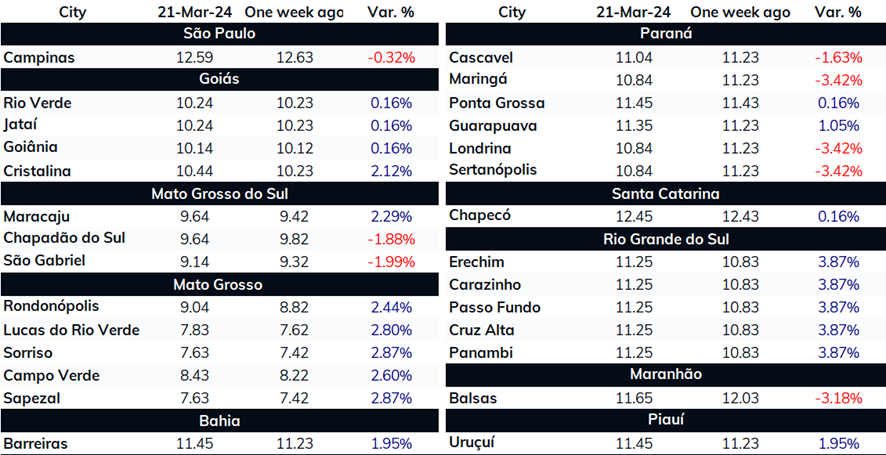
Spot prices in Brazil (USD/60kg-bag)