StoneX logo

Corn Weekly Report

By: StoneX Intelligence Brazil, StoneX Intelligence Brazil

Corn has a week of significant gains in Chicago
 
Felipe Sawaia
Analista de Inteligência de Mercado
Macroeconomic disclosures in the United States and a cut in the Argentine production estimate were the factors behind the rise
Bearish Factors
  • Outlook of high stocks at the end of the crop year 23/24;
  • Possibility of USDA having overestimated the reduction in corn planting area in the US;
  • StoneX increased its estimate for the Brazilian crop 23/24.
Bullish factors
  • USDA projects a reduction in corn acreage in the US in 24/25;
  • The spread of the leafhopper is impacting Argentina's productive potential;
  • American inflation shows signs of resilience.

Overview

Last week (04/29 to 05/03), corn futures appreciated in Chicago. The July contract ended the quoted period at 460.25/bu, a weekly appreciation of 2.3%.

The earnings were driven by macroeconomic issues in the United States. First, on Wednesday (01/05), the Federal Reserve kept the interest rate of the US economy unchanged, with the institution's president, Jerome Powell, ruling out any possibility of new increases. Then, on Friday (05/03), the US government announced that 175 thousand jobs were created in April in the country, below analysts' expectations of 243 thousand.

Both disclosures were read as factors reinforcing the possibility of interest rate cuts in the United States in 2024. For the commodities market, interest rate cuts at a time when the US economy is still relatively strong brought the possibility of inflation returning, a bullish factor for corn.

Adding to this inflation issue, corn futures were also driven by the deepening supply problems in Argentina, a consequence of the spread of illnesses caused by the leafhopper. On Thursday (2), the Buenos Aires Grain Exchange estimated the country's crop at 46.5 million tonnes, an 18% reduction from the initial estimates.

Amid this scenario, the appreciation of corn was only not more significant because the grain supply in the spot market increased recently, as American and Brazilian farmers took advantage of the price appreciation to trade significant volumes.

From a broader perspective, last week's disclosures did not fundamentally alter the supply and demand outlook. In general, they continue to be surrounded by uncertainty, which has kept investors cautious and future prices relatively stable since mid-March.

Among the factors of uncertainty, the highlight is the United States' 24/25 crop, which still needs to go through the entire development period. Furthermore, there are uncertainties regarding the 23/24 crop in Brazil (since the figures from USDA and CONAB do not match) and in Argentina (affected by the leafhopper).

Accordingly, the USDA supply and demand report, which will be released next Friday (09/05), is characterized as the market's new focus. It will bring the first estimate for the American cycle 24/25 and updates for the crops 23/24 from Brazil and Argentina.

Intraday (15 min) July/24 contract - CBOT
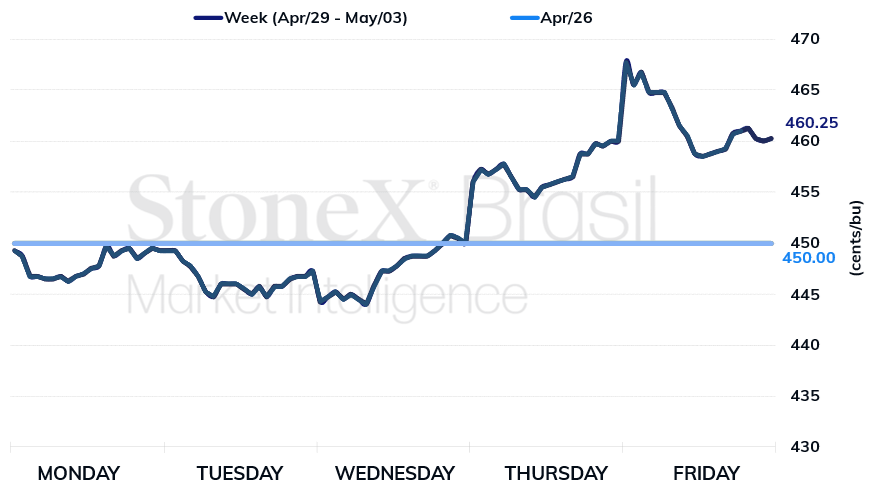
image 94186
Source: USDA. Design: StoneX.

United States

In recent days, corn planting in the United States has been hindered by the rains that fell over an important part of the agricultural belt, especially in the central and western areas. This phenomenon, however, was not read negatively by the market. In general, the agents understood that the rains were positive for the quality of the soils and did not increase the risk of corn being planted outside the ideal window. This is because a drier pattern is expected to return to affect the agricultural belt starting on May 10, opening up the possibility of planting progress still within the ideal period. In this sense, the weather has benefited the development of corn in the United States.

At the moment, the only point of attention is the possibility of the rains lasting longer than currently forecasted. For example, if it rains until after May 15, planting delay becomes more plausible. For now, however, the weather stations do not indicate this.

By April 28, 27% of the estimated corn area in the United States had already been planted. Today, the data referring to May 5 will be released.

In addition to the planting progress, last week there were also announcements related to demand. Regarding exports, the USDA report showed 758 tmt were sold, a volume 27% higher than the average for the last three years. In the aggregate of the 23/24 crop year, export sales are at 46.7 million tonnes.

Regarding ethanol sector consumption, the NASS monthly grinding report showed that 11.9 million tonnes of corn were used for fuel production in April, compared to 11.1 million in April 2023. The report confirms the EIA data consistently showing that ethanol plants are consuming high volumes of corn.

With exports and consumption in the ethanol sector rising, it is important to stay tuned to the USDA's supply and demand report, which will be released next Friday (10). If there are changes in the estimates for these indicators, there will necessarily be changes in the carryout 23/24 of the United States, a very closely watched indicator by the market.

Export sales from the United States (tmt)
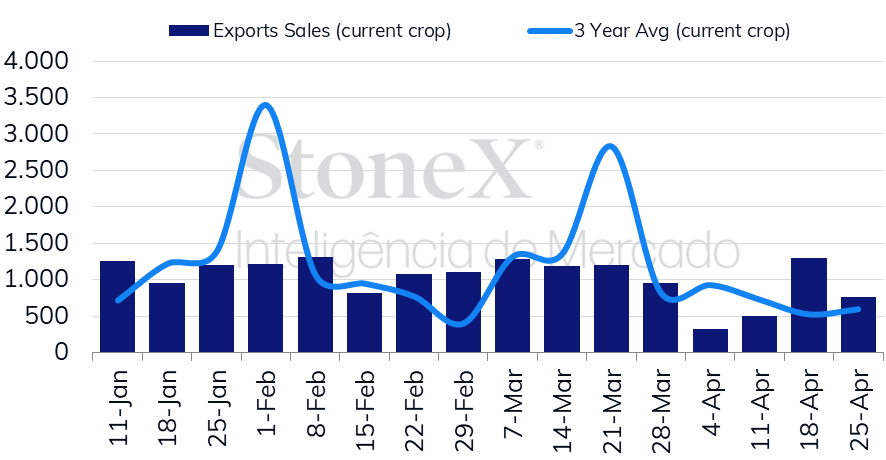
image 94188
Source: USDA. Design: StoneX.

Brazil

On May 2, StoneX updated its estimate for the Brazilian 23/24 corn crop. Regarding the first corn crop, StoneX's production estimate increased from 25.9 to 26.1 million tonnes on a monthly basis, as a result of the rains that fell on states in the North/Northeast and resulted in positive adjustments in productivity.

Even so, it is worth noting that in the annual comparison, the summer crop did not achieve the same potential as last year due to a smaller area. The national acreage for the 23/24 cycle decreased by 13.5% compared to the 22/23 cycle.

For the second corn crop 23/24, StoneX raised its production estimate from 96.1 to 97.3 million tonnes, representing a monthly variation of 1.2%. Expected production was cut in São Paulo, Paraná, and Mato Grosso do Sul, with adjustments in the São Paulo area and a decrease in productivity in Paraná and Mato Grosso do Sul (due to the weather). Nonetheless, the expected growth in production in Mato Grosso and Goiás more than offset the losses in other states. The occurrence of rains in the largest corn producer in Brazil led the production of Mato Grosso to be estimated at almost 47 million tonnes, a figure still below last year's record but representing an increase of 2.7 million tonnes in the state estimate. In Goiás, the productivity review increased the expected production in the state from 12.2 to 12.7 million tonnes.

Making an overall assessment, the increase in monthly estimates is classified as a bearish factor for corn. To some extent, this rebound was not expected, mainly due to the problems faced by farmers in Mato Grosso do Sul and Paraná.

The focus now turns to the weather throughout May. Despite the critical period for the development of most crops being behind us, some regions of late planting are still subject to risks. It has rained in no producing state in the last seven days; for the next 14 days, the forecast is also for little or no rain. In this sense, new cuts in production estimates are still not ruled out.

About Rio Grande do Sul, the state does not produce second crop corn and the first crop corn harvest has been completed since early April. In this sense, the climate catastrophe that hit the state can only have affected the supply of corn in case silos and warehouses have been damaged. For now, it is still not possible to draw big conclusions.

Intraday (15 min) July/24 contract - B3
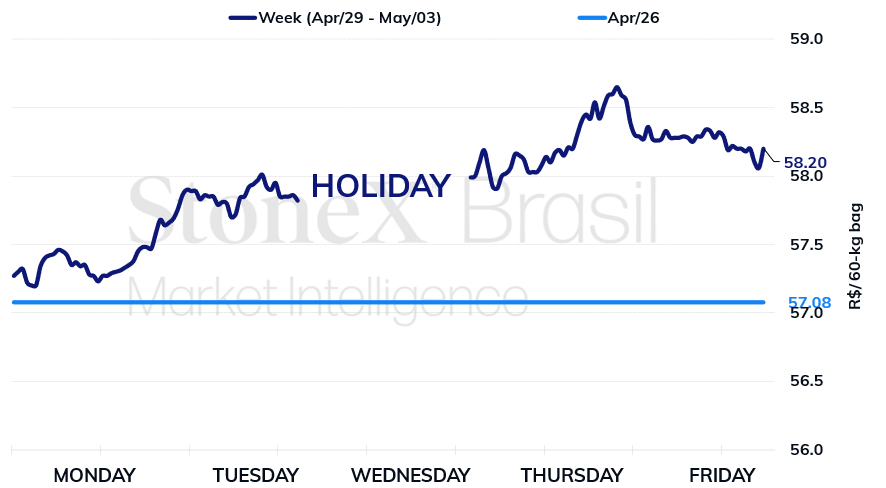
image 94185
Source: B3. Design: StoneX.

Argentina

In its latest weekly report, the Buenos Aires Grain Exchange (BCBA) estimates that 22.1% of Argentine corn crops have been harvested. As approximately 70% of corn in Argentina is planted late (December-January), the harvest in the country usually only gains traction in June.

In this sense, the majority of the crops remain subject to the serious problems caused by the leafhopper. In particular, the northern portion of the Argentine agricultural belt is being severely impacted, with the BCBA classifying 17% of the acreage planted in this region as unharvestable. In areas that are still eligible for harvesting, an advancement of this activity is now expected, as the incidence of illnesses tends to accelerate the corn cycle.

Facing the problems recorded in northern Córdoba, northern Santa Fé, eastern Entre Ríos, and a large part of the provinces of the Northwest and Northeast, the BCBA now estimates the Argentine corn crop at 46.5 million tonnes, a decrease of 3 million tonnes compared to the previous estimate.

It's worth noting that until the beginning of March, BCBA's estimate was a production of 56.5 million tonnes. In other words, the crop failure is already at 17.7% and new cuts are not ruled out.


Future and spot prices


Futures contracts traded on the CBOT (US¢/bu)
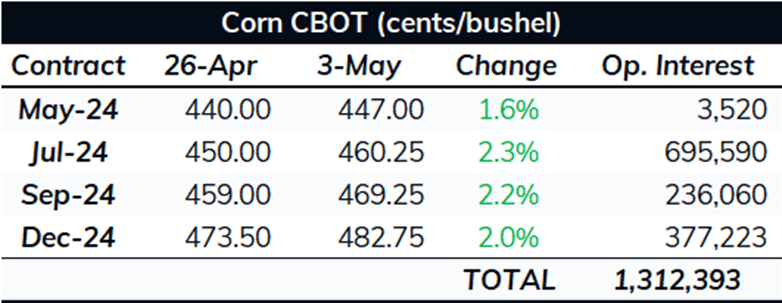
image 94183
Source: CME. Design: StoneX.
 

Future contracts traded on B3 (BRL/bag)
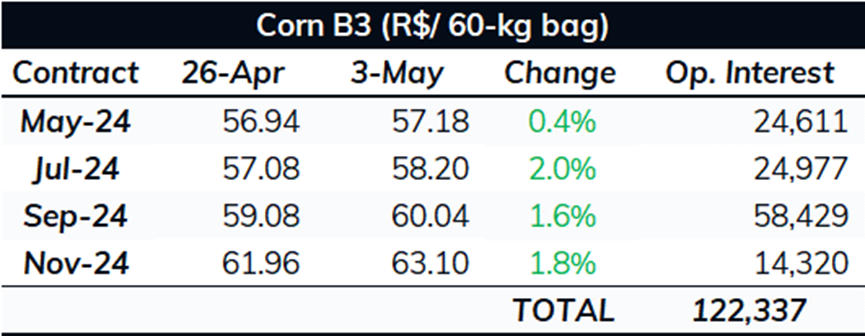
image 94184
Source: B3. Design: StoneX.

Spot prices in Brazil (USD/60kg bag)

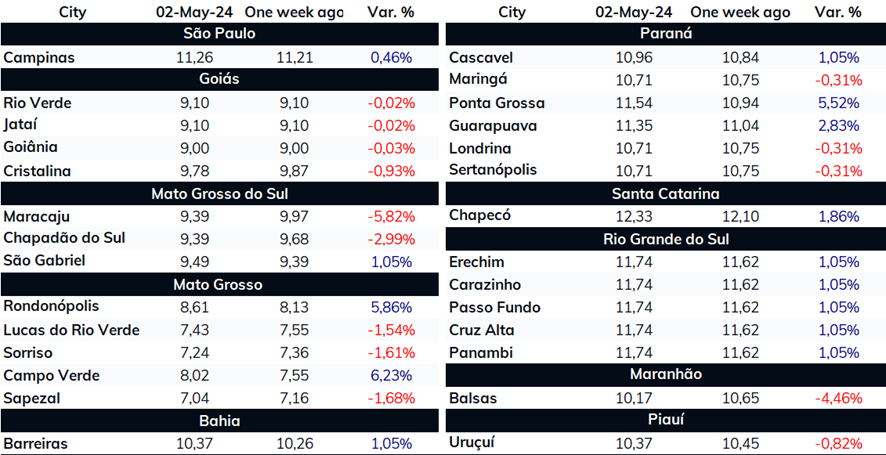
image 94187
Source: StoneX.

INDICATORS
  • Grains & Oilseeds

The StoneX Group Inc. group of companies provides financial services worldwide through its subsidiaries, including physical commodities, securities, exchange-traded and over-the-counter derivatives, risk management, global payments and foreign exchange products in accordance with applicable law in the jurisdictions where services are provided. References to over-the-counter (“OTC”) products or swaps are made on behalf of StoneX Markets LLC (“SXM”), a member of the National Futures Association (“NFA”) and provisionally registered with the U.S. Commodity Futures Trading Commission (“CFTC”) as a swap dealer. SXM’s products are designed only for individuals or firms who qualify under CFTC rules as an ‘Eligible Contract Participant’ (“ECP”) and who have been accepted as customers of SXM. StoneX Financial Inc. (“SFI”) is a member of FINRA/NFA/SIPC and registered with the MSRB. SFI is registered with the U.S. Securities and Exchange Commission (“SEC”) as a Broker-Dealer and with the CFTC as a Futures Commission Merchant and Commodity Trading Adviser. References to securities trading are made on behalf of the BD Division of SFI and are intended only for an audience of institutional clients as defined by FINRA Rule 4512(c). References to exchange-traded futures and options are made on behalf of the FCM Division of SFI . StoneX is a trading name of StoneX Financial Ltd (“SFL”). SFL is registered in England and Wales, Company No. 5616586. SFL is authorized and regulated by the Financial Conduct Authority [FRN 446717] to provide to professional and eligible customers including: arrangement, execution and, where required, clearing derivative transactions in exchange traded futures and options. SFL is also authorised to engage in the arrangement and execution of transactions in certain OTC products, certain securities trading, precious metals trading and payment services to eligible customers. SFL is authorised & regulated by the Financial Conduct Authority under the Payment Services Regulations 2017 for the provision of payment services. SFL is a category 1 ring-dealing member of the London Metal Exchange. In addition SFL also engages in other physically delivered commodities business and other general business activities which are unregulated and not required to be authorised by the Financial Conduct Authority. StoneX Group Inc. acts as agent for SFL in New York with respect to its payments services business. StoneX APAC Pte. Ltd. acts as agent for SFL in Singapore with respect to its payments services business. ‘StoneX’ is the trade name used by StoneX Group Inc. and all its associated entities and subsidiaries.
 
Trading swaps and over-the-counter derivatives, exchange-traded derivatives and options and securities involves substantial risk and is not suitable for all investors. Past performance of any futures or option is not indicative of future success. Indicators are not a trading system and are not published as a specific trade recommendation. The information herein is not a recommendation to trade nor investment research or an offer to buy or sell any derivative or security. It does not take into account your particular investment objectives, financial situation or needs and does not create a binding obligation on any of the StoneX group of companies to enter into any transaction with you. You are advised to perform an independent investigation of any transaction to determine whether any transaction is suitable for you. No part of this material may be copied, photocopied or duplicated in any form by any means or redistributed without the prior written consent of StoneX Group Inc.
 
© 2026 StoneX Group Inc. All Rights Reserved.

Satellite view of Earth at night showing illuminated cities across Asia and the Middle East

Discover more insights

Our subscribers have access to comprehensive market analysis from StoneX spanning commodities, equities, currencies and more.

Related articles for Grains & Oilseeds

Perspective: Morning Commentary for August 7

August 7 – The U.S. economy unexpectedly lost 23k jobs in July, dramatically below market expectations of an 80k increase and marking the worst Non-Farm Payrolls print since February. Furthermore, May and June were both revised sharply downward, with combined revisions showing 103k fewer jobs than previously reported. Outside of the healthcare sector, which added 22k jobs in July, the losses were very broad-based. Government payrolls saw the largest decline, shedding 53k jobs in July, the largest seen since October 2025, while June was revised down to show a loss of 10k jobs as well. The private sector at least saw growth, adding 30k jobs in July, now matching the month prior after it was revised down from the 49k initially reported, and substantially missing forecasts of 78k jobs being added. This is a sharp reversal in course from the largely better than expected U.S. labor data seen earlier this week.

Mike Castle
Mike Castle
  • Grains & Oilseeds
  • Energy
  • Dairy
  • Renewable Fuels
  • Cocoa
  • Coffee
  • Cotton
  • Sugar
  • Meats & Livestock
  • Forest Products

Perspective: Morning Commentary for August 6

August 6 – This morning’s stronger-than-expected U.S. labor data offered markets some relief, reinforcing confidence in the economy while giving the Fed greater flexibility to raise rates should inflationary pressures reaccelerate in next week’s July data. Stock futures are pointing to a mixed open to start the day, with the tech-heavy Nasdaq showing the most weakness. The VIX has fallen notably from yesterday’s spike above 18.4 as it starts the day hovering just below the 16-mark. The dollar is quietly higher as it trades just above 99.8, holding in the tight range seen thus far this week as traders continue to digest data to shape expectations for the Fed’s next move, which we’ll dive into in more depth below. Long-term treasury yields have relaxed slightly from their recent spike, with 30-year yields starting the day trading just above 5.19%, while 10-year yields trade above 4.64%, and 2-year yields sit below 4.22%. Crude oil is modestly higher to start the session after sharp declines earlier in the week, with nearby WTI up 1.8% to trade at $76.40 and nearby Brent up 2.4% to trade at $81.40. Meanwhile, the ags are quietly mixed to start the day.

Mike Castle
Mike Castle
  • Grains & Oilseeds
  • Energy
  • Dairy
  • Renewable Fuels
  • Cocoa
  • Coffee
  • Cotton
  • Sugar
  • Meats & Livestock
  • Forest Products

Perspective: Mid-Day Commentary for August 5

August 5 – The Dow Jones is ripping higher for yet another session, up safely over 500 points at the time of this writing to carve out another record high; the S&P and NASDAQ are a bit less enthusiastic but the former is still making its own record high, while the latter is less than 500 points off its own top thanks to a strong ongoing week of trade. The dollar is churning lower this morning in an effort to re-test Monday’s 1 ½-month low, while the ten-year note has flipped higher in the mid-morning hours. The CME FedWatch tool interesting has market odds of a quarter-point rate hike next month coming closer to a 50-50 proposition as crude oil prices decline.

Mike Castle
Mike Castle
  • Grains & Oilseeds
StoneX: We open markets

Our market expertise, advanced platforms, global reach, culture of full transparency and commitment to our clients’ success all set us apart in the financial marketplace.

Reach

With access to 40+ derivatives exchanges, 180+ foreign exchange markets, nearly every global securities marketplace and numerous bilateral liquidity venues, StoneX’s digital network and deep relationships can take clients anywhere they want to go.

Transparency

As a publicly traded company meeting the highest standards of regulatory compliance in the markets we serve, our financials and track record are matters of public record. StoneX’s commitment to “doing the right thing over the easy thing” sets us apart in the industry and helps us build respect, client trust and new partnerships.

Expertise

From our proprietary Market Intelligence platform to “boots-on-the-ground” expertise from award-winning traders and professionals, we connect our clients directly to actionable insights they can use to make more informed decisions and achieve their goals in the global markets.