- Bearish factors
- Prospect of high stocks at the end of the 23/24 and 24/25 crop years;
- Possibility that the USDA has overestimated the reduction in corn planting area in the USA.
- Bullish factors
- Drought in Paraná, Mato Grosso do Sul, and São Paulo;
- Spread of the corn leafhopper in Argentina;
- Funds exiting their short positions.
Overview
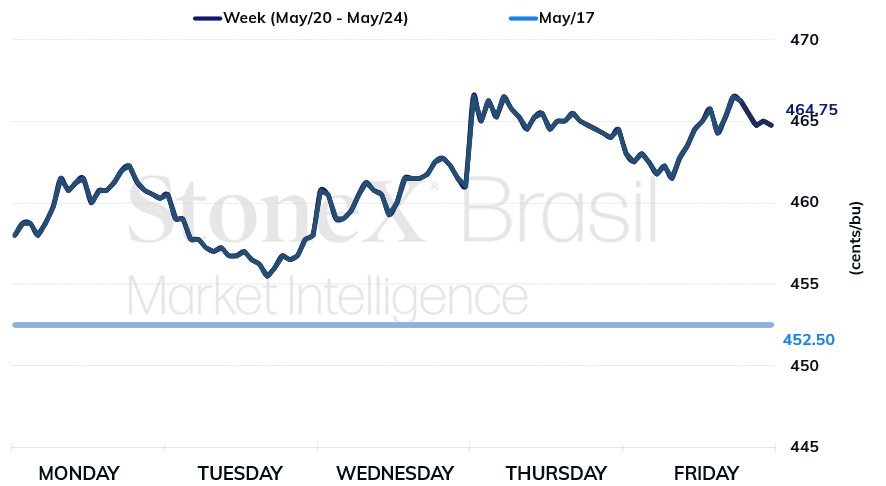
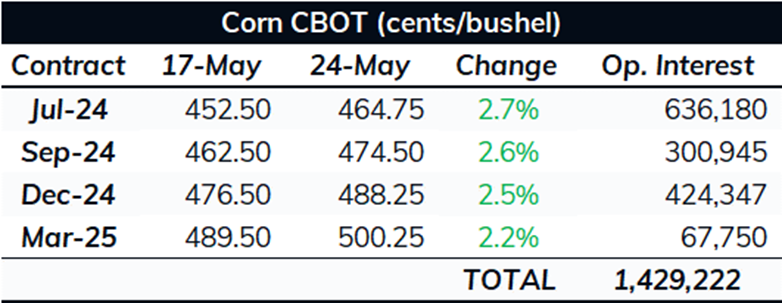
Last week, corn futures contracts traded higher on the Chicago Board of Trade. The July contract ended the period quoted at US$ 465.75/bu, a weekly increase of 2.7%.
The gains were driven by two factors. First, the strong appreciation of wheat, a phenomenon in effect since the end of April due to weather problems faced by farmers in Russia and Ukraine. These countries account for approximately one-third of wheat sales on the international market, meaning that restrictions on their supply have a significant impact on the global supply and demand balance. Given the strong correlation between grain prices, the appreciation of wheat ends up boosting corn prices.
A second point was concerns about planting in the United States, which drove gains on Monday's (20) session. However, on the same Monday, after the session closed, it was revealed that 70% of the corn acreage had already been planted, a weekly advance of 21 percentage points, bringing planting almost in line with the five-year average. Therefore, planting in the United States is no longer a major concern, as it appears to be on track to be completed within the ideal window. On Tuesday (28), when the next update is released, it is expected that planting will have reached 85%. If the number comes in below this, planting will once again become a bullish factor.
After the planting season, the corn market will enter the so-called "weather market" period, characterized by highly volatile prices due to concerns about the weather in the United States. It is during this period that the real size and quality of the US crop will be determined.
If the crop develops without major problems, bearish fundamentals will gain strength, as the global supply and demand balance will be more comfortable. If the crop faces problems, bullish agents, who have dominated the corn market since the end of April, will gain arguments that reinforce their positions.
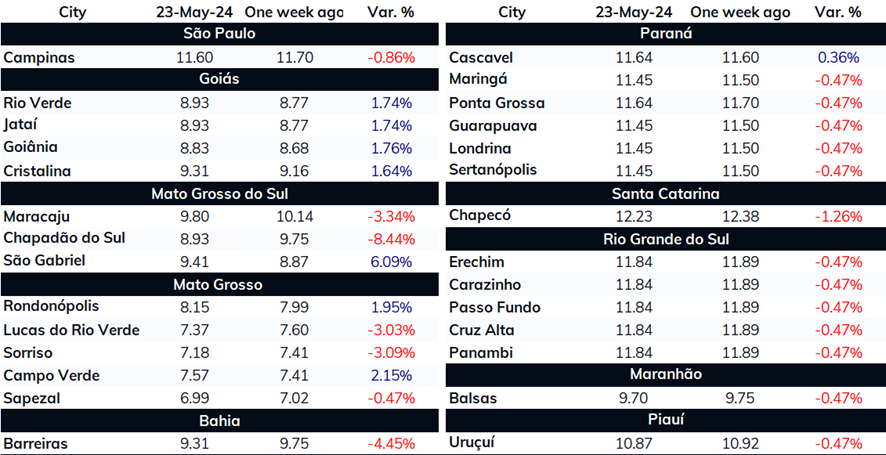
Speaking briefly about Brazil, basis at the port of Santos are holding steady. The marketing of both the first crop and the safrinha (second crop) remains very slow, more delayed than any other crop in the past six years. This issue will be discussed in more detail in the section on Brazil.
Intraday (15 min) July/24 contract - CBOT
United States
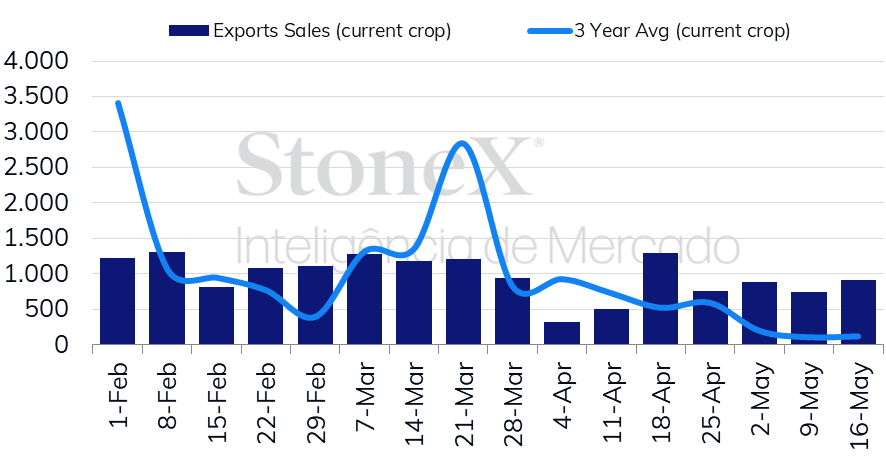
In addition to the planting numbers, last week the United States released updates on corn exports and ethanol production. Regarding exports, weekly sales totaled 911 thousand tonnes, a volume well above the average of the last three years for the period. Among the purchasing countries, the highlights were Mexico, Japan, and China. As a result, US export sales in 2023/24 reached 49.2 million tonnes. With 16 weeks remaining until the end of the crop year, the United States needs to export 5.4 million tonnes to reach the USDA estimate of 54.6 million tonnes.
Regarding corn ethanol, the EIA reported production of 1.019 thousand barrels/day in the week ending May 17. This volume is 7.0% above the five-year average for the period and 3.7% higher than last year. Therefore, ethanol production in the United States remains accelerated, a trend that has continued since the beginning of the year.
US Export Sales (thousand tonnes)
Source: USDA. Design: StoneX.
Brazil
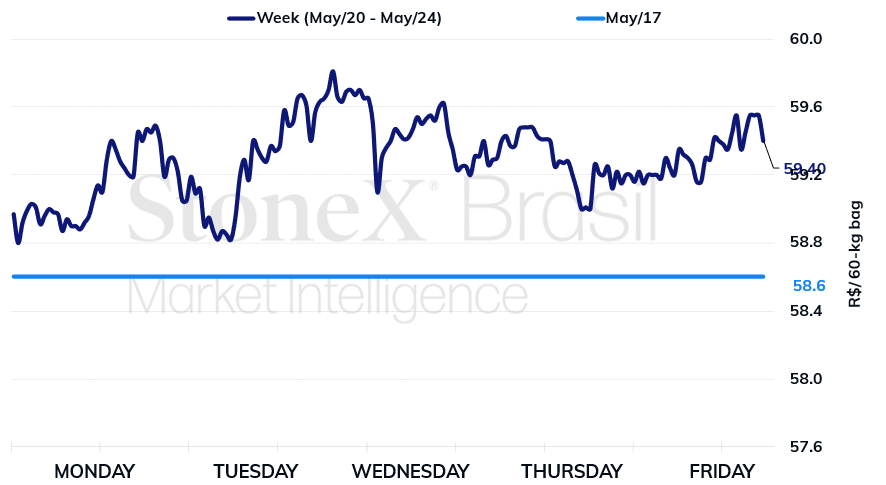
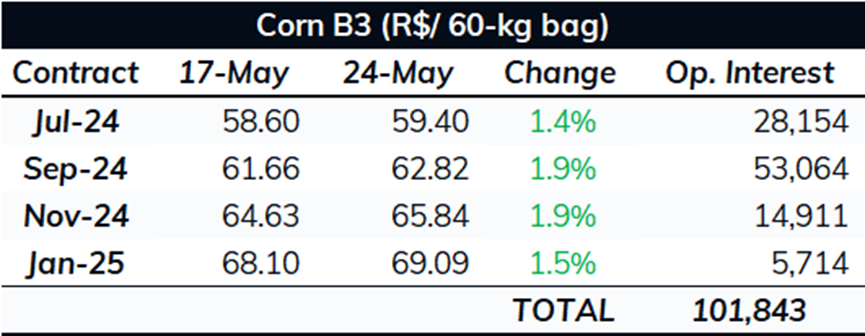
Las Monday (20), corn futures recorded significant gains. For the rest of the week, prices fluctuated little, resulting in a positive weekly balance. The July contract, for example, ended the period quoted at R$ 59.40/bag, a weekly increase of 1.4%.
In addition to prices on the exchange, the Brazilian spot market also showed strength. Looking at cargoes to be shipped in July at the port of Santos, the basis rose from 62 cents/bu to 67 cents/bu. The factor behind the appreciation is the absence of sellers in the market, with many farmers opting not to market their production at the current price level. In the latest StoneX marketing survey, only 47.9% of the summer corn and 26.9% of the safrinha corn had been sold, the lowest percentages in the past six years.
Looking at supply prospects, on June 3, StoneX will update its estimates. The numbers are not yet finalized, but indications are that the lack of rain throughout May will impact safrinha corn production in Paraná, São Paulo, and Mato Grosso do Sul. Until last Friday (24), 2% of the safrinha corn had been harvested, an advance compared to previous cycles.
Intraday (15 min) July/24 contract - B3
Argentina
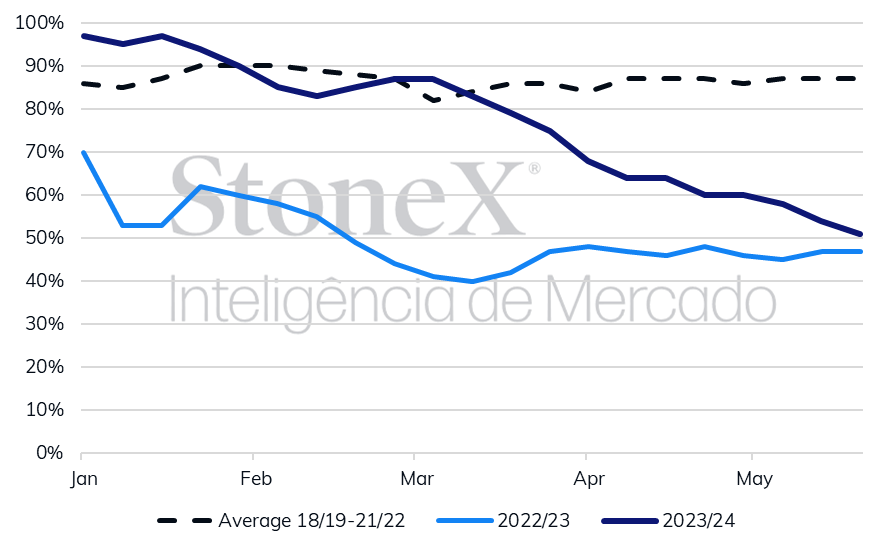
Last week, the Buenos Aires Grain Exchange maintained its production estimate for Argentina at 46.5 million tonnes. Even so, crop conditions continued to deteriorate: now, the percentage of normal, good, or excellent crops is only 51%. Last year, when Argentinians harvested only 34 million tonnes, 47% of the crops were in normal, good, or excellent conditions.
It is worth remembering that the 46.5 million tonnes already represent a drop of approximately 20%, mainly caused by the spread of the corn leafhopper. Currently, the weather in Argentina is cooler, which works against the reproduction of this pest.
Regarding the harvest, it continues to advance at a slow pace. By Wednesday, the 22nd, 28.2% of the crops had been harvested, a weekly advance of only 2.8 percentage points.
Argentine corn crops in normal, good, or excellent condition
Source: Buenos Aires Grain Exchange. Design: StoneX.
Future and spot prices
Futures contracts traded on the CBOT (US¢/bu)

Futures contracts traded on the B3 (BRL/bag)
Spot prices in Brazil (USD/60kg bag)