- Bearish Factors
- Expectation of high stocks at the end of the 23/24 and 24/25 crop years;
- Good condition of US crops;
- Beneficial weather forecasts for North American crops;
- Harvest progress in Brazil (safrinha) and Argentina.
- Bullish Factors
- Delay in the marketing pace in Brazil and the United States;
- Drought in Ukraine impacting the development of the 24/25 crop.
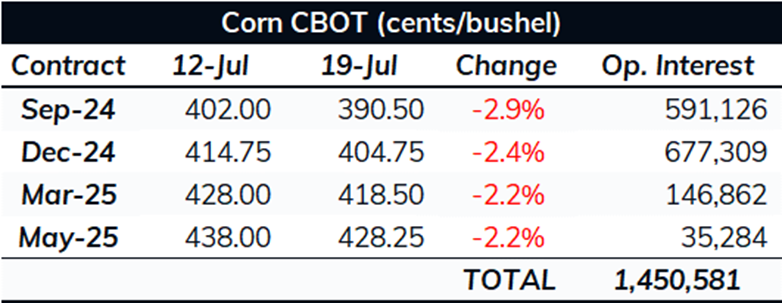
Last week, corn futures depreciated on the CBOT. At the end of the period, the September contract traded at 390.50 cents/bu, a weekly depreciation of 2.9%.
The main factor behind the losses is still the prospect of high productivity in the United States, with the weather remaining beneficial for crop development. It is worth noting, however, that the downward movement has lost intensity in the last two weeks. After prices broke the 400 cents/bushel threshold, investors became more cautious, waiting for further confirmations of high productivity before betting on new declines. Also helping to limit losses is a certain warming of demand in the spot market, with buyers looking to take advantage of lower prices since the last quarter of 2020.
In any case, the bearish sentiment continues to prevail among traders on CBOT and this should remain so unless there are changes in weather conditions. It is worth noting that many tonnes of the old American crop have not yet been sold and will have to leave the silos before the start of the new crop harvest, another factor contributing to lower prices.
Regarding the quality of the American crop, the latest USDA update, as of July 14, showed 68% of the crops in good/excellent conditions, 5 percentage points above the historical average for the period. In the last crop, 52% of the crops closed the cycle with good/excellent quality and productivity was 11.13 ton/ha. In this sense, even if the conditions of the crops in the current crop fall to values close to 60%, Americans may still achieve productivity higher than the 11.36 ton/ha currently estimated by the USDA. Crop quality data will be updated today (22).
Intraday (15 min) September/24 contract - CBOT
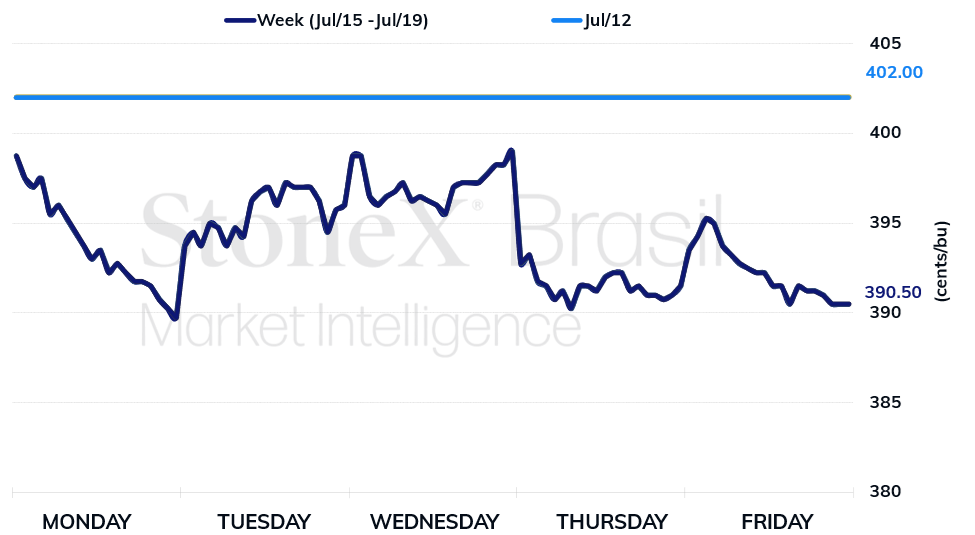
Source: CBOT. Design: StoneX.
Regarding Brazil, the StoneX crop progress report showed that 83.2% of the second corn crop was harvested on July 19, the highest percentage for the period since StoneX began tracking this indicator, still in the 18/19 crop season. In Mato Grosso, the harvest is practically finished, reaching 96%. Therefore, the corn supply in the Brazilian market is increasing significantly, an important factor for the downward trend.
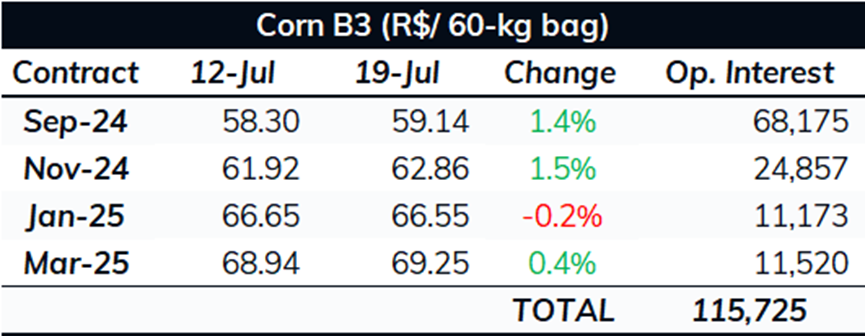
However, the StoneX farmer sales report showed that only 39% of the second crop corn 23/24 was marketed as of July 19, the lowest percentage for the period since StoneX began tracking this indicator, still in the 16/17 crop. For summer corn, sales stood at 69%, the lowest percentage since 17/18. This delay in sales, combined with the dollar appreciation, resulted in gains for corn on B3 last week. The September contract was quoted at BRL 59.14/bag, a weekly appreciation of 1.4%.
Intraday (15 min) July/24 contract - B3
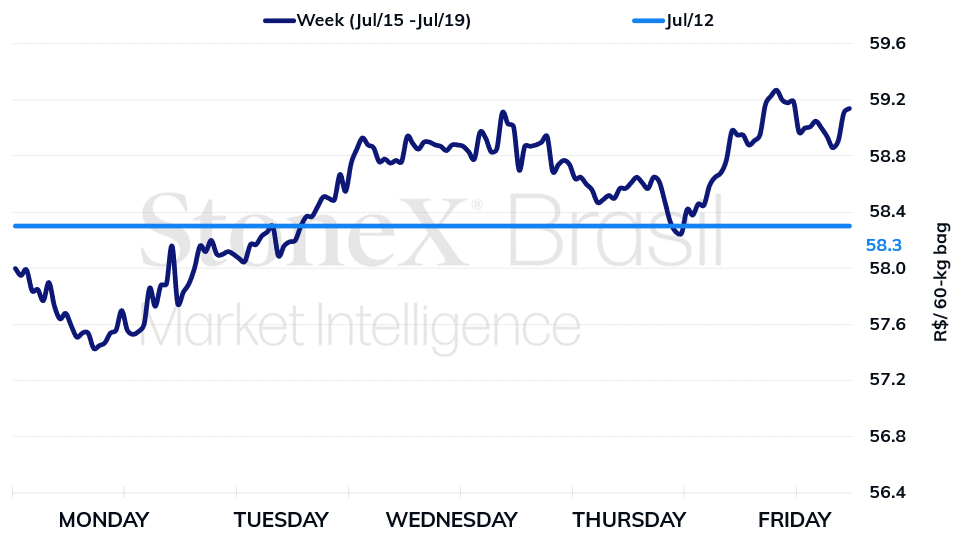
Source: B3. Design: StoneX.
In Argentina, the weekly report from the Buenos Aires Grain Exchange showed that the harvest reached 79.2%, putting the 23/24 season above the average of the last five years for the period.
With the crop developing well in the United States and the harvest advancing in Brazil and Argentina, the primary focus in the corn market's supply side is Ukraine. The Slavic country has been facing dry and hot weather, which has affected the development of its corn crop, currently in the pollination stage. Ukraine is the fourth largest exporter of corn in the world.
Turning our attention to demand, Brazilian corn exports totaled only 848 thousand tonnes in the first two weeks of July, compared to over 1.1 million in the same period last year. In the United States, exports in the first two weeks of July totaled 2.1 million tonnes, indicating a certain advantage for the Americans over the Brazilians.
Indeed, the marketing delay has strengthened basis in Brazil, a factor that takes competitiveness away from Brazilian exports. At the moment, the FOB corn price in the four main exporting countries is US$ 180/ton in the United States (New Orleans), US$ 182/ton in Argentina (Rosario), US$ 190/ton in Ukraine (Black Sea), and US$ 192/ton in Brazil (Santos).
Regarding China, the trade balance for June was released and the data showed that the country imported 919 thousand tonnes of corn in the period, the lowest monthly value of 2024 and a 50.2% decrease compared to June 2023. Among the main trading partners, Ukraine stands out with 654 thousand tonnes and the United States with 217 thousand tonnes. The low availability of corn in Brazil during April-May (the period when a commodity must be shipped from Brazil to arrive in China in June) limited the country's participation.
In the aggregate of the first semester, China imported 11.0 million tonnes, the lowest volume for the period since 2020. Among the trading partners, Brazil (5.76 million tonnes), Ukraine (3.61 million tonnes), and the United States (1.38 million tonnes) stand out. It is worth remembering that Argentina and China signed a preliminary agreement in 2023 to regulate corn exports. Recently, the Argentine government stated that exports will effectively start to happen in July 2024.
Corn imports by China (million tonnes)
Source: Chinese Customs. Design: StoneX.
Future and spot prices
Futures contracts traded on the CBOT (US¢/bu)

Futures contracts traded on B3 (BRL/bag)
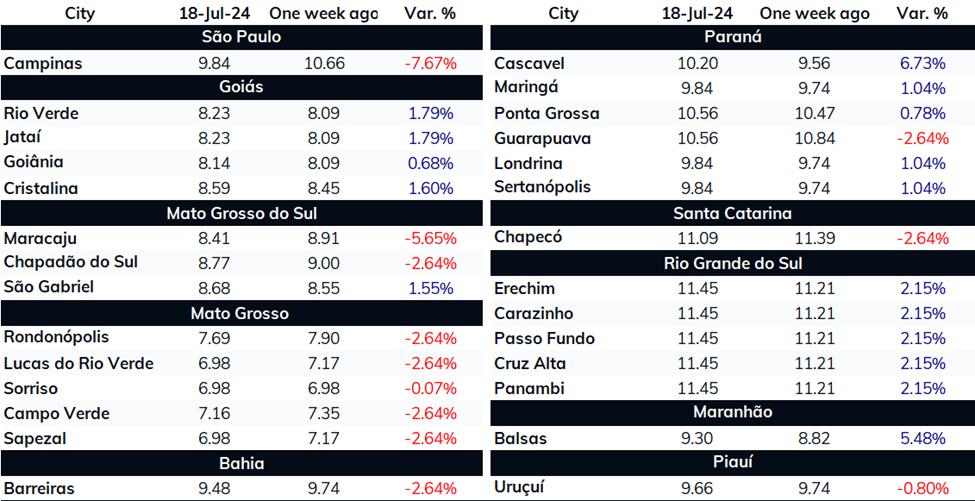
Spot prices in Brazil (USD/60kg bag)