Bullish DRIVERS
- Restricted grains supply due to conflict in the Black Sea;
- Drier weather in east US belt.
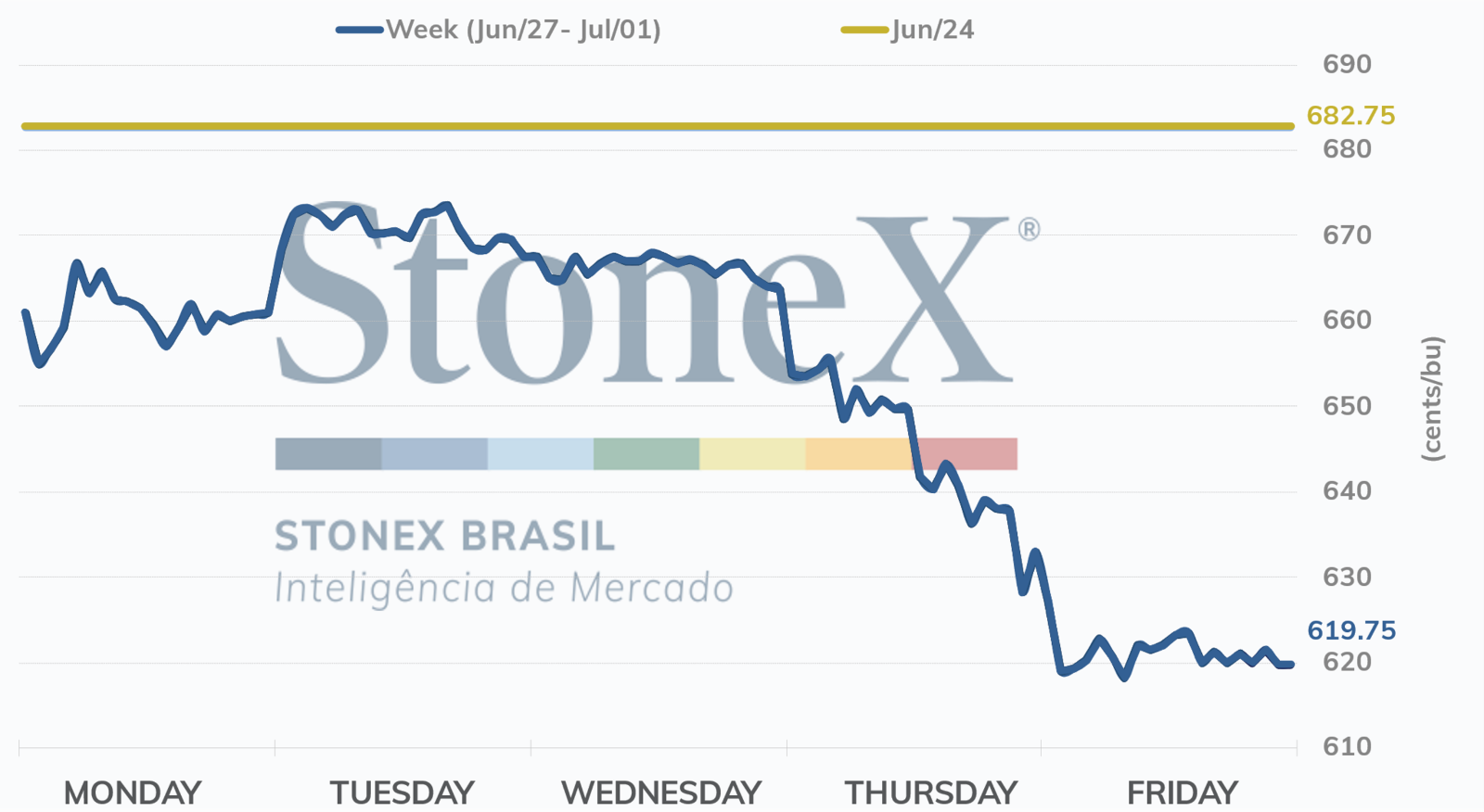
In the first session of last week, corn futures in Chicago had a strong contraction. The main market driver on the day, and which would also become the main reason for the fluctuations throughout the week, was the weather in the US. Above-forecast rains on the weekend before the session in parts of the corn belt and temperatures within the normal range raised optimism around the US crop, pressuring corn prices. The contract maturing in September 2022 ended Monday at 661.28 cents/bu, a devaluation of 21.5 cents/bu compared to the previous close.
As released in the USDA's weekly export inspection report, the US shipped 1.25 million tonnes of corn in the week ended June 23, 54,000 tonnes higher than the previous week's export volume and 201,000 tonnes more than in the same period of 2021. Cumulative exports totaled 47.42 million tonnes, 9.62 million less than at the same time last season.
Also on Monday, the USDA released its weekly crop progress report. On June 26, 67% of cereal crops were in good or excellent condition, a weekly drop of 3 points, which surprised the market, as agents expected a drop of only 1 point. In the same period last year, 64% of the crop was in good or excellent condition.
Intraday (15 min) - September/22 (CBOT)
Source: CME. Design: StoneX.
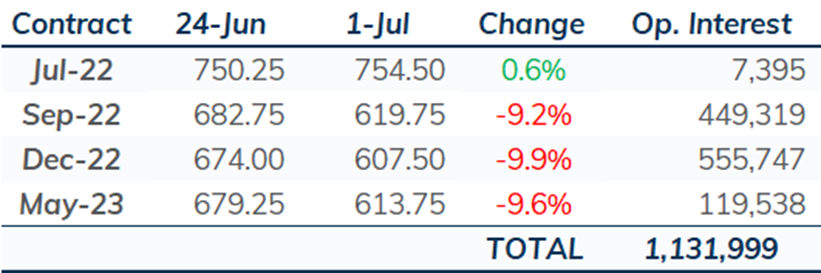
Corn Prices - CBOT (cents/bushel)
Source: CME. Design: StoneX.
On Tuesday, futures had another day of decline in Chicago, following the trend observed in the wheat market. July/22 ended the day losing 1 cent/bushel. The conflict in the Black Sea continues to be an important driver of corn prices. Discussions about the possibility of Russia providing a corridor for the safe passage of Ukrainian grains are still taking place. If the talks are successful, we could see an increase in Ukrainian corn exports, reducing the tightening for global supply. However, there is still nothing concrete. Furthermore, the risk of a recession continues to haunt the market, generating concerns about corn consumption.
On Wednesday, corn contracts did not point to one single direction. While the nearby rose 5.75 cents/bu in the intraday, the most distant contracts had slight setbacks.
The Energy Information Administration (EIA) reported that US ethanol production rose to 1.060 million barrels per day in the week ended June 10, a weekly increase of 21,000. Ethanol stocks dropped, to 23.20 million barrels, down 439,000 compared to the previous week.
On Thursday, the July/22 had another close in the positive field in Chicago, accumulating a significant increase of 14.25 cents/bu in the daily comparative.
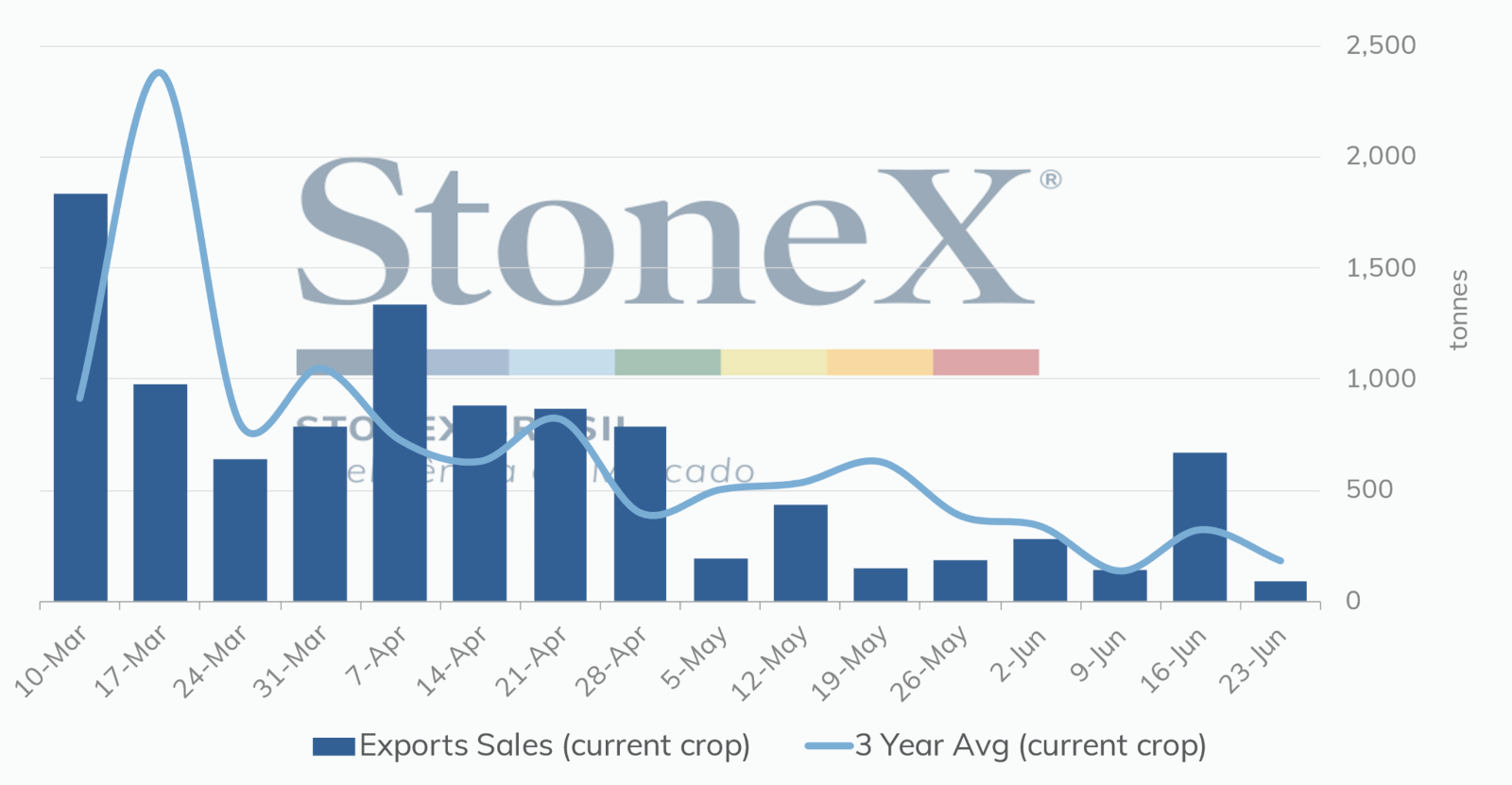
The USDA reported that net sales for the 2021/22 crop totaled 140,9400 tonnes in the week ended June 9, which is 139,500 tonnes less than in the previous week, but122,900 above the same week of 2021. The volume surpassed the ceiling of market expectations, which ranged from 100,000 to 500,000 tonnes.
Weekly US export sales - 2021/22
Source: USDA. Design: StoneX.
On Friday, corn futures retreated once again. In the last trading session of the week, September/22 accumulated a daily contraction of 9 cents/bu. As a result, the contract in question ended the week quoted at 619.75 cents/bu, accumulating a devaluation of 63 cents/bu, or 9.2% in the period.
With the issue of corn planted area no longer one of the main unknowns for the market at the moment, the condition of crops in the US is starting to gain more and more prominence. As grains enter important stages of development, this will be a crucial point in corn pricing. The month of July will be crucial for the performance of the American crop, and although forecasts currently point to a favorable weather for development, it is not uncommon to see sudden changes in models and, therefore, it will be essential to monitor them closely.
Finally, it is worth noting that StoneX released its new figures for the 2021/22 Brazilian grains crop on the day. The first 2021/22 corn crop was marginally increased to 26.4 million tons, while the second crop was increased by 2.7%, to 90.7 million tonnes. In the case of the safrinha, most of this increase was driven by more favorable prospects for planted area and productivity in Goiás and Mato Grosso. The third corn crop was also revised positively to 2.2 million tonnes, resulting in total production of 119.3 million.
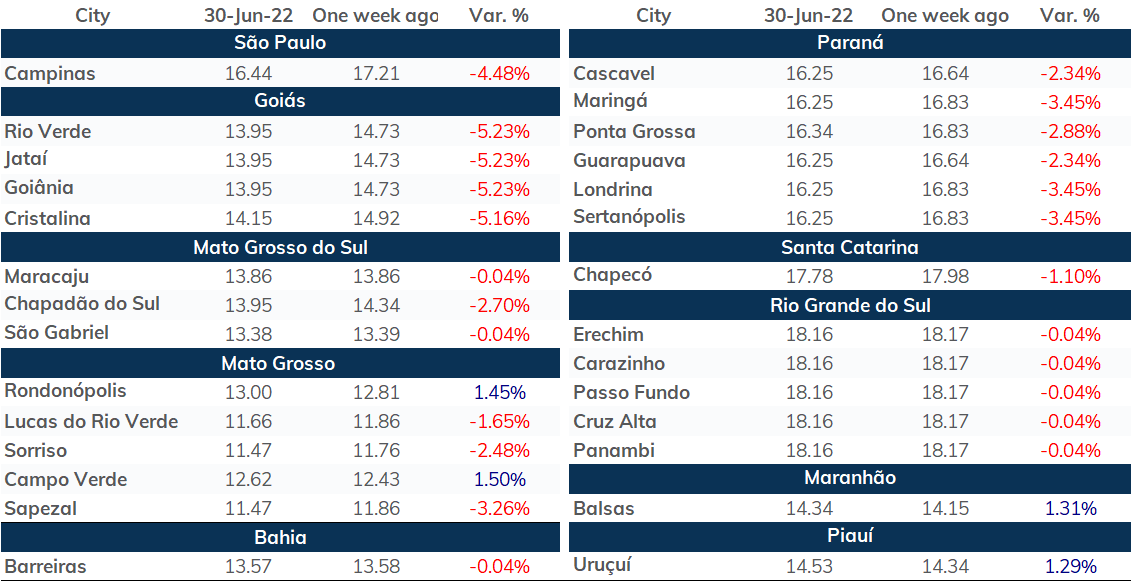
SPOT PRICES (USD/60kg-bag)
Source: StoneX, Agrolink and IMEA. Design: StoneX.