BEARISH DRIVERS
- Fear about a global recession;
- Agreement involving the creation of a Ukrainian export corridor through the Black Sea;
- Concern about possible weakening of Chinese demand.
Bullish DRIVERS
- Restriction on grain supply due to conflict in the Black Sea;
- Further decline of US crop conditions;
- Expectation of lower production in the European Union due to drought.
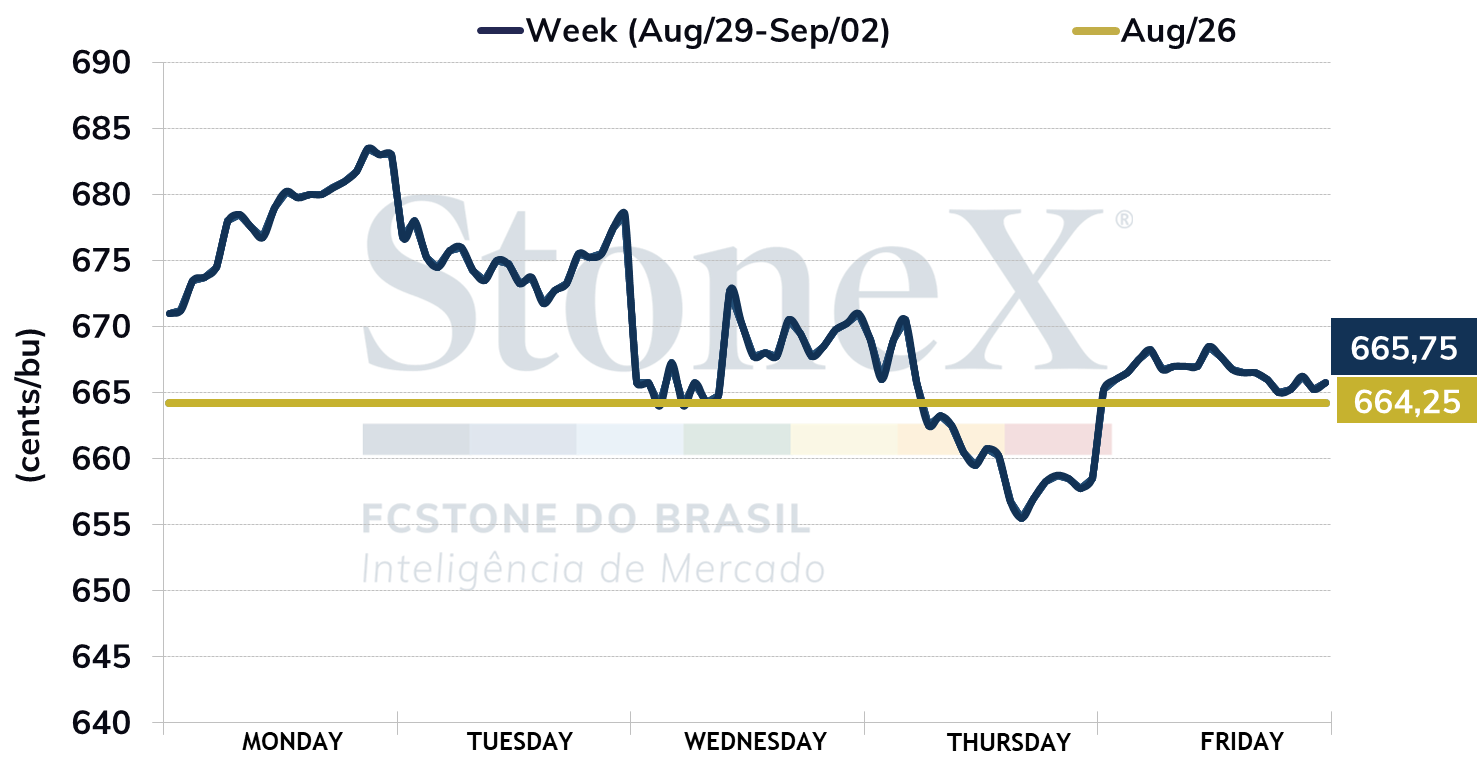
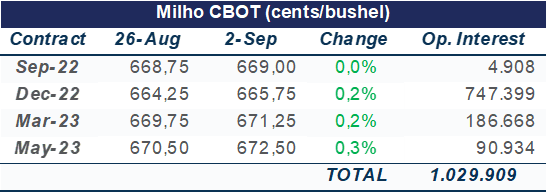
Last week, corn fluctuated between highs and lows in Chicago, with gains at the beginning and end of the period and drops in midweek trading, ending around stability.
Quotes started Monday (29), with gains, still influenced by the results of the Pro Farmer's Crop Tour in the US, which had been concluded on the previous Friday (26). US 2022/23 corn production was estimated at 349.5 million tonnes, more than 15 million tonnes below the USDA's August figure. Average productivity expected for corn was 10.55 tonnes per hectare, against 11 tonnes per hectare from the USDA.
These results reflect the warmer and drier weather that prevailed mainly in the west of the US belt in recent months.
It is noteworthy that private institutions are also reducing their estimates for the US. StoneX released its September review with 2022/23 corn production coming in at 359.9 million tonnes, 4.85 million less than the USDA's August figure, or over 10 million more than estimated by the Pro Farmer.
Therefore, despite the prospects for crop losses for corn in the US, the size of this reduction still needs to be confirmed, which will become clearer with the harvest in the coming months.
Intraday (15 min) - November/22 (CBOT)
On the downside, corn was pressured, like other commodities, by the prospects of economic slowdown around the world.
Faced with concerns about inflation, Fed Chair Jerome Powell signaled that more restrictive measures could be taken to combat accelerating prices in the US, which is likely to impact the country's economic growth and labor market more strongly. Earlier, Powell was advocating that the US economy would make a “soft landing.”
In Europe, there is also an increase in interest rates to fight inflation and the possibility of an energy crisis is raising concerns. The region's major economies are likely to suffer from Russian gas cuts as winter approaches.
China has also been showing signs of economic weakness, with the market following the country's indicators. As a result, the Chinese economy is no longer expected to grow by 5.5% in 2022, as was the previous target. The zero-tolerance policy against Covid-19 remains in place in the country, with the imposition of extensive lockdowns, even with a dwindling number of cases of the disease being recorded.
This prospect of an economic slowdown has also weighed heavily on energy markets, which affects corn, largely used for ethanol production in the US. In the week ended August 26, the country's ethanol output reached 970,000 barrels per day, a level lower than a week earlier, but enough to guarantee the estimate for the crop-year up to the end of August. On the other hand, it should be noted that US ethanol stocks remain at elevated levels.
On Friday, the rally in the energy market as crude oil moved up ahead of the long weekend in the US (with the Labor Day holiday on Monday, 5) supported corn in the day.
Returning to the corn crop, StoneX Brazil has also updated its numbers for the first 2022/23 crop, whose planting is already advancing in the south of the country. Production was estimated at 29.85 million tonnes, nearly 500,000 less than the August estimate.
The main conditioning factor for this decrease in production expected for the summer was the negative adjustment of planted area in Minas Gerais, which occurred in the face of lower demand seen for inputs, such as seeds.
Even so, prospects continue to be of growth compared to the previous year, when losses were recorded due to drier weather in the South.
In any case, the total production will only be defined in 2023, with planting and the weather during the safrinha, which is already more than three times bigger than the summer crop.