BEARISH DRIVERS
- Further increase of US interest rates and signs that contractionary policy should continue;
- Concerns about the level of Chinese economic activity and possible reduction in demand for grains;
- Progress of US corn harvest;
- Weaker-than-usual US export shipments and sales for this time of year.
Bullish DRIVERS
- Questions raised by Russia about the Ukrainian grain export corridor;
- Russian reservists summoned to support the war against Ukraine and threat to use nuclear weapons;
- Higher-than-expected cuts in US production estimates;
- Expectation of lower production in the EU due to drought.
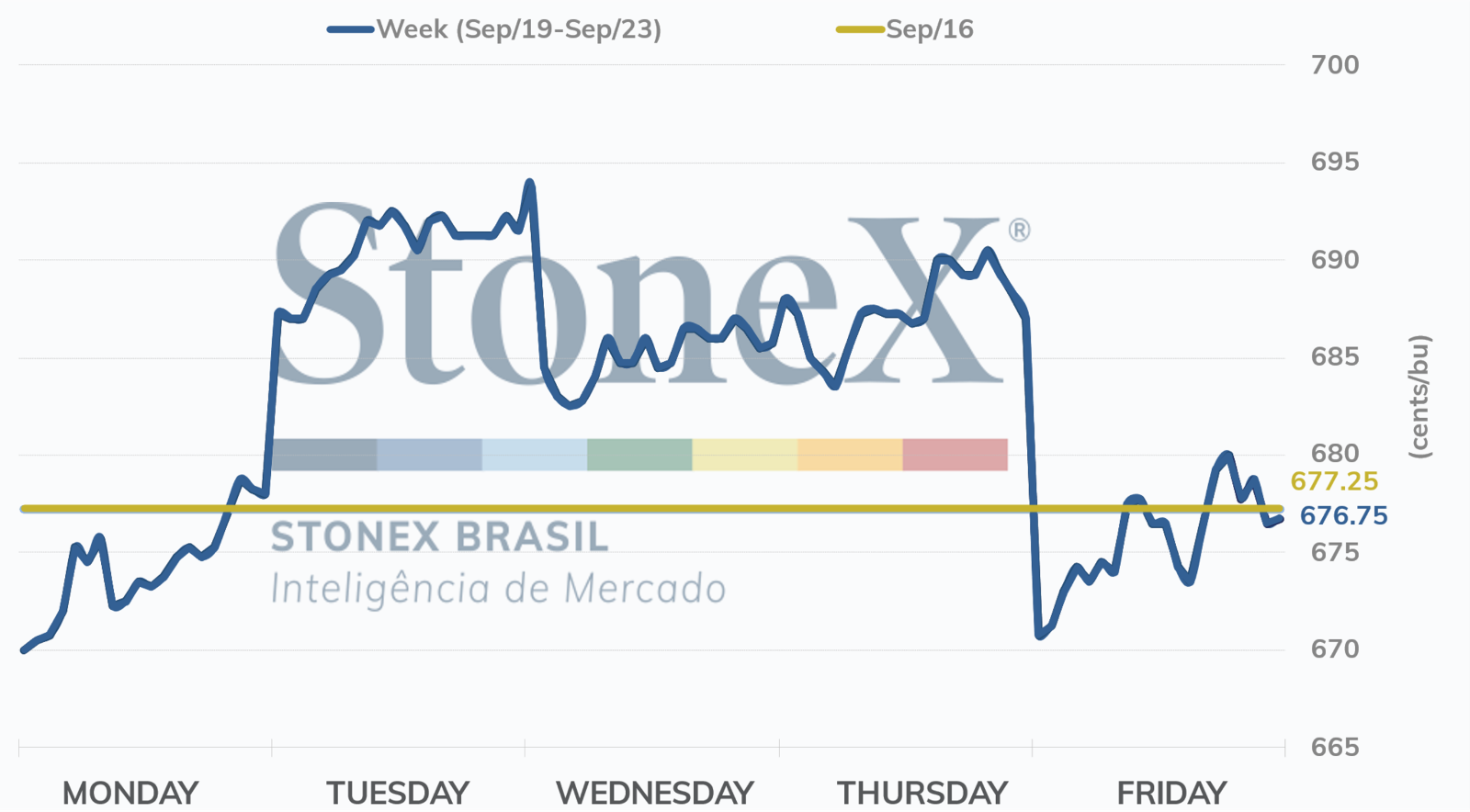
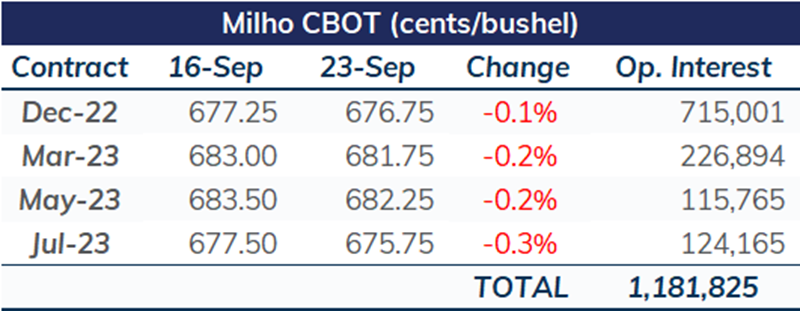
Corn futures started last week higher in Chicago, supported by tensions in the Black Sea after Putin's remarks. However, over the course of the week, prices returned the gains, pressured by a further increase in US interest rates, and weak ethanol production and US corn export sales. The contract expiring in December 2022 ended Friday (23) at 676.75 cents/bu, accumulating a weekly devaluation of 0.5 cent/bu, or 0.1%.
Intraday (15 min) - November/22 (CBOT)
Escalating tension in the Black Sea supports the market. In the last week, concerns about a possible intensification of the conflict between Russia and Ukraine boosted corn prices. Although Ukraine has been showing greater volumes of grain shipments, the questions made by Russia about the Ukrainian grain export corridor, the call of 300,000 reservists to support the war against the Ukrainians, and the threat of nuclear weapons by Putin raised questions about whether the treaty for Ukrainian grain exports through the Black Sea will be continued.
US shipments at the beginning of the 2022/23 crop are below what is usually observed in this period of the year, but they were within market expectations. According to data released in the USDA's weekly export inspection report, the US shipped 549,400 tonnes of corn in the week ended September 15, 75,000 above the volume shipped one week earlier and 145,900 more than the same period of 2021. The volume was within the range of market estimates, which varied between 375,900 and 800,100 tonnes. Exports accumulated in 2022/23 totaled 1.1 million tonnes, against 622,000 tonnes in the same period of the previous season. Despite better volumes compared to the 2021/22 crop, this is not the ideal comparison, given that the US had problems carrying out shipments at the beginning of last season. In the week ending September 17, 2020, for example, US exports had totaled 845,000 tonnes, while in the equivalent week of 2018, shipments exceeded 1 million tonnes.
Further deterioration in US crop conditions. Agents expected the good/excellent percentage of crops on September 18 to be the same as one week earlier. However, the level dropped 1 percentage point to 52%, 7 points below the same period last year. Despite the decline, the current weather has a less intense impact on the US crop, especially as maturity and harvesting progress. Until the period in question, 7% of the crop had been harvested, 1 point below the five-year average.
Increase in US interest rates pressures the market. The Federal Reserve decided to continue its contractionary policy and raise the US benchmark interest rate again by 0.75 percentage points. In addition, the Fed has signaled that it should continue raising interest rates at future meetings, which could put pressure on the commodities market.
Ethanol stocks and weekly production in the US record further decline. The Energy Information Administration (EIA) released data on US ethanol production for the week ended September 16 showing that the volume dropped to 901,000 barrels per day, 62,000 lower than a week earlier, an issue that had a downward influence on corn prices in Chicago. Stocks, in turn, fell to 22.5 million barrels, from 23.84 million the week before.
US export sales decline and stay below market expectations. The USDA reported that net sales for the 2022/23 crop totaled 182,400 tonnes in the week ended September 15, against 583,100 tonnes in the previous week. In the equivalent week of 2021, US net sales stood at 458,700 tonnes. The volume was below the range expected by the market, which varied between 400,000 and 850,000 tonnes. Commitments to all destinations rose to 12.5 million tonnes, against 24.9 million in the same period last year.
Weekly US export sales - 2021/22
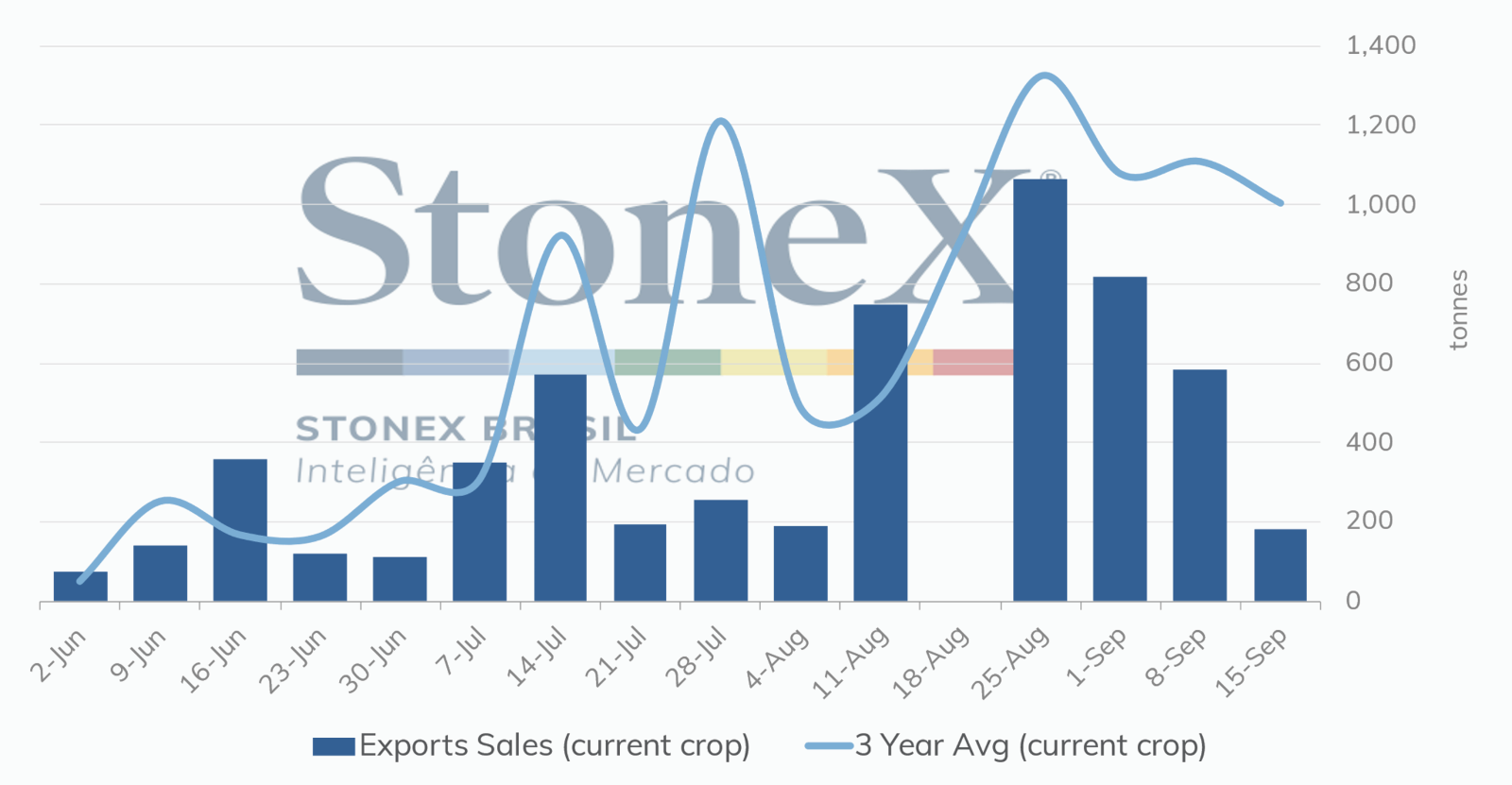
Source: USDA. Design: StoneX.