Deficit in shipments compared to the 2021/22 season widens. According to the USDA Export Inspection Report, the US shipped 805,200 tonnes in the week ended April 6, 293,300 tonnes less than a week earlier and almost 700,000 less than the same week of last year. With this, the country increased the deficit of accumulated shipments in relation to the 2021/22 season, from 11.2 to 11.9 million tonnes. Until April 6th, the US exported 20.2 million tonnes of corn.
Planting progress is below expectations but above average. On Monday (10), the USDA released its Crop Progress Report. The Department reported that US corn plantings hit 3% as of April 9, 2 points below market expectations, but above the five-year average for the same period (2%). Over the last week, a very favorable weather pattern was recorded for the progress of field work in the Midwest. As a result, the market is waiting for significant progress in the percentage planted, which will be announced today (17). Despite this optimism for much of the corn belt, the market is still concerned about snow cover in the Great Plains. As much as the area covered in the Dakotas and Minnesota has reduced considerably in the last week, and without causing flooding, agents have been closely monitoring conditions in the region, as part of the state is still covered by snow and weather models indicate that rains will hit the Great Plains this week, which could delay seeding progress, raising concerns about prevent planting, especially in the Dakotas and Minnesota.
Ethanol production in the US declines, but stocks remain stable. According to data released by the Energy Information Administration (EIA), US ethanol production dropped to 959,000 barrels per day in the week between April 1 and 7, a contraction of 44,000 on a weekly basis and 36,000 below the five-year average for the same period. Ethanol stocks remained virtually stable at 25.13 million barrels, just 8,000 barrels less than a week earlier. It is true that stocks are 1.3 million barrels below March 10, the highest level of stocks since March 2022, but they are 1.6 million barrels above the five-year average for the period.
USDA makes new announcements of China flash sales. Last week, the USDA announced a total of 709,000 tonnes in flash sales to China, of which 437,000 tonnes are for delivery in 2022/23 and 272,000 for delivery in 2023/24. The announcement of these flash sales helped to offset the pressure caused by the weakened pace of US shipments.
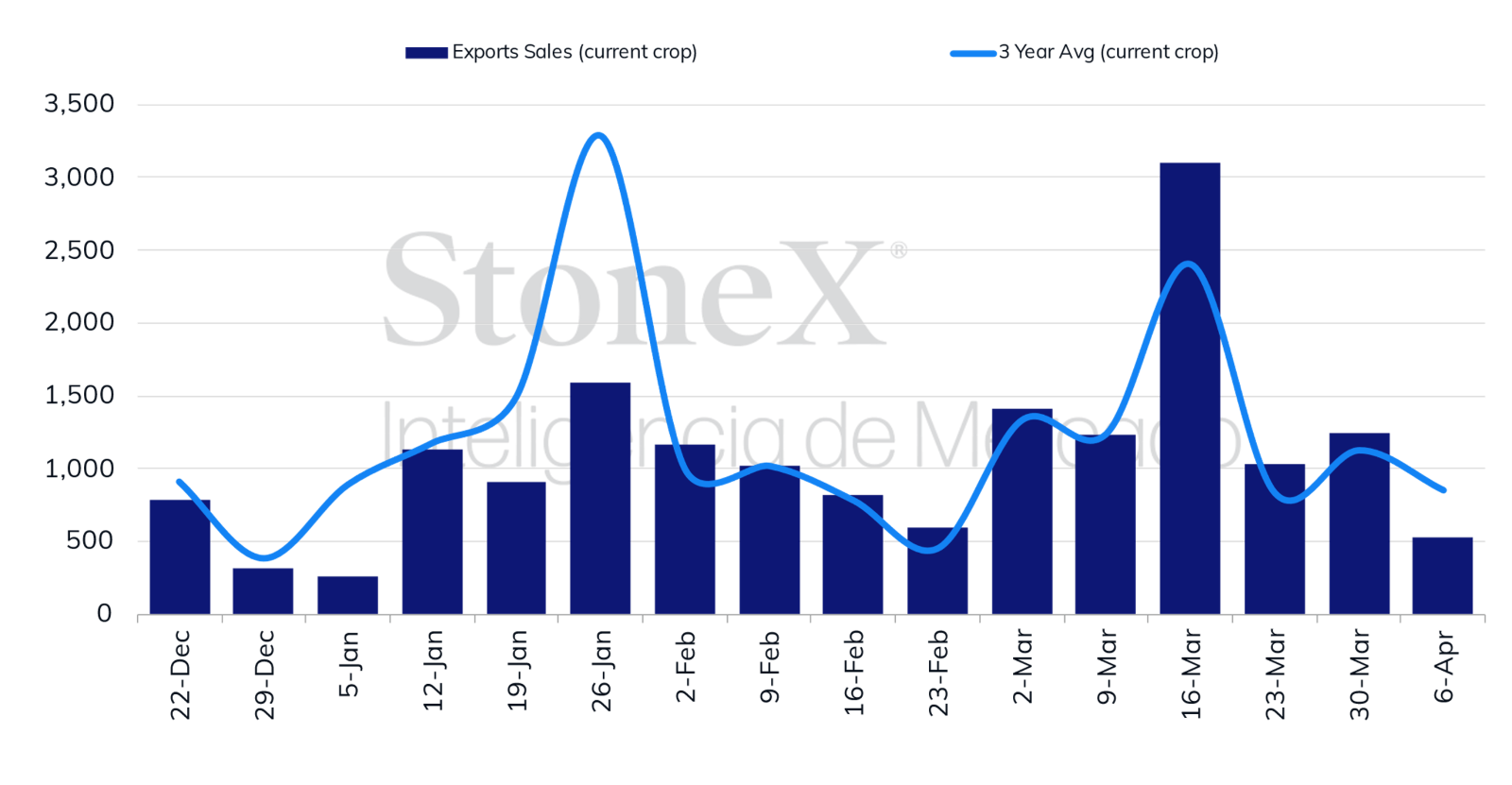
Deficit in export sales volume compared to last season widens again. In its Export Sales Report, the USDA reported that US net sales totaled 527,700 tonnes for the week ended April 6, 718,900 tonnes less than a week earlier, 805,200 tonnes lower to that registered in the same period of 2022 and 263,300 below the five-year average. As a result, cumulative sales increased to 37.7 million tonnes, but the deficit compared to the 2021/22 season increased from 17.2 million tonnes to 18 million.
US weekly export sales (000 tonnes)
Source: USDA. Design: StoneX.
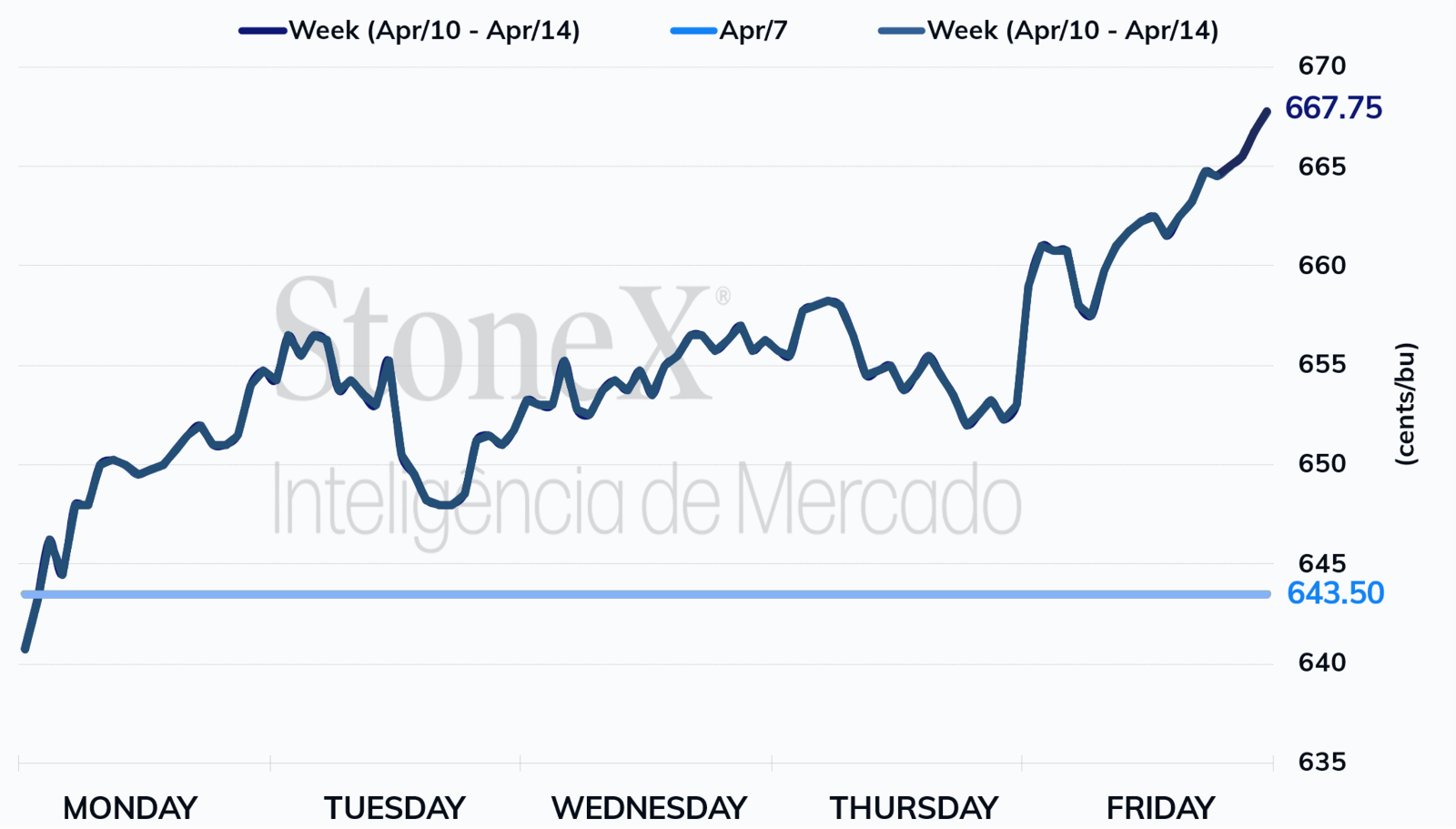
WASDE brings no major surprises. On April 11, the USDA released its monthly S&D report. In the case of corn, the report was considered noneventful, not bringing any big surprises to the market. The Department practically did not change the balance of the 2022/23 US crop. On the supply side, the only change was the slight decrease of 250,000 tonnes in imports, to 1.02 million, which was offset by the contraction of the same volume in the use of corn for Food, Seed, and Industry. As a result, ending stocks for the 2022/23 crop in the US remained estimated at 34 million tonnes, 500,000 tonnes above average market expectations, which had little impact on corn futures in Chicago.
USDA reduces Argentine corn production. For the other players, it is worth highlighting the cut of 3 million tonnes in Argentine production, to 37 million, a variation in line with what was expected by the market. Due to the lower availability of corn in the South American country, exports were also reduced by 3 million tonnes, to 25 million. The Department stated that the reduction in the Argentine crop was motivated by the high temperatures seen in March, which jeopardized the development of corn planted late, despite the rains received recently, and that new cuts are not ruled out. The USDA figure is below the estimate by Bolsa de Cereales (36 million tonnes) and Bolsa de Rosario, which last April 12 reduced its forecast from 35 to 32 million tonnes. StoneX's Market Intelligence team prepared a special article addressing the main changes made to the Soybean, Corn, and Wheat balance sheets. Click here to access the complete material.
Argentine crop conditions worsen again. The Buenos Aires Cereales Exchange reported that 6% of Argentine cereal crops were in good/excellent condition on April 12, down 1 point in the weekly comparison and 14 points below the level recorded in the same week of 2022. The corn harvest in the country reached 12.7%, an increase of 2.3 points. However, the pace remains below that observed last season (19.4%) and the five-year average (23.8%).
CONAB makes slight increases in Brazilian corn production. On April 13, CONAB released its monthly S&D report. In the case of corn, total production increased marginally, to 124.88 million tonnes, driven by small positive adjustments in the 1st and 2nd crops.
Concern about the continuity of the Black Sea grain export agreement supports the market. Last week, one of the main factors supporting corn prices was the increase in concern related to the grain export agreement through the Black Sea. Russia threatened not to accept a further extension of the agreement, which is valid until mid-May. Russia demands some counterparts, such as the reintegration of the Rosselkhzbank bank into the Swifts financial communications system and the end of the block on Russian companies' bank accounts linked to the production of fertilizers and food. Since its inception, the agreement has been subject to uncertainty, mainly caused by Russian statements, and its possible end would bring further limitations to global supply and grains, especially corn and wheat, which already have tight balances.
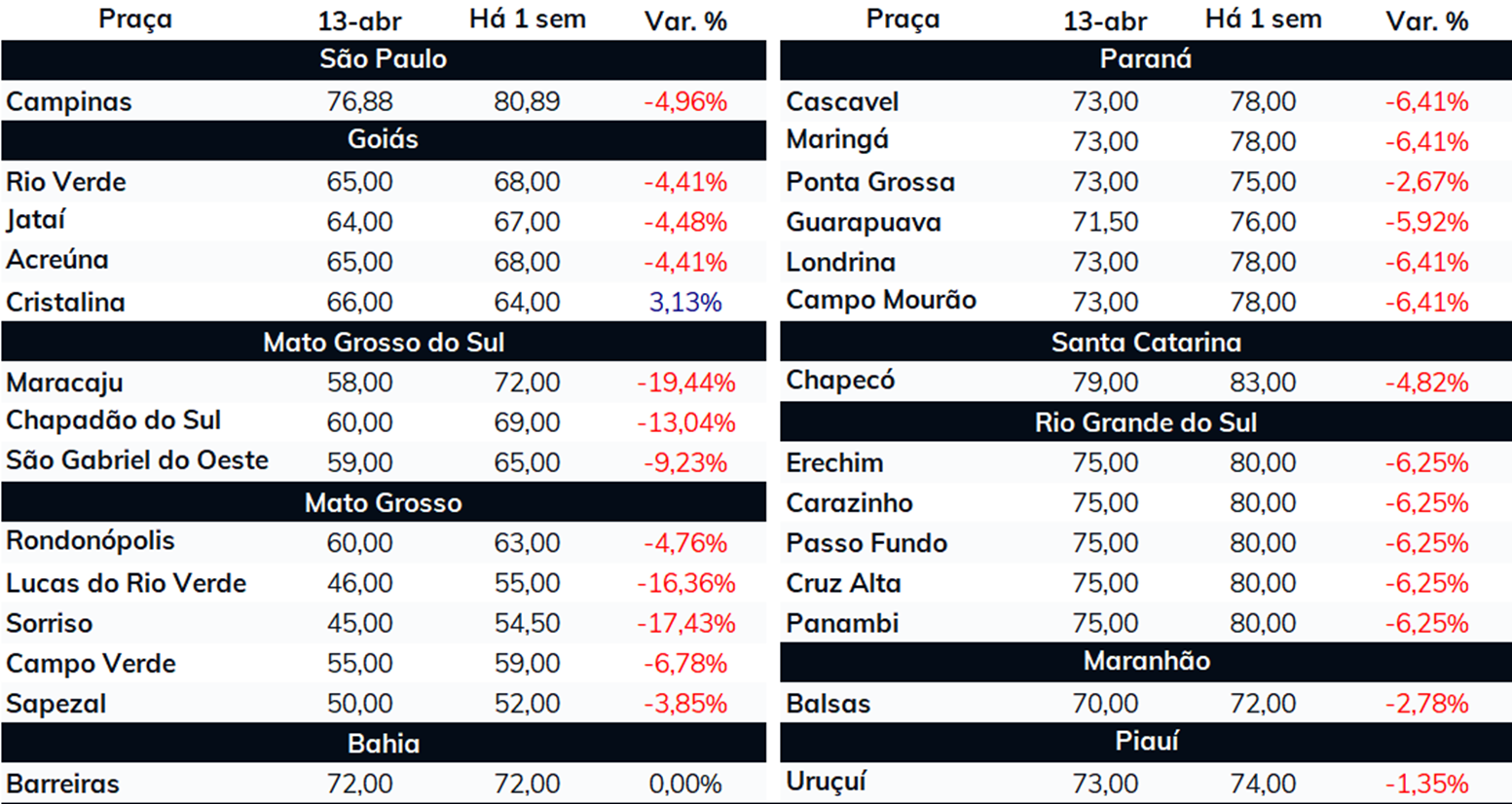
SPOT PRICES (USD/60kg-bag)