- Favorable outlook for the Brazilian supply;
- Weakened pace of US sales and shipments;
- Weather models indicating increased moisture in July in the corn belt;
- US planted area above market expectations.
- Statement that Russia will leave the Grain Initiative after its expiration;
- Concern about the impacts of the drought observed in parts of the US Midwest;
- Fears that a drier pattern in China could impact local production.
American crop conditions begin to react to increased rainfall and show improvement. The good/excellent index of corn crops in the US advanced one percentage point (p.p.) on the weekly comparison, reaching 51% on July 2, an increase in line with market expectations. This improvement can be attributed to the good volume of rain recorded two weeks ago. Despite the progress, the current level is 13 points below that observed in the same week last year and 16 points below the average of 5 years for the same period. In addition to improving crop conditions, another sign of drought relief was brought by the NOAA's Drought Monitor, which pointed out that on July 4, the drought covered 67% of corn farms, compared to 70% the previous week. The current scenario still brings fears about the productivity of the US 2023/24 crop, but models continue to point to the occurrence of rain in much of the US Midwest over the next two weeks, which, if materialized, should allow for a crop within normality.
Ethanol production in the US registers a slight increase in weekly comparison, but stocks decline. According to the data released by the Energy Information Administration (EIA), American ethanol production stood at 1,060 thousand barrels per day (mbpd) in the week between June 24 and 30, an increase of 8 mbpd in the weekly comparison. The observed production was 16 tbpd above what was observed in the same period last year and 28 tbpd above the 5-year average for the same period. On the other hand, biofuel stocks fell to 22.26 million barrels, 719 thousand barrels less than a week before.
The pace of US shipments advances on a weekly comparison but remains lower than the previous season. According to the USDA Export Inspection Report, the US shipped 642.9 thousand tonnes in the week ending June 29, 92.4 thousand tonnes more than a week before but 233.8 thousand below what was observed in the same period of the previous year. With this, the accumulated shipments for the 2022/23 season totaled 33.1 million tonnes, 15.2 million less than in the same period of the previous cycle.
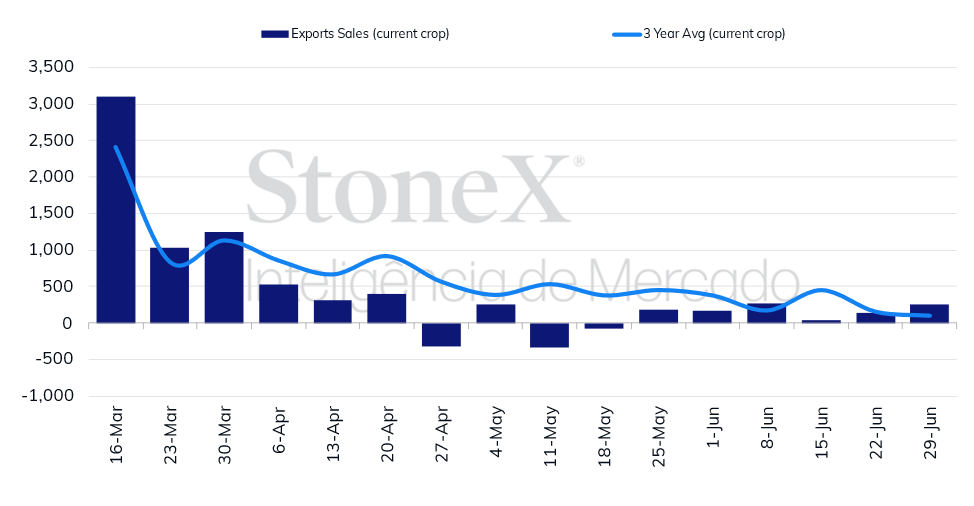
US net sales advance and allow a slight reduction in relation to the previous crop. In its Export Sales Report, the USDA reported that US net sales totaled 251.7 thousand tonnes in the week ending June 29, 111.3 thousand tonnes more than a week earlier and 318.3 thousand tonnes above what was recorded in the same period of 2022. With this, cumulative sales advanced to 39 million tonnes, allowing a setback in the deficit compared to the 2021/22 season to 21.3 million tonnes, against 21.6 million one week before.
Corn harvest pace in Argentina in line with that recorded a year earlier. The Buenos Aires Grain Exchange reported that 9% of Argentine cereal crops were in good/excellent condition on July 6, an increase of 1 percentage point on a weekly comparison but six p.p. below what was recorded in the same week of 2022. The corn harvest in the country reached 51.6%, 1.4 percentage points below that observed a year earlier and 12.2 percentage points below the 5-year average.
StoneX raises its estimate for corn production in Brazil. On July 3, StoneX released updates to its estimates of the Brazilian grain crop. The first 2022/23 corn crop was maintained at 28.6 million tonnes. By the end of June, the harvest had already been completed in Brazil, with the number referring to the summer crop being slightly subject to a future revision. The second corn crop once again increased by 2.2% to 105.2 million tonnes compared to June. The review was prompted by the record of favorable weather conditions for the crops over the past month, which resulted in a more optimistic scenario for production in Paraná and the Central-West states and boosted the average yield estimate for the winter crop to 5.9 tonnes/hectare. With this, the combined production of Brazil's three corn crops advanced to 136 million tonnes. Amid expectations of an increase in national supply, Brazil is expected to allocate a larger volume of grain to the international market. StoneX has increased its export estimate by 2 million tonnes to 50 million.