- Favorable prospects for Brazilian supply.
- Slow pace of US shipments.
- Reports of good rainfall and weather models pointing to a cooler and wetter pattern in a considerable part of the Corn Belt in August.
- Reports that Russia is willing to resume negotiations for exports through the Black Sea.
- Escalation of the conflict between Russia and Ukraine, with ports in both countries being targeted.
- Concerns about the impacts of the drought in parts of the US Midwest persist.
- Concerns that developing a drier pattern in China could impact local production.
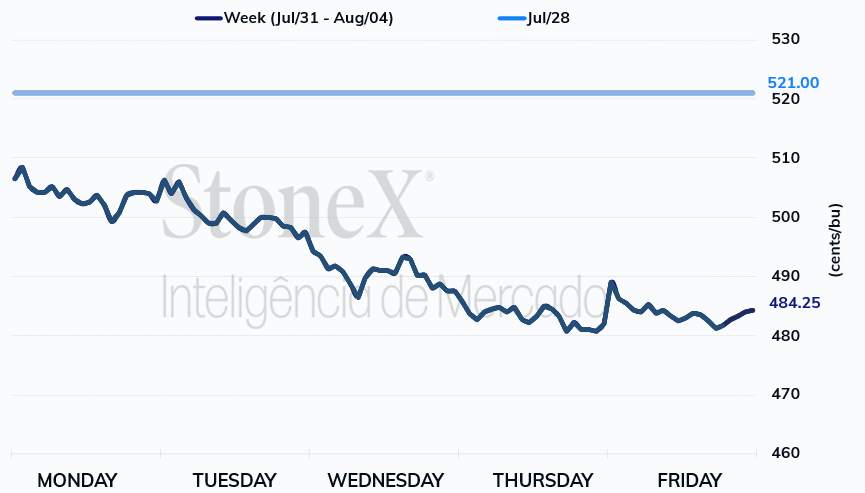
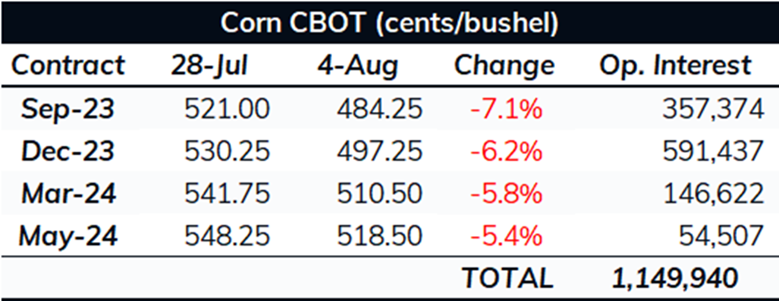
Last week, corn futures showed a significant downward trend in Chicago. Despite the ongoing concerns about grain supply from the Black Sea region due to tensions in the area, they were not enough to support corn prices in recent days. Weak demand for US corn exports improved US weather conditions, and forecasts of more favorable weather in large part of the Corn Belt in August weighed on grain prices on the CBOT. The September/23 contract ended the period with a devaluation of 7.1%, trading at 484.25 cents/bu.
The Russo-Ukrainian conflict remains a major concern. Last week, the war between Russia and Ukraine continued to raise doubts among market participants regarding grain shipments through the Black Sea. Russian airstrikes destroyed grain warehouses at the port of the Danube River. With the grain export corridor closed since July 17, suppliers prepared to export via the ports of Izmail and Renti on the Danube River. On the other hand, it was reported that Ukraine executed drone attacks on the port of Novorossiysk, one of Russia's main oil terminals and a major exit point for grain exports. These attacks showed that Russian resources are also subject to severe damage. The attacks by both nations increased uncertainty about the availability of insurance for future shipments and fueled fear about high food costs. However, it was also reported that Russia is willing to return to the negotiating table. China is negotiating with Ukraine about grain movement without involving Russia, factors that counterbalanced concerns about shipments through the Black Sea and pressured prices.
US weather conditions have improved, raising prospects for crops. Due to the hot and dry weather observed in the last week of July, crops classified as good/excellent fell two percentage points compared to the previous week on July 30, according to the USDA's Crop Progress Report, to 55%, 6 points less than a year ago and 10 points less than the 5-year average. However, significant rainfall and milder temperatures have been observed in many of the Corn Belt in the past few days. Furthermore, weather models have been gradually improving the chances of rain in the driest areas of the Midwest for the first half of August. Although this month is not decisive for corn, rainfall or the lack of it can still impact final productivity in the coming weeks.
Ethanol production and stocks dropped in the US. According to data released by the Energy Information Administration (EIA), US ethanol production stood at 1,067 thousand barrels per day (tbpd) between July 22nd and 28, a decrease of 27 tbpd compared to the previous week. Ethanol stocks declined to 22.86 million barrels, 368 thousand barrels less than a week before.
Export inspections show weekly shipment growth, but the deficit compared to the previous crop increased again. According to the Export Inspection Report, the US shipped 522.9 thousand tonnes of corn in the week ending July 27, against 329.8 thousand tonnes the previous week but below the 905.3 thousand tonnes observed in the same week last year. As a result, accumulated exports in the US 2022/23 crop reached 34.8 million tonnes, against 52 million in the same period of 2021/22, a difference of 17.2 million tonnes.
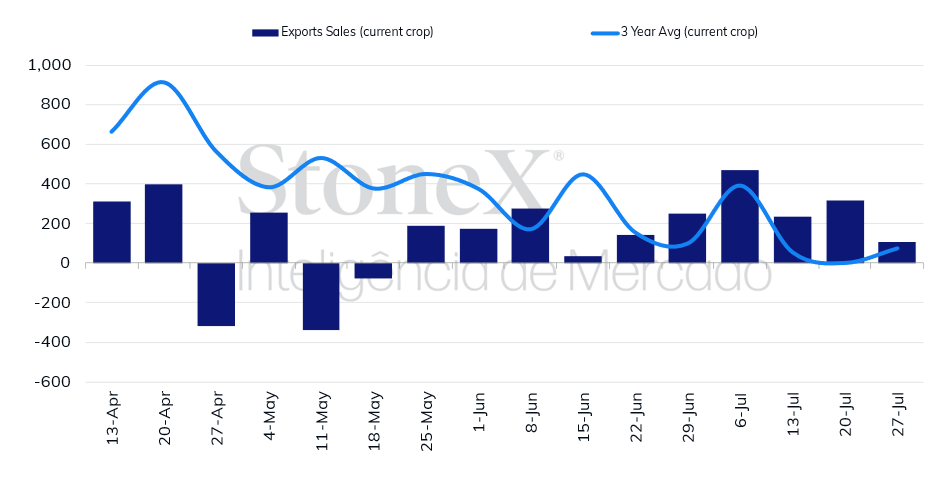
US net sales decline on a weekly basis, but the delay compared to the previous crop shows a slight reduction. In its Export Sales Report, the USDA reported that US net sales totaled 107.5 thousand tonnes in the week ending July 27, 206.7 thousand tonnes less than the previous week but 46.9 thousand tonnes above the same period in 2022. With this, accumulated sales advanced to 40.2 million tonnes, and the deficit was reduced compared to the previous season but remains high at 20.5 million tonnes.
Weekly export sales - US (thousand tonnes)
Corn harvest reaches 72.6% in Argentina. The Buenos Aires Grain Exchange reported that 72.6% of the corn crops were harvested by August 3. As a result, 24.76 million tonnes of corn have been harvested so far. In the same period last year, 81.4% of the crop had already been harvested, while the 5-year average for the same period is 88.1%.
StoneX releases its first estimates for the 2023/24 crops of the US and Brazil. StoneX released its first survey for the US soybean and corn crops. The average corn productivity was seen at 11.11 tonnes/ha, slightly below the latest USDA estimate (11.14 tonnes/ha). StoneX projects a slightly lower production than the Department's figure (389.14 million tonnes) at 387.97 million tonnes. For Brazil, StoneX released its first estimate for the 2023/24 summer corn production, which stands at 28.6 million tonnes, almost steady compared to the previous cycle, with a slight decrease in area. Regarding the 2022/23 crop, StoneX increased its number for the second corn crop, which reached 108.3 million tonnes. For the 2022/23 third crop, StoneX estimates production at 2.3 million tonnes, slightly above the previous cycle.