- Sluggish pace of US shipments;
- Significant rainfall recorded in the first two weeks of August in the Corn Belt;
- WASDE report generating uncertainties on global corn demand.
- Escalating tensions between Russia and Ukraine;
- Concerns about climate impacts on China's corn crop.
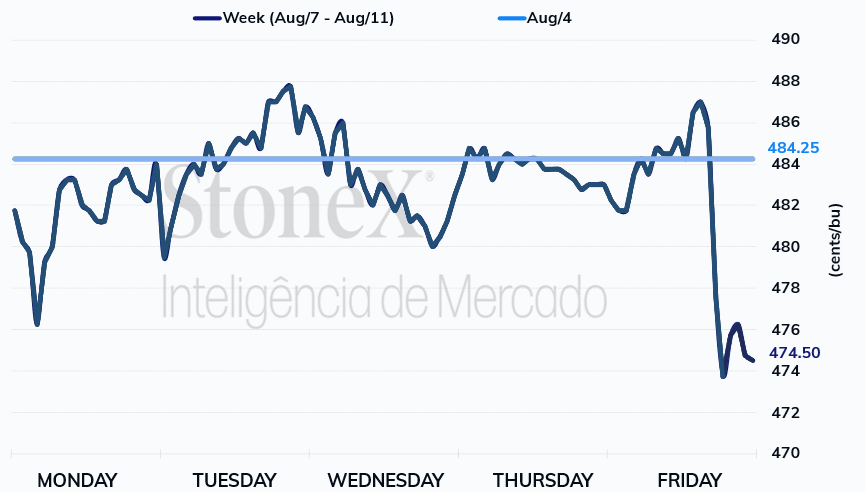
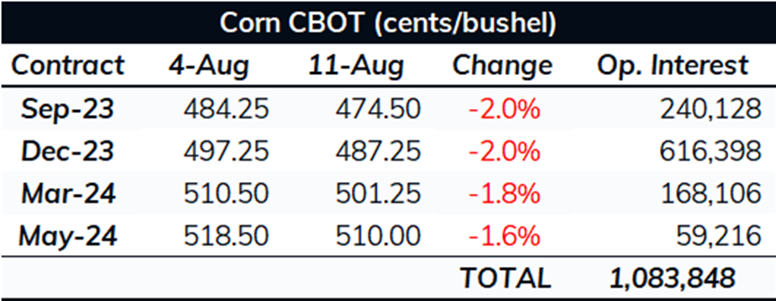
Corn futures declined again last week, marking the third weekly drop for the cereal in Chicago. Despite heightened tensions in the Black Sea, the substantial rainfall observed in recent weeks in the US Corn Belt and corn demand uncertainty prevailed. The September/23 contract ended the period with a 2% depreciation, trading at 474.5 cents/bu.
The conflict between Russia and Ukraine once again supported corn prices but wasn't sufficient to prevent the decline in prices last week. Tensions in the Black Sea region continue to be closely monitored by the market. Ukraine launched new attacks against the Russians in the past week, targeting oil tankers. Following the event, Ukraine declared that the Kremlin should consider its ports a war zone. With uncertainty surrounding grain supply from the region, futures contracts initially showed some recovery but faced bearish pressures towards the end of the week as no significant new developments in the conflict emerged.
Beneficial rainfall in the US Midwest leads to improved crop conditions. The last two weeks have seen beneficial rainfall volumes in the US Corn Belt. Amid these favorable conditions, market participants expected the USDA to indicate a 1-percentage-point increase in crops classified as good/excellent in its report on August 6. However, the Department surprised positively by raising the number by 2 points to 57%, which is 1 point lower than the previous year and 7 points below the five-year average. With significant rainfall expected in the second week of August, it is also anticipated that the USDA will indicate an increase in crops with good/excellent conditions in today's report. Climatic models suggest that the following two weeks will not have as abundant rainfall as the previous two weeks. While end-of-month rains might not be as significant for corn crops as in July, they will still be closely monitored.
USDA brings US crop yields in line with market expectations. The market highly anticipated the August WASDE report as it expected a reduction in US corn production due to drier weather than forecasted in July in many parts of the US Corn Belt. Analysts anticipated a decrease in yield from 11.14 t/ha to 11.02 t/ha, resulting in a production decline from 389.1 million tonnes to 384.44 million tonnes. The Department made these cuts, which were slightly stronger than expected, with yield falling to 10.99 t/ha and production to 383.8 million tonnes.
Regarding the US balance, it's worth noting that ending stocks for 2022/23 increased by 1.4 million tonnes to 37 million tonnes. This result was due to reduced demand for US corn, primarily from exports. In addition to larger ending stocks, the reduction in 2023/24 production was partially offset by declines in domestic consumption and exports related to the 2023/24 crop. As a result, US ending stocks for the next crop decreased to 55.9 million tonnes, slightly higher than the market's average estimates of 55.07 million tonnes.
Concerning other players, due to excessive moisture, the USDA reduced its estimate of China's 2023/24 corn production from 280 million tonnes to 277 million tons, and further cuts are not ruled out. Models indicate that a high volume of rain will continue to occur in northeastern China, which could harm cereal development and increase vulnerability to pests and diseases.
Ethanol production and stocks decline again in the US. According to data from the Energy Information Administration (EIA), US ethanol production fell by 44 thousand barrels per day (tbpd) in the weekly comparison, reaching 1,023 tbpd in the week between July 29 and August 4. Meanwhile, stocks slightly increased from 22.86 million barrels to 22.88 million barrels.
Export inspections showed a decline in shipments on a weekly basis, with deficits compared to the previous crop continuing to widen. According to the Export Inspection Report, the US shipped 376.6 thousand tonnes of corn in the week ending August 3, compared to 538.2 thousand tonnes in the previous week and 555.6 thousand tonnes the previous year. As a result, cumulative exports for the US 2022/23 crop reached 35.2 million tonnes, compared to 52.5 million tonnes in the same period of 2021/22, widening the gap to 17.3 million tonnes.
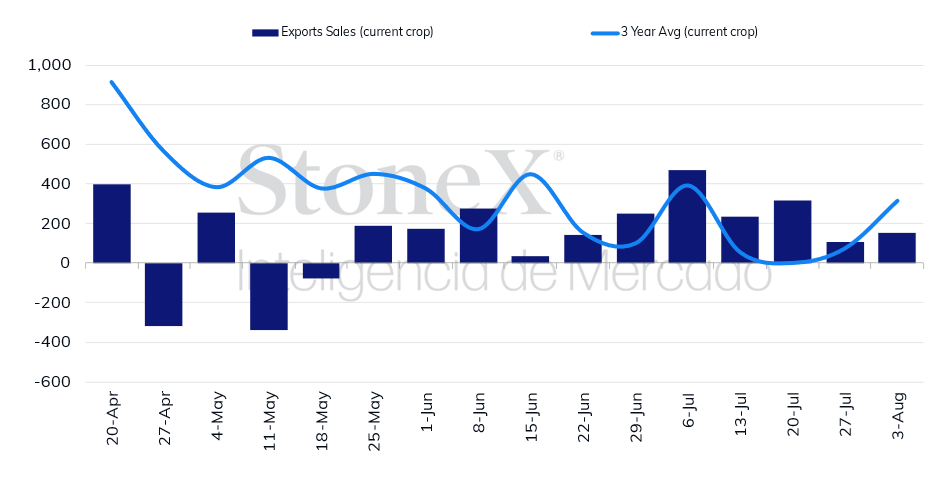
US net sales advance on a weekly basis, but deficits compared to the previous crop slightly expand. In its Export Sales Report, the USDA stated that US net sales totaled 150.4 thousand tonnes in the week ending August 3, 42.9 thousand tonnes more than the previous week but 41.4 thousand tonnes less than the same period in 2022. As a result, cumulative sales advanced to 40.3 million tonnes, and the deficit compared to the previous season increased to 20.53 million tonnes.
Weekly export sales - US (thousand tonnes)
Harvest progress reaches 80.9% in Argentina. The Buenos Aires Grain Exchange reported that 80.9% of corn crops were harvested by August 10. This means 27.68 million tonnes of corn have been harvested so far. In the same period last year, 89.8% of the crop had already been harvested, while the five-year average for the same period is 93.7%.
Conab increases Brazil's production estimates again. Conab has once again raised its total 2022/23 corn production estimate for Brazil to 129.96 million tonnes, with slight positive adjustments to both the first and third crops and a more than 2 million tonnes increase in the safrinha, reaching 108.18 million tonnes.