- Slow pace of shipments in the US;
- Concern about river levels in the US and impacts on grain flow;
- US harvest progress.
- Tensions between Russia and Ukraine;
- Logistical problems at ports in Northern Brazil;
- Corn crushing for ethanol production above the level recorded a year ago.
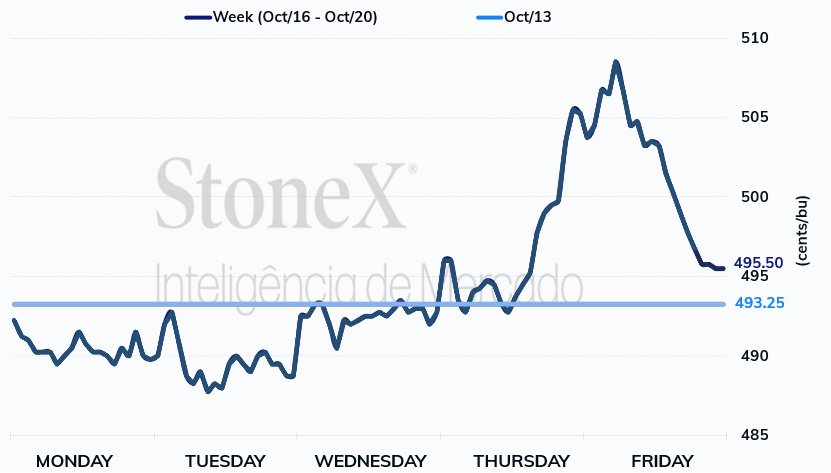
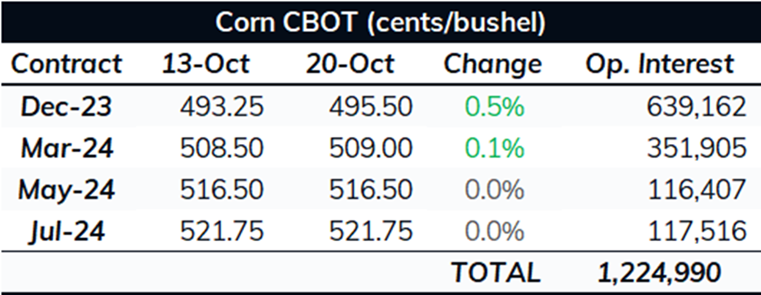
Last week, especially the last two days was marked by high volatility in the corn market. However, once again, corn futures ended the period nearly unchanged. December/23 ended the week quoted at 495.5 cents/bu, an increase of 0.5% compared to the previous week.
US crop progress: As expected by the market due to the advanced stage of the American corn crop, the USDA showed that 53% of the crops remained in good/excellent condition in the week ending October 15. This was the fourth week in a row that conditions remained stable. On the crop rhythm side, the harvest continues to progress smoothly, reaching 45%, an 11 percentage point increase compared to the previous week. The national rhythm is 2 points above last year and 3 points above the 5-year average. Click here to access the full report.
Corn ethanol production: The profit margins of ethanol plants in the US remain attractive enough to keep the sector crushing more than a year ago, as seen in the Energy Information Administration (EIA) data. The American ethanol production totaled 1,035 thousand barrels per day (tbpd) in the week ending on October 13, 31 tbpd more than a week before, 19 tbpd more than in the same week of the previous year, and 29 tbpd above the 5-year average for the same period. On the stocks side, there was a reduction to 21.11 million barrels, 414,000 less than a week earlier and 513,000 less than the 5-year average for the same period.
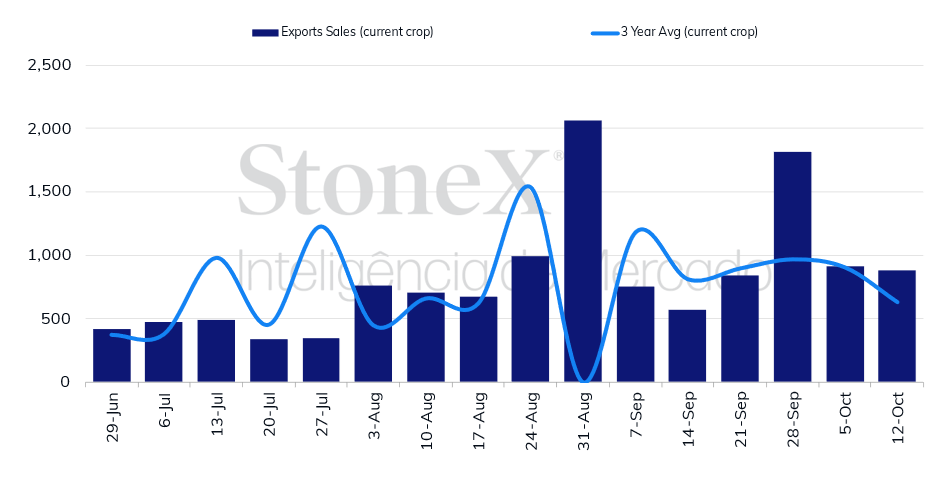
Weekly export sales - US (thousand tonnes)
US export inspections: As disclosed in the USDA's Weekly Export Inspection Report, the US shipped 434.5 thousand tonnes of corn in the week ending on October 12, a volume lower than what has been observed in recent weeks and close to last year's record. The exports for the week were 46% lower than the previous week and 37.7% lower than the average of the last five weeks. The shipped volume was 5.5% lower than the same week last year. Despite the drop, the pace is still ahead of last year, by 634 thousand tonnes, but below the necessary to reach USDA's estimated 51.4 million tonnes. It is still too early to say anything about the shipments, but the market will closely monitor them.
US export sales: The US export sales data did not come as a big surprise in the market. Net sales for the 2023/24 crop totaled 881,000 tonnes in the week ended Oct. 12, about 30,000 tonnes less than a week earlier and in the central region of the market's expectations range, which ranged from 500,000 to 1.1 million tonnes. In total, the country traded 16.2 million tonnes in 2023/24 versus 13.8 million in the same period of the previous season.
Chinese imports: The Chinese Customs Department reported that the country imported 1.65 million tonnes of corn in September, a volume 37.4% higher than that recorded in August and 7.3% above what was observed in September 2022. Despite the improvement in the pace of imports, the deficit compared to last year persists. In the first nine months of this year, China imported 16.6 million tonnes of corn, compared to 18.5 million tonnes in 2022.
Mississippi River Level: Just like in previous weeks, the river conditions in the US continue to be closely monitored. According to NOAA data, the levels in Memphis were at -3.0 meters this Monday morning (23), above the recorded one week before (-3.6m). However, NOAA expects a new drop in the reading, estimated at around -3.3 meters, in early November. Accordingly, the market must remain attentive to the navigation conditions on the Mississippi River, as they can affect the pace of corn shipments from the US.
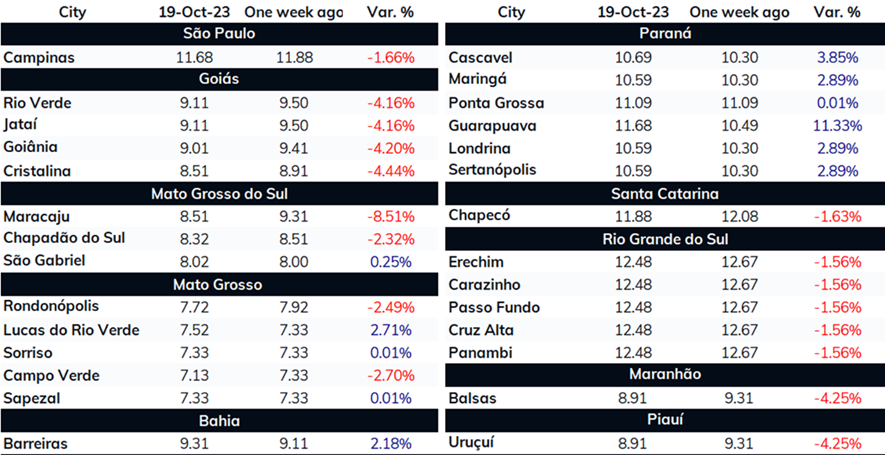
Logistics in Brazil: In recent weeks, there has been much discussion about American logistics, but recently, another country that has started to face difficulties in the flow of cereal is Brazil. Tributaries of the Amazon River have reached their lowest levels in a century, and there have already been reports of problems in transporting the cereal to ports in the northern region. Amid this scenario, cargoes have already been diverted to the ports of the South and Southeast, especially Santos. This issue has already supported domestic prices in Brazil and will be closely monitored by the market.