- Lagging pace of shipments in the US;
- US harvest progress;
- More positive USDA estimates for US production and global stocks.
- Tensions between Russia and Ukraine;
- Logistical problems at ports in Northern Brazil;
- Concern about weather conditions in South America.
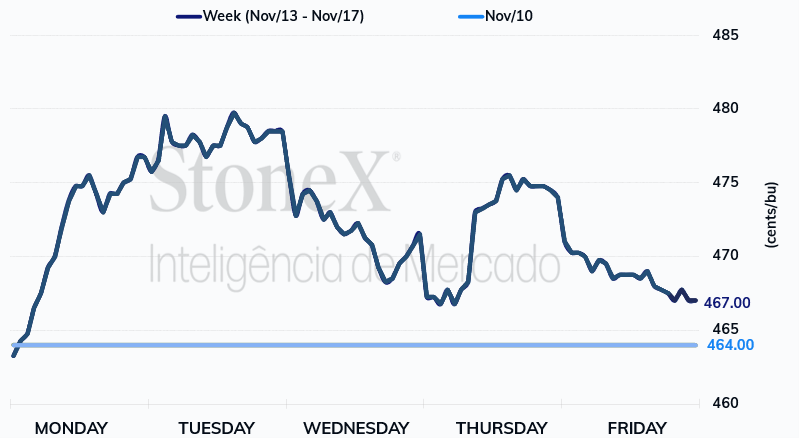
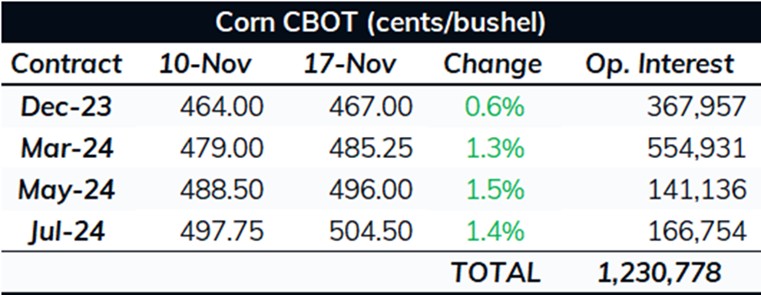
The corn futures started last week with a sharp upward movement, with the December/23 contract approaching 480 cents/bu. Part of this movement was motivated by the soybean market, which received support at the beginning of the week due to concerns about a possible shortage of soybeans in Argentina for crushing and adverse weather conditions on the continent, which has also been an important driver of the corn market. Nonetheless, the contracts returned a good portion of their gains throughout the week but ended the period in positive territory. In the analyzed period, it is worth highlighting the above-expected volume of corn exports from the US and the high use of corn for ethanol production in the country. The December/23 contract ended last Friday (17) at 467 cents/bu, accumulating an appreciation of 0.6% during the week.
US crop progress: As disclosed in the USDA's Weekly Crop Progress Report, corn harvest in the US reached 88% on November 12, a seven percentage point (p.p.) increase compared to the previous week. Thus, the pace of the current crop is two p.p. above the 5-year average for the same period. The weather models do not show large volumes of rain for the next 14 days in the corn belt, which should ensure that the final stages of field activities occur without major obstacles. Click here to access the full report.
Corn ethanol production: According to data released by the Energy Information Administration (EIA), US ethanol production totaled 1,047 thousand barrels per day (tbpd) in the week ending Nov. 10, up five tbpd from a week earlier and 18 tbpd above the 5-year average for the same period. On the other hand, the stocks fell by 35 thousand barrels to 20.95 million.
US export inspections: The Weekly US Export Inspection Report did not bring much optimism to the grain market at CBOT. Despite an advance in the weekly comparison, going from 574.6 TMT in the week ended on November 2 to 608.8 TMT in the week ended on November 9 - and about 70 tmt above the registered in the equivalent week of 2022 -, the pace of shipments still falls short of the USDA's projection. In the accumulated, 6.16 million tonnes were shipped in the 2023/24 season, compared to 5 million in the same period of 2022/23.
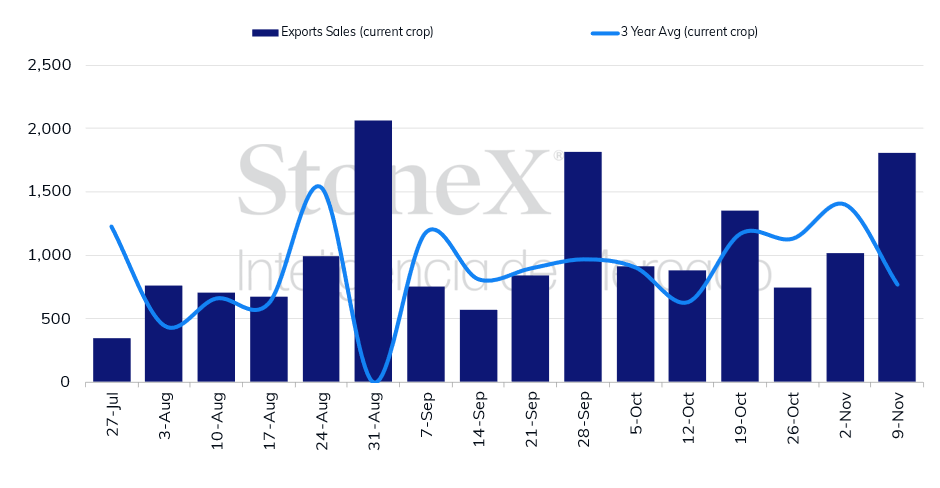
US export sales: On the export sales side, USDA data brought some optimism to the trade, contributing to the highs observed last Thursday (Nov. 16). About 1.8 million tonnes were traded in the week ended on November 9, 792 thousand more than the previous week and 639 thousand more than the same period last year. The volume was also above the upper limit of the market estimate range, which ranged from 900 thousand to 1.6 million tonnes. The country traded 21.1 million tonnes in 2023/24, 5.2 million tonnes above the same period of the previous season.
Weekly export sales - US (tmt)
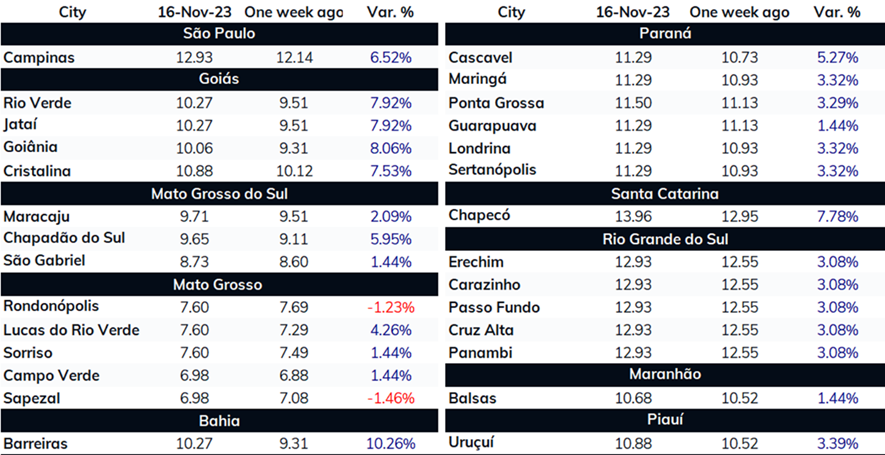
South American crop progress: In the last few weeks, there has been much discussion about the conditions of the South American grains crop, and this issue is expected to remain at the center of attention for a long period. The excessively moisture weather in Southern Brazil and the quite hot and dry pattern witnessed in a large part of the other producing areas of soybean and second corn crop have been generating a lot of concern about the supply in the country. The situation in Argentina is also concerning, as the country has experienced below-average rainfall in the last few weeks.
According to data from BCBA, despite relatively drier weather in the last week, there was a hike in crops in good/excellent conditions of 5 points in the weekly comparison, reaching 29% on November 16. The forecast for next week does not indicate a large volume of rain; nonetheless, in the second half of the next two-week period, we should observe a significant improvement in moisture in Argentina's producing region.
In Brazil, the first corn crop planting continues to be behind schedule, reaching 59% at the end of last week, compared to 71.1% in the same period last year. In addition to the pace of summer corn planting, the trade also pays attention to soybeans, as their delay could harm the second crop corn planting. The soybean planting reached 65.9%, compared to 79.2% in the same period last year. The weather models indicate that some parts of the grain-producing regions of Brazil are expected to receive good rainfall over the next week, but some important areas will be left out. It will be essential to monitor whether the forecasts for the next few days will materialize to have a slightly better direction on the crop in the region.