- Slow pace of shipments in the US;
- More positive USDA estimates for US production and global stocks;
- Good rainfall volume recently recorded in Brazil and Argentina's main grain-producing regions.
- Tensions between Russia and Ukraine;
- Logistical problems at ports in Northern Brazil;
- Despite registering a more favorable weather pattern, concern about weather conditions in South America persists.
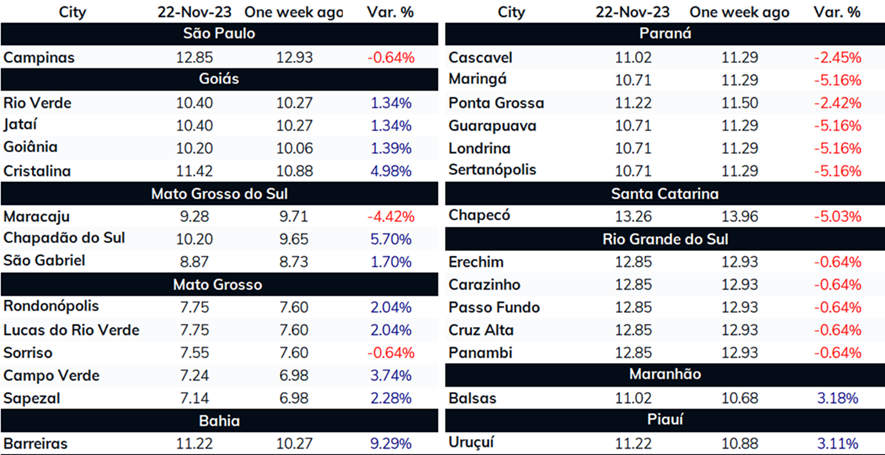
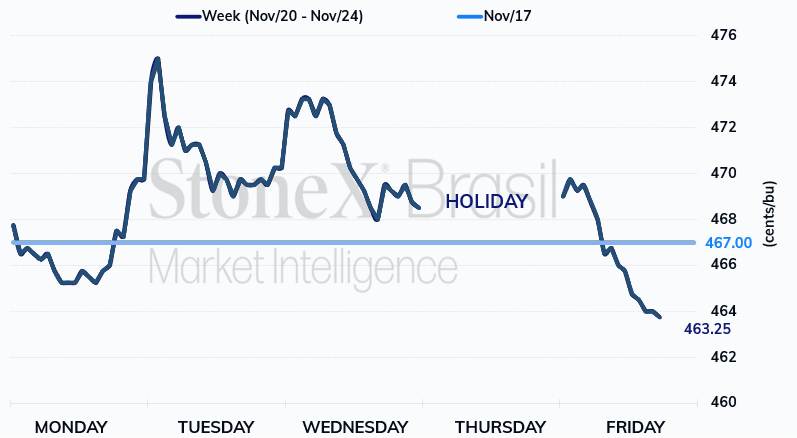
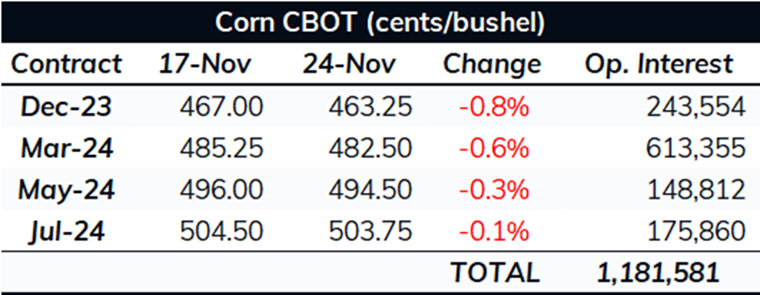
The last week in Chicago was marked by a high agitation in the future corn trade. The December 2023 contract started the period on a high note, reaching the level of 475 cents/bu, largely driven by concerns related to the weather in South America. Nonetheless, starting from Wednesday, corn started to show a downward trajectory, also influenced by the weather in the region. A change in perspectives on the climate pattern in Brazil and Argentina resulted in a sales movement on the CBOT, which remained even after Thanksgiving. December/23 ended last Friday (November 24), quoted at 463.25 cents/bu, showing a drop of 0.8% in the weekly comparison.
Corn ethanol production in the US: According to data released by the Energy Information Administration (EIA), US ethanol production totaled 1,023 thousand barrels per day (tbpd) in the week ending November 17, down 24 tbpd from a week earlier and 8.4 tbpd below the 5-year average for the same period. The stocks increased by 698 thousand barrels to 21.65 million. The lower production and higher stocks may indicate some short-term drop in demand. Nonetheless, despite the recent decline in cereal processing, the trade has speculated a possible hike in USDA's estimate for corn use for ethanol production in 2023/24, currently at 135.3 million tonnes.
US export inspections: The USDA Export Inspections Report indicated that 533.9 TMT of corn were shipped by the US in the week ending November 16, a fall of 173.5 TMT (-24.5%) on a weekly comparison. The observed volume was slightly above the one recorded in the same week of last year (499.1 tmt). The accumulated shipments totaled 6.8 million tonnes, 1.3 million more than the number recorded in the same period of the previous season. Nonetheless, USDA estimates that exports in 2023/24 will be 10.5 million tonnes higher than in 2022/23, which raises the question of whether the US will reach the Department's projection with the current pace observed. It is still too early to say anything, but it is a matter that the trade will continue to monitor.
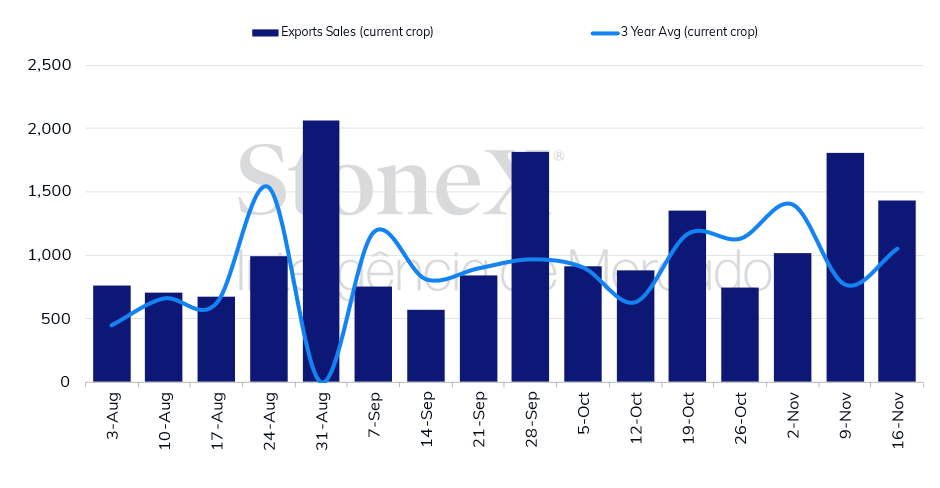
US export sales: On the export sales side, USDA reported that 1.4 million tonnes of corn were traded in the week ended November 16, a fall of 375.1 thousand tonnes compared to the previous week and a decrease of 417.9 thousand tonnes versus the same week in 2022. The volume stayed within the range of market estimates, which ranged from 700 thousand to 1.6 million tonnes. The country traded 22.5 million tonnes in 2023/24, 4.8 million tonnes above the amount recorded in the previous season. As commented, the USDA estimates that exports in 2023/24 will be 10.5 million tonnes higher than in 2022/23, creating concerns about how much the US will ship by the season's end.
Weekly export sales - US (tmt)
Chinese imports: The Chinese government reported that the country imported 2.04 million tonnes of corn in October, a volume about four times larger than that recorded in October 2022. Of the total recorded last month, 1.8 million tonnes, or 88%, originated from Brazil, followed by the USA (140 thousand tonnes, or 7%). In the accumulated of this year, the imported volume reached 18.6 million tonnes, against 19 million in the same period of 2022.
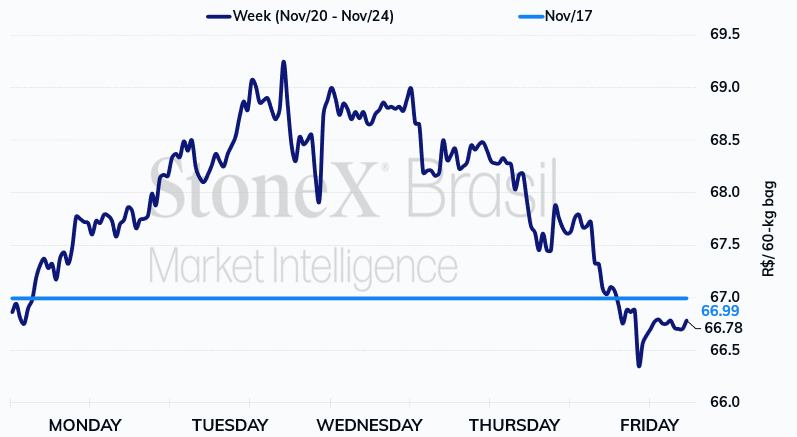
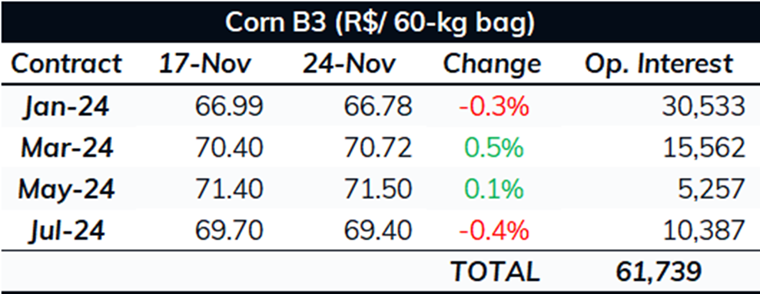
On the B3, corn quotes also had a week marked by significant variations. The January 2024 contract started the period on the rise, trading around BRL 69/bag, but also started to decline in the second half of the week, ending last Friday priced at BRL 68.9, a slight drop of 0.3% in the weekly comparison. The weather, especially in Brazil, can also be attributed to being responsible for a large part of the direction of contracts. In the first half of the week, when more negative prospects related to weather conditions in the region prevailed, prices ramped up. Still, with the record of good rainfall in the second half and forecasts pointing to good volumes last weekend, which were largely realized, prices fell again.
Crop conditions in Brazil: At the beginning of last week, a major concern related to the weather in Brazil set the tone for the trade in both the US and Brazil. The excess moisture in the Southern region raised concerns about the development of the summer corn crop. In contrast, the water deficit in the northern portion of Brazil's soybean-producing region, which coincides with the majority of the winter corn crop area, resulted in less favorable prospects for the pace of development of the oilseed crop, which could also affect the second crop planting window and make its production riskier. Nonetheless, in the second half of the week, heavy rains were observed in most areas affected by the drought, while a smaller amount of rain was recorded in the South of the country, bringing some reprieve to the trade. According to the crop progress report from Brazil conducted by StoneX, planting the first corn crop continues to be behind schedule, reaching 65.6% at the end of last week, compared to 77.4% in the same period last year. In addition to the pace of summer corn planting, the trade also pays attention to soybeans. The planting of the oilseed reached 74%, compared to 85.4% in the same period last year. In recent days, good rains have been observed in Center-West Brazil. The expectation is that in this last week of November and in the first week of December, more abundant rains will occur in the region, which can contribute to the development of soybean crops and, as a result, positively impact second crop planting. In any manner, it will be essential to continue monitoring the weather conditions and the development of crops in the region.
Crop conditions in Argentina: The grain-producing regions of Argentina have also recently shown better moisture conditions. According to data from BCBA, crops were maintained in good/excellent conditions in the weekly comparison, reaching 29% on November 23, and a decrease in crops in poor/very poor condition by 2 points, to 4%. Approximately 26.2% (or 1.86 million hectares) of the 7.1 million hectares estimated have been planted. The forecast for the next two-week period indicates a good volume of rain in the country's agricultural area, which could result in a more favorable outlook for the region.