- Low international demand for American corn;
- Good expectations for Argentine production;
- USDA figures above expectations for Brazilian production and global stocks.
- Despite registering a more favorable weather pattern, concern about the crop in Brazil, especially the 2nd corn crop, persists;
- Adverse weather has affected Argentina recently.
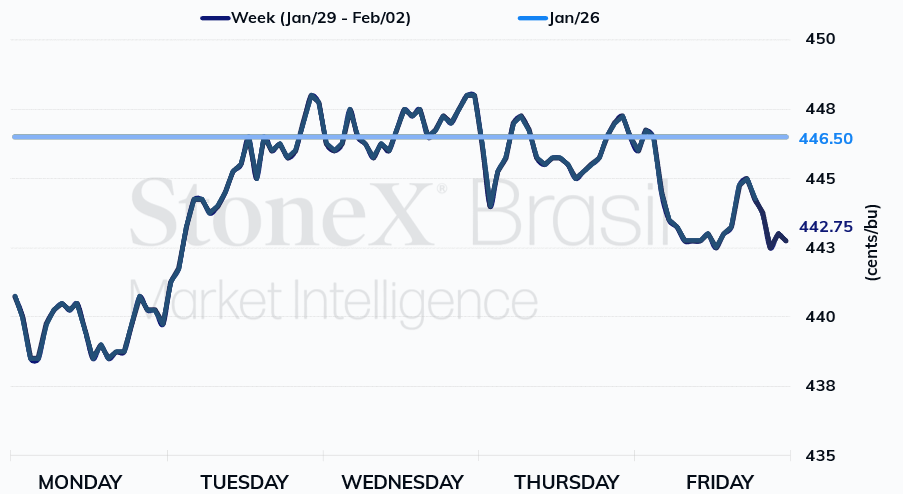
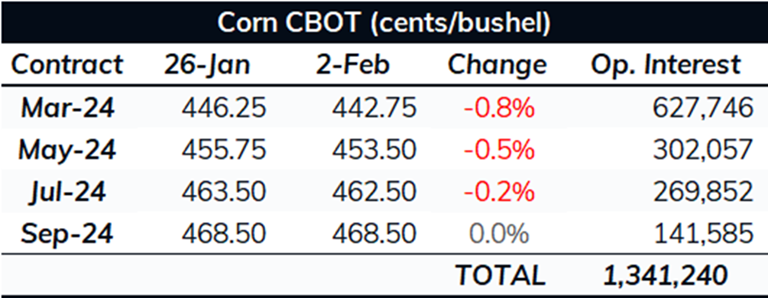
Corn futures closed lower last week on the CBOT, with March/24 ending last Friday (2) at 442.75 cents/bu, a 0.8% decline compared to the previous week. Even with the recent adverse weather in Argentina, prospects for production in the country remain optimistic.
Corn-based ethanol production in the US: As expected, the Energy Information Administration (EIA) report showed a rebound in US ethanol production. Recently, an extreme cold wave negatively impacted the ethanol plants in the US Midwest, and with the weather no longer hindering the transportation of biofuel and the operation of the plants, ethanol production has increased again. In the week ending January 26, 991 thousand barrels per day (mbpd) were produced, compared to 818 mbpd the previous week. The stocks fell by 1.5 million barrels to 24.3 million.
US export inspections: The US export inspection report indicated a hike in shipments compared to the same week last year and the previous week. The US shipped 901.96 tmt in the week ended January 25, 155,000 more than a week earlier and 357.5 thousand more than in the same period of 2023. Thus, total loadings in the US 23/24 crop reached 15.64 million tonnes, 3.58 million more than the registered in the same period of 22/23.
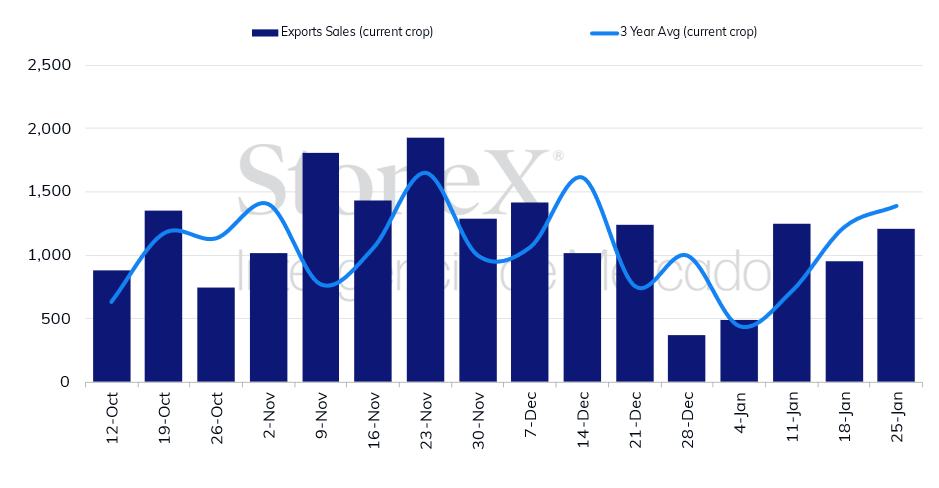
US export sales: According to data from the USDA export sales report, the United States recorded 1.21 million tonnes of net sales in the week ended on the last day of the 25, compared to 954.8 thousand tonnes in the previous week, but below the 1.6 million tonnes sold in the equivalent week of 2023. The figure is close to the upper limit of the market range estimates, which ranged from 800 thousand to 1.3 million tonnes. In the accumulated, the sales of the 23/24 crop totaled 33.7 million tonnes, against 25.6 million in the same period of 22/23.
Weekly export sales - US (thousand tonnes)
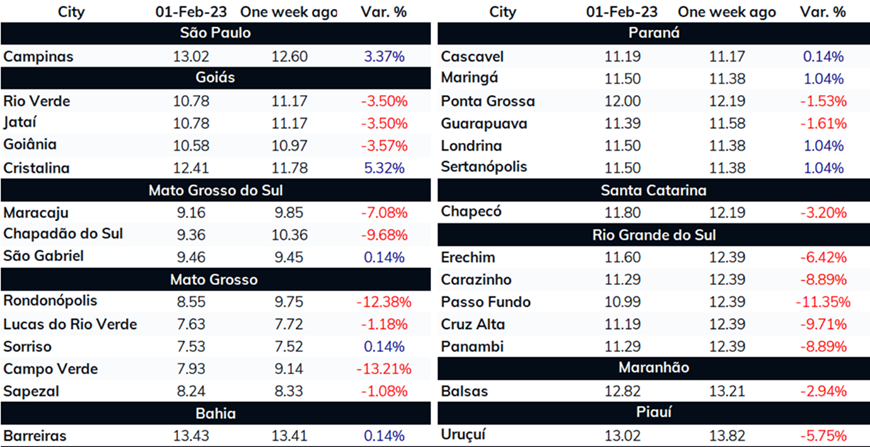
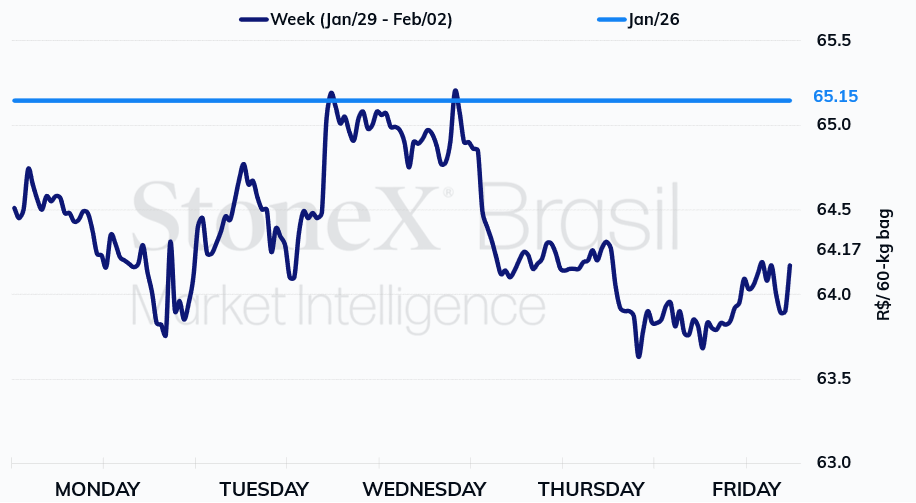
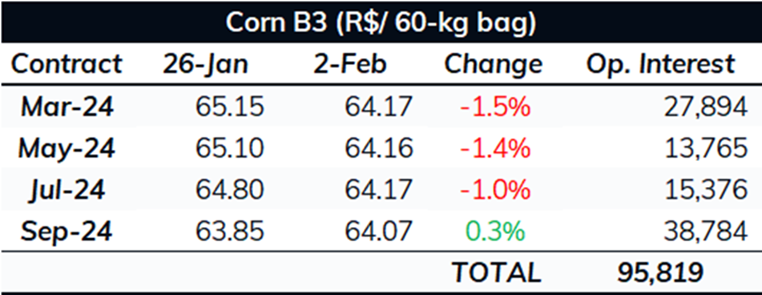
Just like in Chicago, corn futures also declined in Brazil last week. March 24 ended last Friday at BRL 64.17/bag, a depreciation of 1.5% for the week.
StoneX Estimate - Brazil: On February 1, StoneX released its estimates for Brazilian grain crops. Regarding the first corn crop in 2023/24, the production was slightly revised upwards. The summer crop is now estimated at 25.9 million tonnes, 0.4% higher than the figure released in early January. This hike was mainly driven by more favorable expectations for the MATOPIPA states. A more favorable climate for cereal crops in the North/Northeast region could be observed throughout the past few weeks, resulting in a hike in expected productivity.
Regarding the second crop 2023/24, StoneX made a marginal cut in its production estimate to 96.4 million tonnes, a contraction of 0.1% compared to the report released in January. Although the safrinha crop is still subject to some area changes, the focus will be especially on productivity, which will depend on the weather in the coming months and is still quite uncertain.
Amid slightly higher production in the first crop and a marginal reduction in the second, total production in 2023/24 was estimated at 124.5 million tonnes, virtually unchanged compared to the last report. Click here to access the full report.
Argentina: According to a report from the Buenos Aires Grain Exchange (BCBA), corn planting in the country has reached 98.4% of the expected area. Nonetheless, the low volume of rainfall and intense heat have greatly affected the water condition, with crops classified as optimal/adequate decreasing by 15.4 percentage points per week compared to 71.6%. Despite this, the current condition is 16 percentage points higher than a year ago. The worsening condition has brought some concern to the market, but the prospects are still favorable. The weather models indicate a wetter pattern in the next two weeks, which, if realized, can contribute to the consolidation of productive potential.