- USDA projects hike in US ending stocks for 24/25;
- Despite recent adverse weather, prospects for Argentine production remain positive;
- WASDE reports a slight increase in US ending stocks for 23/24.
- CONAB and USDA reduce production estimates for Brazil's 23/24 crop;
- USDA reduces estimate for global production and ending stocks in 23/24;
- USDA projects a reduction in corn acreage in the US in 24/25.
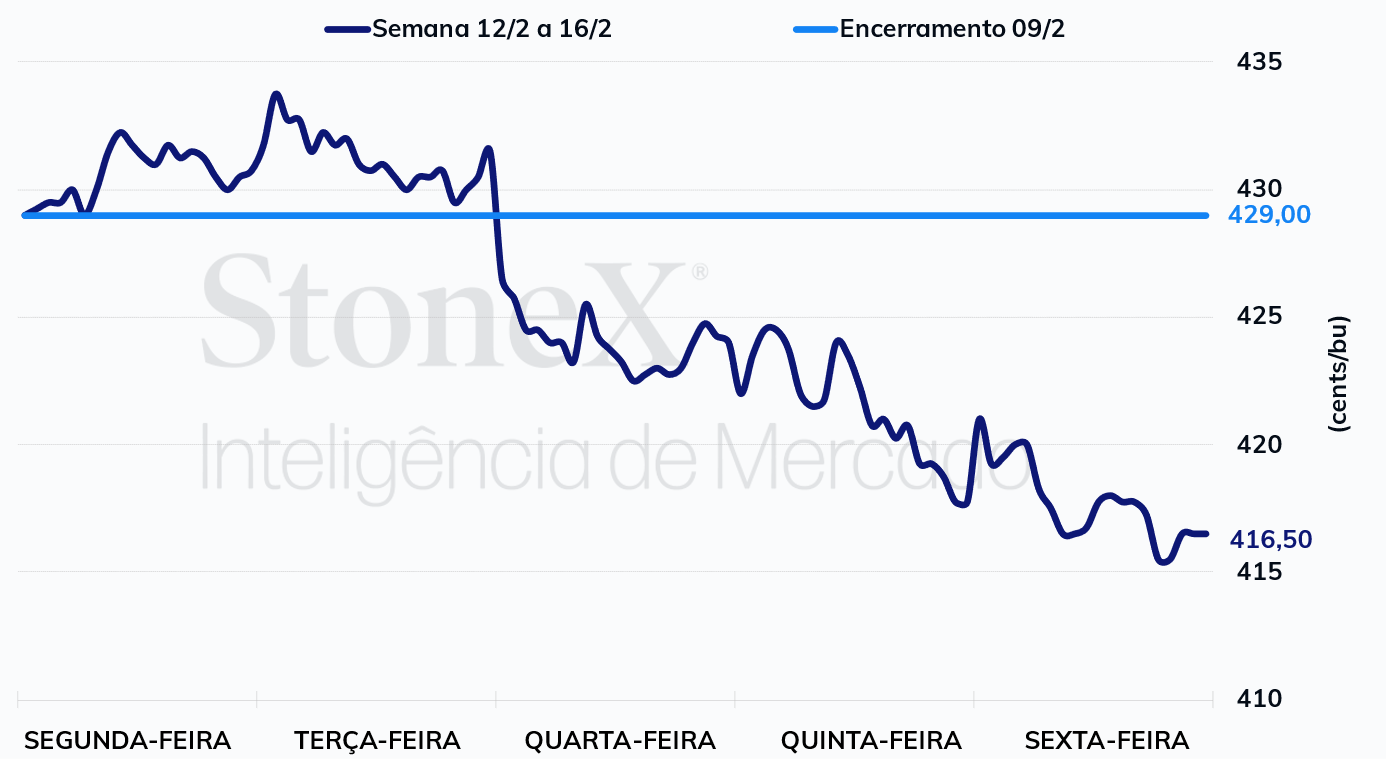
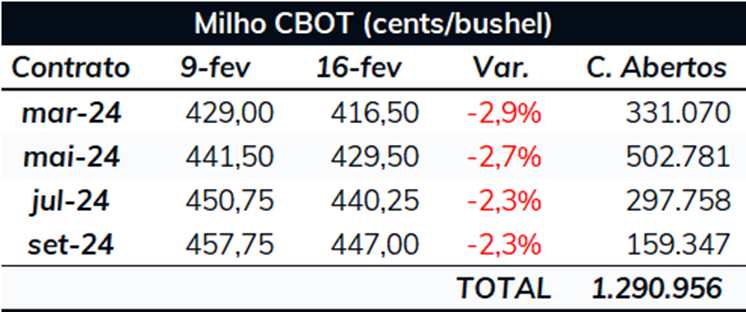
Corn futures ended another week in negative territory in Chicago's field. The March 2024 contract ended last Friday (16), quoted at 416.5 cents/bu, a 2.9% decrease compared to the previous week and its lowest closing since it began trading. The week's main event was the Agricultural Forum, which brought more comfortable ending stocks for the country despite the USDA indicating a smaller acreage for the US corn in 24/25.
US export inspections: The US Export Inspection Report, released on Monday (12), indicated that American shipments totaled 880 tmt in the week ending on February 8, about 235 tonnes above what was shipped a week before and 317 above what was recorded in the same week of 2023. In total, the exports of the 23/24 season reached 17.2 million tonnes, 4.1 million more than in the same period of 22/23.
Corn ethanol production in the US: According to data released by the Energy Information Administration (EIA), US ethanol production has recovered from the issues caused by the extreme cold wave in the US Midwest. In the week ending on February 9, 1.083 million barrels per day (mbpd) were produced, 50 mbpd above the previous week and the level observed in the weeks before the weather adversity. The sharp increase in production was not accompanied by demand, resulting in a stock growth from 1.03 million barrels weekly to 25.81 million.
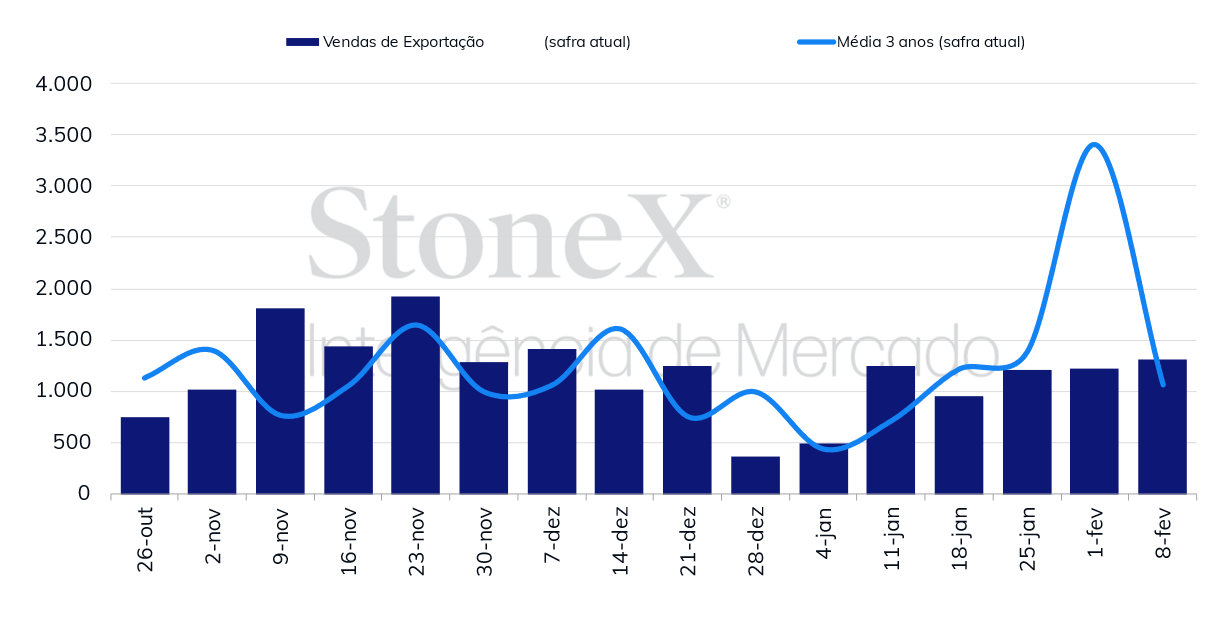
US export sales: According to the USDA Export Sales Report, the US showed 1.3 MMT of net sales in the week ending on February 8, 87.6 TMT more than a week before and 282.4, above what was documented a year before. The volume stayed within the market estimates, which ranged from 800,000 to 1.5 million tonnes. The accumulated sales of the 23/24 season reached 36.2 million tonnes, compared to 27.8 million in the same period of 22/23, a difference of 8.4 million tonnes.
US weekly export sales (thousand tonnes)
USDA Agricultural Outlook Forum: On February 15 and 16, the USDA Agricultural Outlook Forum took place, where the Department presented its supply and demand estimates for the US 24/25 crop. In general, the figures released stayed within the market's expectations. The acreage was close to the lower end of market estimates, which ranged from 36.5 to 37.6 million hectares, at 36.8 million hectares. Even with an area 1.5 million hectares below 23/24, the yield of 11.36 tonnes/ha expected for 24/25 would produce 382 million tonnes.
If this production materializes, it would be below the record of 389.7 million reached last year, but it would still be a robust production. On the demand side, the Department projects modest growth annually, with exports advancing 1.3 million tonnes to 54.6 million and domestic consumption increasing by 2.6 million to 319 million. Thus, USDA expects a new advance in carryout to 64.3 million tonnes, 9.1 million more than in 23/24.
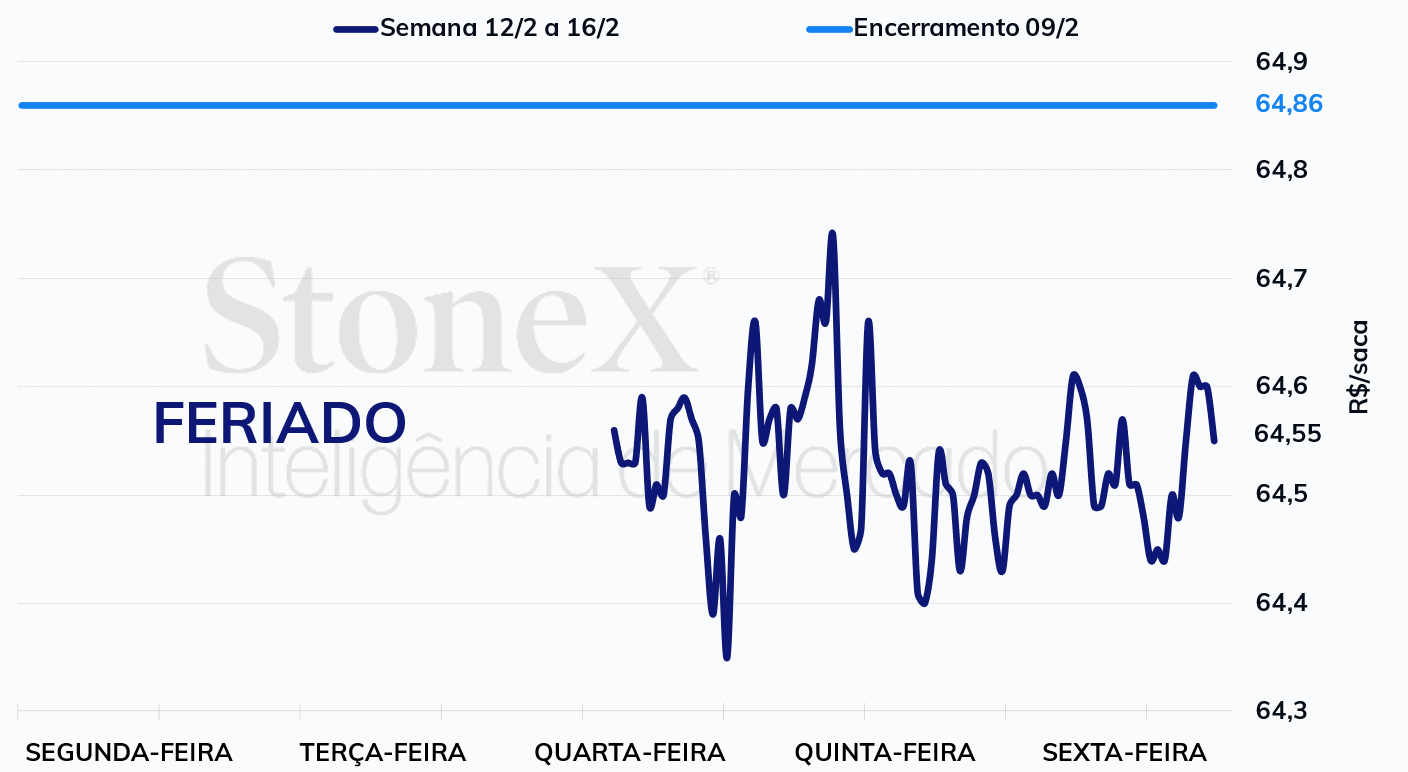
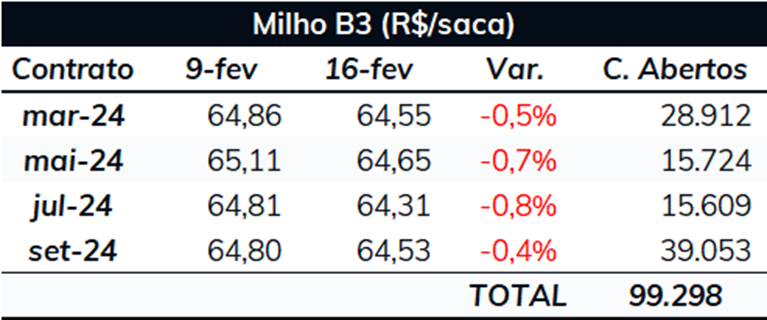
In a shorter week due to Carnival, corn futures fell again on the B3. The March 2024 contract ended last Friday (16) at BRL 64.55/bag, a 0.5% weekly depreciation. Even with concerns about the Brazilian crop, supply in South America is expected to be robust, which has constrained the quotes.
Crop progress 23/24: At the end of last week, StoneX released its weekly Brazil Crop Progress Report, indicating that both the 1st and 2nd crops are progressing faster than last year. According to the report, 26.5% of the summer crop had been harvested, compared to 16.8% in the same period last year. For safrinha, 49.4% of the crops had been planted by the end of last week, 12.3 percentage points above the same period last year. As mentioned in the last report, the faster planting pace brings some reprieve to the productive potential of the next crop. However, there is still a long way to go, and favorable weather conditions are essential for achieving a robust crop in the coming months.
Argentinian crop: In Argentina, recent weather adversities continue to create concerns about the country's crop. According to data from the Buenos Aires Grain Exchange (BCBA), the percentage of crops in good/excellent condition decreased from 46% in mid-January to 27% last week. In comparison, areas classified as poor/very poor ramped up from 3% to 17% in the same period. Weather models indicate that rain is only expected to return more significantly next week, which could result in further declines in crop conditions. Despite this, the agents still show confidence regarding the supply of our neighbors.