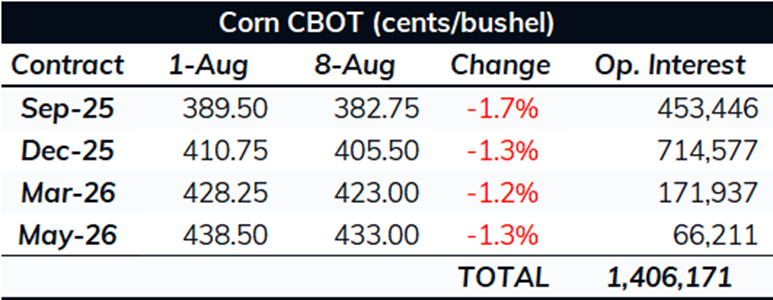
Weekly overview | Corn futures observed another week of decline. Last week, the December/25 contract traded in Chicago saw a drop of 1.3% to close at US¢405.50/bu, after testing resistance below the US¢400/bu level. At this point, the U.S. market sees little grounds for upside. The high levels of corn exports by the United States have little effect on the bearish dynamics that have been dominating trading in Chicago for several months now. The truth is that any reaction on the demand side will do little against the high production level expected for the U.S. crop.
This week, the commodities market has reacted to statements by president Donald Trump that China could quadruple its purchases of soybean from the US. The fact is not based on any bilateral agreement and, in fact, seems implausible at the moment. In any case, the fact that Trump has taken the American agricultural sector into account in trade negotiations with China is already an important gesture, contributing to the bullish tone of the statement.
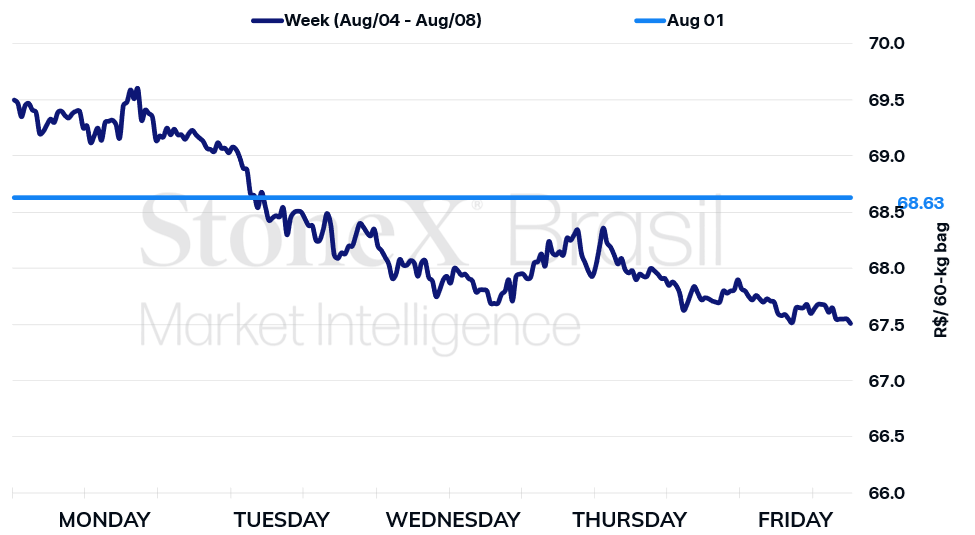
Intraday (15 min) Dec/25 contract - CBOT
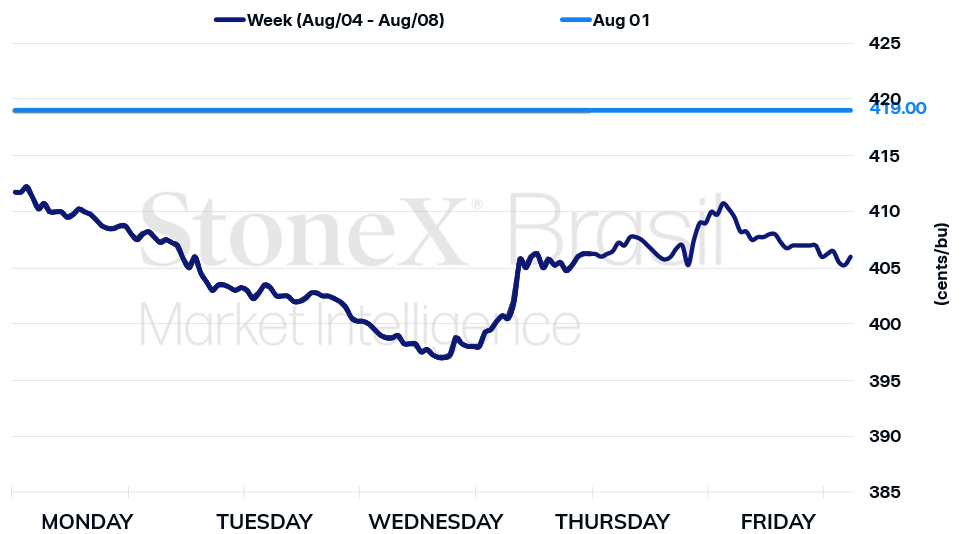
Source: CBOT. Design: StoneX.
Exports | With three weeks left until the end of the corn crop year, U.S. corn exports are already almost in line with the current estimate by the USDA. In this way, the expectations are that the department will revise, in its monthly report to be published tomorrow, the country's shipment estimates upward. The export market was the highlight of this crop year, which saw the largest volume shipped by the USA in history.
In addition to the robust North American crop, both last year and this year, factors such as more expensive corn from other sources, like Brazil and Ukraine, have made North American corn practically the unanimous choice among importers, such as Japan, South Korea, Spain, and especially Mexico, which has imported record volumes in recent months.
From now on, the doubts weigh on whether Brazil can become competitive again after the progress of the safrinha corn harvest. The safrinha we see this year is robust and should sustain shipment levels above what was seen last year. Still, domestic prices have remained relatively high, a factor not helped by the Brazilian real, which has shown an appreciation dynamic versus the dollar since the beginning of the year, creating some uncertainty regarding the attractiveness of Brazilian corn in major destinations.
US Crop | 73% of corn fields in the United States are rated in good/excellent condition. At this stage, the robust crop already leaves the realm of prospects and becomes an increasingly concrete reality. Most of the crops have already pollinated and are now entering the dough stage of the cornfields.
In the coming weeks, the market will follow a series of field surveys that will collect productivity data in the main producing regions, which will provide clearer perspectives on productivity. Last week, we saw the results of the first crop estimate from the American division of StoneX, which indicated a yield of 11.81 tonnes/ha, which would constitute a record crop of 414.62 mmt for the United States.
Some estimates indicate that the USDA may already revise American productivity in its estimate tomorrow. In any case, it is practically unanimous that the current estimate (the one from the July report) is below what will actually be realized after the harvest.