
Corn ends the week higher, boosted by soybean gains following indications of a US-China agreement
- Bullish
- Global consumption remains strong;
- USDA projects lower global stock levels for the 2025/26 harvest;
- Strengthened US exports;
- Improved US-China relations.
- Bearish
- Expanded planting area for 2025/26 in Brazil;
- Potential record harvest in the US;
- Higher stock levels in the US.
CBOT
Chicago corn futures closed last week on a positive note, with the December/25 contract ending Friday at US¢431.50/bu (+1.9%). The Chicago corn market was lifted by other commodities, particularly soybeans, which benefitted significantly from trade discussions between the US and China following Donald Trump’s meeting with Xi Jinping last Thursday in South Korea. According to statements from US Treasury Secretary Scott Bessant, China has pledged to purchase 12 million tonnes of US soybeans this crop year and an additional 25 million annually over the next three years. This development has energized the US grain market, as it would lead to a less relaxed balance compared to previous expectations, given China’s complete absence from the US market.
Intraday (15 min) Dec/25 contract - CBOT
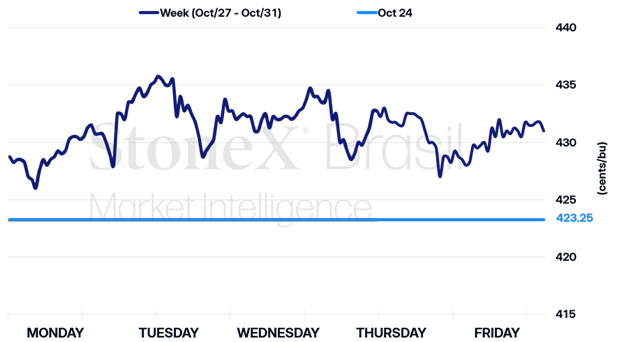
Source: CBOT. Design: StoneX.
With the harvest nearing completion, the US market is increasingly weighing prospects for the 2026/27 crop year. It is clear that there has been a substantial increase in planted corn acreage this year, which could lead to a reduction next year. Moreover, the recent strength in soybean prices bolsters the idea of a decrease in corn acreage, potentially suggesting higher risks for the US balance next year. That said, spring in the Northern Hemisphere is still far off, so a lot remains uncertain before these assumptions materialize.
This week, the US market will focus on whether Democrats and Republicans can find a resolution to the government shutdown that has persisted for over a month. The shutdown has left the market operating in the dark for much of the past weeks, notably causing the absence of an October WASDE report. Regardless, the USDA has confirmed that the November WASDE report will be released on the 14th.
Brazil
Brazilian futures on the B3 exchange ended the week higher, following Chicago’s lead. The November/25 contract closed Friday trading at BRL 68.04/bag (+1.3%).
This morning, StoneX released its traditional Brazilian grain crop estimate. The November report provided the first outlook for next year’s second corn crop as well as an analysis of Brazil’s corn balance for the 2025/26 crop year. An estimated 230,000-hectare increase in planted area for the second crop is expected to support a harvest potential of 107 million tonnes. Consequently, Brazil’s total corn production next year is projected to reach approximately 135.2 million tonnes.
For the 2024/25 crop year balance, with a reduction in the export estimate and a revision of previous harvests, Brazil is expected to enter the 2025/26 crop year with an availability of 18.8 million tonnes, a significant figure.
Intraday (15 min) Nov/25 contract - B3
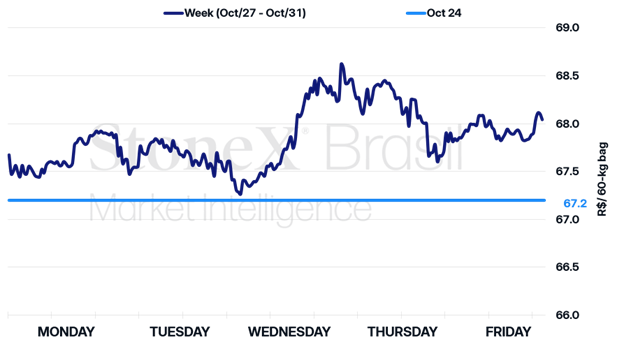
Source: B3. Design: StoneX.
Exchange rate
The USDBRL exchange rate ended the week relatively stable after trading lower for most of the period.
First, Lula’s meeting with Donald Trump last Sunday (26) appears to have been constructive in addressing the tariff dispute that has persisted for several months. This development supported Brazilian assets at the start of the week, despite limited clarity so far regarding a potential trade agreement that remains under discussion.
Additionally, the US monetary policy decision, which resulted in another 25 basis points cut to its interest rate, widened the rate differential between the countries—a positive development for emerging market currencies. However, subsequent remarks from Federal Reserve Chair Jerome Powell, suggesting the Federal Open Market Committee (FOMC) is divided on the likelihood of another rate cut in December, provided support for the dollar. The market had largely anticipated this cut, and the increased uncertainty surrounding the decision contributed to heightened risk aversion globally.
This week, the Brazilian Central Bank’s Monetary Policy Committee (COPOM) will meet, likely maintaining the interest rate at 15%. As a result, the market will closely monitor subsequent statements from monetary authorities regarding the direction of rates in the coming months. While inflation is slowing—though still above the target—it continues to pressure the committee to signal the start of a rate-cutting cycle in the near future.
-
Special | China
-
The corn market in China has been heavily impacted by adverse weather conditions during the harvest season in the Northern Plains, one of the country’s key production regions. Persistent rains have caused excessive moisture in the fields, delaying the harvest and compromising grain quality. Local consultancies estimate that 12 to 13 million tonnes of corn could be damaged due to this factor.
Nevertheless, drier weather in recent days has helped alleviate concerns about further losses. Additionally, improved harvesting conditions and the onset of a more stable weather pattern have contributed to reducing pressure on the crops.
Meanwhile, delayed winter wheat planting has driven up prices in the domestic Chinese market, reducing its appeal as animal feed and restoring corn’s position as the primary grain for livestock feed.
At the same time, pig slaughter in China increased during the third quarter. This trend reflects tightened margins for livestock producers in the country. Consequently, a reduction in the pig herd could help partially balance the grain market.
Looking ahead, China’s corn balance is expected to remain tighter but without immediate signs of shortages. A combination of a robust harvest in the Northeast, which should offset losses in the North, and slightly reduced demand due to a smaller pig herd, creates a relatively balanced outlook for the coming months. Regarding imports, the USDA projects the country will import 10 million tonnes this crop year. However, local consultancies suggest this figure could range between 3 and 6 million tonnes. With localized crop losses, this number may increase, though the USDA’s estimate appears optimistic given the current scenario.
-
Rainfall in Sandong, China 2025
30-day moving average compared to historical values (1961-1990)
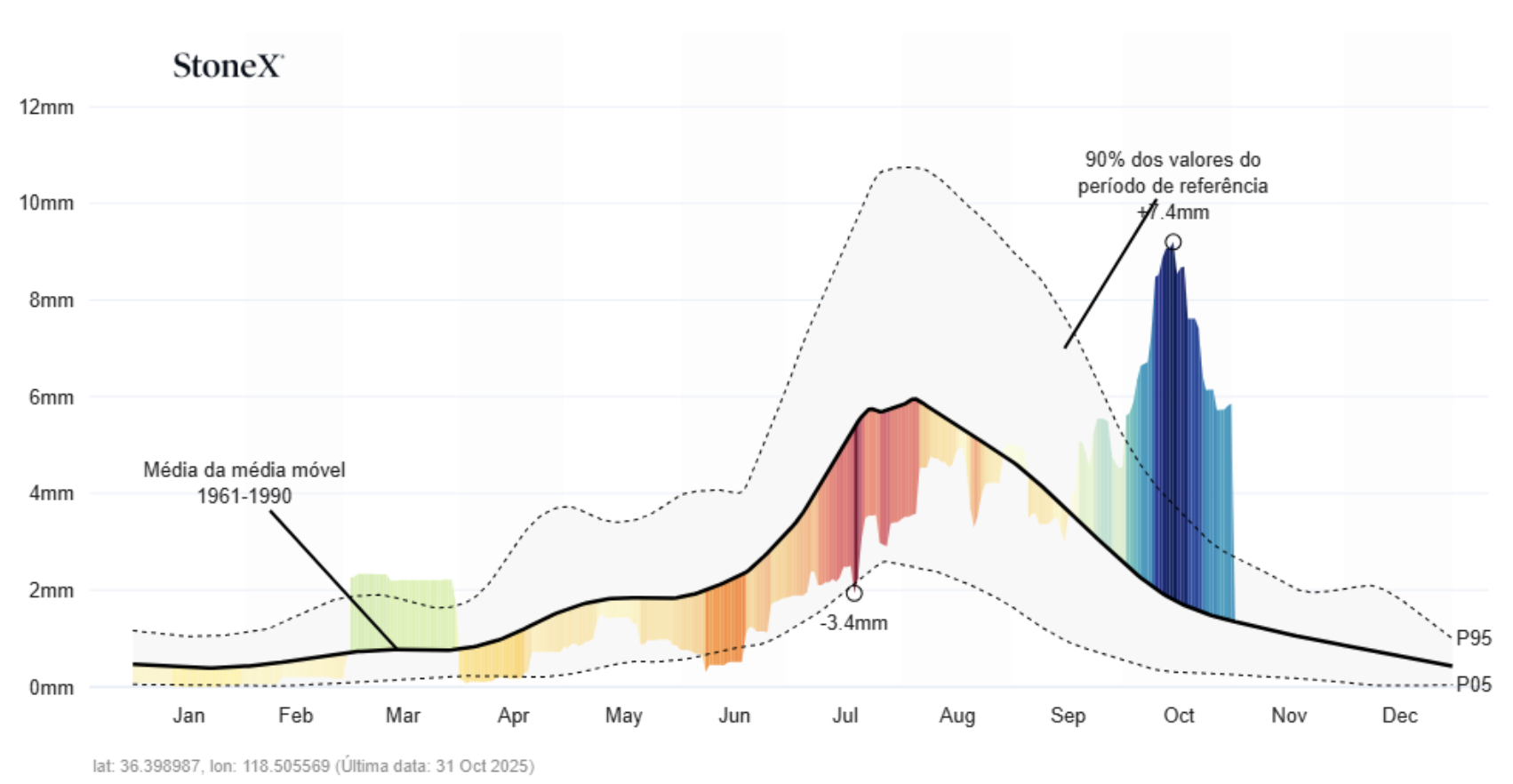
-
Source: StoneX.
Futures contracts traded on CBOT (US¢/bu)
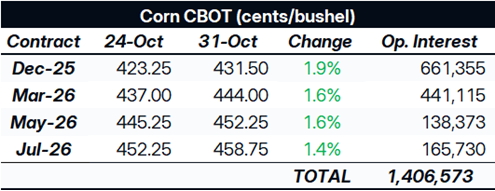
Source: CME. Design: StoneX.
Futures contracts traded on B3 (BRL/bag)
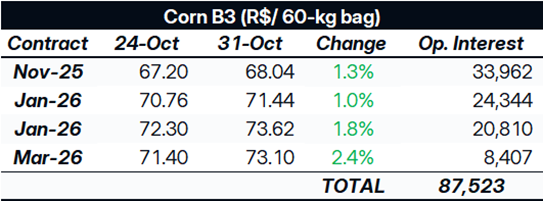

Source: B3. Design: StoneX.
Spot prices in Brazil (BRL/bag)
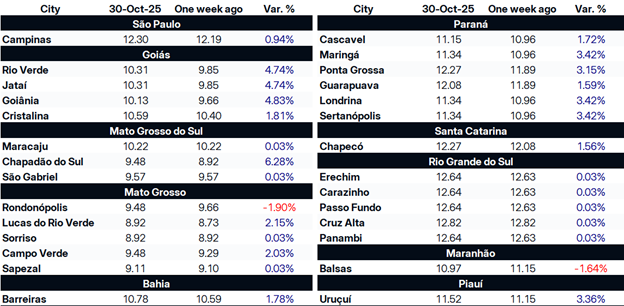
Source: StoneX.





