Mato Grosso
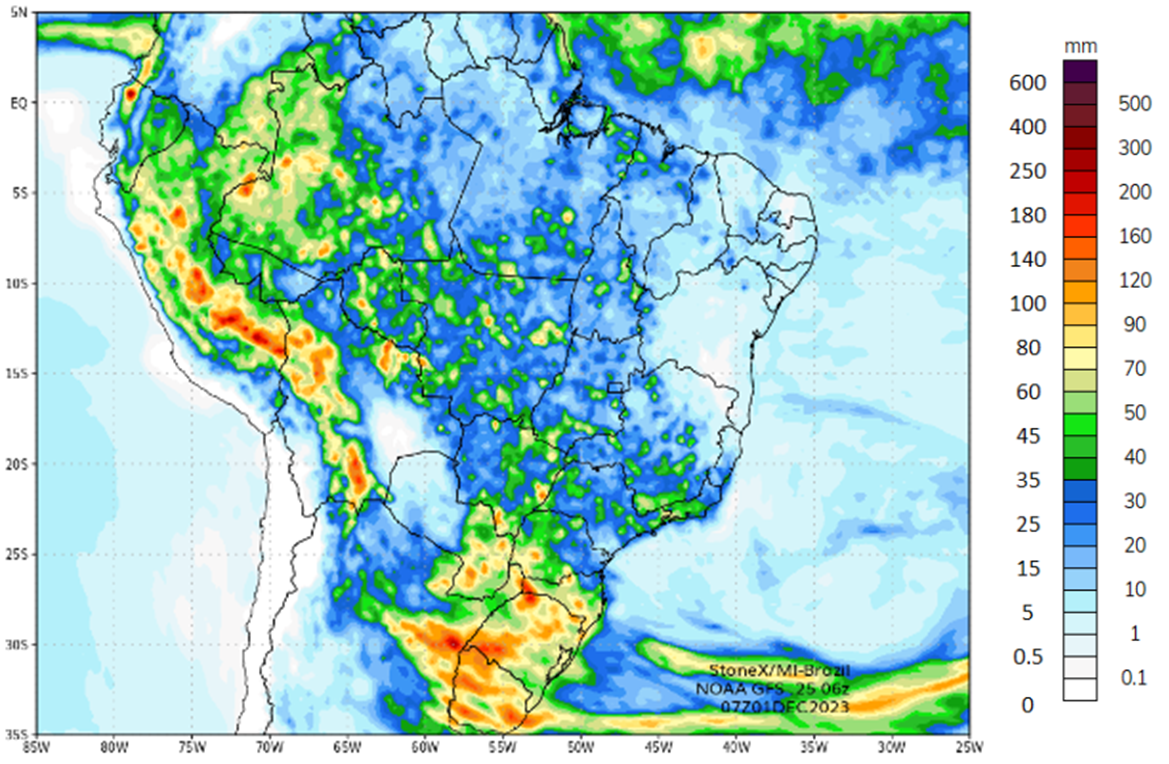
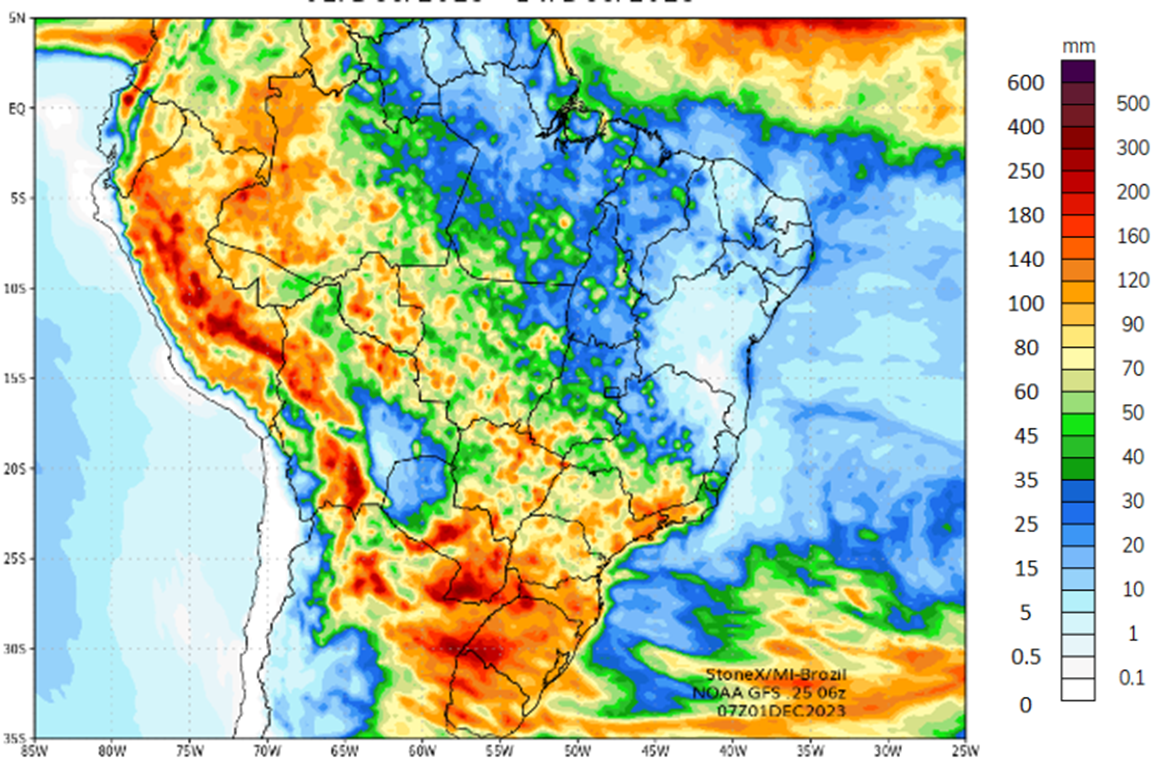
In Mato Grosso, what has been observed differently over the past two weeks is mainly related to the rains. In the last comment, the production situation was expected to improve, as there was an expectation of new rains in Mato Grosso after a long drought in all state regions. Indeed, as the maps showed, there was rain. Still, the state is marked by these irregularities and poor distribution, with different volumes observed even within the same property. The perspective is that it will continue to rain, and the situation will improve in the coming weeks. Still, the fact is that we have already estimated a reduction in production due to water stress and recent poor distribution. Finally, the reduction in the soybean production estimate, which was about 2.2 million tonnes lower than our November figure, in addition to considering the mentioned issues, also considers the replanting situation and the planting of cotton crops in areas where soybean crops failed.
Southwest of Goiás
The southwestern region of Goiás represents around 45% of the soybean area in Goiás, which has already been 100% planted for a few days. We continue to experience the same weather as in the past few weeks, with very hot days and highly irregular rainfall. However, these rains have been more frequent in the last ten days and have affected many of our producing regions, with customers reporting volumes of 40 to 120 millimeters last weekend.
Rain will be crucial in the coming weeks, and there are still areas with greater risks. Today, we estimate 5-6 bags per hectare reduction for soybean production in Goiás compared to the 2022/23 crop, but this figure would still be within the historical average for the state. Regarding safrinha corn 2024, we are already considering a 10% reduction in the area compared to the second crop 2023 for Goiás, and the decision on which crops will be planted in these areas still needs to be made. In some cases, the main crops are sorghum, sunflower, sesame, and even brachiaria.
In the eastern region of the state of Goiás, the planting continues; however, there is still localized rain. The soybean planting is historically behind schedule, currently at around 55%, compared to 90% last year (some regions even at 100%). The soil in the region depends heavily on rain, as it retains less moisture due to being less clayey. The rains have become slightly more satisfactory this week; however, some regions have already reported replanting. Rain forecasts are showing good volumes for the next few weeks. We will have a satisfactory crop in the region if we confirm these rains.
For the safrinha crop, there is already talk of reduction; however, there is still no talk of the amount of reduction. We are waiting to assess when it will be possible to plant the "safrinha" with this delay in soybean planting and also looking at profitability in the planting decision months.
The planting is practically finished in Mato Grosso do Sul, with the state's western region being one of the most delayed and affected by weather adversities. Nonetheless, the performance of the crops still seems to be closer to the upper range of productivity expectations. The average precipitation accumulation in the state in the last week ranged from 40 to 100 mm, and for the next seven days, forecasts show rainfall from 15 to 40 mm in the north of the state, from 40 to 60 mm in the south, and from 80 to 100 mm in the west. The month of December is very important, especially for the flowering stage.
Due to improved weather in other states, buyers have reduced the premium on soybeans and corn, resulting in price decreases of up to BRL 3 per bag. Even so, as buyers and sellers feel secure about the supply, new businesses have been happening normally, with slight advances in commercialization. Lots of corn available in the southern state were traded at BRL 50.00/bag with an extended payout.
In recent days, the rains have given respite to the Rio Grande do Sul producer, benefiting both the development of corn crops and soybean planting. For corn, there are several reports of heading problems, illnesses, and bacterioses; however, we still maintain our crop at 5.27 million tonnes, with a trend yield of 115 bags per hectare.
With the relief of the weather in the last week, soybean planting is at 60% in the northern part of the state. There are some specific problems with replanting, but today, it only significantly affects the supply of soybeans from Rio Grande do Sul.
The oilseed sowing in the southern region of the state is somewhat uneven. In the lower areas, with heavier soil, it is becoming complicated due to excessive moisture, resulting in approximately 15% of the sown crops. However, in the higher areas, with more undulating terrain, the sowing is going a little better, with 35% to 50% of the crops planted. In some regions, there are also reports of replanting due to difficulties in plant germination.
The state of Rio Grande do Sul as a whole has 55% of the acreage planted. Our crop forecast remains at 23 million tonnes, with a trend yield of 56.6 bags per hectare.
In Paraná, the soybean and corn planting is finished. We observe good crop conditions at the beginning of the season; however, difficulties are still being reported in fieldwork due to excessive moisture in some regions. This condition favors the spread of some illnesses, so better weather, with localized and low-volume rain this week, was essential for investing in cultural treatments.
Between 30% and 40% of soybean crops have entered the flowering/fruiting stage this week, and 50% of corn crops have already outpaced this stage. The weather is expected to continue with rain showers next week, favoring the conditions for a crop within the expected yield.
After the heatwaves that affected the state during the second and third weeks of November, temperatures began to become more moderate with the arrival of more significant rainfall, especially in the Itapetininga/Itapeva and Itaberá regions, where over 50 mm of precipitation was recorded, a similar situation also observed in the Casa Branca/Campinas region. In Presidente Prudente/Cândido Mota, where the rains had been showing a more irregular pattern, there was a significant hike last week, allowing for more significant advances in planting. Araçatuba experienced punctual improvements in weather conditions, although some areas required replanting. However, this did not occur on a large scale, with an accumulated total of approximately 30 mm in the last week. The Ribeirão Preto/Guaíra region maintained a weather pattern similar to Araçatuba's. The state is expected to fully complete the planting by next week, reaching up to 90%, depending on the area considered, by Friday, December 1.
Total volume expected in the state (soybean): 5.50 million tonnes / Estimated productivity: 62 bag/ha | 3.72 t/ha.
Total volume expected in the state (1st corn crop): 2.34 million tonnes / Estimated productivity: 150 bags/ha | 9.0 t/ha.
Minas Gerais
The long-awaited rains have fallen in the state since November 20. The reports are about planting delays in several regions and, where planting had already occurred, the stress due to hot and dry weather was significant for the crops. The rains relieved the producers, but the big question (not only for the state but for all of Brazil) remains: how much of the productive potential was eliminated due to weather stress? The answer to this question is still uncertain, and many will calibrate their estimates in the coming weeks.
Bahia
The rains in Western Bahia have not occurred satisfactorily in recent days, a fact that, in addition to continuing to delay planting, also contributed to replanting in some locations. However, despite the reports, replanting records are still very specific and not widespread.
The planting progress continues in areas with adequate moisture as the rains become regular in part of the region. The weather forecasts bring maps with better precipitation prospects from the second half of December.
By the end of November, soybean accounted for 68% of the acreage, compared to 95% for the same period last year. For the summer corn, 40% of the area had been planted, compared to 72% in the previous crop.
BASIS: May/24: -308c/bu (SK4)
In Rondônia, good volumes of localized rains have motivated producers in general. The rains in the last seven days in places with more than 10-20 days of drought have renewed producers' hopes, both for the areas of soybean that have already been planted and for those that are outstanding for planting. Today, the total area sown in Rondônia, according to Embrapa/RO, is 80% due to the presented weather problems. The planting figure represents a delay of at least 25 days in a normal soybean calendar in the state. Thus, the responsible organs should extend the sowing deadline, which is currently set until December 20. It is worth noting that, despite the shortening of the soybean cycle due to the problems presented, the corn areas in 2024 are likely to decrease.
North/Northeast
Northern Paraguay (Eastern Region: Canindeyú, San Pedro, and Alto Paraná above Route 2)
In Paraguay's northern region, good rainfall levels were observed in the last 15 days, which provided excellent conditions for soybean development during this period. The average crop in the region is between the R1 and R2 stages. However, 10% and 15% of the areas that suffered from heat and drought in the initial stages had their cycle shortened and should begin to be harvested at the end of December. Production from the 2023/24 harvest still has low levels of commercialization. Basis Katueté: -272c/bu (SK24).
Southern Paraguay (Eastern Region: Caaguazú, Itapúa and Alto Paraná below Route 2)
The southern region of Paraguay also received considerable amounts of rain in recent days, with several days of low light. Soybean crops in this region are at more advanced stages, between R4 and R5, and some sunny days would be welcome, both for adequate grain filling and fungicide applications. So far, there has been no compromise in productivity. Sales have been at a standstill for the last two weeks. Basis Encarnación: - 266c/bu (SK24).