IEA confirms largest supply shock in history and projects deficit through Q3
The International Energy Agency's monthly report released this Wednesday highlights the scale of the crisis caused by the Persian Gulf conflict, with cumulative losses of over 1 billion barrels since the start of the conflict and a drop in global inventories by 246 million barrels between March and April.
The agency broadly revised its projections, with global supply expected to fall by 3.9 mbpd by 2026. Initially, the agency anticipated a surplus of nearly 4 mbpd for that year in December, but now forecasts a deficit of 1.8 mbpd.
Why this matters: Even assuming the conflict ends in June and the strait gradually reopens from Q3, the IEA expects the market to remain severely undersupplied through September, with a deficit of 6 mbpd in Q2.
- This means inventories will continue to decline during the peak summer demand in the Northern Hemisphere, increasing volatility and sustaining high prices.
- The coordinated release of 400 million barrels from strategic reserves — the largest in history — has already consumed 164 million barrels, demonstrating that this additional supply from SPR stocks has not been enough to mitigate the war's impacts.
What to expect? IEA's report projects a return to a slight market surplus only in Q4, provided the strait reopens gradually in the coming months.
- If the conflict extends beyond June or the reopening proceeds slower than expected, the deficit could persist into 2027, necessitating another round of strategic reserve releases and potentially pushing Brent prices to levels similar to those seen after the onset of the Russia-Ukraine war in 2022.
Iran institutionalizes control over Hormuz via bilateral agreements with Iraq and Pakistan
Throughout this week, Tehran finalized agreements with Baghdad and Islamabad to permit the transit of specific cargoes through the Strait of Hormuz. Two Iraqi VLCCs carrying approximately 4 million barrels crossed the strait on Sunday, while two LNG ships from Qatar are en route to Pakistan under Iranian protection.
Why this matters: By granting selective passage to allies and countries reliant on Gulf oil supplies, Tehran is furthering its strategy of controlling the strait, with the market anticipating continued implementation of Iran's "toll" policy for crossings.
Overview: Before the war, around 3,000 vessels crossed Hormuz monthly; current traffic stands at approximately 5% of that level, according to maritime tracking data, underscoring the extent of logistical bottlenecks.
- Iraq is assembling specialized teams within the Ministry of Oil to provide detailed information to Iranian authorities, formalizing a bureaucratic process that previously did not exist and could serve as a model for other nations.
- Qatar did not directly participate in the negotiations with Pakistan but informed the U.S. prior to the LNG shipments, signaling an effort to maintain an open channel with Washington while enabling exports via Tehran.
What to expect? In the short term, these agreements marginally alleviate pressure on Iraq and Pakistan but do not solve the global deficit.
- If more countries formalize agreements with Tehran, international pressure for an unconditional reopening of the strait may ease, prolonging the current scenario.
- On the other hand, if the U.S. interprets these transits as a violation of the blockade, there’s a risk of naval interception and further escalation of the conflict, which would contribute to sustaining high oil prices.
Daily Table – Price variation from the previous session
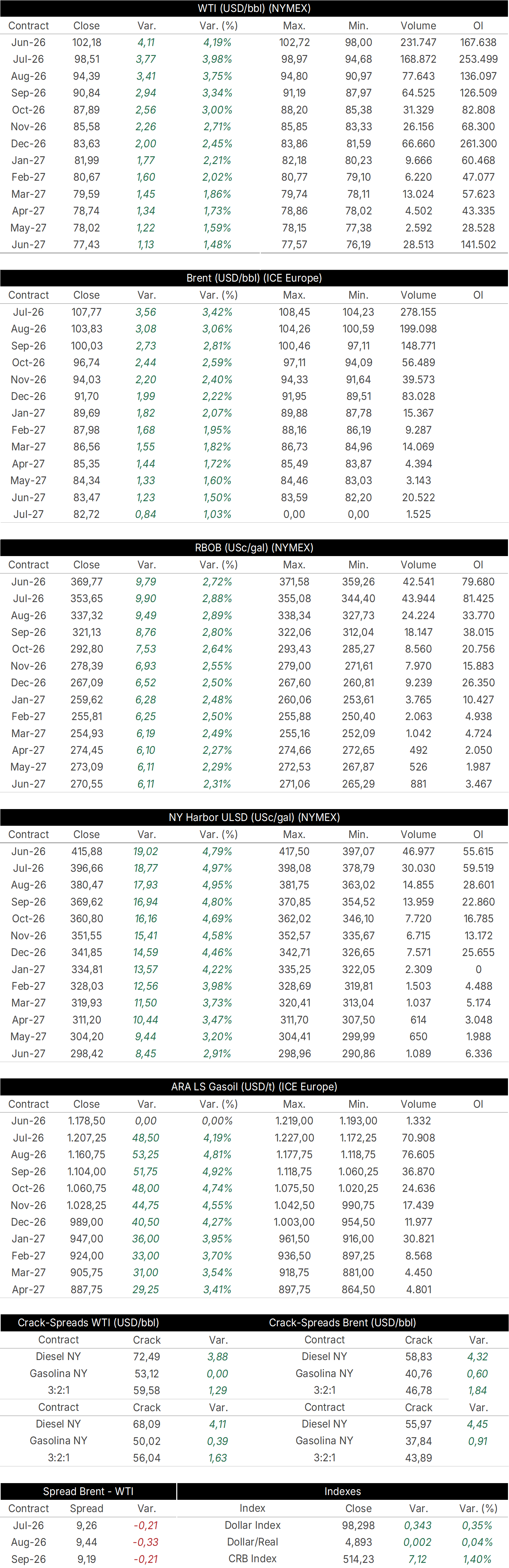
Source: ICE, NYMEX. Prepared by: StoneX.