Oil rebounds after 9% drop in the previous session
The most actively traded Brent contract closed lower on Wednesday (20), at USD 107.34/bbl (-8.8%), following Donald Trump's statement that negotiations with Iran were in the "final stages."
The price decline over the past two days was triggered by verbal indications of diplomatic progress. On Tuesday (19), JD Vance stated "significant progress" in talks, and on Wednesday, Trump suggested a deal was close. The immediate impact was a compression of the geopolitical risk premium embedded in the futures curve, as investors recalibrated expectations for the potential resumption of flows through the Strait of Hormuz.
On Thursday morning (21), Brent is trading at USD 107.4/bbl (+2.2%), and WTI at USD 100.97/bbl (+2.8%), correcting some of the losses from the previous day. Oil futures are recovering because, despite diplomatic progress, Tehran and Washington remain without a formal peace agreement.
Meanwhile, Iran's announcement yesterday of the creation of an authority to control the Strait of Hormuz, coupled with confirmation from Iran’s Supreme Leader that enriched uranium stockpiles will remain in the country, contributed to the rebound at the start of this session.
Iran establishes authority to control flows in the Strait of Hormuz
Iran announced the creation of a "Persian Gulf Strait Authority," formalizing a controlled maritime zone and requiring transit authorization, potentially with tariffs—a move Washington has already rejected. Yesterday, two Chinese supertankers carrying roughly 4 million barrels exited the Persian Gulf through the Strait of Hormuz, along with a South Korean tanker that crossed the strait in mutual agreement with Tehran.
Why this matters: Selective reopening to "friendly nations" fragments access to the strait, directly affecting physical flows. In the short term, this measure marginally eases pressure on oil flows, but in the medium term, it institutionalizes an Iranian mechanism to control transit—a stance deemed unacceptable by Washington, which could stall any agreement and push prices higher.
Overview: Before the conflict, 140 ships crossed Hormuz daily. Today, the daily average is about 26 vessels, 20% below pre-conflict levels.
- Last week, 54 vessels made the crossing—double the previous week's count—but still a low volume compared to historical capacity.
- Chinese state refineries have cut processing from 10 mbpd (pre-conflict) to 8.4 mbpd in May, directly impacted by reduced exports through the Persian Gulf.
- The European economic zone is already experiencing its sharpest contraction in 2.5 years, partially driven by inflationary pressures from the energy shock.
- Iran’s latest proposal repeats conditions previously rejected by Trump (strait control, reparations, troop withdrawal), indicating limited room for negotiation.
What to expect: If Pakistan manages to bring Washington and Tehran closer in the coming days and there is concrete signaling of unrestricted reopening of Hormuz, Brent could drop below USD 100/bbl again, eliminating part of the residual premium.
- On the other hand, if negotiations collapse and Trump resumes aggressive rhetoric, the market could face renewed bullish momentum in futures, with Brent potentially moving back above USD 115/bbl.
Accelerated decline in U.S. oil inventories
The EIA data released yesterday showed a reduction of 7.9 million barrels in U.S. commercial oil inventories for the week ending May 15, more than double the expected 2.9 million. Combined with a record draw of 9.9 million barrels from the Strategic Petroleum Reserve (SPR) during the same week, the total decline reached nearly 18 million barrels.
Why this matters: The accelerated depletion of strategic and commercial inventories signals that the physical market remains far from balanced, with the SPR being utilized as an operational cushion to sustain high exports and domestic consumption in the U.S. This has pushed strategic reserves down to 374 million barrels—the lowest level since July 2024—with the downward trend expected to persist in the coming weeks.
Overview: Commercial oil inventories fell to 445 million barrels, slightly above the 5-year seasonal average but with a sharply declining trajectory.
- U.S. oil exports increased to 5.6 mbpd (+112 kbpd), reflecting intense demand from other countries to offset the Middle East supply gap.
- Gasoline inventories dropped by 1.5 million barrels to 214.2 million, while consumption remained resilient at 8.77 mbpd despite prices exceeding USD 4.50/gallon.
- Diesel reserves showed a slight increase (+372,000 barrels) but remain below historical seasonal norms, with no structural relief in the balance.
What to expect? If the EIA confirms total inventories below seasonal averages in the coming weeks, the market is likely to reprice global supply risk, with the U.S. market facing increased pressure due to heightened demand from international buyers.
- Even with a formal ceasefire and gradual reopening of Hormuz easing pressures, the time required to rebuild inventories would not be short, as global logistical adjustments for the commodity are expected to resolve only in the long term.
Daily table - Price variation in the previous session
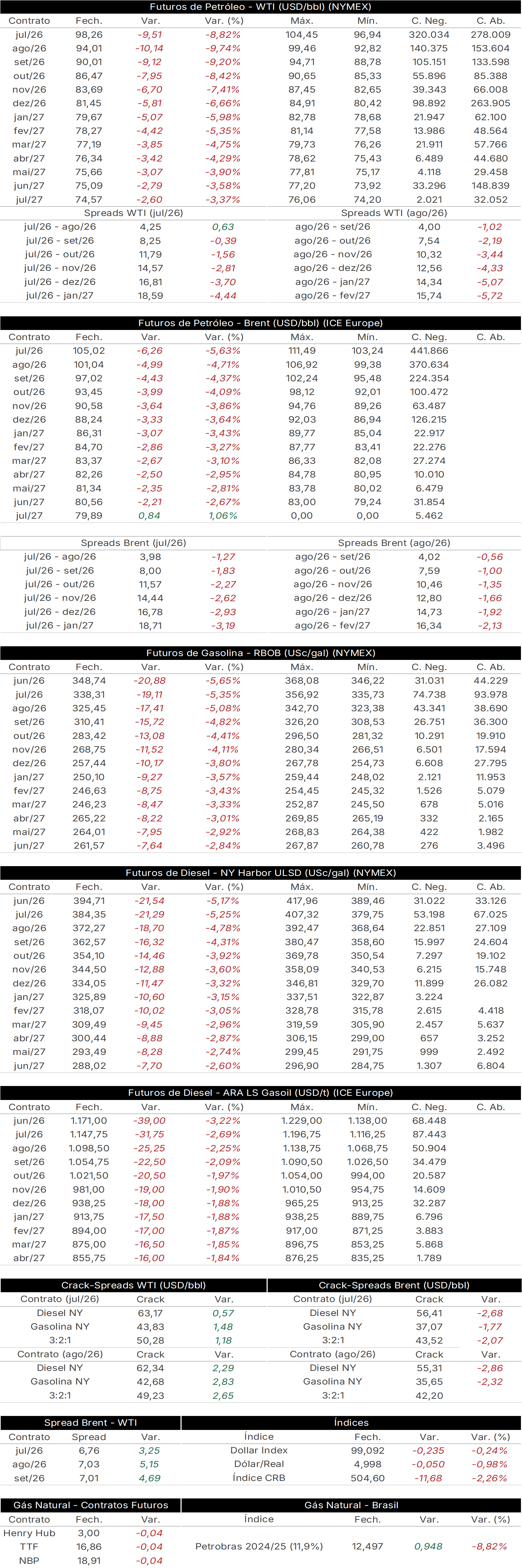
Source: ICE, NYMEX. Prepared by: StoneX.
The StoneX Group Inc. group of companies provides financial services worldwide through its subsidiaries, including physical commodities, securities, exchange-traded and over-the-counter derivatives, risk management, global payments and foreign exchange products in accordance with applicable law in the jurisdictions where services are provided. References to over-the-counter (“OTC”) products or swaps are made on behalf of StoneX Markets LLC (“SXM”), a member of the National Futures Association (“NFA”) and provisionally registered with the U.S. Commodity Futures Trading Commission (“CFTC”) as a swap dealer. SXM’s products are designed only for individuals or firms who qualify under CFTC rules as an ‘Eligible Contract Participant’ (“ECP”) and who have been accepted as customers of SXM. StoneX Financial Inc. (“SFI”) is a member of FINRA/NFA/SIPC and registered with the MSRB. SFI is registered with the U.S. Securities and Exchange Commission (“SEC”) as a Broker-Dealer and with the CFTC as a Futures Commission Merchant and Commodity Trading Adviser. References to securities trading are made on behalf of the BD Division of SFI and are intended only for an audience of institutional clients as defined by FINRA Rule 4512(c). References to exchange-traded futures and options are made on behalf of the FCM Division of SFI . StoneX is a trading name of StoneX Financial Ltd (“SFL”). SFL is registered in England and Wales, Company No. 5616586. SFL is authorized and regulated by the Financial Conduct Authority [FRN 446717] to provide to professional and eligible customers including: arrangement, execution and, where required, clearing derivative transactions in exchange traded futures and options. SFL is also authorised to engage in the arrangement and execution of transactions in certain OTC products, certain securities trading, precious metals trading and payment services to eligible customers. SFL is authorised & regulated by the Financial Conduct Authority under the Payment Services Regulations 2017 for the provision of payment services. SFL is a category 1 ring-dealing member of the London Metal Exchange. In addition SFL also engages in other physically delivered commodities business and other general business activities which are unregulated and not required to be authorised by the Financial Conduct Authority. StoneX Group Inc. acts as agent for SFL in New York with respect to its payments services business. StoneX APAC Pte. Ltd. acts as agent for SFL in Singapore with respect to its payments services business. ‘StoneX’ is the trade name used by StoneX Group Inc. and all its associated entities and subsidiaries.
Trading swaps and over-the-counter derivatives, exchange-traded derivatives and options and securities involves substantial risk and is not suitable for all investors. Past performance of any futures or option is not indicative of future success. Indicators are not a trading system and are not published as a specific trade recommendation. The information herein is not a recommendation to trade nor investment research or an offer to buy or sell any derivative or security. It does not take into account your particular investment objectives, financial situation or needs and does not create a binding obligation on any of the StoneX group of companies to enter into any transaction with you. You are advised to perform an independent investigation of any transaction to determine whether any transaction is suitable for you. No part of this material may be copied, photocopied or duplicated in any form by any means or redistributed without the prior written consent of StoneX Group Inc.
© 2026 StoneX Group Inc. All Rights Reserved.