Yesterday (May 26, 2026), the most actively traded Brent contract closed with a gain of approximately 3.6%, reaching USD 99.58/bbl after the US launched fresh strikes on Iranian installations near the Strait of Hormuz, dismissing expectations for an immediate agreement. WTI followed a divergent trajectory, undergoing corrections after the Memorial Day holiday.
Futures found support from both the military escalation and contradictory diplomatic signals, with Marco Rubio stating an agreement "may take a few days," while Iran accused the US of violating the ceasefire in effect since April. The market responded to the risk of protracted conflict, pricing in greater uncertainty regarding the prospects for reopening the Strait of Hormuz in the near term.
This morning (May 27, 2026), Brent trades down by 3.1%, at USD 96.47/bbl as of 8:30 am, erasing nearly all the previous day's gains. Market sentiment shifted toward the sell side in light of evidence of progress behind the scenes in negotiations in Doha and reports of crude carriers transiting the Strait—a signal interpreted as a precursor to reopening.
Number of vessels transiting the Strait of Hormuz increases
LNG tankers and VLCCs—capable of transporting up to 2 million barrels of crude oil—have resumed transit through the Strait of Hormuz in recent days, albeit at volumes much lower than those observed before the conflict. This data has fueled expectations for a gradual reopening, even under Tehran's toll system, compressing the embedded risk premium in price levels.
Why this matters: The passage of vessels indicates a relaxation of Iranian control over the route, and its recurrence signals that the corridor may be reopening via negotiated arrangements—which tends to gradually, not abruptly, reduce the risk of supply shocks. Each sign of a return to normalized flows removes part of the geopolitical premium added to Brent since February, albeit only marginally given uncertainties about exports resuming from the Persian Gulf.
Overview: Since the effective closure of the Strait, physical crude oil prices in the Middle East reached historic highs, with the Ras Tanura FOB differential from the UAE trading at record premiums over Dated Brent;
- Asia, which absorbs roughly 80% of the crude oil passing through the Strait, was the most impacted region, prompting rapid reconfiguration of routes and sourcing, with China and India reducing their consumption of the commodity and simultaneously seeking alternatives in the Americas and Africa;
- Meanwhile, volumes diverted to alternative routes via the Red Sea have pushed average VLCC freight rates up more than 60% since April.
What to watch: Should transits through the Strait consolidate and a memorandum of understanding be announced in the coming days, Brent could retreat to the USD 80–90/bbl range as long positions are unwound and the geopolitical premium declines.
- If US or Israeli strikes on Iran resume—with Israel intensifying bombardments in Lebanon yesterday—the bias returns to bullish. The asymmetric risk remains; any incident in the Strait that disrupts recent transits could trigger more substantial price advances than the current downside movement.
US SPR reaches Asia for the first time since 2022
A shipment of 616,000 barrels of crude oil from US strategic inventories departed Texas bound for the Philippines, marking the first SPR delivery to Asia since November 2022. The cargo, chartered by Shell, is scheduled to arrive in Bataan in early July.
Why this matters: SPR flows to Asia confirm that the supply reconfiguration caused by the closure of the Strait has already produced permanent short-term effects—asian buyers, previously reliant on the Persian Gulf, now access both commercial and strategic volumes from the United States. The political move reinforces coordination among IEA member countries to mitigate supply disruptions caused by the conflict, with the US market serving as a supplier of last resort to the rest of the world.
Overview: The Philippines had not received US crude oil since February 2020 and structurally depend on Saudi Arabia, the UAE, and Iraq for domestic supply;
- The Philippine government has already expressed its intention to diversify to the US, Canada, Colombia, and Argentina and is seeking White House authorizations to acquire Russian crude oil;
- US strategic inventories have previously been exported to Northwest Europe, the Mediterranean, and the Balkans, signaling globally coordinated releases;
- It is worth noting that the 172 million barrels released from the SPR by Washington is comparable to the volume observed in 2022, when 180 million barrels were used to contain post-Ukraine invasion supply shocks. Additionally, the IEA's release of 400 million barrels of crude oil and products surpasses all previous historic episodes of coordinated reserve releases.
What to watch: While the Strait remains closed or with unstable transit, new SPR shipments to Asia are likely to multiply—especially for countries lacking consolidated alternative agreements. It is important to reiterate that Asia was the main destination for the commodity supplied from the Persian Gulf.
- With full reopening, flows may cease rapidly due to logistical cost reasons, and Asian buyers would return to Gulf suppliers; any delay in normalization would prolong elevated freight rates and physical premiums.
Daily table – Previous session price variation
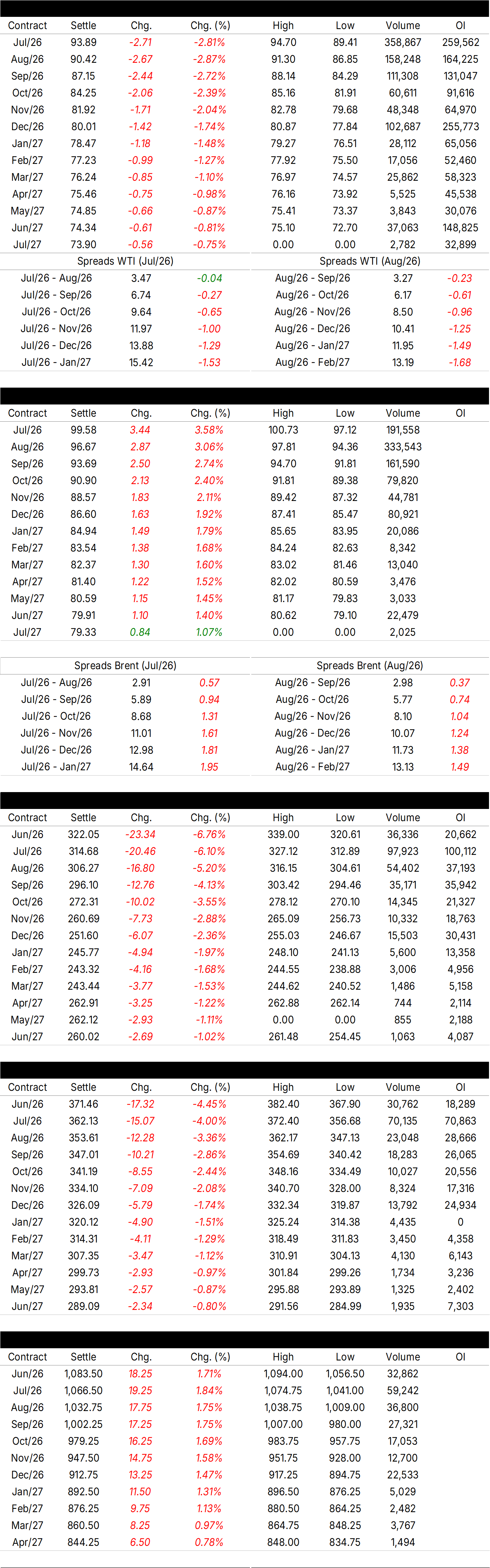

Source: ICE, NYMEX. Compiled by StoneX.




