StoneX logo

Daily Petroleum Report

By: Bruno Santos, Market Intelligence Analyst

Banner Currencies

Oil reaches six-week low amid potential US-Iran agreement

Yesterday (May 28), the most active Brent contract for July settled down 0.6%, quoted at USD 93.71/bbl, after a volatile session marked by intense fluctuations between USD 94.59/bbl (high) and USD 92.99/bbl (low). WTI followed a similar trajectory, closing marginally higher by 0.3% at USD 88.90/bbl. Despite heightened military tensions between Iran and the United States, overall movement pointed toward profit taking and the closing of long positions on expectations for diplomatic progress.

The primary factor impacting the commodity futures market was a report by Axios stating that the final deal to extend the ceasefire depended solely on Trump’s approval, strongly pressuring prices and reversing gains observed earlier in the session.

This morning (May 29), the Brent contract for July delivery showed a decline of 1.8%, quoted at USD 92.05/bbl, with the most traded contract (August) at USD 91.07/bbl (-1.76%). The prevailing sentiment is short-lived momentum for long positions: the market is weighing a base-case scenario of a US-Iran agreement, pricing in the gradual return of barrels through the Strait and a reduction of the geopolitical risk premium.

US-Iran ceasefire and potential reopening of the Strait of Hormuz

The provisional agreement to extend the ceasefire between the United States and Iran by 60 days intensified long liquidation and triggered the largest weekly decline in Brent (-11%) and WTI (-10%) since April. Although sources indicate an understanding towards easing the maritime blockade of Hormuz, final confirmation hinges upon President Trump's approval and formalization of the text, which is still pending ratification by Iranian negotiators.

Why this matters: The consolidation of the agreement and a potential reopening of the Strait of Hormuz tend to return part of the volumes lost at the outset of the war to the physical market, pressuring price structure and regional spreads. In the very short term, the expectation of an agreement is already inducing profit taking and reducing the geopolitical premium.

  • In the medium term, should the agreement evolve to include the release of frozen assets and lifting of sanctions, the trend is for a gradual replenishment of global inventories and recalibration of global flows, with downside risk should the text not be approved or Hormuz remain partially closed.
  • It is noteworthy, however, that expectations point to a slow recovery of output by Gulf countries, which face technical difficulties in rapidly increasing crude oil extraction.

Overview: The US-Iran negotiations involve multiple aspects: ceasefire extension, gradual reopening of the Strait of Hormuz, lifting of sanctions, return of frozen assets, nuclear issues, and limits on armaments. The scenario remains unsettled, with tail risk linked to Israel’s stance, a regional conflict focal point and a critical actor in the security equation.

What to expect? In the base-case scenario, Brent maintains a pronounced weekly downward trajectory, with the possibility of further declines should the agreement be formalized. Risks persist along the curve, especially if political resistance arises in the US or if there are military retaliations—any setback tends to reactivate the premium and volatility, driving Brent back to higher levels.

US diesel inventories hit lowest level since 2003

US commercial crude inventories decreased by 3.3 million barrels last week, below the consensus of 4.1 million, according to DOE data. Gasoline inventories fell by 2.6 million and distillates dropped by 2.1 million, driven by robust summer demand and refineries operating at 94.5% capacity. US crude exports contracted by 1.16 million bpd, totaling 4.4 million bpd, while Cushing inventories registered a sharp drop (-2.79 million).

Why this matters: Alongside the reduction in commercial reserves, there was an accelerated drawdown from the SPR, around 9 million barrels, with total US inventories declining by 12.4 million barrels. In the short term, this data already exerts a limited effect on price, given the bearish pressure imposed by the geopolitical scenario.

  • In the medium term, sustained high consumption—especially in gasoline, for which inventories are at very low levels—and robust refining capacity may provide new support to the market, should the return of barrels from the Persian Gulf prove slower than anticipated.

Overview:  The reduction in commercial crude oil inventories marks the sixth consecutive week of decline. At the same time, since the beginning of the conflict, the SPR has dropped 50 million barrels, with this drawdown expected to continue until the US completes the sale of all volumes released under the IEA agreement, totaling 170 million barrels.

  • Diesel inventories have reached their lowest value since 2003, near 100 million barrels, constituting a more evident market risk for the fossil derivative. Even so, the fact that the market is experiencing a moment of lower demand for this fuel has limited upward pressure on prices.

What to expect? In the base-case scenario, refineries are expected to maintain high utilization rates and fuel inventories to keep falling, but prices will adapt to a new reality of greater potential supply from the Persian Gulf. If exports accelerate and the US-Iran deal stalls, the bullish bias may return, with Brent reclaiming USD 95/bbl.

 Daily table – Price variation in the previous session
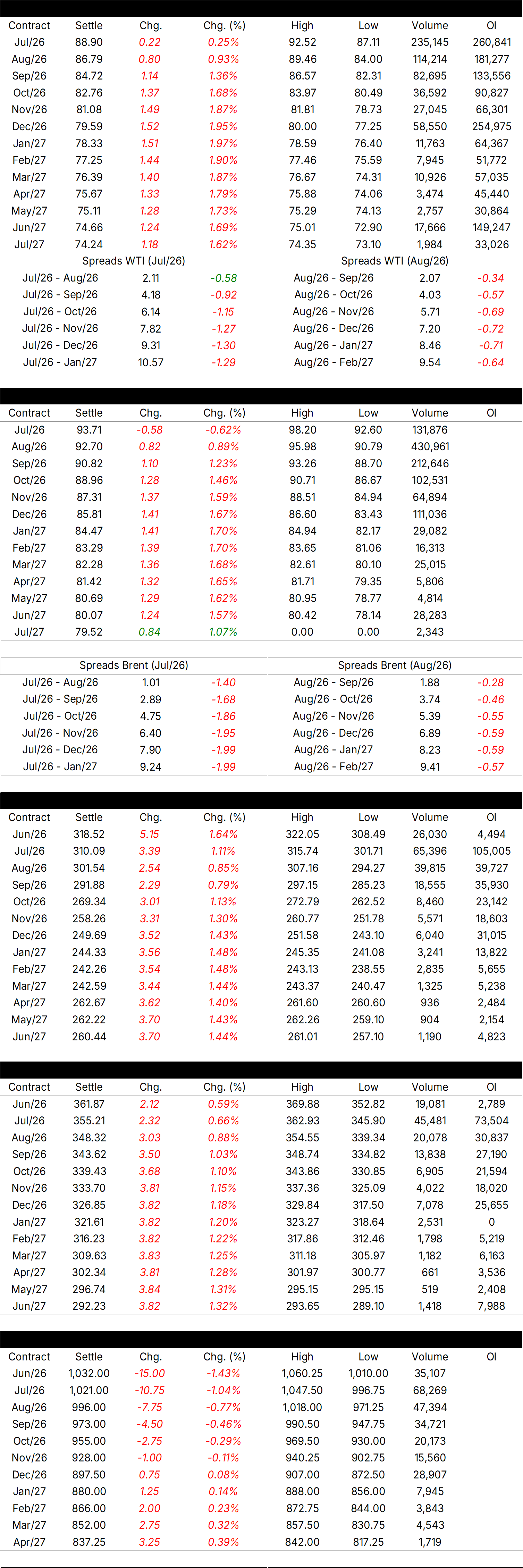
image 132014

Source: ICE, NYMEX. Prepared by: StoneX.

  • Energy

The StoneX Group Inc. group of companies provides financial services worldwide through its subsidiaries, including physical commodities, securities, exchange-traded and over-the-counter derivatives, risk management, global payments and foreign exchange products in accordance with applicable law in the jurisdictions where services are provided. References to over-the-counter (“OTC”) products or swaps are made on behalf of StoneX Markets LLC (“SXM”), a member of the National Futures Association (“NFA”) and provisionally registered with the U.S. Commodity Futures Trading Commission (“CFTC”) as a swap dealer. SXM’s products are designed only for individuals or firms who qualify under CFTC rules as an ‘Eligible Contract Participant’ (“ECP”) and who have been accepted as customers of SXM. StoneX Financial Inc. (“SFI”) is a member of FINRA/NFA/SIPC and registered with the MSRB. SFI is registered with the U.S. Securities and Exchange Commission (“SEC”) as a Broker-Dealer and with the CFTC as a Futures Commission Merchant and Commodity Trading Adviser. References to securities trading are made on behalf of the BD Division of SFI and are intended only for an audience of institutional clients as defined by FINRA Rule 4512(c). References to exchange-traded futures and options are made on behalf of the FCM Division of SFI . StoneX is a trading name of StoneX Financial Ltd (“SFL”). SFL is registered in England and Wales, Company No. 5616586. SFL is authorized and regulated by the Financial Conduct Authority [FRN 446717] to provide to professional and eligible customers including: arrangement, execution and, where required, clearing derivative transactions in exchange traded futures and options. SFL is also authorised to engage in the arrangement and execution of transactions in certain OTC products, certain securities trading, precious metals trading and payment services to eligible customers. SFL is authorised & regulated by the Financial Conduct Authority under the Payment Services Regulations 2017 for the provision of payment services. SFL is a category 1 ring-dealing member of the London Metal Exchange. In addition SFL also engages in other physically delivered commodities business and other general business activities which are unregulated and not required to be authorised by the Financial Conduct Authority. StoneX Group Inc. acts as agent for SFL in New York with respect to its payments services business. StoneX APAC Pte. Ltd. acts as agent for SFL in Singapore with respect to its payments services business. ‘StoneX’ is the trade name used by StoneX Group Inc. and all its associated entities and subsidiaries.
 
Trading swaps and over-the-counter derivatives, exchange-traded derivatives and options and securities involves substantial risk and is not suitable for all investors. Past performance of any futures or option is not indicative of future success. Indicators are not a trading system and are not published as a specific trade recommendation. The information herein is not a recommendation to trade nor investment research or an offer to buy or sell any derivative or security. It does not take into account your particular investment objectives, financial situation or needs and does not create a binding obligation on any of the StoneX group of companies to enter into any transaction with you. You are advised to perform an independent investigation of any transaction to determine whether any transaction is suitable for you. No part of this material may be copied, photocopied or duplicated in any form by any means or redistributed without the prior written consent of StoneX Group Inc.
 
© 2026 StoneX Group Inc. All Rights Reserved.

Satellite view of Earth at night showing illuminated cities across Asia and the Middle East

Discover more insights

Our subscribers have access to comprehensive market analysis from StoneX spanning commodities, equities, currencies and more.

Related articles for Energy

WTI and Brent Crude Are Now Reading the Strait of Hormuz Differently

WTI and Brent crude are moving to different beats as a possible U.S. Iran deal reshapes the oil market. The two benchmarks are pricing Strait of Hormuz risk in their own ways, and the gap between them says a lot about where crude goes next.

Editorial Team
Editorial Team
  • Energy

Perspective: Morning Commentary for August 7

August 7 – The U.S. economy unexpectedly lost 23k jobs in July, dramatically below market expectations of an 80k increase and marking the worst Non-Farm Payrolls print since February. Furthermore, May and June were both revised sharply downward, with combined revisions showing 103k fewer jobs than previously reported. Outside of the healthcare sector, which added 22k jobs in July, the losses were very broad-based. Government payrolls saw the largest decline, shedding 53k jobs in July, the largest seen since October 2025, while June was revised down to show a loss of 10k jobs as well. The private sector at least saw growth, adding 30k jobs in July, now matching the month prior after it was revised down from the 49k initially reported, and substantially missing forecasts of 78k jobs being added. This is a sharp reversal in course from the largely better than expected U.S. labor data seen earlier this week.

Mike Castle
Mike Castle
  • Grains & Oilseeds
  • Energy
  • Dairy
  • Renewable Fuels
  • Cocoa
  • Coffee
  • Cotton
  • Sugar
  • Meats & Livestock
  • Forest Products

Diesel Supply Faces Three Fresh Risks Before the Winter Heating Season

The oil market keeps watching the Strait of Hormuz, but the tighter pressure on fuel is building in refining. With a large share of global capacity offline and unplanned outages carrying no repair timeline, diesel supply faces three fresh risks before winter.

Editorial Team
Editorial Team
  • Energy
StoneX: We open markets

Our market expertise, advanced platforms, global reach, culture of full transparency and commitment to our clients’ success all set us apart in the financial marketplace.

Reach

With access to 40+ derivatives exchanges, 180+ foreign exchange markets, nearly every global securities marketplace and numerous bilateral liquidity venues, StoneX’s digital network and deep relationships can take clients anywhere they want to go.

Transparency

As a publicly traded company meeting the highest standards of regulatory compliance in the markets we serve, our financials and track record are matters of public record. StoneX’s commitment to “doing the right thing over the easy thing” sets us apart in the industry and helps us build respect, client trust and new partnerships.

Expertise

From our proprietary Market Intelligence platform to “boots-on-the-ground” expertise from award-winning traders and professionals, we connect our clients directly to actionable insights they can use to make more informed decisions and achieve their goals in the global markets.