Yesterday (02), the most active Brent contract closed higher, totaling USD 96.00/bbl (+1.1%), after fluctuating between lows of USD 94.20/bbl and highs of USD 96.19/bbl. WTI ended at USD 93.76/bbl (+1.7%), both reaching the highest level since May 26. The session was marked by investors reacting to the IEA's signaling of critical risk in global reserves and diplomatic uncertainty between Iran and the United States.
The main support element was the halt in communications between Tehran and Washington regarding the truce proposal, prolonging the closure of the Strait of Hormuz. Additionally, the IEA stated that global stocks could reach critical lows in the Northern Hemisphere summer, with estimates of weekly declines in U.S. reserves, signaling an acceleration of the global deficit. The interruption of communications and the absence of a concrete decision on reopening the strait heightened risk perception, with high sensitivity to any diplomatic developments.
This morning, Brent continues to rise, quoted at USD 98.49/bbl (+2.6%) around 08:30, expanding the risk premium due to the resumption of attacks by Iran's Revolutionary Guard against Kuwait and new U.S. bombings on Qeshm Island. In this context, investors are adjusting their positioning, betting that the geopolitical impasse and tight stock situation will sustain prices longer.
Military escalation amplifies risk perception and reduces truce expectations
Missile and drone attacks by Iran against Kuwait and Bahrain, along with U.S. bombings of Iranian facilities in Qeshm, intensified the military escalation and frustrated expectations of progress in negotiations between the parties. The prolongation of the conflict and contradictory signals from the Trump administration and Iranian authorities converge toward a stalemate scenario, keeping investors in a defensive posture.
Why this matters: Each round of hostilities amplifies the risk premium embedded in spot and futures prices, increasing volatility and complicating the normalization of the oil balance. The persistence of the impasse stalls diplomatic initiatives and reduces the predictability of physical flows, with the risk of new logistical disruptions. In the short term, each attack or negotiation failure has the potential to accelerate abrupt price movements.
- It is worth noting that Kuwait, hit by Iranian attacks, is one of the countries most affected by the Middle East war, with its production dropping by more than 2 mbpd (70% of the total) since the beginning of the conflict between Iran and the U.S.
- Other major producers, such as Saudi Arabia, the United Arab Emirates, and Iraq, are also suffering from this scenario, operating with stocks at maximum capacity and without alternative routes to ship their products.
What to expect? The current scenario indicates the maintenance of the stalemate and expectations of escalation, sustaining prices. If a new truce is formalized, the risk premium may decrease without completely eliminating volatility; on the other hand, an aggravation of the bombings could push Brent beyond USD 100/bbl in a short period.
Strait of Hormuz remains closed, amplifying global supply restrictions
The Strait of Hormuz, responsible for about 20% of the world's oil and LNG flows, has been closed for over three months. Iran's Revolutionary Guard continues to restrict non-Iranian vessels, while the U.S. maintains blockades at Iranian ports.
The impasse compromises the export flow of Gulf countries, increasing the international supply deficit. Negotiation signals persist, but the communication hiatus since Tehran's last message aggravates the perception that an agreement to reopen is still far off.
Why this matters: The prolongation of restrictions in the Strait of Hormuz maintains the dependency on stocks for global supply, raising risk premiums in prices. The logistical deficit expansion pressures distributors and refineries, with the potential to pass energy costs to consumers, especially during the peak demand of summer. The risk lies in a possible interruption of alternative flows, exacerbating stress in curves and potentially driving Brent and WTI to unprecedented levels if there is no concrete truce signal.
• It is worth noting that API data showed a 6.8 million-barrel decline in U.S. commercial oil stocks this week, demonstrating that the North American market remains pressured by increased Asian demand seeking alternatives to Gulf-offered oil.
What to expect? While the Strait of Hormuz remains closed and the absence of agreements dominates the diplomatic landscape, prices are likely to remain elevated, sustained by the risk premium.
Accumulated declines in global reserves intensify short-term stress
The IEA warned yesterday that global reserves could reach historic lows before the peak summer demand. Preliminary API data indicates a withdrawal of 6.8 million barrels from U.S. reserves last week, marking the seventh consecutive decline, above the five-year average of 2.7 million barrels.
Why this matters: Persistent reserve declines intensify the market's vulnerability to supply shocks, limiting the ability to absorb volatility caused by conflicts and blockages. In the medium term, operational shortage risks could result in faster depletion of oil and derivative reserves, potentially further increasing the risk premium. If a new cycle of global reserve declines is confirmed, stress on prices is likely to be amplified.
What to expect? With continued blockages and stock withdrawals, oil futures are likely to maintain an upward bias. If a new decline in EIA/API weekly data is confirmed, short-term stress is expected to intensify, limiting downward reactions. An unexpected increase in reserves could temporarily ease the upward momentum but does not eliminate the structural premium.
Daily table - Price variation in the last session
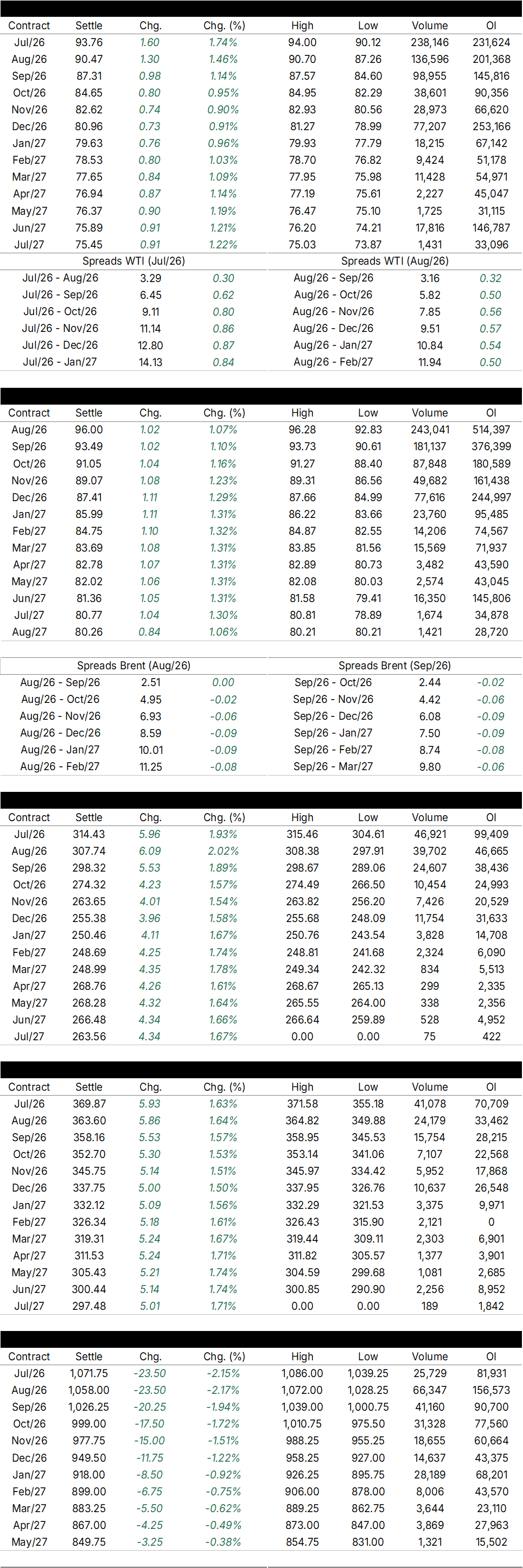
Source: ICE, NYMEX. Prepared by: StoneX.