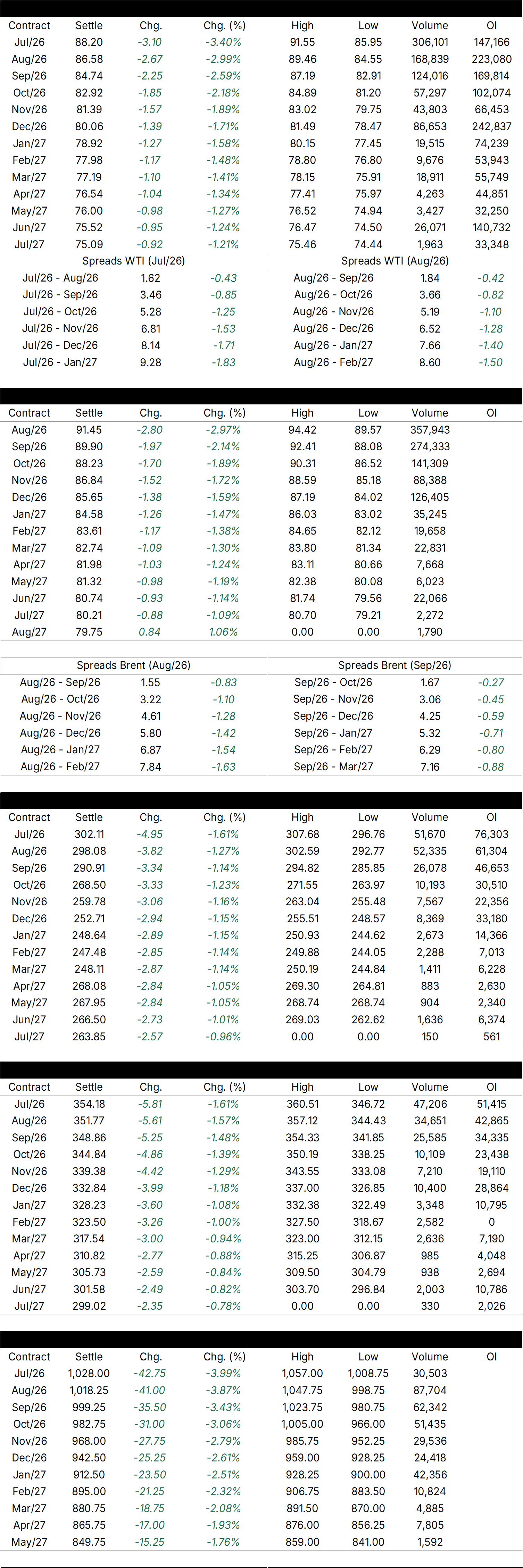
Yesterday (09), the most liquid Brent contract ended down 3%, reaching USD 91.45/bbl. WTI closed at USD 88.2/bbl (-3.4%).
The movement reflected the relief in the futures market after confirmation by both Iran and Israel that attacks between the two countries would be temporarily halted. Meanwhile, rumors regarding progress in negotiations between Tehran and Washington also exerted negative pressure on crude futures.
In the early hours of this morning, Brent is trading up 1%, quoted at USD 91.24/bbl around 08:30 AM, tracking renewed exchanges of attacks between the US and Iran in the Gulf region and signs that diplomatic discussions are advancing sluggishly.
Logistical restrictions at the Strait of Hormuz and US-Iran escalation limit visibility for supply normalization
The resumption of cross-bombardments between the US and Iran, with Iranian attacks on US bases in Bahrain, Kuwait, and Jordan and US offensives against Iranian positions near the Strait of Hormuz, has increased operational uncertainty in the main maritime routes for crude oil. Iran maintains a significant blockade on navigation in the region, even after international mediation reiterated calls for a ceasefire, and has stated it will impose conditions and potential transit tariffs with Oman for partial release of flows.
Why does this matter: In the short term, renewed attacks between Tehran and Washington impede the rebalancing of the global oil balance and necessitate further withdrawals from strategic inventories, as expectations for reopening the Strait of Hormuz become increasingly remote. In the medium term, it amplifies the risk of abrupt price movements in the event of military intensification, within an already strained environment marked by a broad global structural deficit and limited OPEC+ response.
What to expect? While the partial blockade of the Strait of Hormuz and intermittent attacks persist, crude futures are likely to maintain an elevated floor, sustaining price differentials between Asian and European markets.
- If diplomatic discussions move forward and a memorandum of understanding is formalized — which is unlikely at this moment — there is potential for a partial retreat in the current risk premium. Nonetheless, expectations remain for weakened inventories in the long term, even with an eventual full reopening of the Strait of Hormuz.
Global inventories at 20-year lows intensify structural price pressure
According to the EIA, crude oil inventories among OECD economies are projected to fall below 2.3 billion barrels by December, the lowest level since the beginning of the historical series in 2003. This movement is driven by the need to offset the Middle East supply deficit, with consumers burning reserves to ensure full availability of energy commodities. The agency projects that inventories will continue to decrease sharply at least through 2027 as long as flows in the region remain disrupted.
Why does this matter: The reduction in inventories acts as a structural basis for maintaining Brent prices above USD 90/bbl in the coming months, even as diplomatic progress brings occasional relief to risk premiums. The depletion of inventories imposes limits on the market's capacity to cushion additional supply shocks, increasing vulnerability to further production losses or unexpected restrictions. For Brazil, any eventual need for emergency diesel or other refined product purchases may find persistently elevated price conditions and reduced international availability.
What to expect? Should flows through the Strait of Hormuz remain restricted and alternative exporters maintain limited response, global inventories are expected to decline throughout the second half of the year, sustaining elevated spot price levels. A more robust resumption of transit in the region is necessary for reversal of this scenario, with risk of aggravation should additional sanctions or interruptions increase logistical and production deficits.
Global demand weakens with elevated prices, but constrained supply maintains Brent support
The EIA has also revised its outlook, projecting a decrease of 1.1 million bpd in global oil consumption for 2026 relative to the prior year, reversing expectations for growth. This trend reflects the impact of elevated prices on industrial activity and government rationing measures, especially in developed and Asian markets. Chinese imports remain below expectations, limiting upside for prices, but downward adjustment in supply continues to dominate.
Why does this matter: The forced decline in demand does not immediately normalize the market balance, as the reduction in supply exceeds consumption softening, deepening the risk of refined product deficits, especially in import-dependent markets. This phenomenon heightens the importance of strategic reserves and underscores the need for emergency supply plans, including for markets such as Brazil.
What to expect? If elevated prices and constrained supply persist, global demand tends to register a further retreat in the second half, with potential for broader cuts in importing countries. Should flows in the Persian Gulf reopen, there may be a marginal downward adjustment in prices, but full rebalancing is expected only with inventory replenishment starting in 2027.
Daily Table - Price Variation in the Previous Session
Source: ICE, NYMEX. Preparation: StoneX.




