Yesterday (08/03), the most active Brent contract closed down 4.7%, priced at USD 83.77/bbl. WTI followed the trend, ending at USD 80.34/bbl (-5.1%). The session reversed previous gains accumulated over weeks of escalation in the Strait of Hormuz.
The drop occurred after Trump indicated on Sunday the suspension of new attacks on Iran due to alleged ongoing negotiations, while the statement was promptly denied by Tehran, which rejected any active diplomatic contact. The market interpreted the ambiguity as an opening for risk premium relief, temporarily ignoring that physical flows through the Strait of Hormuz remain severely restricted and that regional production remains below pre-conflict levels.
By around 8:20 AM this Tuesday (08/04), Brent was trading at USD 83.9/bbl (+0.1%), with WTI at USD 80.2/bbl (-0.2%), as investors re-priced the risk following a new attack on a ship in the Strait of Hormuz and the absence of any verifiable diplomatic progress.
U.S.-Iran diplomatic deadlock keeps Strait of Hormuz blocked
Contradictory signals from Washington and Tehran deepen uncertainty over the conflict that began in February. While Trump claims negotiations are taking place at the request of Gulf countries, Iran's Ministry of Foreign Affairs denies any contact and indicates that the only ongoing discussions are with Oman regarding the management of the Strait of Hormuz — where Iran seeks control over inbound traffic and visibility over outbound traffic. On Tuesday, a cargo ship was hit by an unknown projectile 20 nautical miles from Al Khasab, Oman.
Why this matters: Tehran's denial of new peace talks, followed by attacks on a vessel in the Persian Gulf, frustrates some expectations related to a potential diplomatic alignment between the U.S. and Iran, with geopolitical risk premiums rising again amid fears of a new military escalation in the Middle East.
What to expect? The current scenario is one of prolonged deadlock, with Brent holding above USD 80/bbl as flows through the Strait of Hormuz remain depressed and Trump's "threat-retreat" pattern continues, with no prospects for a diplomatic resolution in the short term. The market is increasingly approaching the "deadlines" set by the IEA regarding the suspension of oil and derivative flows through the Persian Gulf, with signs of shortages in some regions raising alerts among investors.
Ship passage through main routes between the Middle East and Africa
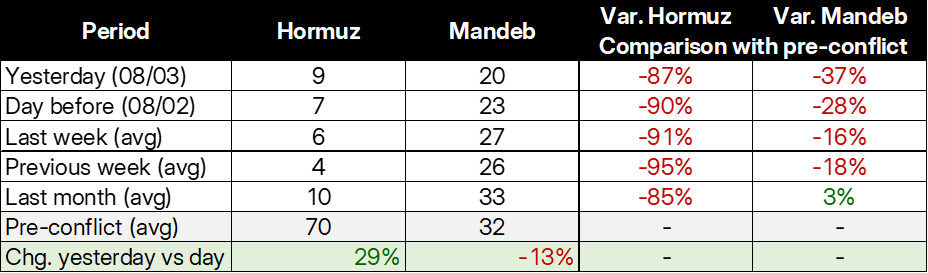
Source: Kpler, Reuters. Prepared by: StoneX.
U.S. oil exports drop to eight-month low
U.S. exports fell to 3.66 mbpd in July, the lowest in eight months, after reaching a record 5.7 mbpd in May. The movement reflects the temporary reduction in Asian demand during the U.S.-Iran memorandum in June, which allowed for a brief reactivation of flows through the Strait of Hormuz and reduced dependence on American oil by Japan and South Korea. The WTI-Brent differential, which narrowed to USD 4.17/bbl in June, also discouraged exports during that period.
Why this matters: With the collapse of the memorandum and the resumption of restrictions in the Strait of Hormuz, arbitration returned to favor American oil, with the WTI-Brent spread widening to USD 5.42/bbl in July, signaling a recovery in exports for August and September. The U.S.'s export capacity acts as a structural relief valve for the global market but remains below the level necessary to fully compensate for the Persian Gulf's supply shortfall.
Outlook: U.S. exports to Asia fell from 52% of the total in June to 40% in July; shipments to Japan dropped 67%, and to South Korea, 39%. Meanwhile, U.S. refinery utilization averaged 96.3% in the four weeks up to August — the highest rate since 2018 — retaining barrels in the domestic market.
What to expect? U.S. exports are expected to exceed 4 mbpd in August and September, supported by the widening WTI-Brent differential and strong vessel bookings in the Gulf of Mexico. If the conflict in the Middle East escalates and further disrupts flows from the Persian Gulf, the U.S. may be pressured to operate near its export limit, which still would not fully compensate for the regional supply loss — keeping the global balance fragile.
Russian refined product exports drop 33% in July
Russia exported about 0.94 mbpd of refined products by sea in July, a 33% drop compared to June, influenced by Ukrainian attacks on refineries and the temporary ban on diesel exports, extended until the end of August for producers, except for previously signed contracts. Diesel exports fell 60% during the period to about 0.18 mbpd, while naphtha exports dropped 35% to approximately 0.22 mbpd. Reuters reported original volumes of 3.9 million tons of refined products, 0.75 million tons of diesel, and 0.8 million tons of naphtha.
Why this matters: The simultaneous drop in Russian diesel and naphtha tightens the refined product balance in Asian, Turkish, and Brazilian markets — the main destinations for Russian fuel since the European ban in February 2023. Brazil, a significant importer of Russian diesel, faces the risk of higher costs for substitute cargoes, pressuring distribution margins and potentially consumer prices.
What to expect? As the diesel ban remains in place until the end of August and Russian refineries operate at reduced capacity, importing markets — including Brazil — will need to seek substitutes for Eastern European products, increasing the acquisition premium for these fuels. If Ukraine intensifies attacks on refining infrastructure, the restriction may extend beyond August, exacerbating the global diesel deficit and increasing import costs for Brazilian distributors.
Intraday price variation in the energy sector
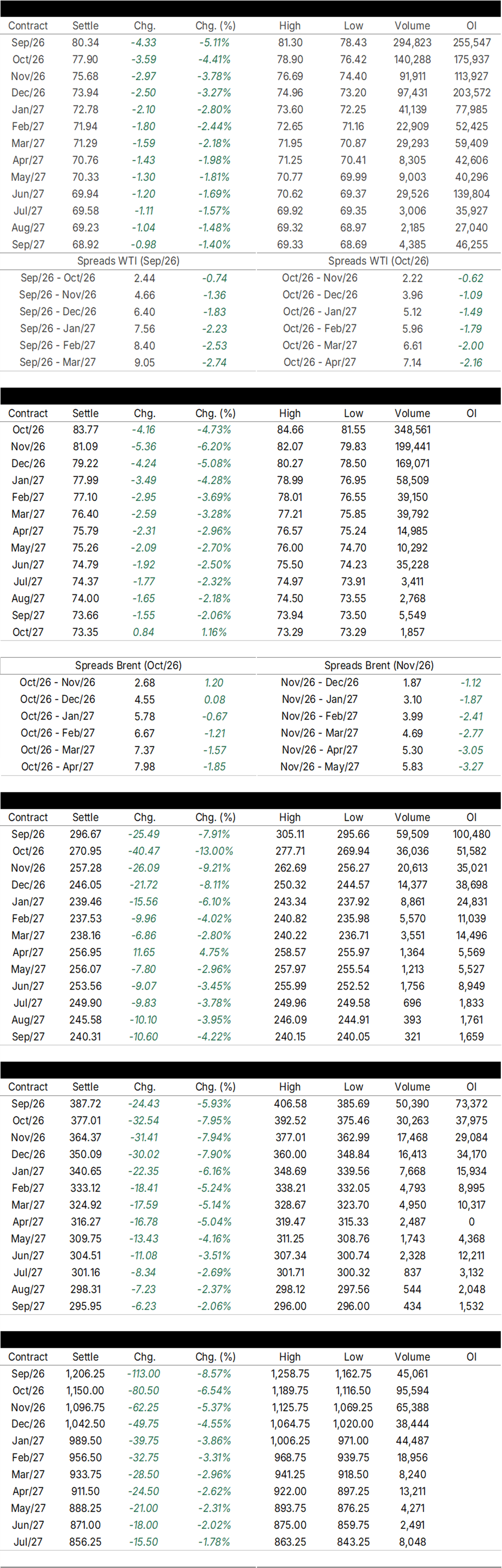
Source: ICE, NYMEX. Prepared by: StoneX.