StoneX logo

Daily Petroleum Report

By: Bruno Santos, Market Intelligence Analyst

Banner Currencies

Brent resumes upward movement amid escalation of attacks between Iran and US

Yesterday (May 27, 2026), the most active Brent contract closed sharply lower, totaling USD 94.29/bbl (−5.3%), while WTI closed at USD 88.68/bbl (−5.5%). Both benchmarks reached their lowest levels since April 17, reversing the 3.6% advance in the previous session amid speculations regarding a potential peace agreement between the US and Iran.

The decline was fueled by reports of an alleged preliminary agreement between Washington and Tehran to restore navigation in the Strait of Hormuz and lift blockades, reducing the geopolitical risk premium and triggering technical selling. However, both the White House and Trump denied any proximity to an understanding, with divergences persisting on the control of the strait, sanctions, and nuclear issues.

This morning (May 28, 2026), Brent rebounded and is trading up 2.5%, at USD 96.67/bbl as of 08:20 AM Brasília time, driven by mutual attacks between the US and Iran and additional sanctions against Iranian authorities. The market is weighing that, given the military escalation and diplomatic deadlock, the likelihood of a full reopening of Hormuz in the short term has decreased, restoring the risk premium throughout the curve.

Aerial attacks and blockades sustain risk premium in Hormuz

Hours after the rejection of the preliminary deal, cross-attacks between Iran and the US—including air strikes in Bandar Abbas—intensified the uncertainty surrounding stability in the Persian Gulf region. The move also involved Iranian retaliation against US bases and new Israeli bombings in southern Lebanon.

Why it matters: The attacks and diplomatic impasse keep oil supply constrained, elevating the risk premium on contracts and impacting short-term price formation. The effect is immediate, with Dubai premiums rising against Brent, as the market interprets this renewed offensive as an obstacle to diplomatic progress. The market is once again monitoring ship movement in the strait and developments in sanctions.

Overview: Reports indicate that two VLCCs and an LNG ship crossed Hormuz with transponders off this week, heading to India and China. The indications point to this movement conducted under Tehran’s toll system policy.

  • Despite this, maritime data indicate that only cargoes with lower operational risk are transiting the strait, reinforcing price support.
  • The US Treasury expanded sanctions against the Persian Gulf Strait Authority, an Iranian entity created last week to manage the strait—directly impacting negotiations between the two countries.

What to expect? If the military conflict escalates, the reopening of Hormuz tends to be delayed and Brent could return to levels above USD 100/bbl. It is important to underscore that ongoing difficulties in resuming dialogue have continually provided momentum for the resumption of the bullish bias in pricing.

  • Meanwhile, the market’s focus remains on the “deadline” for reopening between July and August, a period considered extremely important for normalization of crude flows through the Persian Gulf.

US Inventories: Sixth consecutive week of decline

API data revealed another decline in US crude inventories (down 2.8 million barrels), accelerating the depletion of reserves and underscoring the impact of the Hormuz crisis on the global balance. Gasoline inventories fell 3.2 million barrels, while diesel increased by 1.1 million.

Why it matters: The persistent reduction in American inventories supports the argument for global scarcity and pressures the US petroleum balance. The impact is gradual, materializing as global reserves begin to fall more rapidly, with a greater volume of buyers directing their orders to the US market, which continues to operate with elevated commodity production.

Overview: The weekly decline in US inventories has continued since April, reinforcing the physical market’s vulnerability amid the crisis.

  • Gasoline demonstrates bullish behavior, suggesting resilient demand and logistical constraints, especially during summer months in the Northern Hemisphere.
  • Diesel inventories remain stable, albeit significantly lower compared to the historical five-year average for the period. Despite weakened domestic consumption, exports remain at elevated levels, impacting storage levels.
  • Official DOE data will be published today at 1 PM, with new information expected to weigh on refined product prices.

India Demand: Flight cuts signal disruption

India’s two largest airlines announced reductions in domestic flights for June and July, suggesting adjustments to demand and possible secondary effects from price shocks and regional instability.

Why it matters: Weakening demand resulting from lower global product availability is a key channel for gasoline and refined price adjustments. The effect is gradual, with an initial impact on product crack spreads and expectations for Asian consumption. The key variable now becomes the pace of recovery in flows and consumption.

Overview: The Asian market, responsible for absorbing a significant portion of the Middle East’s surplus, faces direct impact from instability in Hormuz.

  • Crude import figures for India and China remain low, driven by logistical uncertainty and risk of flow interruptions.
  • Thus, this destruction in fuel demand stems mainly from reduced crude supply to processing centers, with airlines seeking measures to curb inflationary impacts on their operations while also adjusting capacity and signaling less willingness to pass elevated prices to end consumers.

What to expect? Despite demand destruction caused by tighter supply, the supply reduction is significantly larger, which results in an accelerated global inventory drawdown. It is notable that since the conflict began, the IEA estimates a decline of over 250 million barrels in global crude and product reserves, a trend expected to persist until the Strait of Hormuz is fully reopened.

 Daily table – Price variation during previous session
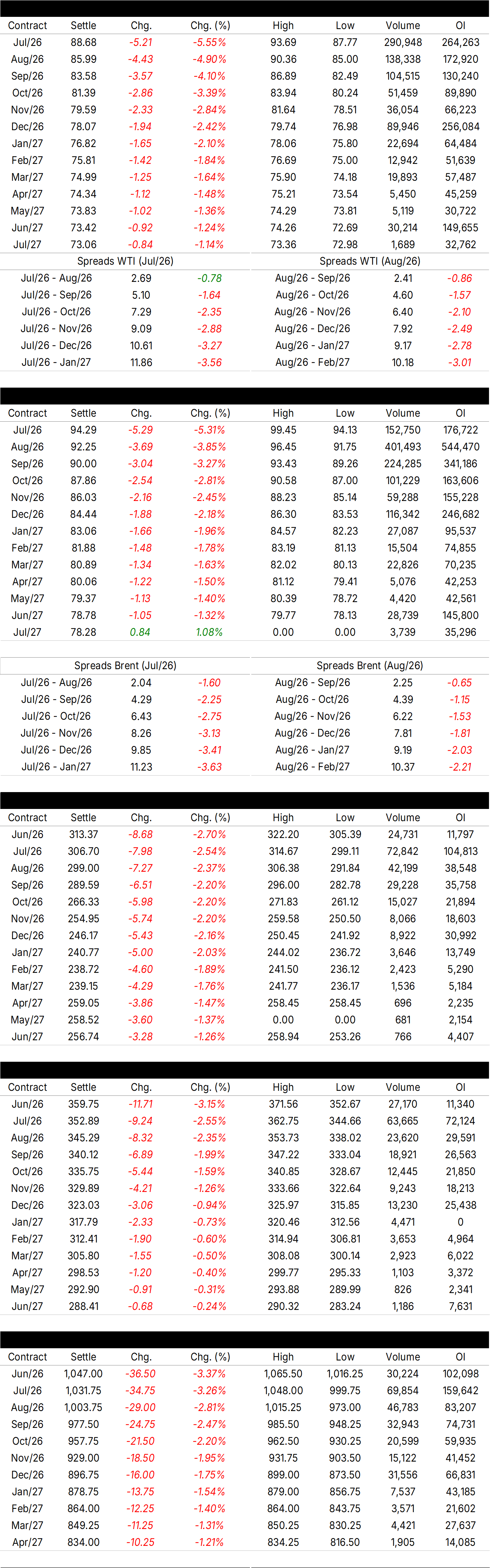
image 131969

Source: ICE, NYMEX. Prepared by StoneX.

  • Energy

The StoneX Group Inc. group of companies provides financial services worldwide through its subsidiaries, including physical commodities, securities, exchange-traded and over-the-counter derivatives, risk management, global payments and foreign exchange products in accordance with applicable law in the jurisdictions where services are provided. References to over-the-counter (“OTC”) products or swaps are made on behalf of StoneX Markets LLC (“SXM”), a member of the National Futures Association (“NFA”) and provisionally registered with the U.S. Commodity Futures Trading Commission (“CFTC”) as a swap dealer. SXM’s products are designed only for individuals or firms who qualify under CFTC rules as an ‘Eligible Contract Participant’ (“ECP”) and who have been accepted as customers of SXM. StoneX Financial Inc. (“SFI”) is a member of FINRA/NFA/SIPC and registered with the MSRB. SFI is registered with the U.S. Securities and Exchange Commission (“SEC”) as a Broker-Dealer and with the CFTC as a Futures Commission Merchant and Commodity Trading Adviser. References to securities trading are made on behalf of the BD Division of SFI and are intended only for an audience of institutional clients as defined by FINRA Rule 4512(c). References to exchange-traded futures and options are made on behalf of the FCM Division of SFI . StoneX is a trading name of StoneX Financial Ltd (“SFL”). SFL is registered in England and Wales, Company No. 5616586. SFL is authorized and regulated by the Financial Conduct Authority [FRN 446717] to provide to professional and eligible customers including: arrangement, execution and, where required, clearing derivative transactions in exchange traded futures and options. SFL is also authorised to engage in the arrangement and execution of transactions in certain OTC products, certain securities trading, precious metals trading and payment services to eligible customers. SFL is authorised & regulated by the Financial Conduct Authority under the Payment Services Regulations 2017 for the provision of payment services. SFL is a category 1 ring-dealing member of the London Metal Exchange. In addition SFL also engages in other physically delivered commodities business and other general business activities which are unregulated and not required to be authorised by the Financial Conduct Authority. StoneX Group Inc. acts as agent for SFL in New York with respect to its payments services business. StoneX APAC Pte. Ltd. acts as agent for SFL in Singapore with respect to its payments services business. ‘StoneX’ is the trade name used by StoneX Group Inc. and all its associated entities and subsidiaries.
 
Trading swaps and over-the-counter derivatives, exchange-traded derivatives and options and securities involves substantial risk and is not suitable for all investors. Past performance of any futures or option is not indicative of future success. Indicators are not a trading system and are not published as a specific trade recommendation. The information herein is not a recommendation to trade nor investment research or an offer to buy or sell any derivative or security. It does not take into account your particular investment objectives, financial situation or needs and does not create a binding obligation on any of the StoneX group of companies to enter into any transaction with you. You are advised to perform an independent investigation of any transaction to determine whether any transaction is suitable for you. No part of this material may be copied, photocopied or duplicated in any form by any means or redistributed without the prior written consent of StoneX Group Inc.
 
© 2026 StoneX Group Inc. All Rights Reserved.

Satellite view of Earth at night showing illuminated cities across Asia and the Middle East

Discover more insights

Our subscribers have access to comprehensive market analysis from StoneX spanning commodities, equities, currencies and more.

Related articles for Energy

WTI and Brent Crude Are Now Reading the Strait of Hormuz Differently

WTI and Brent crude are moving to different beats as a possible U.S. Iran deal reshapes the oil market. The two benchmarks are pricing Strait of Hormuz risk in their own ways, and the gap between them says a lot about where crude goes next.

Editorial Team
Editorial Team
  • Energy

Perspective: Morning Commentary for August 7

August 7 – The U.S. economy unexpectedly lost 23k jobs in July, dramatically below market expectations of an 80k increase and marking the worst Non-Farm Payrolls print since February. Furthermore, May and June were both revised sharply downward, with combined revisions showing 103k fewer jobs than previously reported. Outside of the healthcare sector, which added 22k jobs in July, the losses were very broad-based. Government payrolls saw the largest decline, shedding 53k jobs in July, the largest seen since October 2025, while June was revised down to show a loss of 10k jobs as well. The private sector at least saw growth, adding 30k jobs in July, now matching the month prior after it was revised down from the 49k initially reported, and substantially missing forecasts of 78k jobs being added. This is a sharp reversal in course from the largely better than expected U.S. labor data seen earlier this week.

Mike Castle
Mike Castle
  • Grains & Oilseeds
  • Energy
  • Dairy
  • Renewable Fuels
  • Cocoa
  • Coffee
  • Cotton
  • Sugar
  • Meats & Livestock
  • Forest Products

Diesel Supply Faces Three Fresh Risks Before the Winter Heating Season

The oil market keeps watching the Strait of Hormuz, but the tighter pressure on fuel is building in refining. With a large share of global capacity offline and unplanned outages carrying no repair timeline, diesel supply faces three fresh risks before winter.

Editorial Team
Editorial Team
  • Energy
StoneX: We open markets

Our market expertise, advanced platforms, global reach, culture of full transparency and commitment to our clients’ success all set us apart in the financial marketplace.

Reach

With access to 40+ derivatives exchanges, 180+ foreign exchange markets, nearly every global securities marketplace and numerous bilateral liquidity venues, StoneX’s digital network and deep relationships can take clients anywhere they want to go.

Transparency

As a publicly traded company meeting the highest standards of regulatory compliance in the markets we serve, our financials and track record are matters of public record. StoneX’s commitment to “doing the right thing over the easy thing” sets us apart in the industry and helps us build respect, client trust and new partnerships.

Expertise

From our proprietary Market Intelligence platform to “boots-on-the-ground” expertise from award-winning traders and professionals, we connect our clients directly to actionable insights they can use to make more informed decisions and achieve their goals in the global markets.