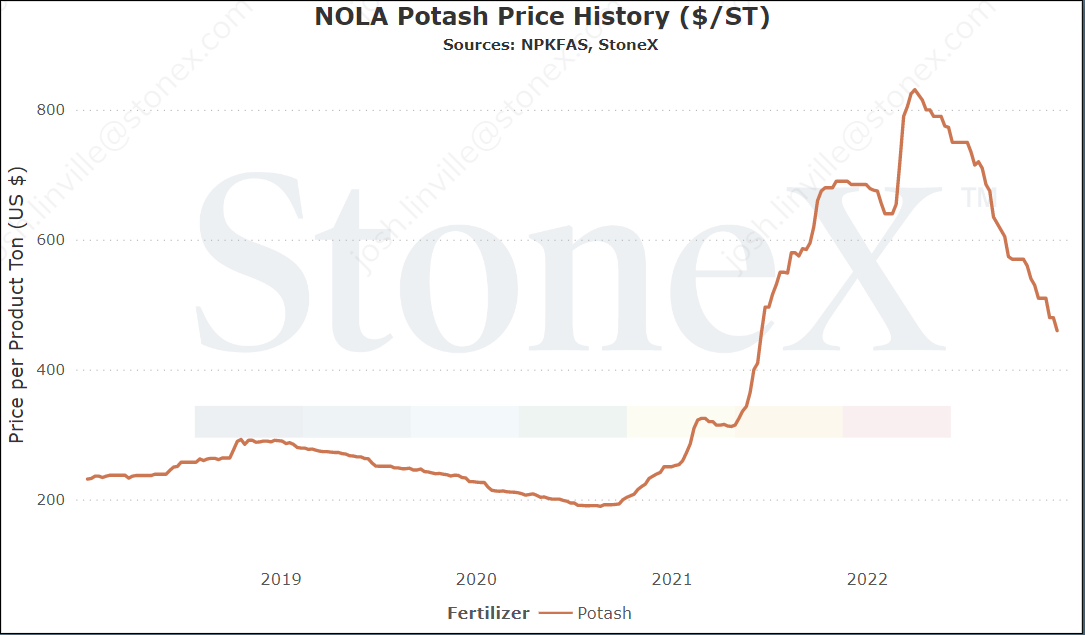
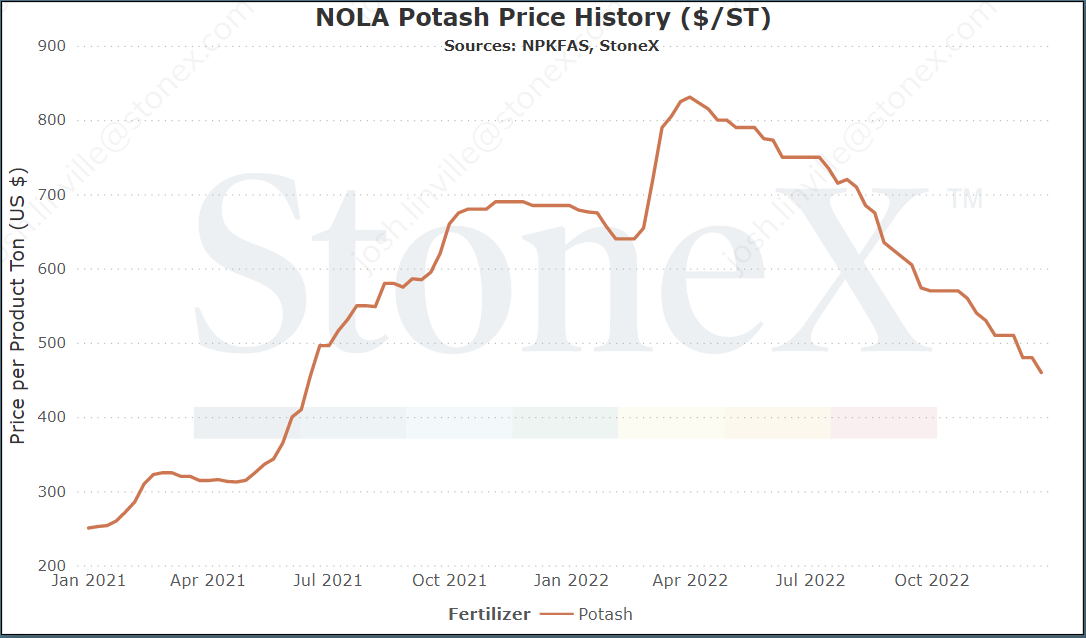
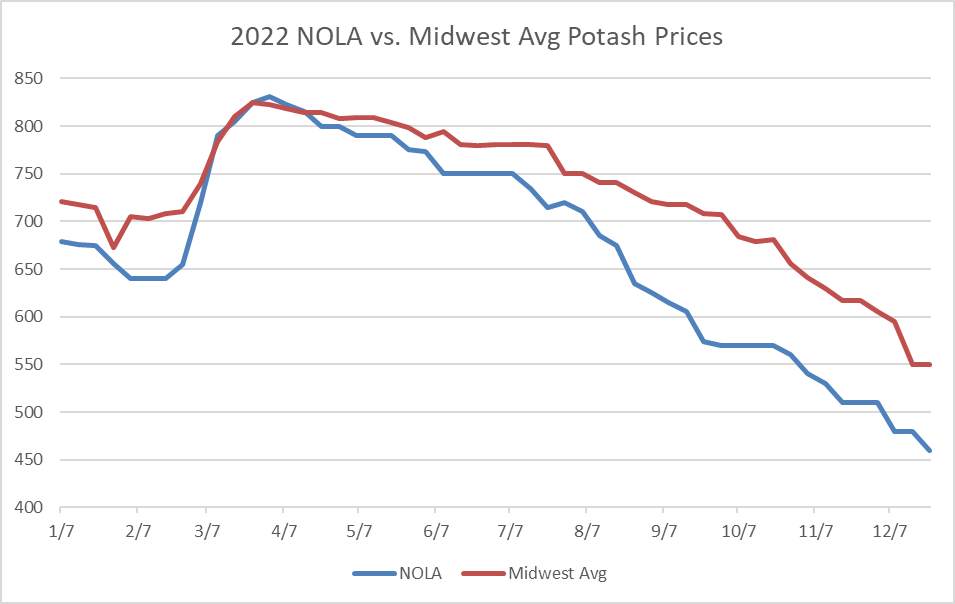
NOLA potash price graph
Please remember that this is looking at the cost of one short ton of potash sitting in a barge at NOLA (New Orleans, Louisiana). Your cost is not going to be the same. This should be looked at more in regards to the price direction rather than the actual pricing.
What everyone wants to know first, what do we think will happen going forward
Today, the global potash market is struggling with an excess of supplies and not near enough demand to offset it. The longer buyers wait, the more the price falls. It has been a self fulfilling prophecy of sorts. The trend has been our friend...but that trend cannot last forever.
There could be a little more downside in the near term but my gut is telling me that at least a short term turnaround is in store.
When I look at that statement and then look at the graph above that shows values falling almost weekly since late March/early April, it scares me to death!
However, I think the current value of potash is pretty darn good. Maybe not from a historical price perspective. From that side, it is still far overpriced. Then again, so are many grains...
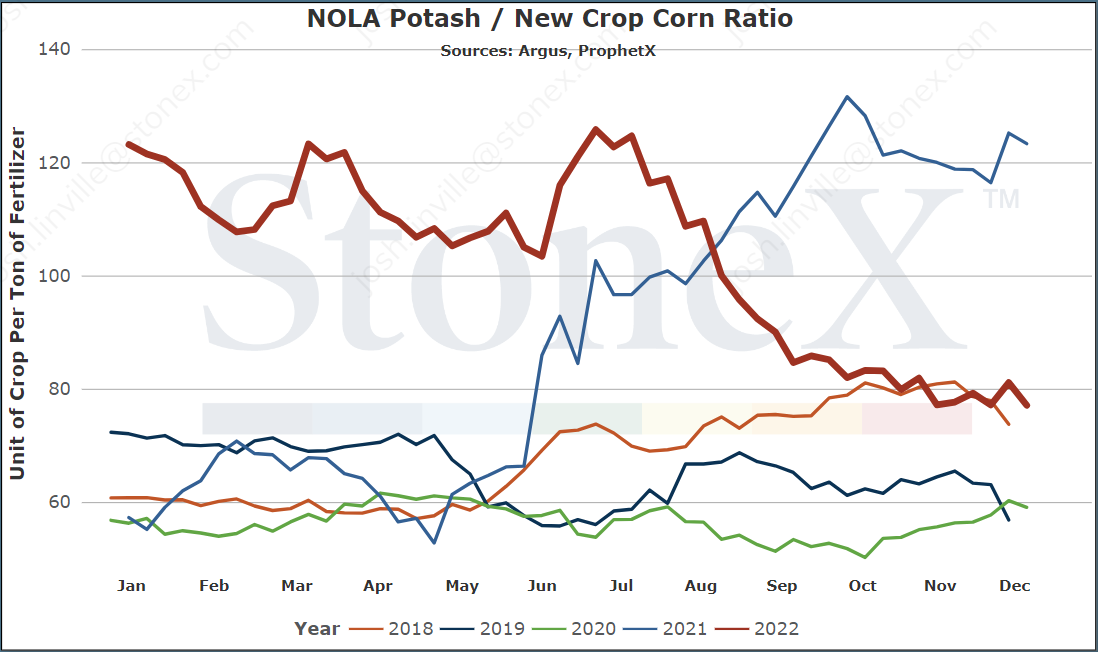
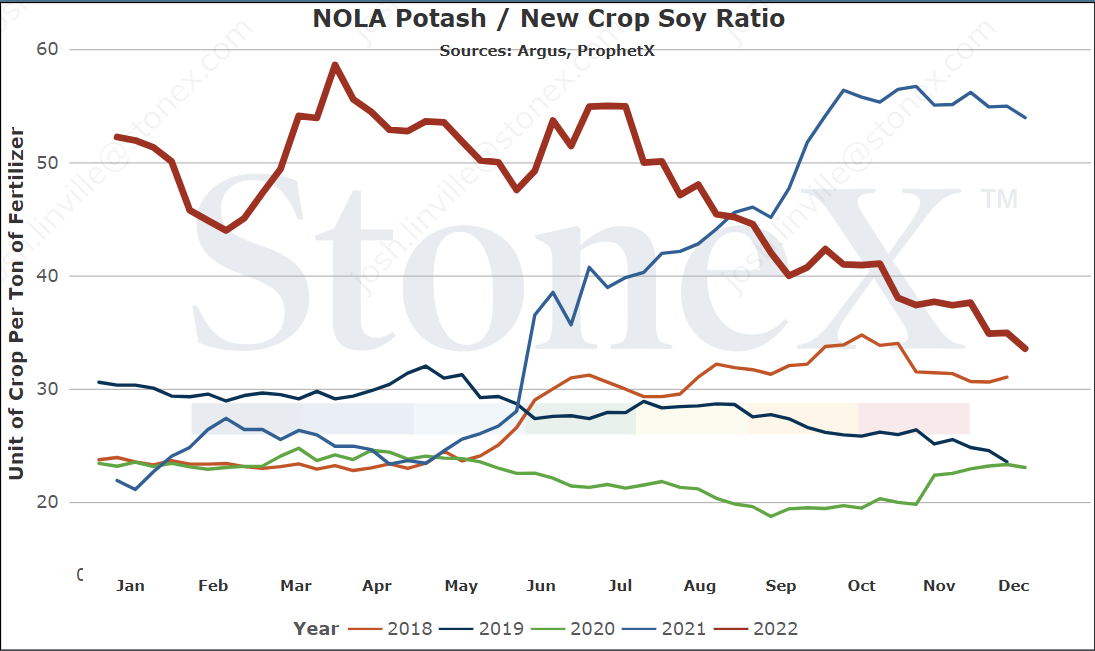
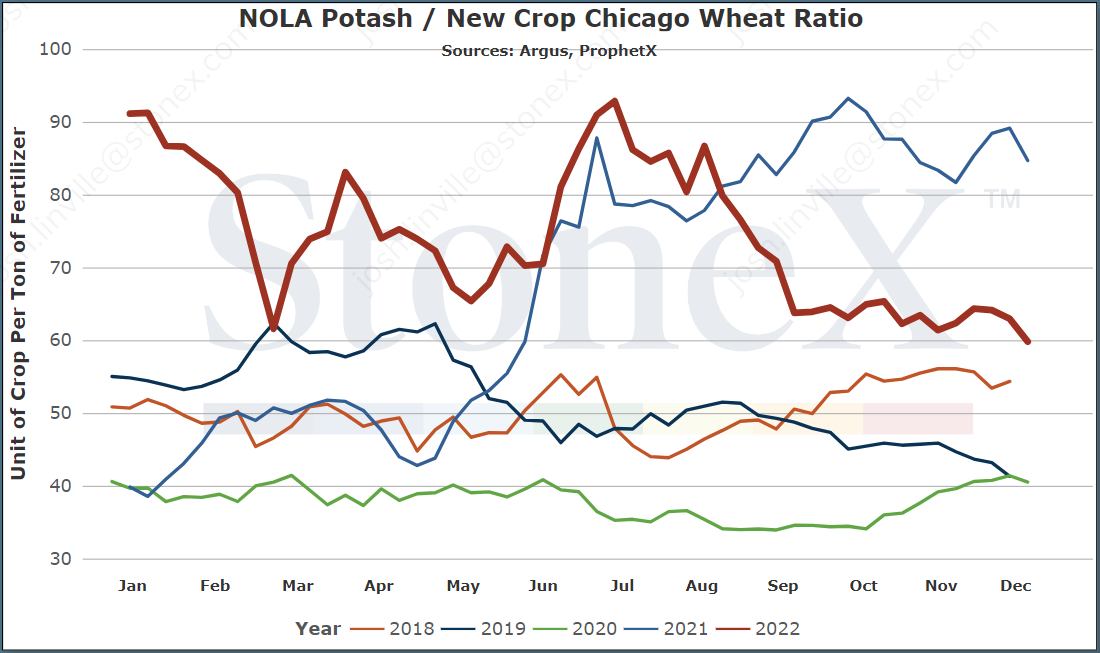
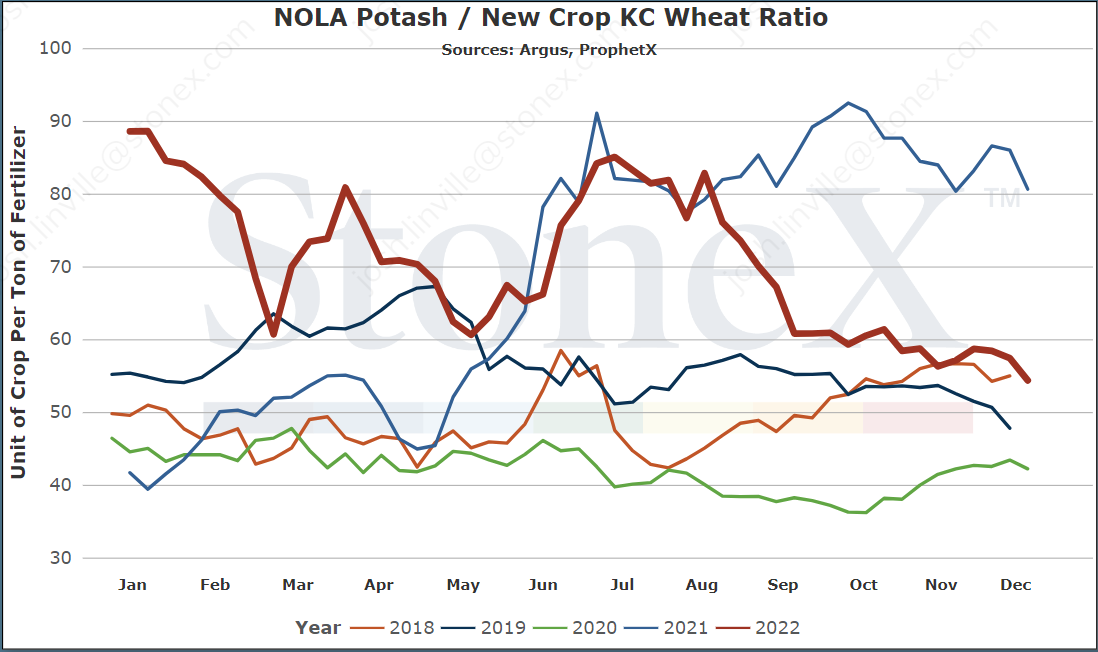
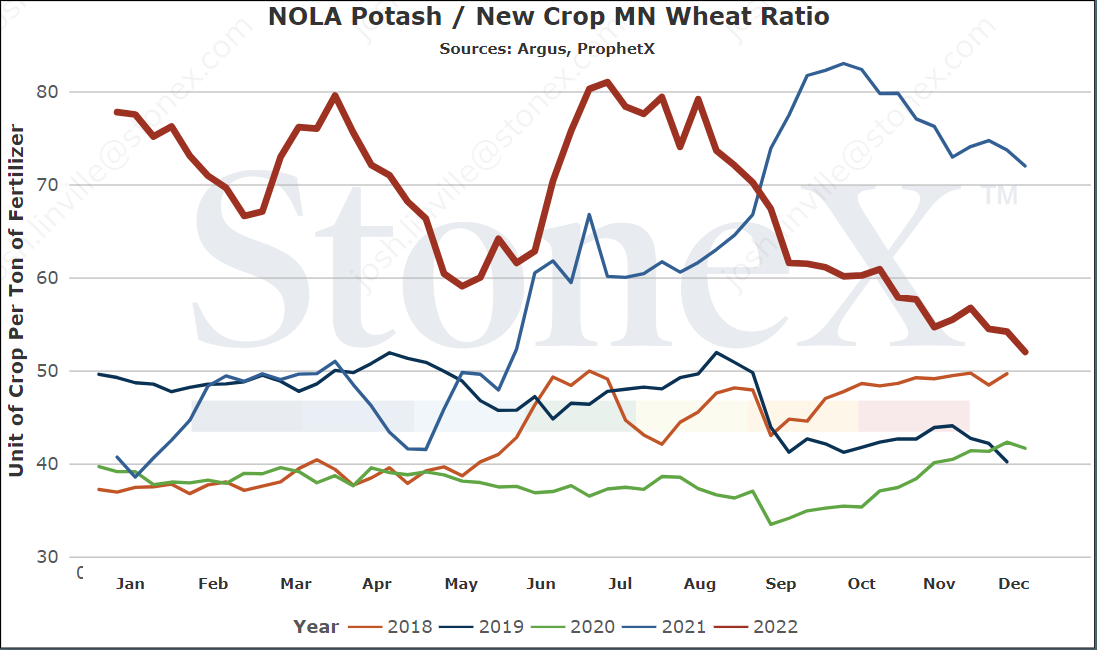
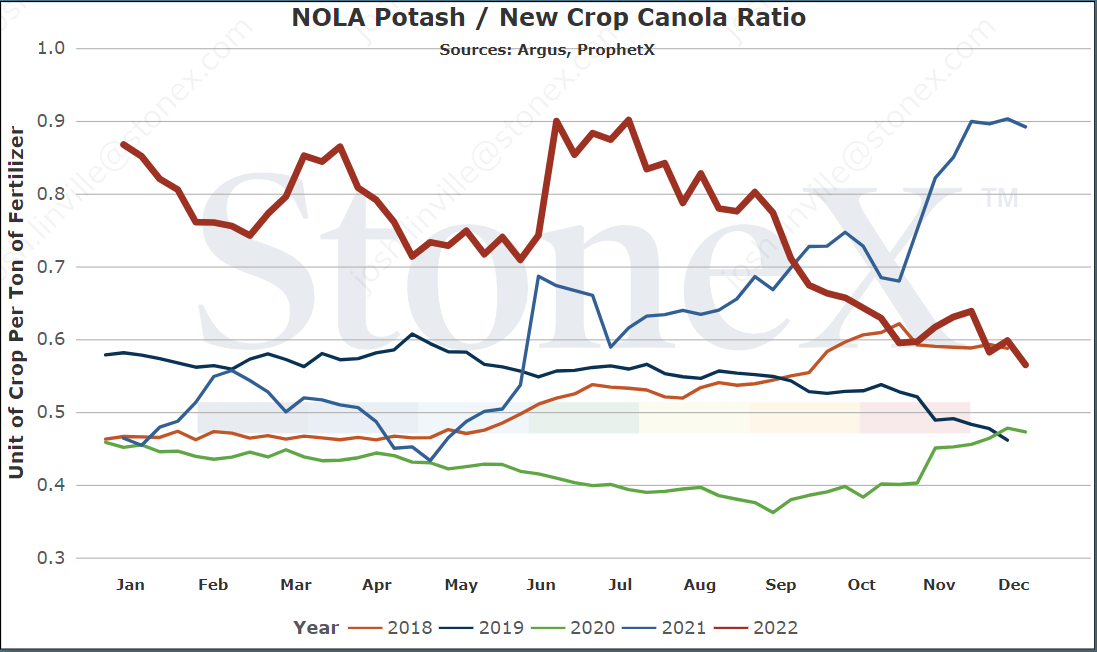
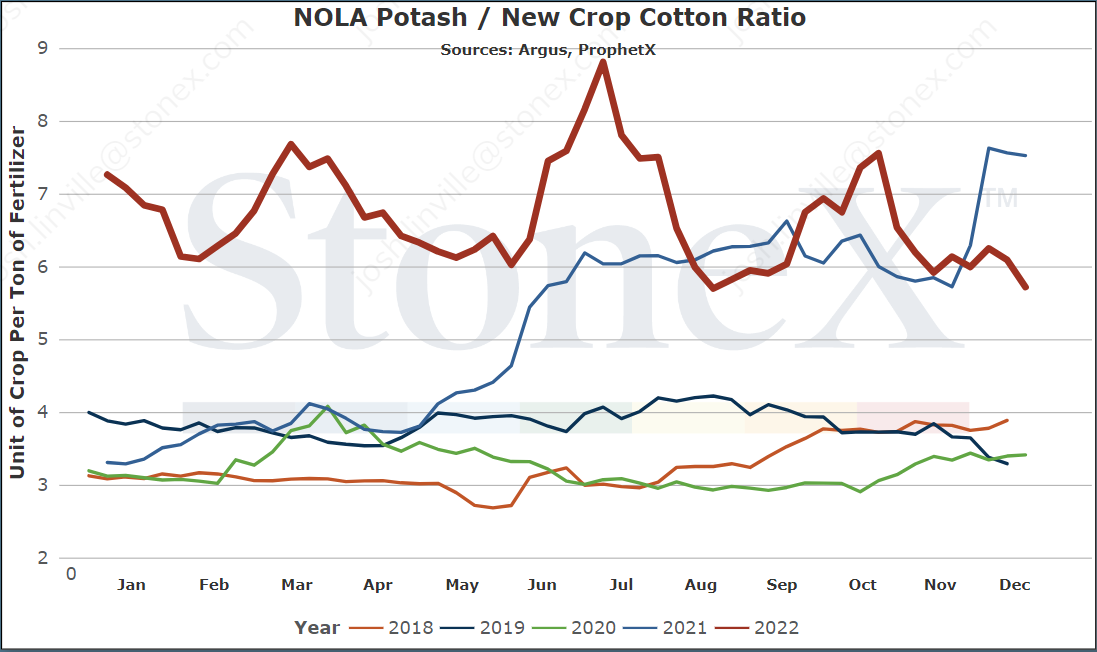
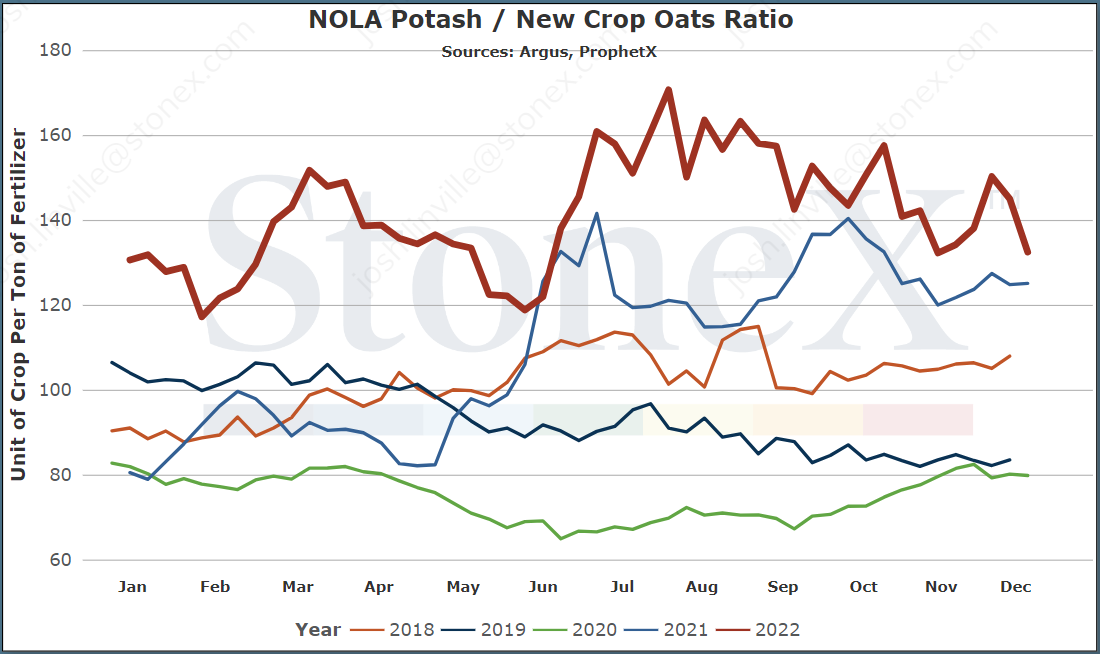
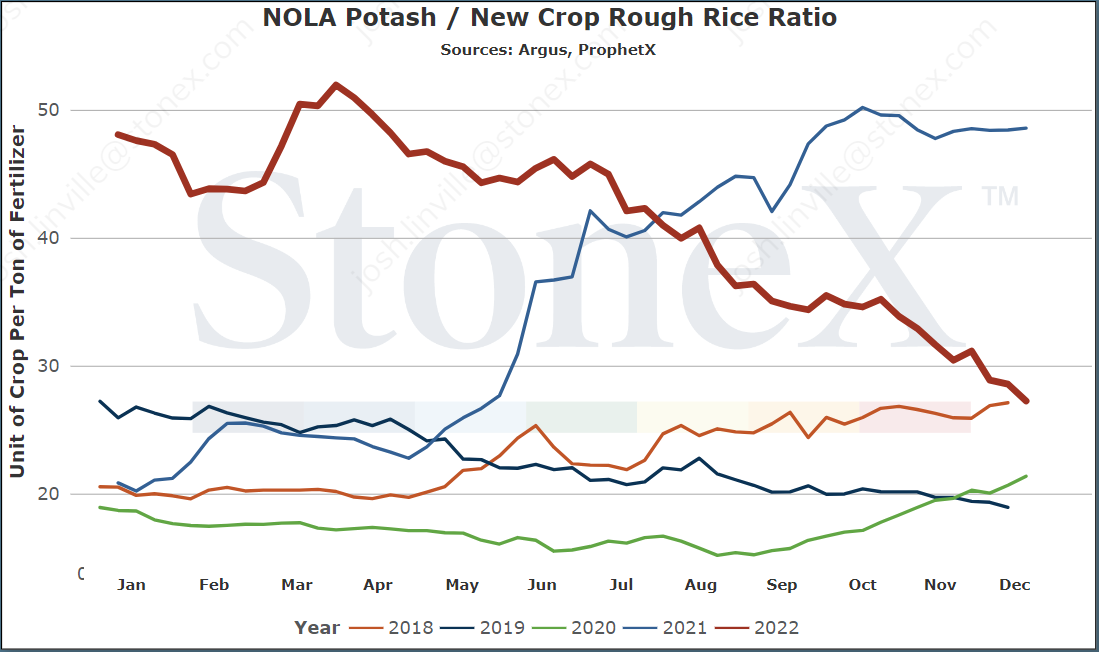
If you look at the ratio graphs below, you will see several of them are either back within recent year ranges or very close to it. Just focusing on December '23 corn, that price has risen from sub $6 when those ratio graphs were created to current $6.07 at time of this writing which improves it that much more. While demand is still not going to be thrilled with the overall flat price, I think many will see the value in it and step forward for their spring needs at normal application rates.
If this storyline holds true, I think we could see a demand wave that helps support price ideas thru spring season. Once past spring, it is likely that we resume the decrease in price ideas but shorter term, support should loom.
Should you lock in spring '23 potash needs today?
If these numbers work for your balance sheet, I would be locking in
That statement does not guarantee that potash prices will not slide more from where it is today. That is a real possibility. However, there are a few factors that would be driving my feeling:
- Potash manufacturers are starting to take steps to lower production rates to balance the market
- Still a lot of perceived farmer spending to be done for year end/beginning
- Current grain/potash ratios are significantly improved which should drive better demand this spring
- Feels like a lot of normal fall demand has been waiting and could overload spring logistics
- North American farmers still need to be worried about logistics
As mentioned above, I cannot say for certain that there will not be a bit more of a dip. For the year, I am still overall bearish. That said, I think there is a lot of spring demand coming and when that dam breaks, watch out. Not saying that prices skyrocket back to the high's but I could see support/push higher.
What has happened in the last 30 days?
Large North American potash manufacturer announces production curtailment
In a sign of the times, a large North American manufacturer has announced a short term production curtailment at their mine in Colonsay. Typically, I would view that move as their needing to make repairs/changes which would slow production. This mine was only recently brought back online after another of their mines flooded sooner than expected. However, the wording was much more geared toward a need to balance the marketplace. It is another reason to believe that fall demand failed to meet expectations.
The fact that values have continued to fall since the announcement is another reason to believe the global potash market is way out of balance (too much supply). We also need to keep in mind that if they are willing to take that step, other producers may not be far behind. If further announcements come soon and demand hits as we are expecting, it could be the thing that starts turning this market higher once again.
General Global Potash Information
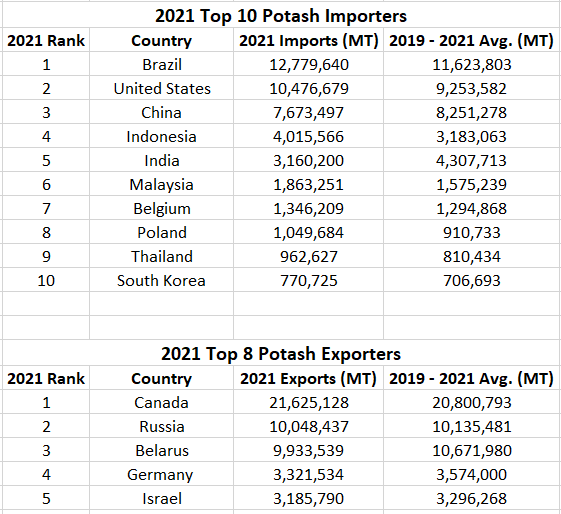
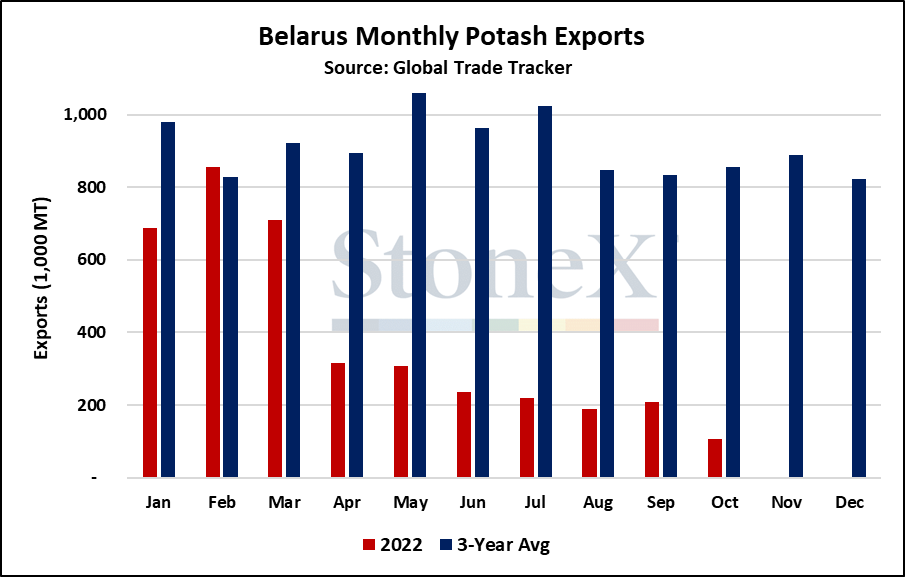
Belarus (world's number 3 exporter) continues to struggle with exports
This is a story that I just cannot ignore. As mentioned over the last several months, Belarus supported Russia in their invasion of Ukraine. That forced Lithuania, Belarus's channel for global exports, to shut their borders to Belarus and as a result shut down their potash exports. Now that Russia is taking very minor steps toward peace talks (far from the invasion being done), the possibility that Lithuania will open its borders again is coming around. Far from happening, but captures our attention.
However, that is all hope and hope is never a strategy. Today, the potash world continues to lose the 3rd largest exporting nation in the world. Trade data thru October continues to point to much lower than average exports with the majority of their exports going to China.
Even without their tons, the global potash market continues to see prices under attack. If peace talks end up resulting in a return to normal and Belarus is allowed to resume shipments...watch out.
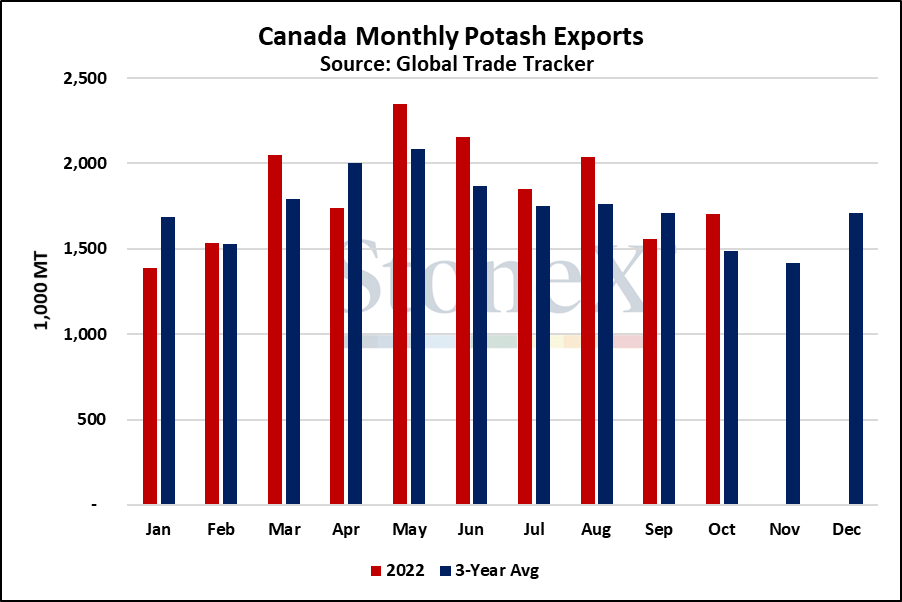
Canadian producers are taking advantage of Belarus being cut out
Canadian/North American farmers may be asking why domestic values are not falling even harder than they already are. Part of that answer comes from the ability to export more potash than the last few years.
The loss of Belarusian product opened a demand hole that Canadian producers were well equipped to take advantage of. While the North American market has been choking on supplies after a perceived poor fall run, producers have been able to pivot slightly to more exports to clear tonnages.
I understand the frustration but this is a free market at work. Canadian producers have been pivoting the same as we all do.
Is a demand wave coming?
This is the question I continue to ask myself. The price trend has been lower for several months in a row which leads many to believe that buyers will sit on the sidelines even longer because no one wants to try and catch the falling knife.
However, I'm starting to think that a small rebound is coming. Even with prices down several hundred dollars, the historical charts show today's values as being far too high. With that, why would I ever think a turnaround is coming? Because grain prices are also historically high.
When you scroll down to the grain/potash ratio charts, you will see many of them are back within recent year ranges. If they are not, they are pretty close. That indicates that today's prices are getting much more attractive and should help drive more demand.
Many in the supply side of the marketplace are likely numb to the market. Demand is down. Prices are falling. It will always be this way. However, if/when that demand wave hits, it will build excitement and with that, higher price ideas.
This does not take into account what could occur if demand surges past expectations this spring. Fall demand is down. To what extent is still being figured out but if that demand reemerges in the spring on top of "normal" spring demand, it could overwhelm just in time logistics.
This is all a bit of speculation on my part but as the prices continue to improve on both sides, I think it is something we need to be concerned with.
North American logistics continue to keep inland values higher
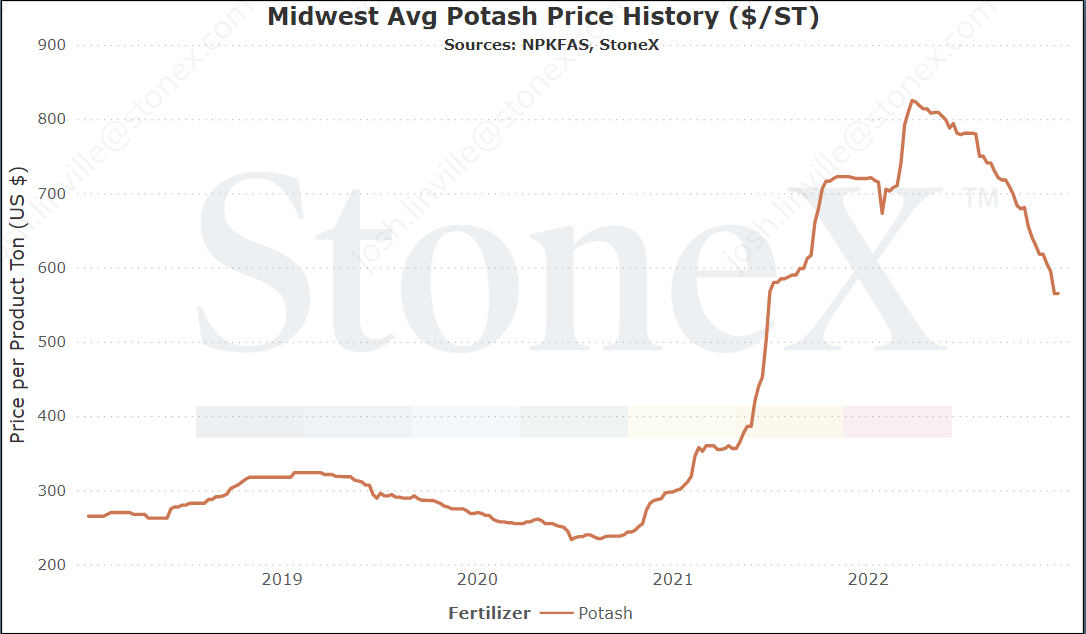
Similar to other fertilizer products, North American farmers/retailers have been frustrated by the lack of price drop compared to NOLA/world values. Unfortunately, logistics continue to struggle to keep pace.
While the rail strike is coming to a peaceful end, there are still plenty that point to slow deliveries and lack of cars to move product. Trucker availability and cost is a situation that gets worse by the season. River systems, whose water flows have improved but are still very low, continue to slow progress and raise freight rates.
Ultimately, this boils down to a simple explanation: it costs more and takes longer to get product into place.
This is going to sound odd given that winter feels like it will take forever to end today but spring is right around the corner. In fact, March 1 is only 2 months away. Not only could we see a demand surge but logistics are struggling more than usual. It is a big reason I'm turning a corner and saying we should be looking to lock in our spring needs and a big reason why inland prices are more sticky than its global counterparts.



 Where are current values in relation to the past