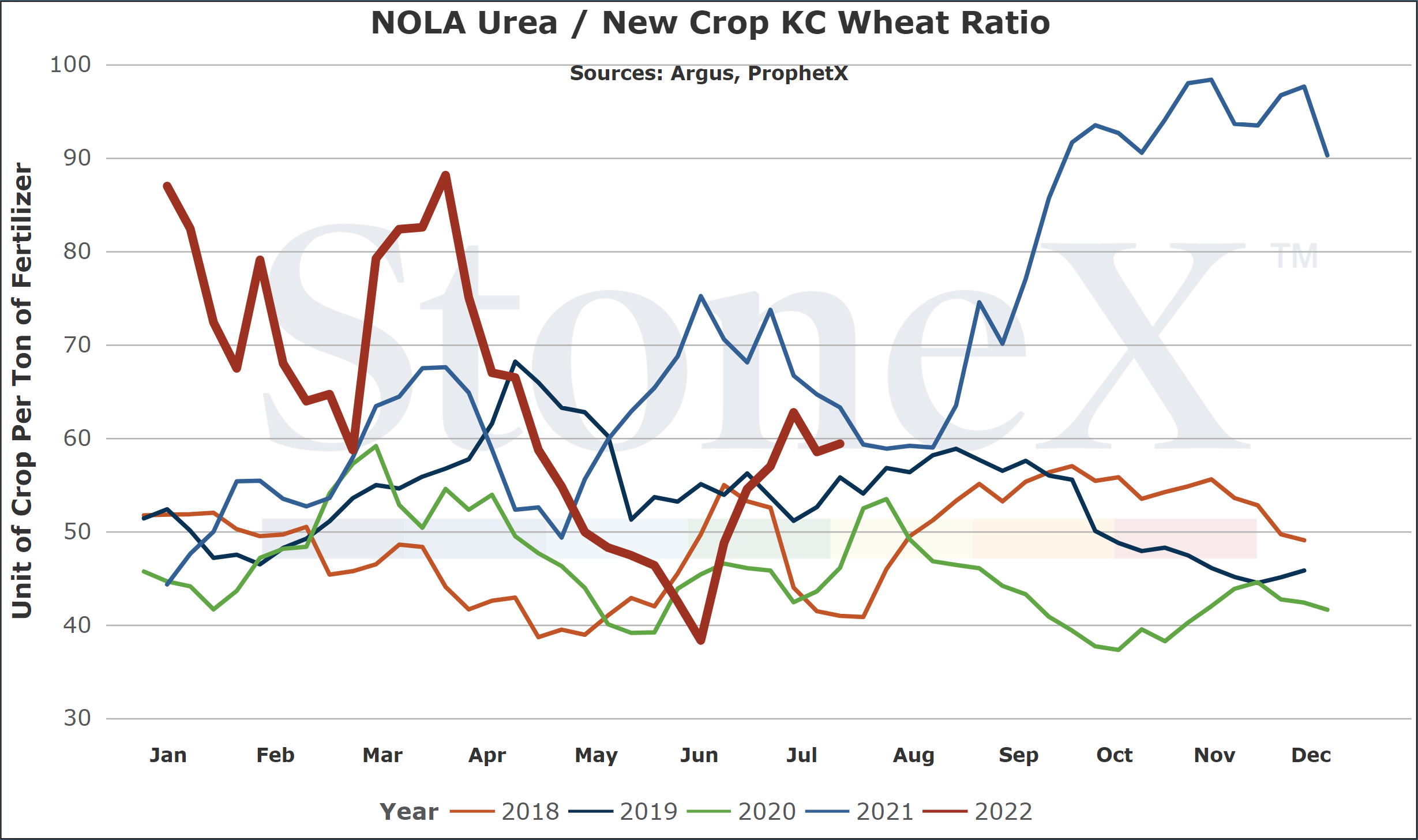
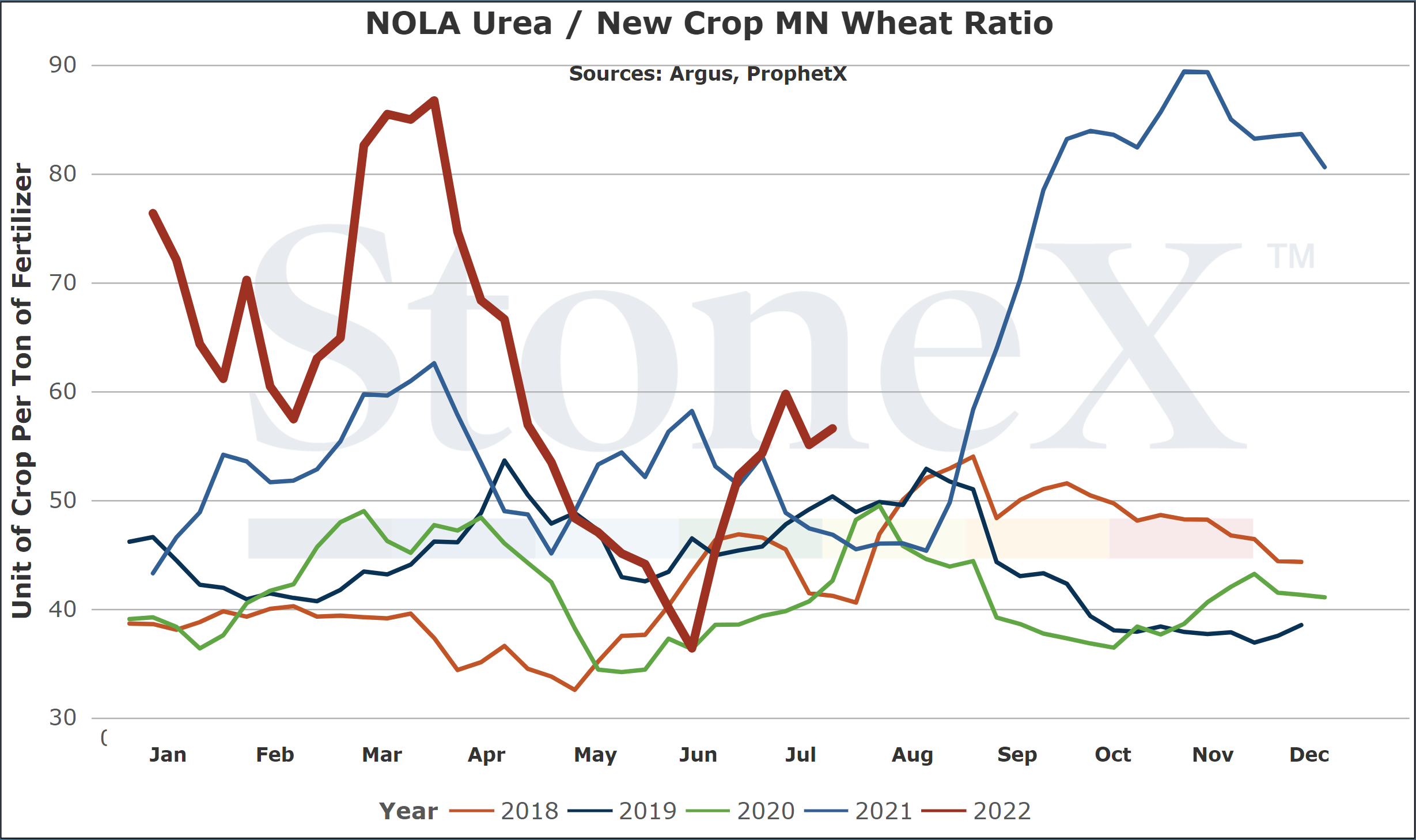
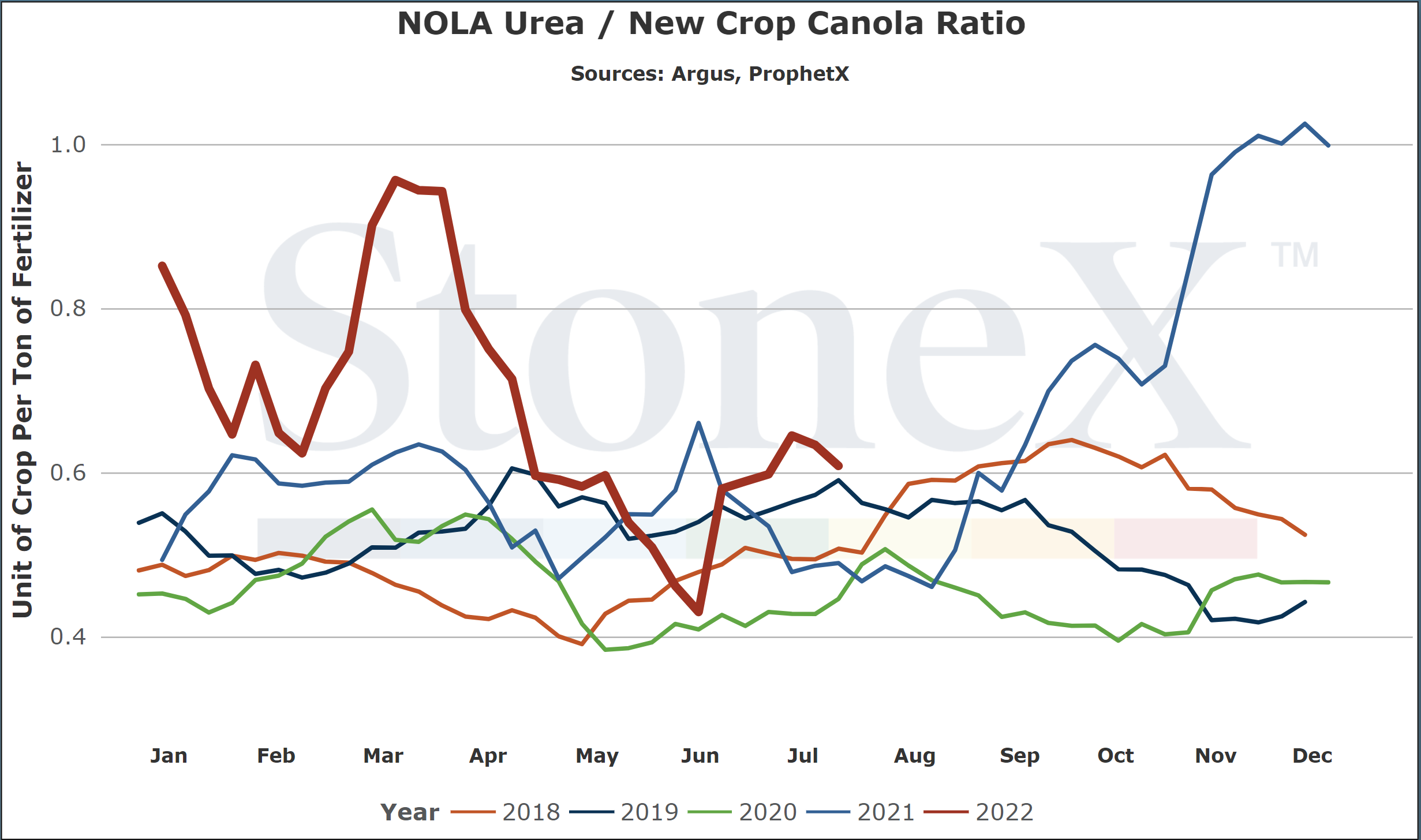
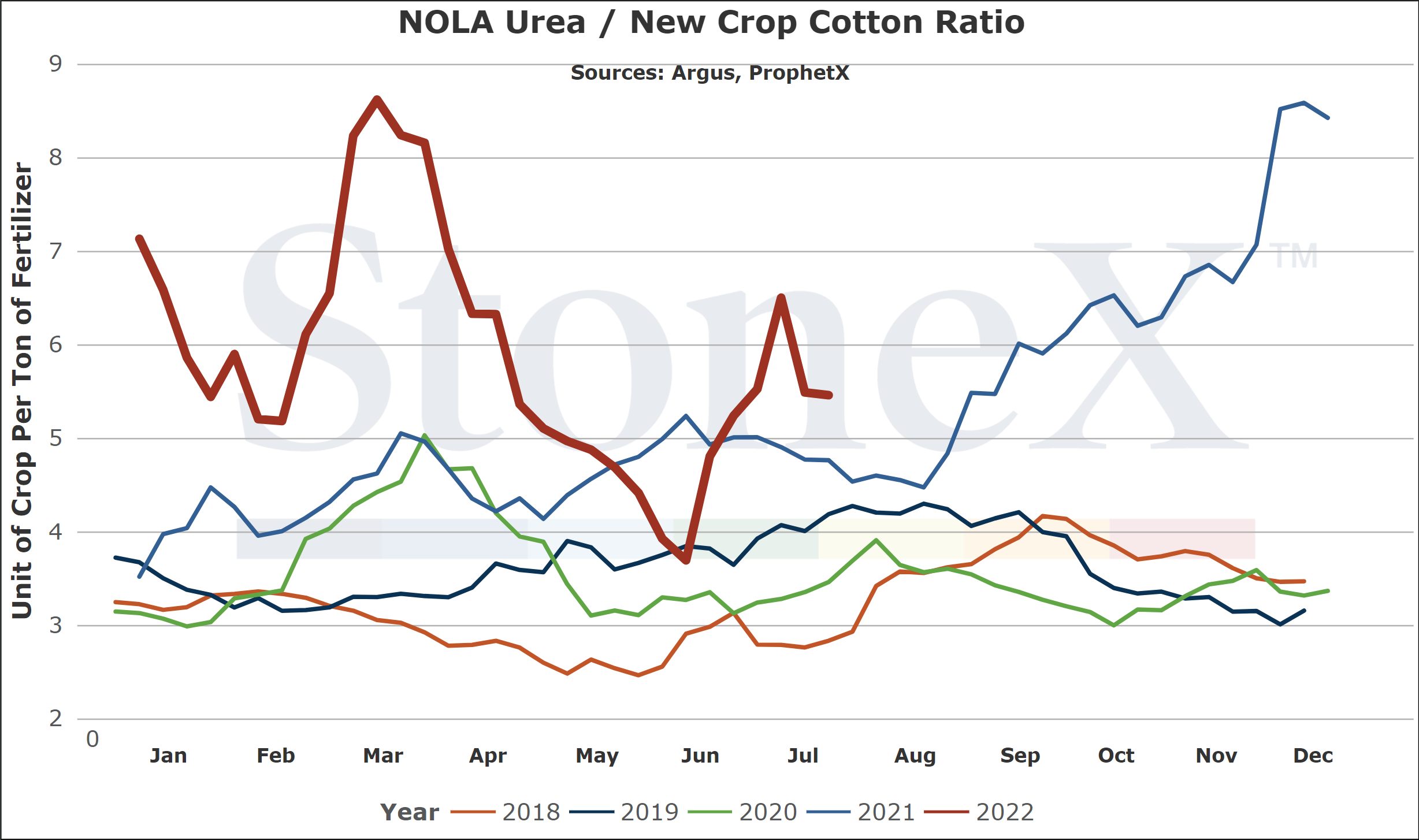
What everyone wants to know first, what do we think will happen going forward
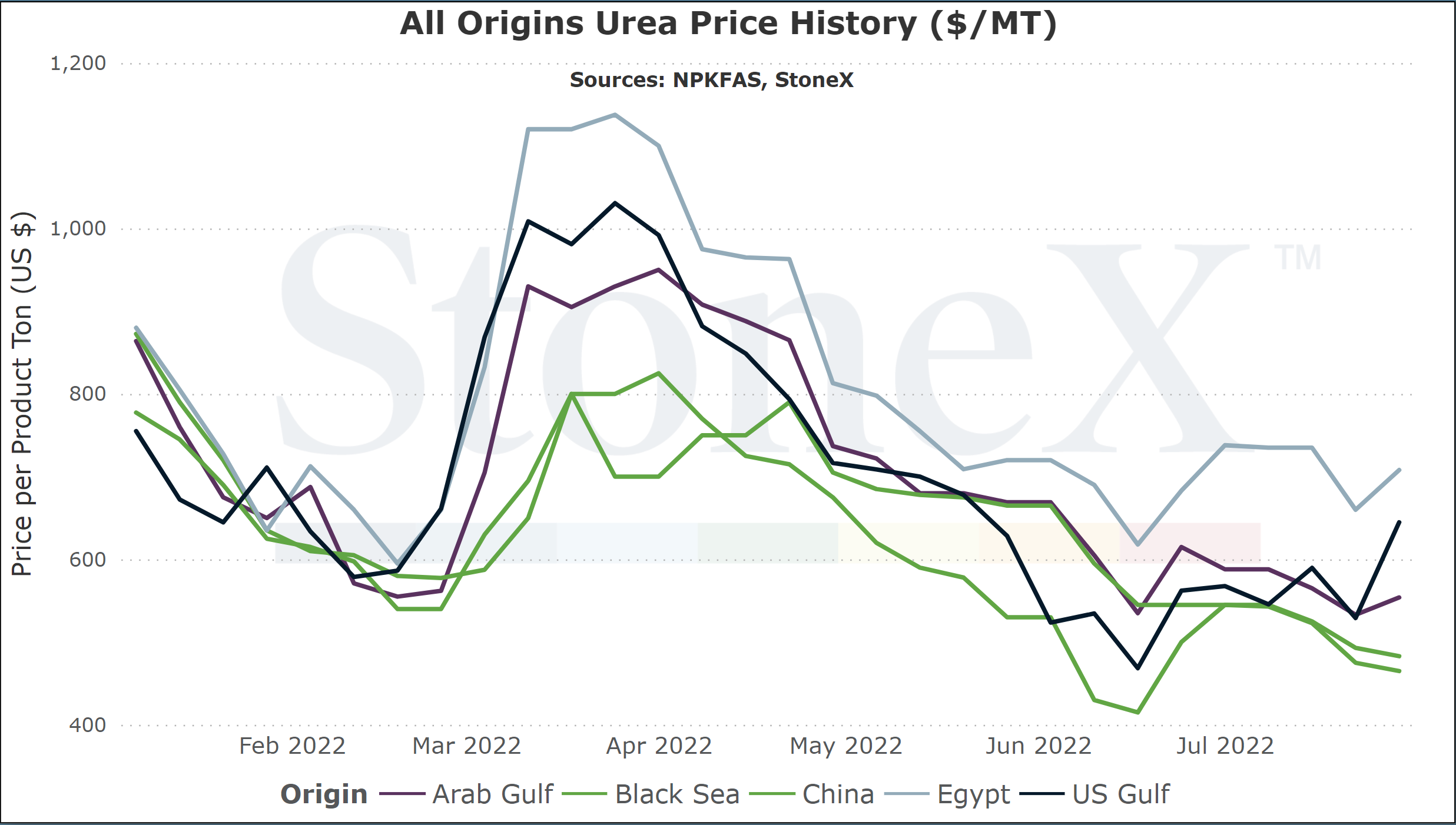
Global urea values hit a low with the recent India purchase tender...but it looks like prices are strong going forward
The surprise of the last 30 days was the results of the India purchase tender. When they announced, they stated that they were only going to purchase 500Kmt, not the 1.5Mmt that many in the market expected. As a result, a single trading firm ended up offering a very low delivered price to both the west and east coasts of India which all other offers had to match to participate. That lowered global price ideas.
Since then, the market is starting to turn a very big corner. Egypt has been successful in selling several small blocks of tons at ever increasing prices. Middle East producers have also been selling product to traders at higher netbacks.
This turn has happened in the last week so we are seeing major weekly price ranges. If we were to use the ending week values, we would see prices higher since last month.
Now, with so much focus on the European natural gas situation, it seems that higher prices are still on the horizon. I know that situation can change in a hurry but given the information today, the world has every right to fear losing more European production. Their costs are well above the current market which means if they lose government support or byproduct markets tank, more production plants could be on the chopping block and the world can ill afford to lose more supply.
N.A. urea values have been cheap enough to see major export flows which means NOLA needs to rise further
While the arbitrage opportunity may have closed, NOLA was cheap vs the world long enough to see major exports flow to the world. One of the major bear points since spring was the heavy inventory carryover which was going to act like an anchor on the market. It seems that anchor has been cut loose, allowing NOLA values to rise once again.
If exports have happened, they can certainly happen again...even if N.A. farmers refuse to purchase. If world values do start rising rapidly, NOLA could be hesitant to move with it. In that situation, exports will flow once more, taking prices higher with it.
Like the rest of the world, N.A. needs to be very weary of the European situation. What happens halfway around the world matters here at home...
Should you buy your spring '23 urea needs today
Start layering
I say this knowing full well that under the right circumstances, we could see values lower. It just doesn't look likely today. 8 months is a long time for things to change but for the short term, things look bullish.
This Russian invasion does not look like it is going away anytime soon. It also doesn't look like Russia's clamping down on natural gas flows to Europe is going to change either. This is what is front of my mind today and what worries me the most. While fertilizer production is going to stay very high on the list of natural gas importance, if flows/supplies are cut enough that governments need to decide if limited product goes to people or the industrial sector, we know the flows will go to people.
With that info in hand and I am a farmer, I would be considering locking in a portion of my needs. Not sure I would be bold enough to lock in everything for next spring without locking in grain as well but would certainly consider a portion.
What has happened in the last 30 days?
N.A. seems to be solving its long position situation
Last month, we talked about how N.A. felt as though it was working thru a very long inventory situation following a less than stellar spring run. That meant that NOLA values were going to be lower vs the world until that situation resolved itself.
That situation may has resolved itself in the form of exports.
It will take a couple months to find out just how many tons departed U.S. shores. The import/export information is delayed 60 days. However, if rumors are true, the export number is going to be big.
This is a win for producers/suppliers who had been choking on their positions on the rivers. However, it doesn't do much for tons still sitting in bins. That is a fear that might play out later in the fertilizer year. If the market comes to the realization that a decent portion of warehouses are already partly full from spring carryover, we could see the market get uncomfortable again.
Today, there is little worry about that. The main focus remains on Europe. If the globe shoots higher with further production downtime or renewed demand, NOLA could be in line to see yet another round of exports occuring.
India disappoints sellers
July/August is typically a very slow period for global demand. This year, most of the market expected to see India step in for 1.5Mmt which would go a long way in mopping up excess length.
Well, the announcement finally came and gave a shot of adrenaline to the market...until the details were released.
India was indeed going to buy a solid chunk of product, but the total number disappointed. When the announcement was made, they stated that they would only be looking to purchase 500Kmt or a third of what we thought. That meant that sellers would need to get aggressive to make sure they were on the lower end of prices offered to give a guarantee that they got to sell. Get aggressive they did.
In the end, lowest offers were made in the $517 - $520 range for east coast/west coast delivered which beat the low end of most expectations and lowered global price ideas.
Once the purchase concluded, conversations quickly turned to the next purchase announcement as it seems they still have nearly 1M tons to buy....
European natural gas values equate to stupidly high cost of production
As of this writing, the Dutch TTF price was in the high $50's thru January '23 and in the $50's thru March '23. That puts European production that has to pay those values cost of producing urea well above $1,000USD. Obviously, the world market is not nearly that high priced today and means that we remain extremely worried that more production will be lost.
Part of the reason more production has not gone down is government help. Whether it be announced or not, this is a situation that has been happening. Governments are well aware of the importance of N inventories to grow a crop to feed its people. Having enough food for your citizens remains the single most important factor. Another part is N production byproduct markets. Anything/everything that can be sold from the production of N will be sold and some of those markets remain sky high which helps to offset production losses.
From my POV, this remains the single biggest story for the time being. It looks like Russia has very little interest in returning to normal flows. The world will do everything it possibly can to help alleviate the loss (natural gas being shipped, NH3 being shipped to inject into Europe production plants, etc.). Unfortunately, at the end of the day, only so much can be done.
Nothing new from China
Another month has come and gone with no new news from the Chinese government regarding urea exports.
In recent years, China has accounted for approximately 10% of the global urea export volume or 5 - 6M tons per year. Since last fall, the government has banned the export of N in an effort to ensure adequate supplies for Chinese farmers as well as lower than global prices. Since then, we have seen China loosen the restriction on phosphate (had the exact same ban)...but not N.
Unfortunately, from my POV, urea more represents energy than phosphate does. Obviously phosphate is an energy but it is mined. Urea requires inputs that can be used in other sectors and so I could see them remaining cagey on lifting that ban even a little.
In the end, it is China and very few to no one outside of China knows what they are going to do. We need to continue to monitor them for any changes. As long as the ban remains intact, global supplies are tight. If they return, it injects several millions of tons per year.
N.A. urea looks good vs NH3 / great vs UAN
Now the North America has its values on current urea, summer fill UAN and fall NH3 prepay, we can finally start comparing to see where each sits.
For these comparisons, I am using:
- NOLA urea @ $585 or $0.636/lb of actual N
- NOLA UAN @ $395 or $0.617/lb of actual N (hearing rumors of values rising but not convinced yet)
- Midwest NH3 @ $975 or $0.595/lb of actual N
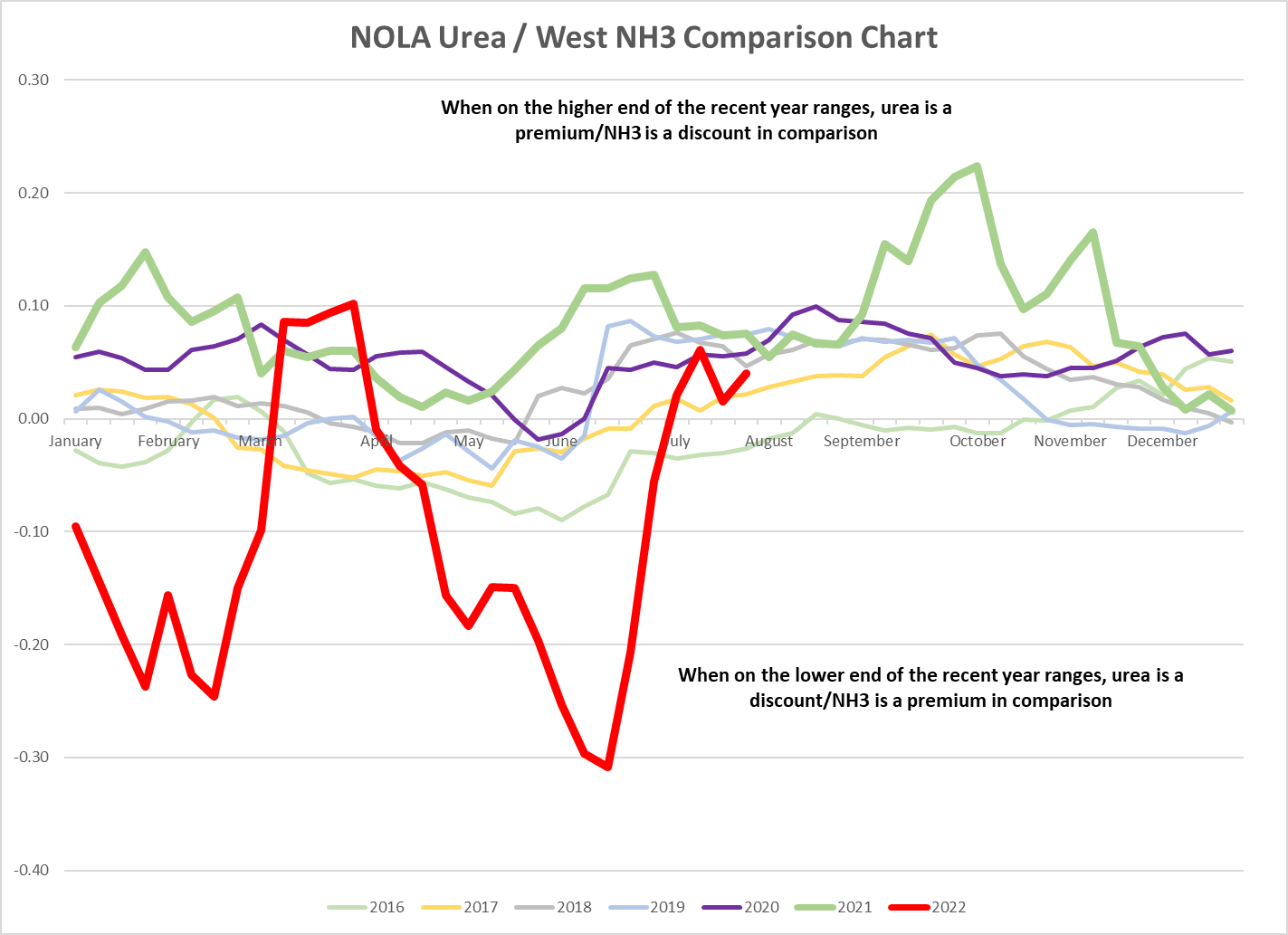
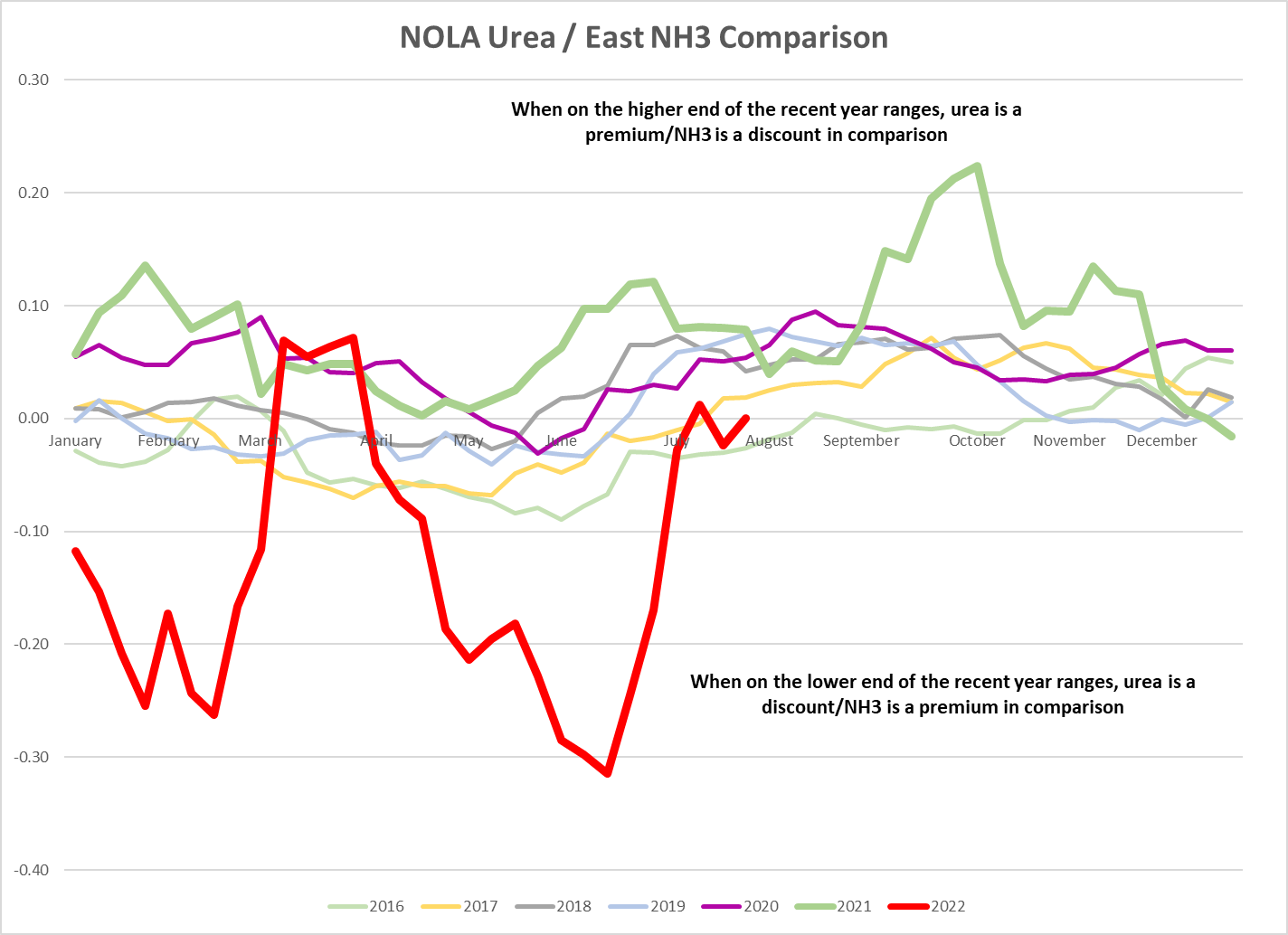
Today, the price difference between NOLA urea and NOLA UAN sits with urea being a 2 cent premium. The graph below plots the price difference between urea and UAN over recent years. Urea being a 2 cent premium is right in the middle of where it should be today vs historical.
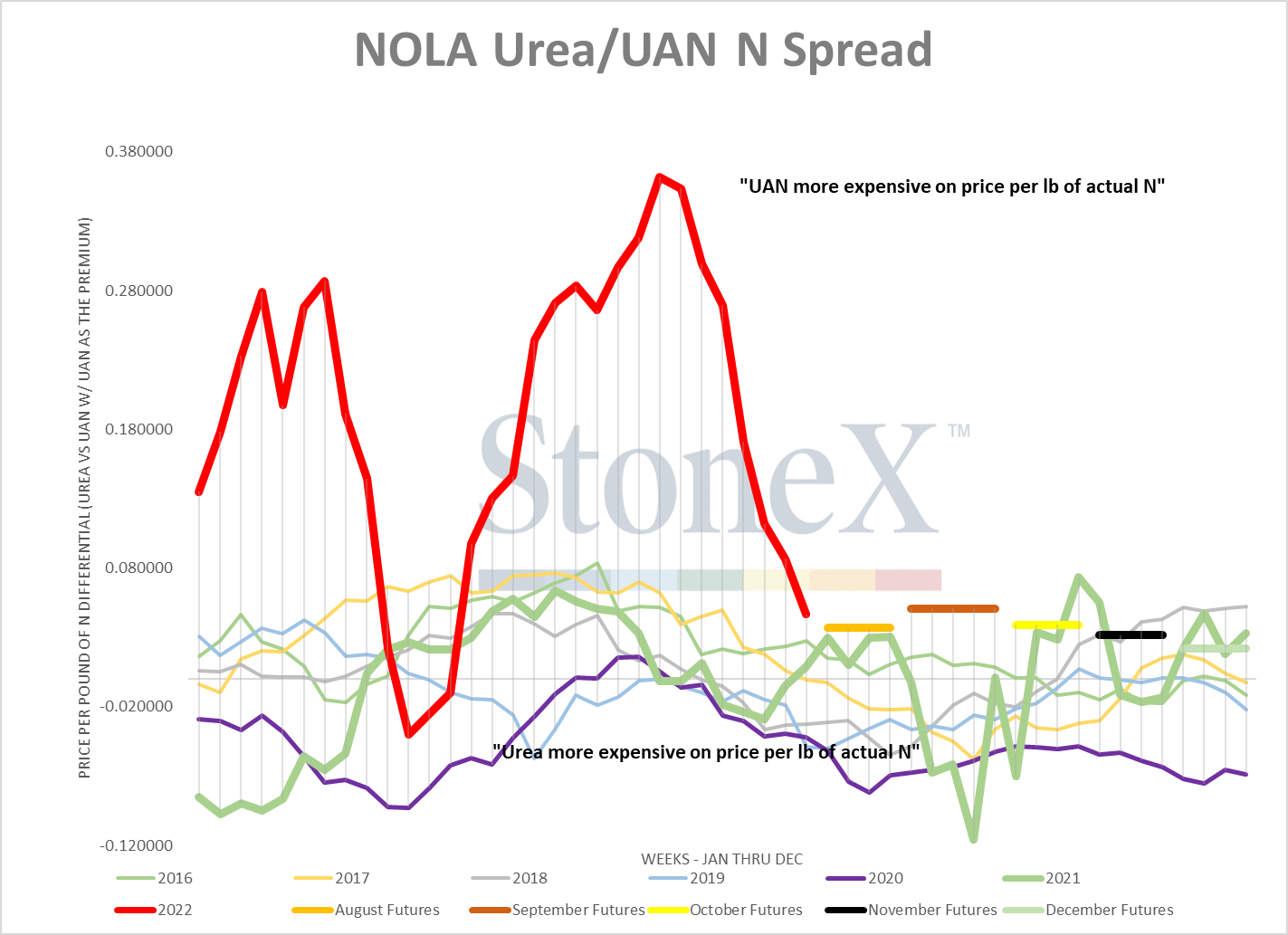
The price difference between NOLA urea and Midwest NH3 sits at 4 cents with urea being the premium. Again, looking at the chart comparisons below, that is right about where it should be.
So today, nothing really stands out as being "out of line". UAN was originally priced well above urea but the recent rally in urea pricing saved it.
N.A. urea production should be higher this year with CF losing the UAN duty case
In the shock of a lifetime for the fertilizer world, CF lost its counter vailing / anti-dumping duty case against Russia/Trinidad produced UAN imports. All, this simply does not happen when you look at the history of these types of cases. That no longer matters because it did happen which will allow imports to flow freely once again.
In the last year, N.A. producers had leaned their production more toward UAN and less toward urea with UAN imports blocked. UAN was a premium price and there was a big shortfall of supply that they wanted to capitalize on.
No, with these imports coming back, there is no need to move everything toward UAN. More urea being produced means less of a need of imports now thru June '23. We will still be an importer, just not at the rate at which we have been accustomed to.