INTRODUCTION
The corn ethanol industry has been consolidated in the US for years. The country is the largest producer of ethanol from this source in the world and practically all its output is made from grain. In Brazil, on the other hand, despite having a long tradition in sugarcane ethanol production, corn-based production is something relatively new. It was only in 2012 that a plant started using corn to produce ethanol in the country.
However, despite being recent, the activity has grown exponentially over the last few years. In the 2014/15 sugarcane season in the Center-South (Apr/14 to Mar/15), the region produced 84,800 m³ of corn ethanol, while in 2021/22, production reached 3.5 million m³.
The production of fuel from corn has been significant to supply the domestic demand for ethanol, especially in years of crop failure or when sugar is more attractive compared to alcohol. In 2014/15, its share was only approximately 0.3% of total production in the Center-South, while in 2021/22 this level reached about 13%, a figure that should increase due to the expected growth in production capacity.
STIMULATING FACTORS FOR CORN ETHANOL PRODUCTION
The advance in production took place mainly in the states of Mato Grosso and Goiás, which is closely linked to the surplus of corn production in the region, especially that produced in the winter crop. With the combination of this scenario marked by corn surplus and the logistical challenges faced by the region, the price of corn in the Center-West tends to present a significant discount in relation to producing regions closer to the ports or the main consuming centers. As such, the high availability of corn in the region and the more attractive price compared to other large producers has helped to ensure sustainability and keep the activity attractive in the Center-West, stimulating the increase of ethanol production in the region.
The Center-West handled about 97% of national corn ethanol production in the 2021/22 season, with Mato Grosso alone having a share of 86%, while Goiás was responsible for 11%. Mato Grosso do Sul is not yet a reference in the industry, but major projects are underway and in the coming seasons the state should reach a prominent position on the national scene.
In addition to the high availability of corn, its use for ethanol production has some other favorable points, such as storage time and the plant's operation period. While sugarcane needs to be processed in a brief period after harvesting, corn can be stored for longer periods, allowing for more constant production throughout the year. In addition, the possibility of storage allows mills to buy the product at a time that it considers most advantageous, expanding the possibilities for its strategy structuring.
Another point that has contributed to the activity is that the corn ethanol generation process produces by-products, particularly Distillery Grains (DGs), diversifying the plant's sources of revenue and minimizing its risks. Even at the height of the pandemic, when the ethanol industry experienced a combination of unfavorable factors for investment in the activity, such as uncertainties related to consumption, production continued to increase, as sales of corn ethanol by-products kept a positive profitability for plants.
LIMITING FACTORS TO THE GROWTH OF CORN ETHANOL PRODUCTION
In ethanol production from sugarcane, bagasse is used as a source of energy, while in production from corn, this is not possible. In Brazil, one of the most viable feedstocks for the process is woodchip, obtained from wood processing. Therefore, for a standalone plant to be installed (one that only produces corn ethanol), it is necessary to have a wide supply of raw material to generate the energy demanded by the process.
In flex plants (which can produce ethanol from sugarcane or corn), cane bagasse can also be used, which helps to explain why this type of plant appeared in the early period of corn ethanol production expansion. Currently, the number of dedicated plants is already greater than that of flex plants, but the issue of energy source is still a point of attention.
Although the sector has been taking a more relevant role in corn consumption, the use for animal feed continues to be the main one in the country. In this sense, the growth of herds and, so, the growth of demand for corn can be an unfavorable factor for ethanol production. On the other hand, Distillery Grains (DGs), the main by-products of the process, have the potential to be inserted in animals' diet, and contribute to the attractiveness of production.
CONTEXT OF THE FUEL MARKET IN MATO GROSSO AND GOIÁS
According to the National Supply Company (Conab), in the 2021/22 crop (Apr-Mar) Mato Grosso accounted for 83.5% of corn ethanol production in the Center-West region, with 15.1% in Goiás, and the two states together produced 98.6%. Naturally, the location of plants closer to the corn producing regions reduces operating costs and improves the ethanol flow to distributors in the cities of Mato Grosso and Goiás.
The 2022/23 cycle should be the 10th with ethanol production from corn and, since 2014/15, there has been an average growth of 79.3% in production per year, reaching 3.47 million m³. This expansion of the sector is reflected directly in the structure of the alcohol market in MT and GO. In 2018/19, corn ethanol accounted for 32.8% and 3.9% of total production in Mato Grosso and Goiás, respectively. In 2021/22, this share rose to 74.7% and 7.3%, showing how, especially in Mato Grosso's supply, corn already accounts for a good part. In the state of Goiás, the share of alcohol from corn is less relevant due to the smaller number of crushing plants compared to MT, but also because it is the second largest producer of sugarcane ethanol and the third largest producer of sugarcane, in the Center-South.
The supply of fuels in the Brazilian Center-West also has some logistical difficulties, mainly since it is a region further away from ports and refineries. Structurally, the supply of gasoline to the region faces difficulties and, consequently, prices are higher. On the other hand, ethanol production only covers Mato Grosso (due to the corn ethanol market) and Goiás, causing these two states to have a parity (ratio between ethanol and gasoline) historically below 70%, which favors consumption of ethanol. That is because gasoline supply, as mentioned, is lower, but ethanol has higher volumes offered to gas stations.
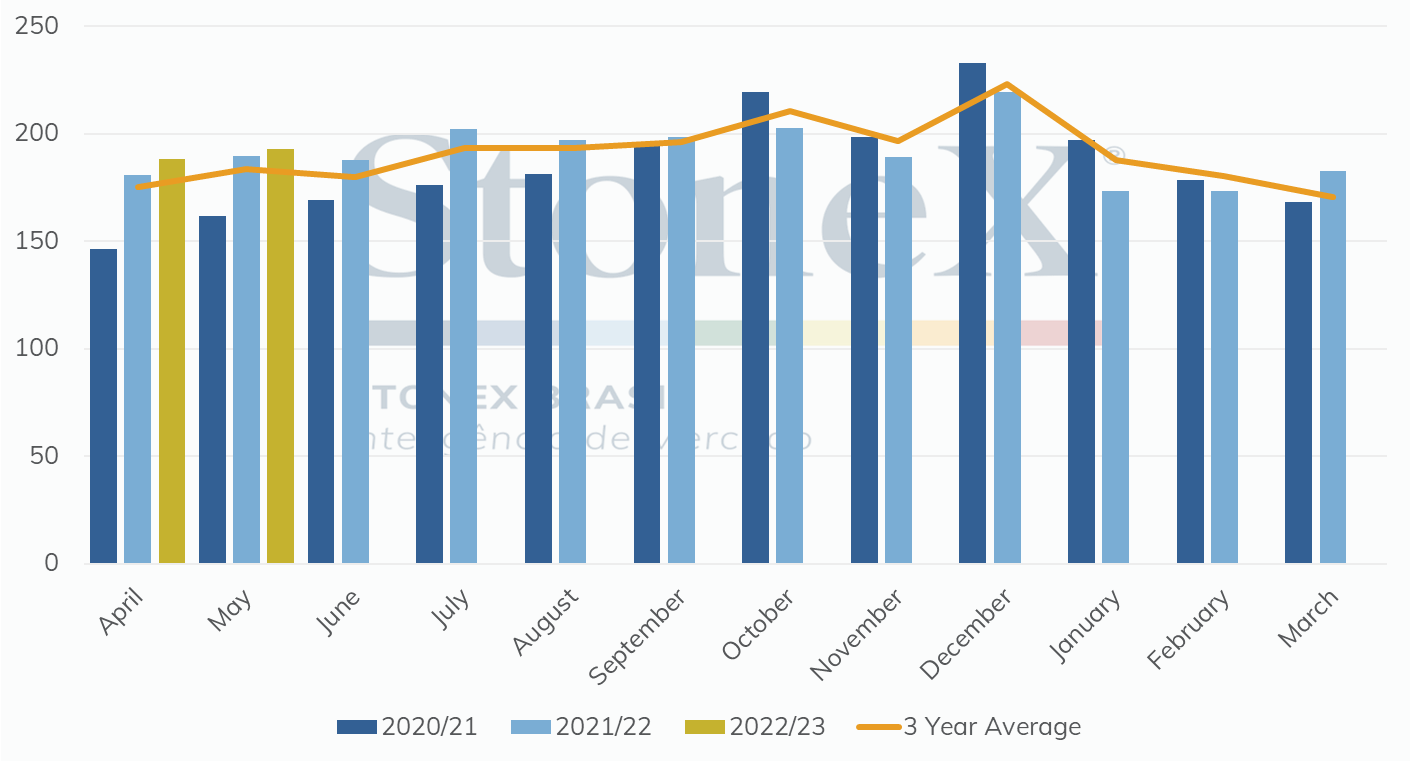
The growth in fuel demand in both states has been detached from the aggregate of the Center-South states, that is, it has been above average, precisely because of the generally higher growth rates in the Center-West over the last few years. According to data from the National Agency of Petroleum, Natural Gas and Biofuels (ANP), the two states together accounted for 9% of Otto cycle fuels consumption in 2021/22 (Apr-Mar), but the highlight is consumption of hydrous ethanol. In 2014/15, 11.9% of demand for alcohol in the Center-South came from MT and GO and, in 2021/22, this share was already 15.7%, causing the dynamics of the two states to affect each analysis for the search for Otto cycle fuels across the region. Furthermore, it is a direct consequence of sustained parity at attractive levels for ethanol, influenced by the exponential growth of corn-based production.
OTTO CYCLE FUELS CONSUMPTION (000 M³)
Source: ANP. Design: StoneX.
OTTO CYCLE FUELS CONSUMPTION IN MATO GROSSO (000 M³)
Source: ANP. Design: StoneX.
In this sense, parity between ethanol and gasoline already approached 50% in mid-2018 and operated below 70% in these first months of the 2022/23 cycle in Mato Grosso, for example. It is curious to analyze the very structure and lack of competitiveness of gasoline in those Center-West states where supply of ethanol is greater, something unusual in the rest of Brazil. In São Paulo and, to a lesser extent, in Minas Gerais, Otto cycle fuels behave in a way that reflects a parity that tends to be balanced at 70%, mainly in the gas stations of São Paulo, where supply of ethanol is the largest in the country, in the biggest sugarcane-producing state of Brazil, but the cities are also close to refineries or ports. In northeastern states, in contrast, or even in Rio Grande do Sul, the parity has been above 80% historically, due to the barrier of the fuel chain in obtaining greater competitiveness in ethanol prices, due to low availability of the product in these locations. In MT and GO, the picture is opposite: ethanol has a very expressive share in Otto cycle fuels consumption, responding to parity relatively below 70% in the historical series.
PARITY BETWEEN ETHANOL AND GASOLINE
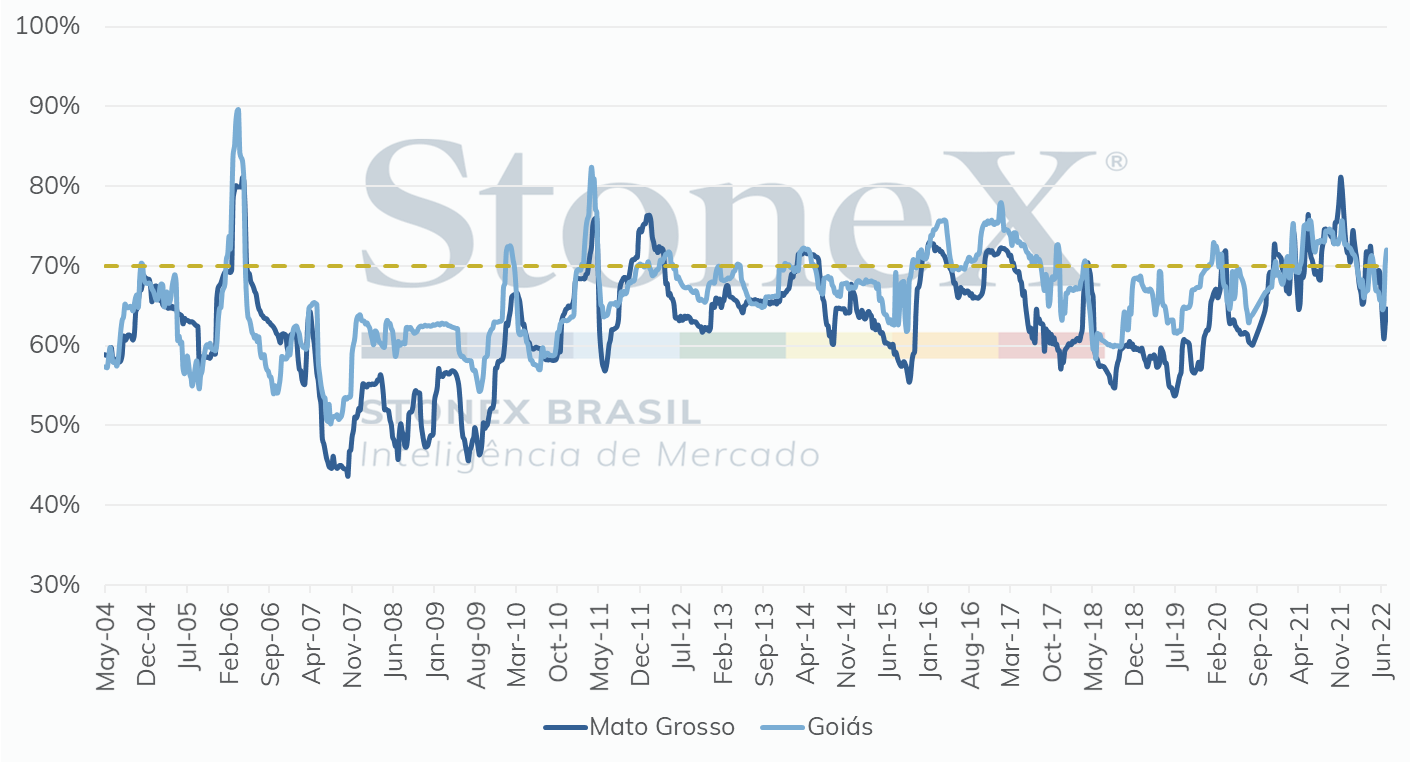
Source: ANP. Design: StoneX.
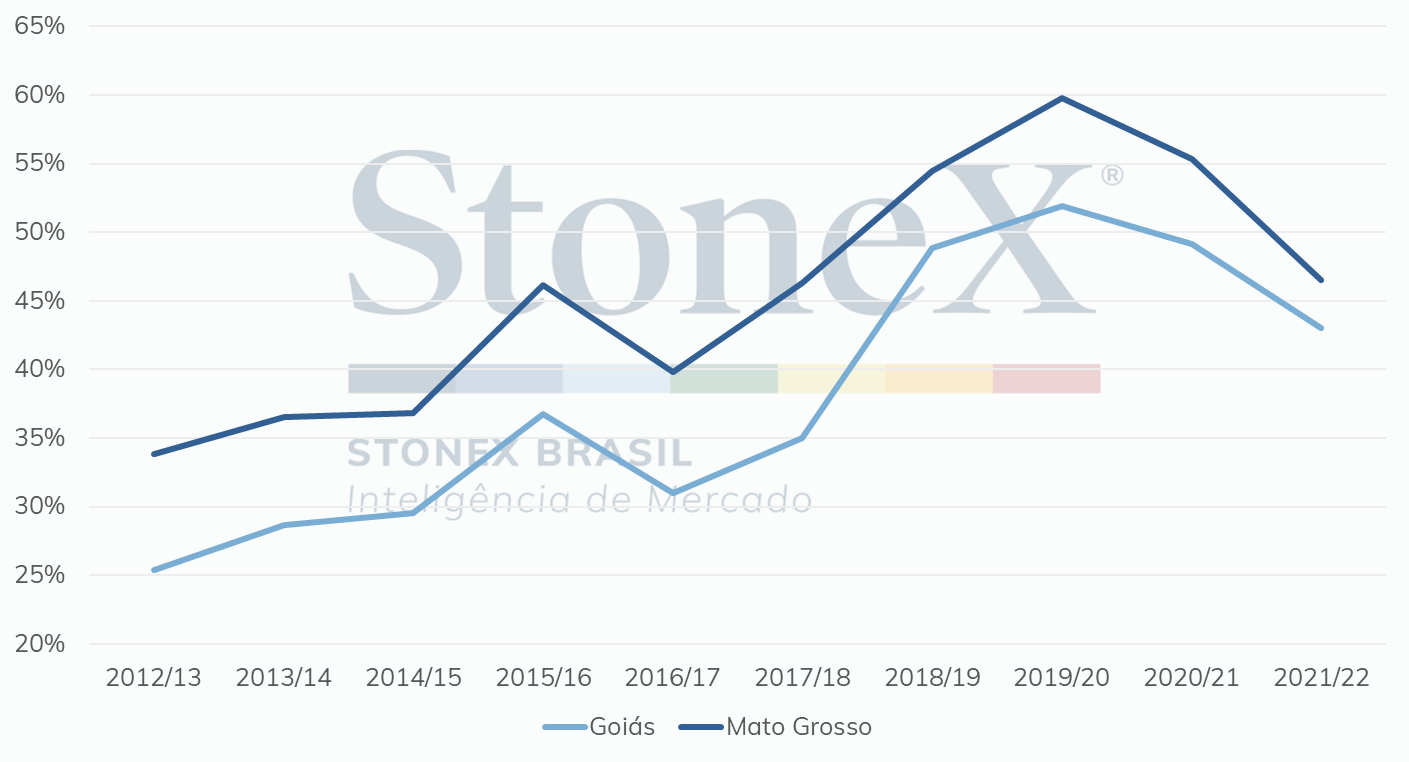
The expansion of the corn ethanol market in the states contributes to this scenario. As an immediate effect, the participation of hydrous in Otto cycle consumption is expressive and growing in these two states where corn-based ethanol is present. In 2019/20, in Mato Grosso, the share of alcohol in Otto cycle fuels consumption was 59.8%. In the Center-South, it is not common for ethanol demand to be greater than demand for gasoline.
SHARE OF HYDROUS IN OTTO CYCLE FUELS CONSUMPTION
Source: ANP. Design: StoneX.
Given the optimistic prospects for the corn ethanol sector in the Center-West region, it is possible that ethanol will make an even greater contribution to the fuel consumption pattern as a whole and, thus, to the structure of the market itself. Keeping the increasing pace of investments in grain crushing plants for ethanol generation, it is likely that Mato Grosso, mainly, will increase its relevance in the supply of the renewable alternative throughout Brazil.
PROGRESS AND EXPECTATIONS FOR ETHANOL PRODUCTION FROM CORN IN 2022/23 (APR-MAR) IN THE CENTER-SOUTH
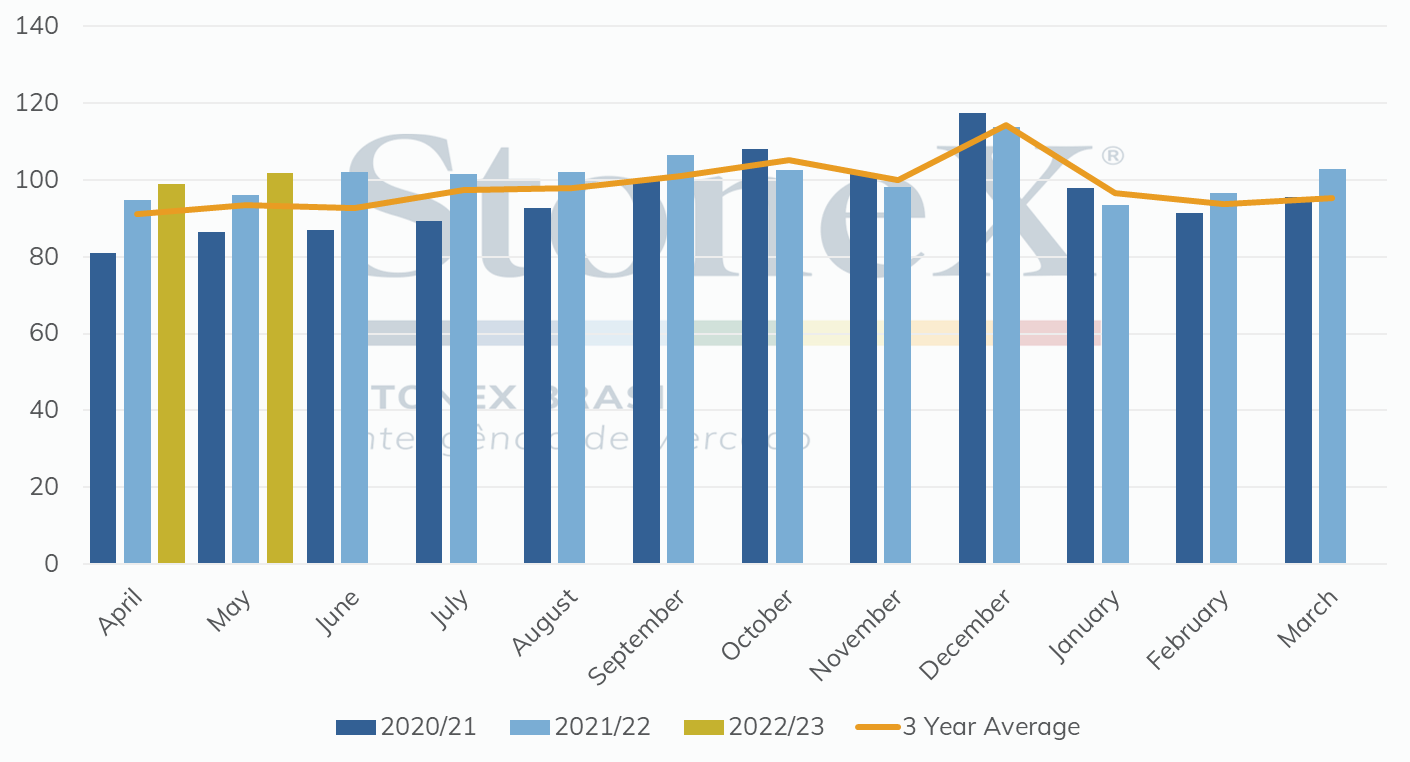
If the 2022/23 sugarcane crop in the Center-South (Apr-Mar) found it difficult to gain a more intense pace until the end of June, when sugarcane and its derivatives' accumulated production is below 2021/22, corn ethanol plants continue to surprise agents in the energy industry. According to the UNICA, by the second half of June, 961,000 m³ of ethanol had been produced from corn, which was 33% higher in the crop-over-crop comparison.
The attractiveness of the sector in the region is kept by the increasing levels of investment in corn crushing plants, by the still rewarding prices in the ethanol market and by the recovery of fuel consumption in 2022. It is possible that in the current cycle the state of Mato Grosso alone will produce a volume greater than the total seen in the entire 2021/22 crop. Following production trends in the CS, StoneX do Brasil revised its estimates for corn ethanol output in the region in 2022/23: from 4.2 million m³ (projected in May) to 4.5 million m³.
TWO-WEEK PRODUCTION OF CORN-BASED ETHANOL IN THE CENTER-SOUTH (000 M³)
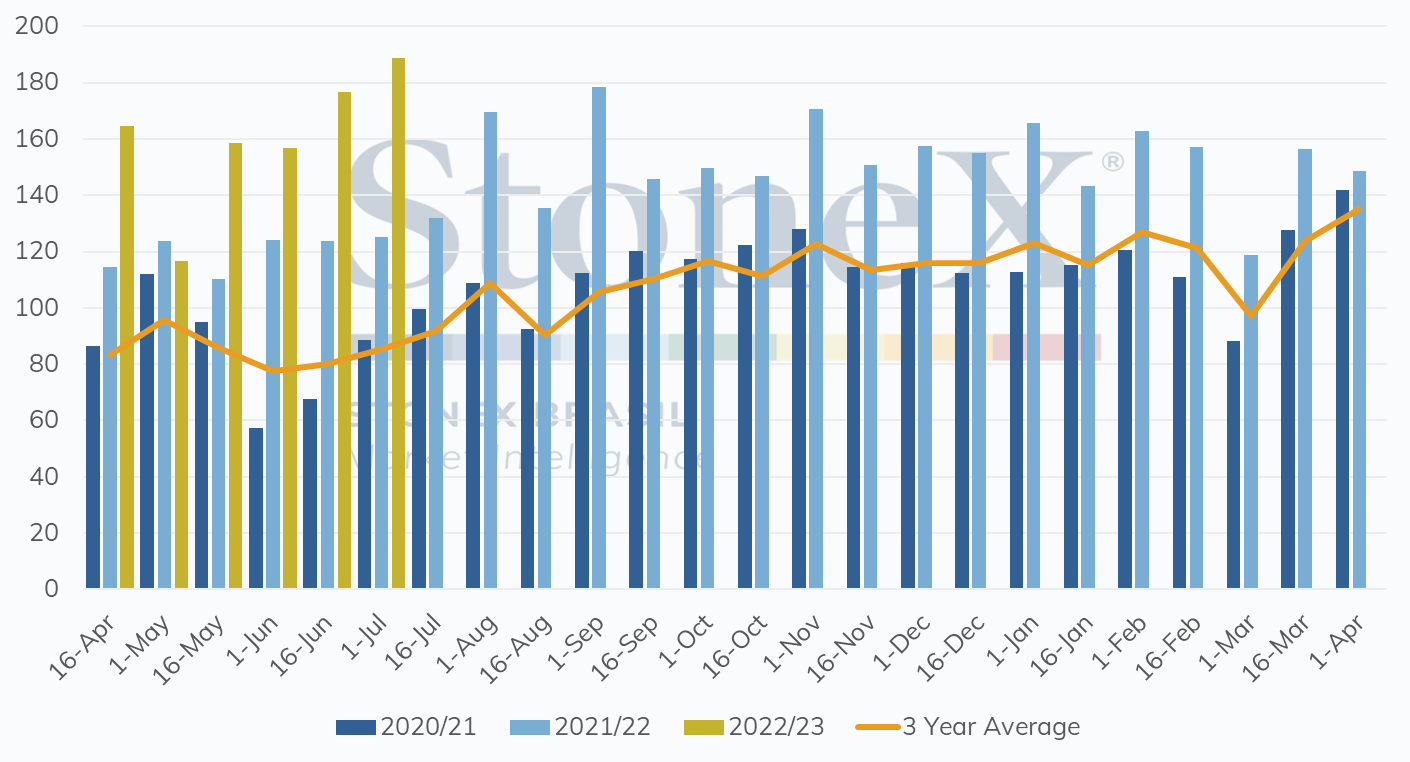
Source: UNICA. Design: StoneX.
PROSPECTS FOR THE CORN ETHANOL MARKET
According to the ANP, in the coming years, 11 new plants should start operating and seven are already being expanded. Of these plants, two are already completed and awaiting authorization to start operating. According to the agency, for 2022, the completion of another four plants and two more in 2023 is planned.
With the completion of construction of these new plants, it is estimated that the sector will grow its daily production capacity by approximately 11 million liters, specifically 6.0 million liters of hydrous and 5.0 million liters of anhydrous. Regarding the expansions of the seven units mentioned above, the expected increase is about 32% of their current production potential, adding about 720,000 liters of hydrous and 225,000 liters of anhydrous.
Therefore, if carried out according to plan, the constructions and expansions on ANP's radar should add a volume of 12 million liters to the daily production of ethanol derived from corn, an increase of 3.1% in relation to the current capacity. which is around 377 million liters.
In Brazil, Mato Grosso is the state with the largest number of plants under construction, totaling 11 units, four under expansion and seven being built. Then comes Goiás, with three units, two under construction and one under expansion.
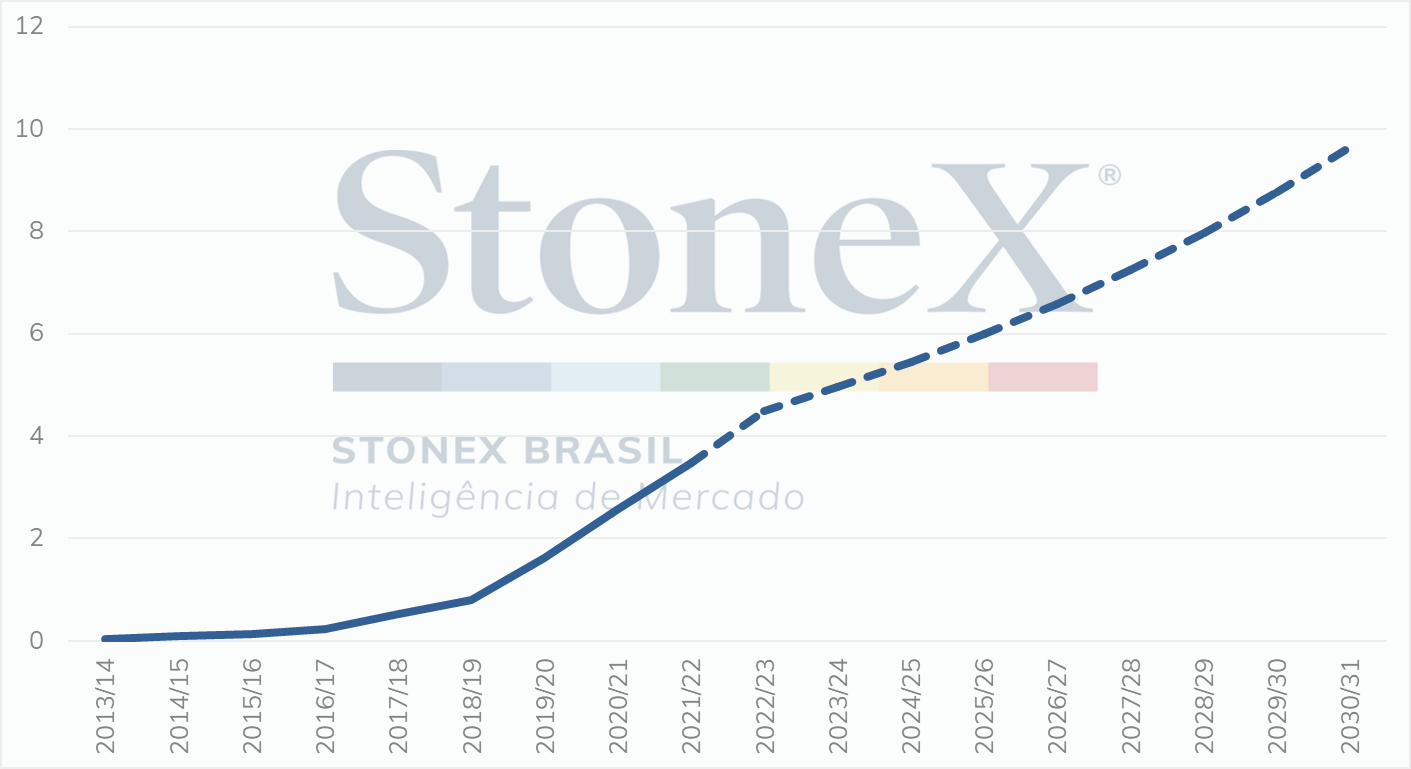
According to a report by the Energy Research Company (EPE), production of ethanol from corn will continue to show significant growth in the coming years, and it is estimated that the volume produced should double in the next 10 years, coming close to an annual production of 10 million m³. Corn production raises good expectations for the sector, and the EPE estimates that in the 2030/31 crop about 22 million tonnes of corn will be destined for ethanol production, reaching a share of 20% in national output.
ESTIMATED GROWTH OF CORN-BASED ETHANOL PRODUCTION IN BRAZIL (MILLION M³)
Source: UNICA, EPE, UNEM & StoneX. Design: StoneX.
The UNEM estimates that although a large part of production is currently concentrated in the Brazilian Center-West, the next growth cycles should expand to the North and Northeast of the country, a region that currently has about 10% of corn cultivation in Brazil.