Global
Potash has gone back to its normal potash self which is alright after the last few years!!! Still, there are some situations that need to be watched which could change the outlook.
I am steady with a tilt to the bullish side for the near term due to coming northern hemisphere spring demand and some concern still for Israeli operations.
Barring an unforeseen situation arising, it should be steady as she goes for the near term.
North America
My North American POV is not much different from the global outlook. Prices have been very steady and at a price level that makes sense vs grain values. However, North America has the added caveat of the huge fall run which emptied inventories.
Feels like there will be some slight bullishness in the lead up to spring application season but should correct moving into late spring/summer.
This assumes a solid opportunity to apply this spring. It wasn't long ago that preplant applications didn't happen. Part of the region was way too hot/dry while the other was cold/wet. That would be a game changer but I'm not in the business of forecasting weather!
The potash market has done (quickly checks notes)...nothing!
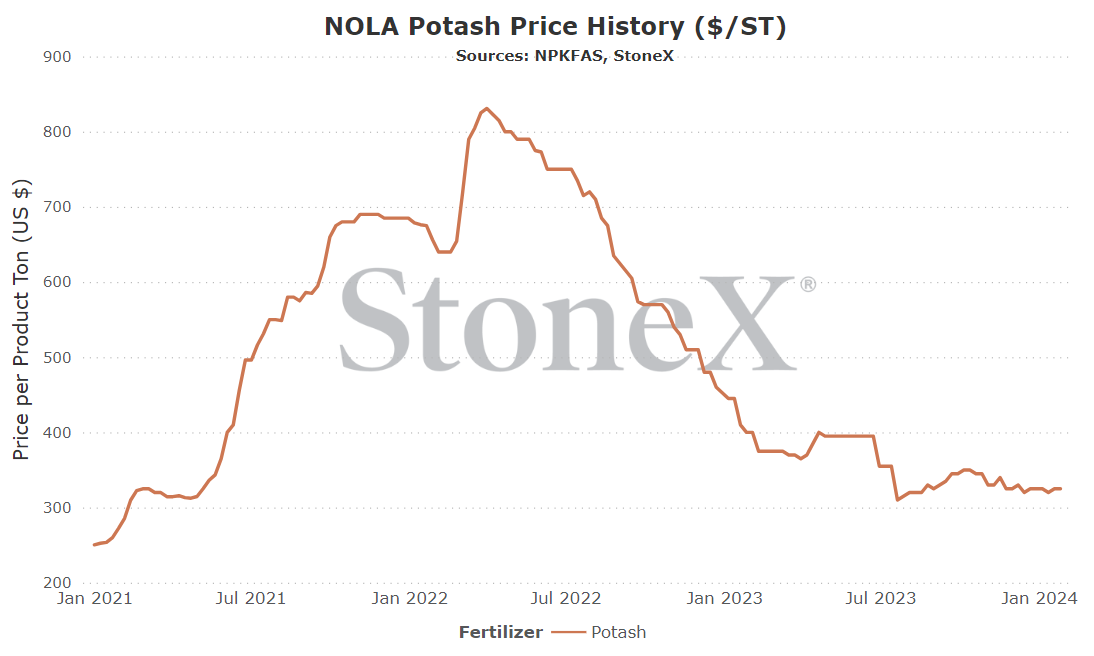
After the last few years, it is hard to believe that we finally have markets that are somewhat subdued! We have gotten used to sensational headlines that had major impacts on fertilizer markets which created double and sometimes triple digit price moves.
Honestly, it brings a tear to my eye when I see nothing happening. I'm tired!
For potash, this is a return to normalcy. If you go back before 2020/21, potash was a slow moving marketplace. Price trends higher/lower took month and sometimes years to complete.
Now, does this mean things will not change? Of course not. There are a lot of factors that still need to be watched:
- The Israeli/Hamas conflict remains in effect which puts Israeli potash operations at a higher level of risk.
- Potash values will still be somewhat determined by grain values. With Dec '24 corn values having fallen around 50 cents per bushel, this could alter application rates or even acreage mix expectations.
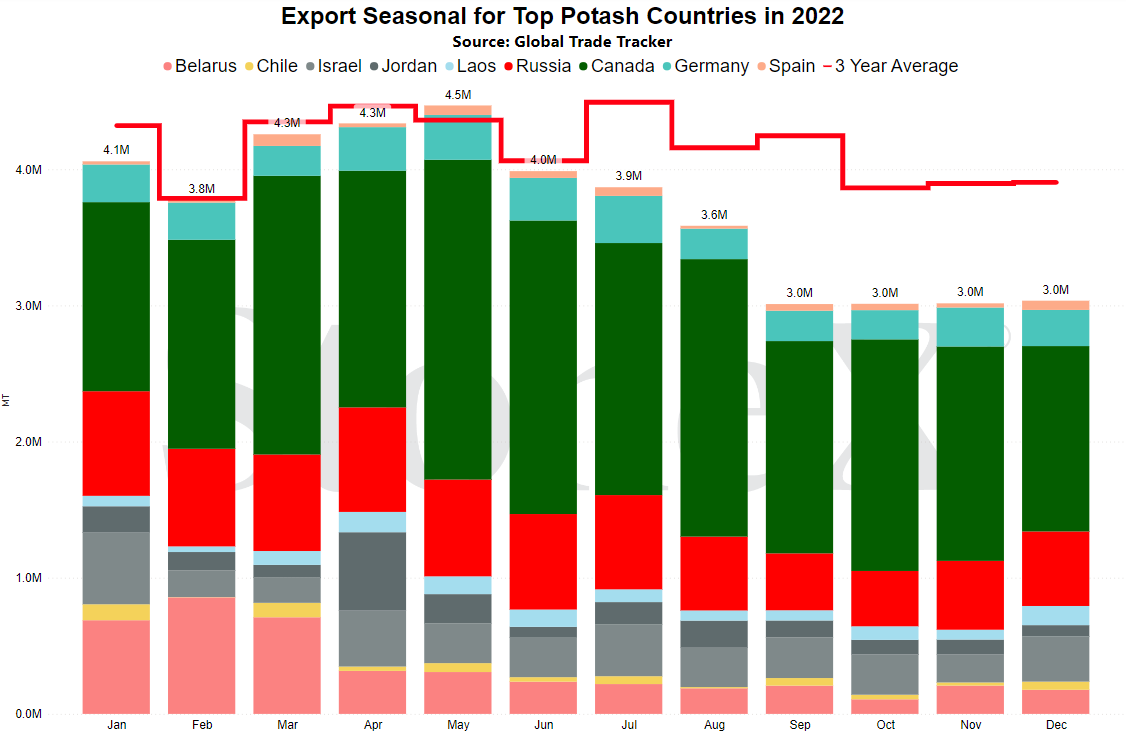
- North America still needs to watch logistics. Last fall was a huge run. It emptied the system and 3 months is not a long time to refill...if spring doesn't start earlier than mid-March. Just because the price of potash doesn't change doesn't mean your price cannot increase due to logistics.
Current potash prices are at decent levels right now vs most grains. It appears priced accordingly. While we do not want to sleep on the market because things can change quickly, enjoy the quiet time. After the last few years, we all deserve it!!!!
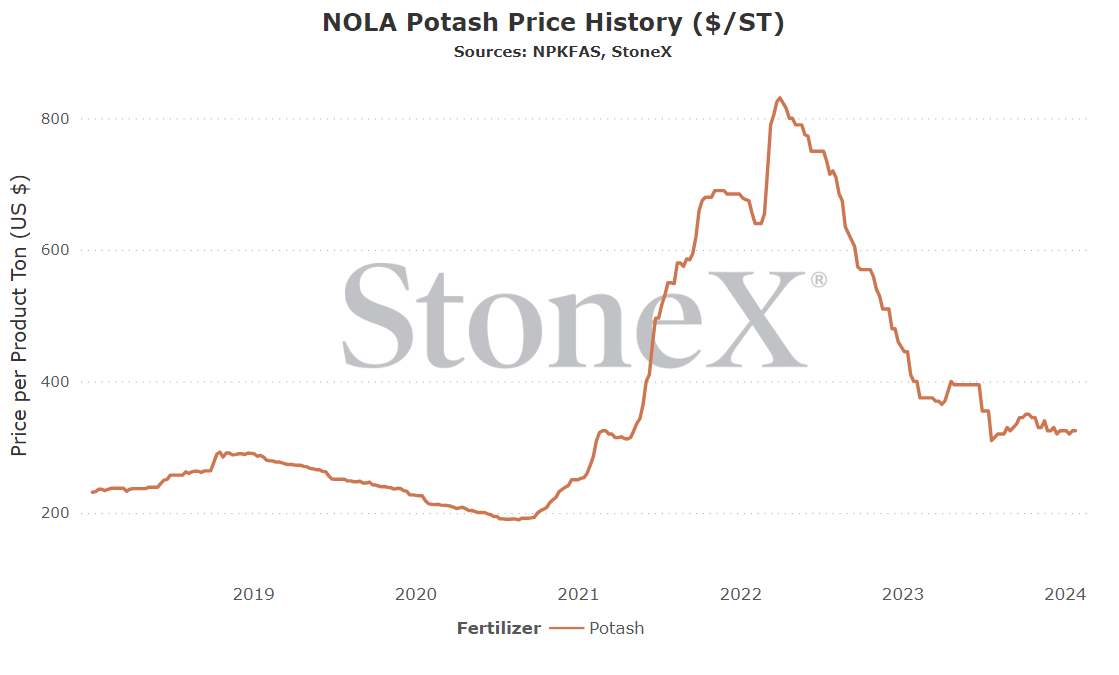
NOLA/New Orleans Louisiana
Vs 30 days ago - unchanged vs last month
Vs 90 days ago - -6% or approximately $20 lower
Vs 6 months ago - +5% or approximately $15 higher
Vs 1 year ago - -19% or approximately $75 lower
U.S. Midwest Average (average of several points across the Midwest)
Vs 30 days ago - -3% or approximately $10 lower
Vs 90 days ago - -5% or approximately $21 lower
Vs 6 months ago - -8% or approximately $33 lower
Vs 1 year ago - -17% or approximately $81 lower
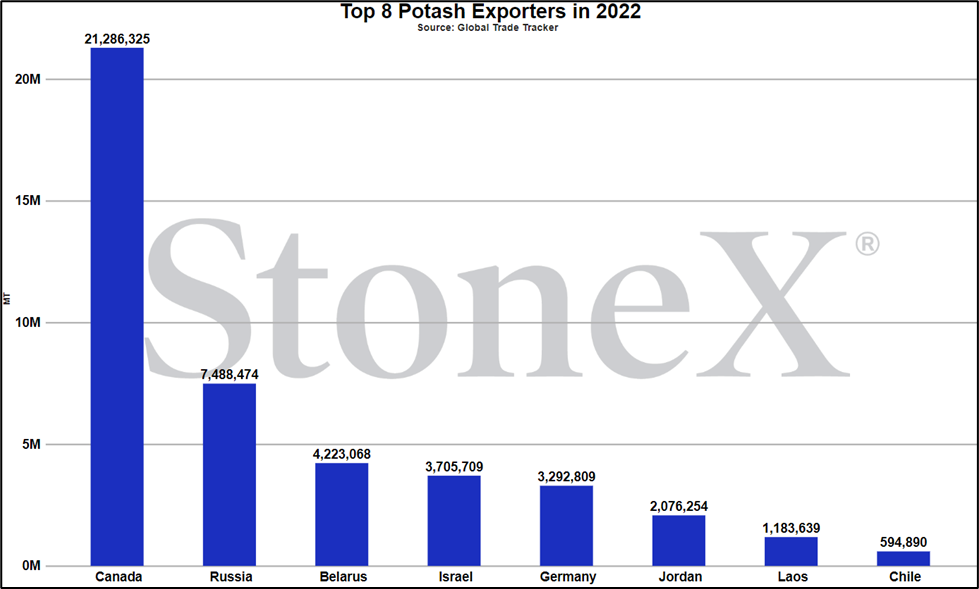
- Israeli operations are impacted – the world's focus is currently on the Middle East, following the attack on a U.S. military base that resulted in 3 deaths. However, the Israel/Hamas conflict continues...it has just been moved to the back of the line. If Hamas were to launch an attack that impacted Israeli mining/production/logistical potash operations, the world could quickly lose the 4th largest exporter in the world.
- Early start to North American spring application - warmer temps and the sun being out sure has me itching for spring to be here. However, it is still far too early. The N.A. fall run was big which effectively wiped out inventories across the continent. If season starts mid-March, the industry will be playing catch up. If, for some reason, temps stay warm and spring starts sometime in February, the industry will not be prepared.
- Lack of winter decisions means just in time demand – a lot of the supply part of the fertilizer industry have dealt with poor fiscal results after fertilizer prices have fallen hard from their high's. Very few in the supply chain want to own all the risk. That means if the demand doesn't step up normally and takes a just in time approach to needs, the rest of the value chain may do the same. That puts a tremendous amount of pressure on logistics.
- Poor weather impacting regional spring application – this isn't a situation that will not happen. We have seen fall and/or spring seasons where mother nature simply does not allow applications of potash and farmers are then forced to make the decision between applying fertilizer or planting. If mother nature stays wet/cold into April, inventories could grow and remain in place leading into summer...no one wants to hold that sort of position.
- Continued degradation of grain values - today, potash values are actually well valued when compared to many grains (see graphs below). However, there is no guarantee that grain prices will not fall further (I sure hope not). If grain prices due deteriorate further, it eats into farmer cash flows. If that happens enough, some may need to make decisions to cut input costs. For those that have healthy supplies of potash already in the soil, it could easily be one of the first cut. Lower demand and prices could reflect it quickly.
- Less than expected corn acreage in U.S. – we went into spring 2023 with the expectation that corn acres (which drive fertilizer demand the most) would be around 92M. Most were surprised when that number ended up at 94M+. That helped to clear a lot of carryover inventory that was expected. However, we are moving into this spring with corn prices on the decline. December '24 corn values had been in the $5.10 - $5.25 range but now reside in the $4.70 - $4.80 range. We could be surprised by acreage...on the lower side if things do not improve. That would hurt potash demand further and lean on pricing.
We believe that only looking at the flat price of either grains or fertilizer can be misleading:
-
Only selling grain can hurt you if fertilizer prices rise substantially
-
Only buying fertilizer can hurt you if grain prices fall
We look at the ratio "value" to get a better indication of where we are or how many bushels of X does it take to pay for 1 ton of fertilizer.
Would you rather:
-
Spend 120 bushels to pay for 1 ton of potash
-
Spend 60 bushels to pay for 1 ton of potash
When we compare the current ratio value against recent years, we start to see if we are high or low.
YOUR VALUES MAY LOOK DIFFERENT
This graph looks at the NOLA potash price vs the flat grain price. There are no logistics on either product. Your location will look different due to fertilizer logistical costs, grain basis, etc.
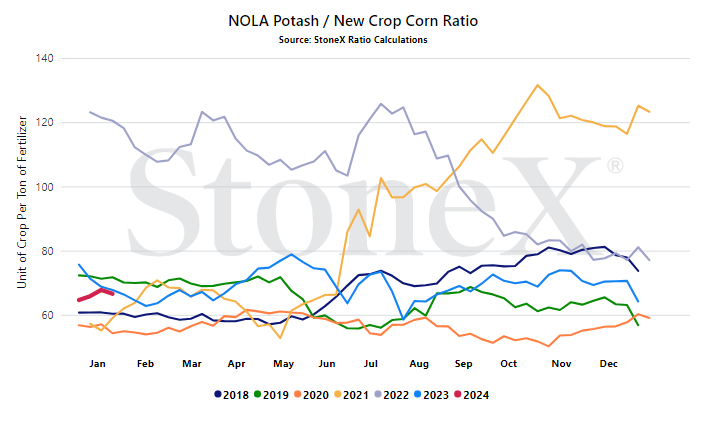
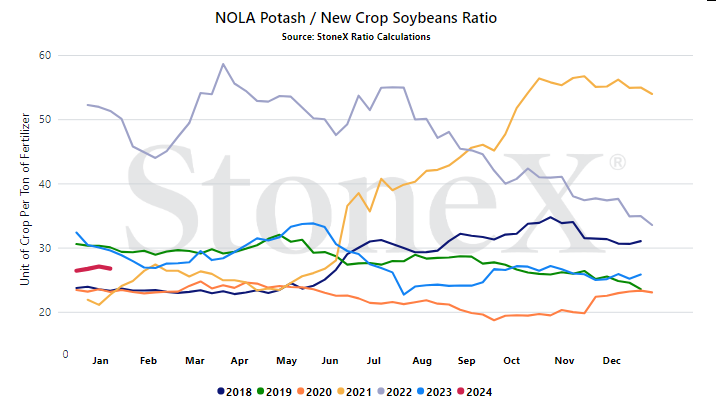
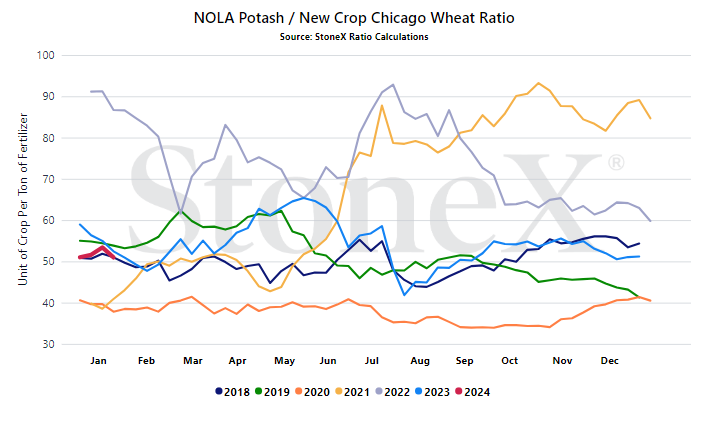
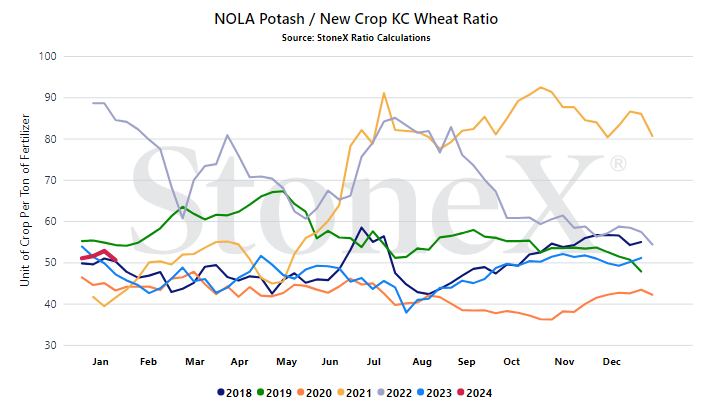
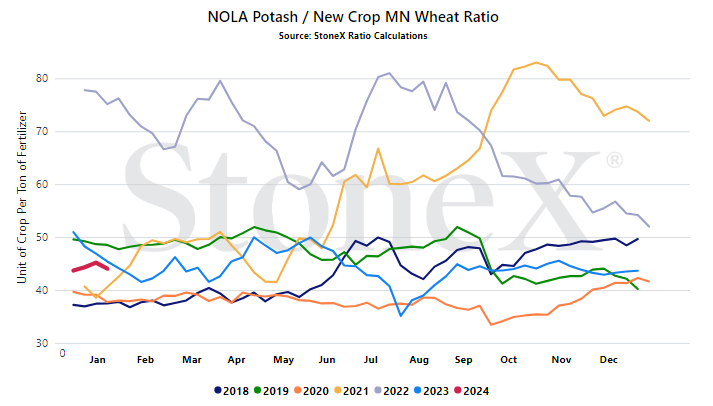
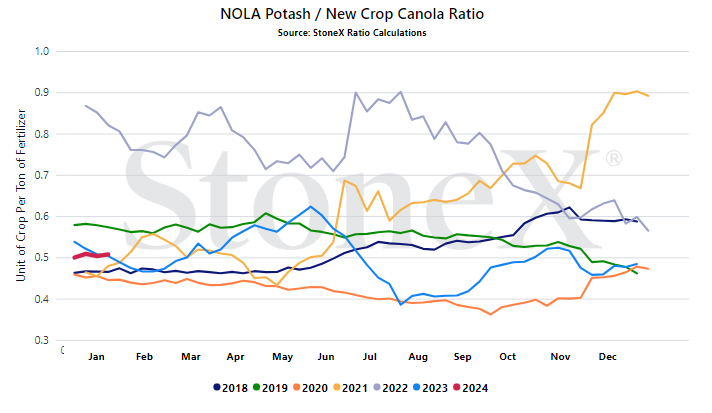
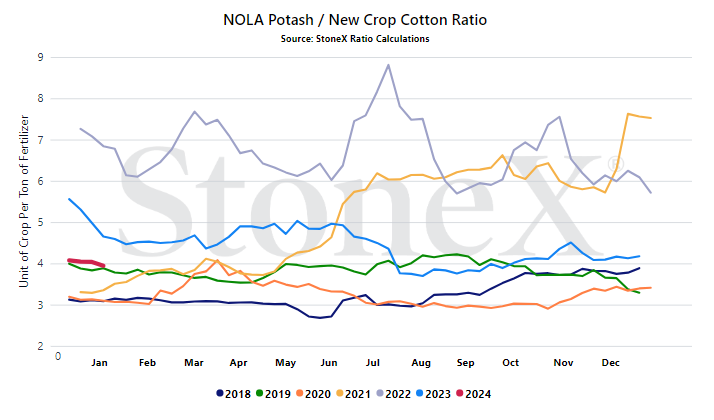
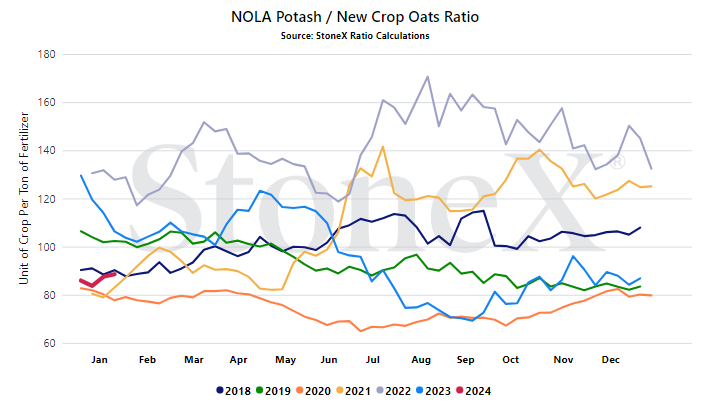
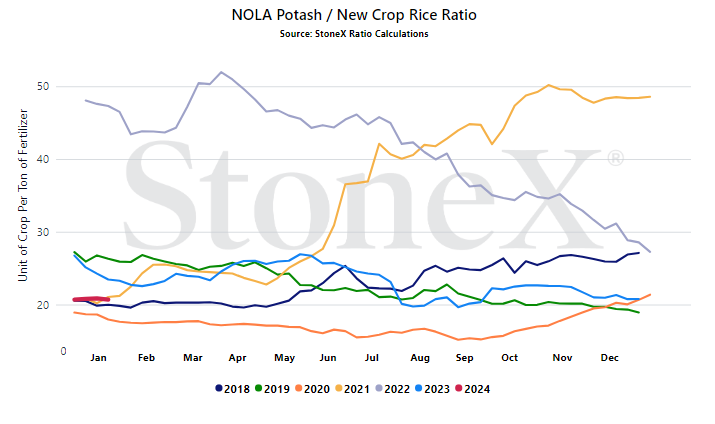
- Grain markets - today, a lot of the grain/potash ratio's are still "in line" with recent years which means no big fear of demand destruction. However, we have seen key grain values (like corn) falling pretty hard. That is going to hit farmers income. If there is enough of a hit, we could start to see farmers looking for ways to decrease their cash flows on inputs. While phosphate is first on that list...potash usually isn't far behind.
- Spring demand meeting tighter supplies - do not sleep on the fact that last fall was a really big run that emptied the system...and there is only 3 months between the end of fall and the start of spring (normally). If demand comes in a big wave or worse, comes earlier due to warmer/drier than typical weather, the logistical system could become overwhelmed. Who will pay that price? You know the answer...
StoneX Ratio Calculation
The ratio calculation is derived from Bloomberg historical grains values as well as fertilizer values from StoneX, NPKFAS, and Argus.
The calculation is simply dividing the fertilizer price by each grain price.
All data was sourced from StoneX unless otherwise noted.