StoneX logo

February '24 Farmer Fertilizer Focus - Urea

By: Josh Linville, Vice President- Fertilizer

February '24 UREA
 
Josh Linville
Fertilizer - Vice President
StoneX Financial Inc. - FCM Division
Major Global Urea Export Location Price Graphs

The intention of the below graphs are not to use to say "my price should be X based on this graph".  These prices are derived from an FOB price point average.  The intent is to show major global price movement trends.  Your values will likely have significant basis difference (similar to your local grain price being different than the traded market price).

This graph is labeled as MT in USD currency.
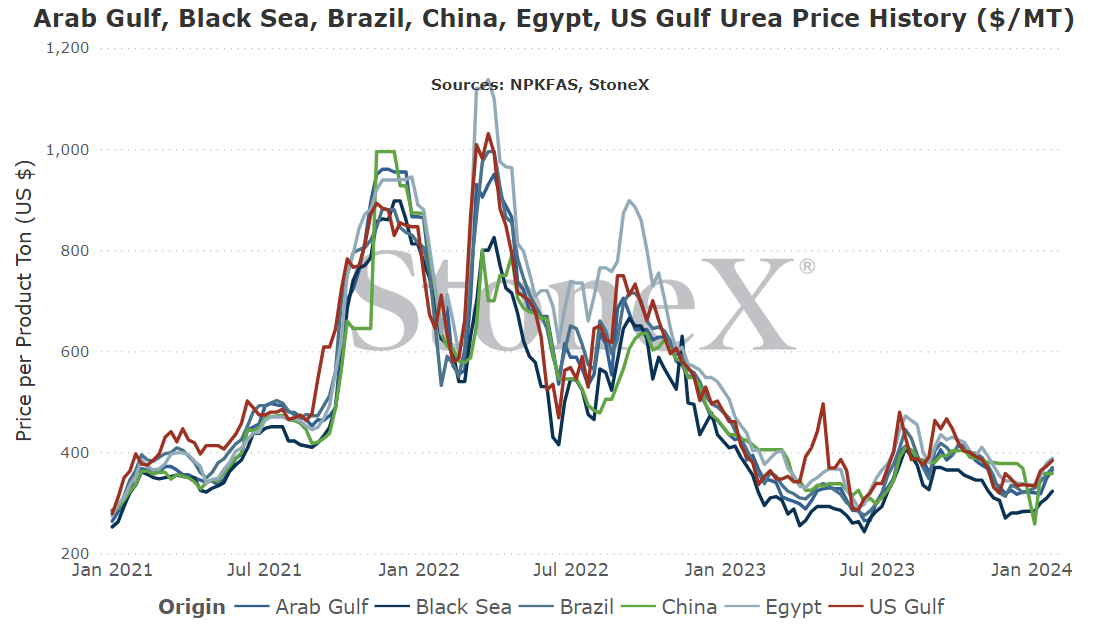
image 88689

What everyone wants to know first, what do we think will happen going forward
GLOBAL
Global values have been hot the last month on the back of the return of buying.  However, there are some things that are bugging me.  There are a lot of sales being made by Egypt.  They are nearly daily...but small in volume.  There isn't a lot of other global selling being reported.  It almost has a feel like this is more of a trader driven market than fundamentally based.  Still, with demand for spring application coming quickly, it may not matter.
I think we are now set in a higher priced value range.  More support arrives as buyers step forward.  However, the market is going to have an eye forward to summer resets, wanting to make sure they do not hold too long.
It's a mixed bag for a little bit and comes down to timing.  
Last, do not sleep on Middle East tension.  Seems we are getting closer and closer to the war edge.  If we start talking about Persian Gulf shipping lane attacks/issues, the market is different immediately.
NORTH AMERICA
NOLA urea continues to follow international values higher.  I cannot get rid of this gut feel nervousness.  There is still some time before spring application.  Yes, we have a lot of fill to go but it would not be a shock to see the market go quiet in February.  With values having rallied in the last month, there are some that could look to sell and lock in profit.
Still believe this North American market is fairly well supported into spring but we could see some volatility between now and then.  Shouldn't be game changing type of stuff, barring international changes.
Ultimately, if you haven't locked up your needs, be speaking with your retailer.  We always find a way to make product appear but that road is much more smooth when talks are had.
CME Futures Settlement Indications

While the fertilizer futures market is far from as liquid as its grain counterparts, it is still active and gives us an insight into what the market is thinking.

Please note that the values below can and will change daily.  This is merely a look at where they are as of writing:

 NOLA UreaMiddle East UreaCFR Brazil Urea
February$354.50$380.00$380.00
March$358.00$377.50-
April$352.50--
May$335.00--
June$335.00--
July$327.50--
August$327.50--
September$327.50--


General Global Urea Information
image 73009
image-20231108150030-2
image 73010
image-20231108150043-3
What has happened in the last 30 days?
Global buyers return, prices respond
One of the bullish factors from last month is if buyers return, prices could/should respond.
That has happened in a big way.
Egyptian producers have been pushing the envelope.  While their sales volumes per day are not huge (4K - 10K per sale), they are linked to near daily activity.  They have been taking full advantage of that situation by taking their price higher.  Sold something today?  Move the price up $5 - $10 and see if they will buy.  If they do, move the price up $5 - $10 higher.  This has happened over and over and over again.
However, it isn't just North Africa that has been selling.  Values around the world have been increasing.  The Middle East has been quiet in terms of sales but manufacturers are reportedly well sold into February.  If true, they are very close to peak demand season which puts them in further control.
Unlike the last few years, this doesn't feel like it is going to get out of hand and rise hundreds of dollars (unless the Persian Gulf erupts...see below).  It feels like this rally has some staying power and with some issues globally, it only supports their cause.
Red Sea attacks raise shipping fears
The top of the recent news cycles have been the attempted and some successful attacks by Houthi rebels in Syria against vessels in the Red Sea.  Fortunately, most of the attacks have been thwarted by western naval forces.  Unfortunately, no defense is perfect and some attacks have gotten thru.
As a result, we have seen some vessel lines refusing to send their ship and crew into harm's way.  Rather than risk an attack, they are able to call upon "war time provisions" in shipping contracts.  That means longer routes, higher freight rates and longer sail times.
This has been a situation that has hit the urea marketplace given how many vessels sail thru this passage.  If the market was still bearish, the additional freight cost would likely be absorbed by the manufacturer in the form of lower netbacks.  Frankly, in this scenario, the buyer doesn't care what your situation is.  They have a price they will buy and that is it.  However, now that urea markets are bullish, buyers are having to consider competing for tons.  That additional cost will be burdening the buyer rather than the seller.
While it does drive costs higher, when spread over 30 - 40K tons, it is manageable.  Not great, but it can be stomached.  The bigger issue is the longer sail time.  For vessels sailing south around Africa and to North America, it adds an additional 10 - 15 days or more.  For most of the calendar, that isn't a big deal.  However, we are quickly reaching that period where we switch from winter to spring.  10 - 15 days could make all the difference in the world.
It is important to note that traffic is still moving thru that region.  This is merely another hiccup that has occurred and could easily occur again...and for western countries, the timing couldn't be worse.
U.S. Jordan military base attack puts global urea on edge
For a while, there has been a lot of tension regarding Houthi rebel attacks/attempted attacks on vessels in the Red Sea.  So far, many of the attacks were either thwarted or only resulted in minor injuries and damage.  While it was seen as an irritation and some retaliatory actions were taken, it was kept relatively in check.
Unfortunately, that same group was successful on a drone attack on a U.S. military base in Jordan that resulted in 3 dead and dozens wounded.  That was a major escalation and the world is now holding its breath on retaliation measures.  With these rebels being backed by Iran, it does bring up different possibilities:
  1. The U.S. takes further action against Houthi rebels only - in this scenario, we will see some nations protest the attacks and blame the U.S. as they do but ultimately, the attacks will come and go and everyone will move on.  Decent chance of occuring, low impact to urea.
  2. The U.S. attacks Houthi rebels and implements sanctions against Iran - in this scenario, tensions will be elevated and the push back from some nations likely larger and louder.  For urea, we need to be cognizant of the chance that urea exports would be included in those sanctions.  If they are, we could see a lot of their urea removed from the world market which would benefit market bulls.  As they did before, they would likely find "work arounds", flowing their product to a nearby nation and then sailing on under that new nationality flag to skirt sanctions.  Still, there would be an impact.  Decent chance of occuring, medium impact to urea.
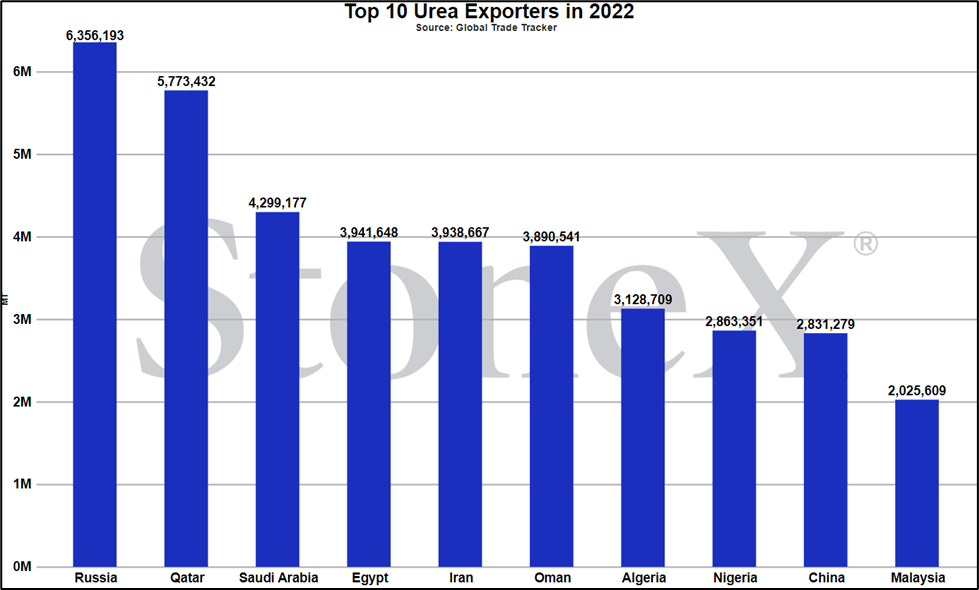
  3. The U.S. retaliates against both Houthi rebels and Iran, seeing both as one in the same.  I put this as an extremely low likelihood due to the chance of creating a regional war in the Middle East.  We know the region is already on edge today and it wouldn't take much to push it over the cliff.  There is already conflicts between Israel/Hamas and Russia/Ukraine.  Would the U.S. really want to chance a 3rd major conflict at the same time?  Still, in the very low chance of it happening, Iran probably isn't going to sit back and take it.  In my mind, if they are smart, they will not look for a direct conflict with the U.S.  Rather, they could use their proximity in the Persian Gulf/Straight of Hormuz to attack vessels.  As proven in the Red Sea, it does not take many attacks to discourage vessels from sailing thru.  If this happens, the world news will be focused on the oil markets and inability to move product.  However, it is massive for urea. Look at the map below.  There are literally millions of tons that originate around and thru the Persian Gulf to the rest of the world.  The global urea market lost its mind when we thought Russian exports were going to be lost.  Russia is one of the top 10 exporting countries.  There are several around the Persian Gulf.  I really hope this does not become reality...  Incredibly low chance of occuring, huge impact to urea.

Today, the market seems comfortable to shove the possibility to the side and does not seem to be factoring it into values.  That said, if you wake up one morning to the news of fighting expanding, be on your toes.

Koch set to purchase Weaver, IA nitrogen facility

This is a storyline that quickly captured the attention of the North American nitrogen market.

There had been rumors swirling that OCI was open to the sale of their Weaver, IA nitrogen plant.  Weaver was, based on my memory, the last new nitrogen production facility to have come online in the U.S.  The plant was seen as a welcome change as it helped add new competition and additional tonnage in a demand rich territory.  This plant was courted by several states in the Midwest but eventually, packages offered by the state of Iowa won out.

Now, with it being confirmed that Koch will spend $3.6 billion to purchase the facility and many organizations are not pleased.

Several groups have come forward in opposition to the sale.  While several arguments are being thrown to the industry, it ultimately comes down to further consolidation.  If this sale proceeds, U.S. urea production by the big 3 (CF, Koch, Nutrien) will rise from an approximate 79% to just over 84% control.  This is another step toward a UAN/nitrogen oligopoly and the market is making it known.

Not that my opinion matters but I continue to believe that the sale will proceed with few issues...but the chance of it being struck down are higher.  The market is pushing.  D.C. has started to shine a light on the fertilizer market.  If I had to put odds on it, I would say 75% approval/25% disapproval odds.  Those are not great for those wanting the sale to be stopped but we have seen less likely things happen in recent years.
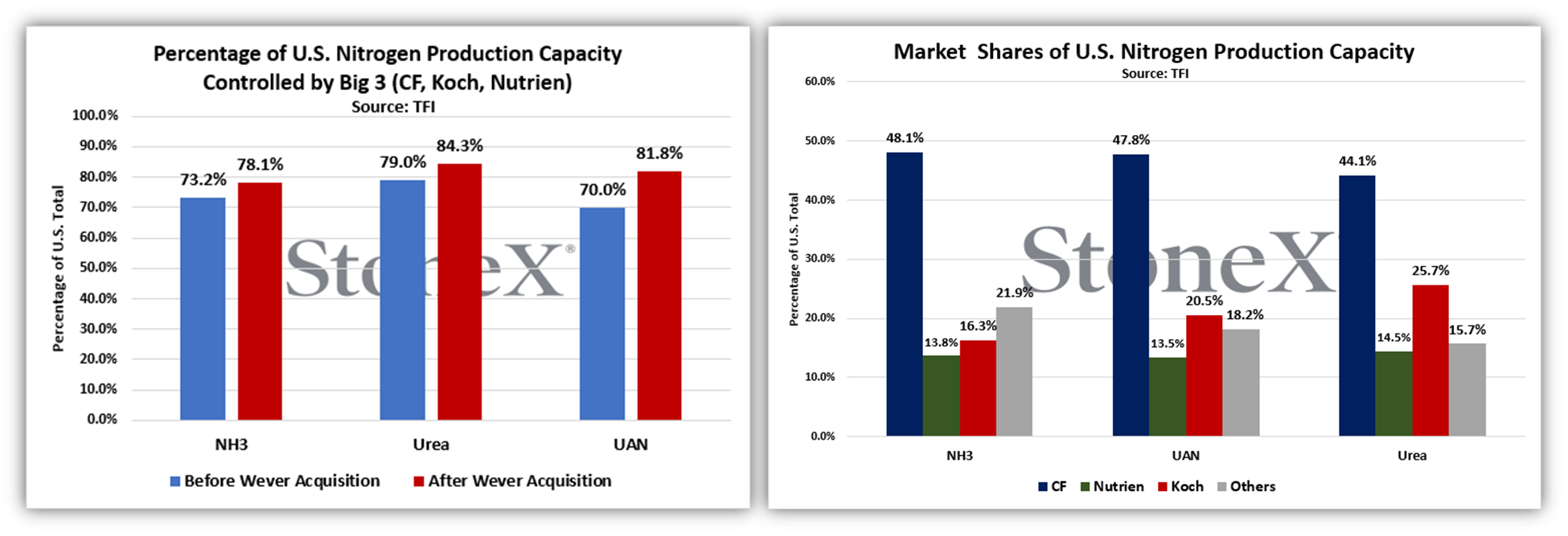
image 89076

 
Where are current values in relation to the past

NOLA/New Orleans, Louisiana 

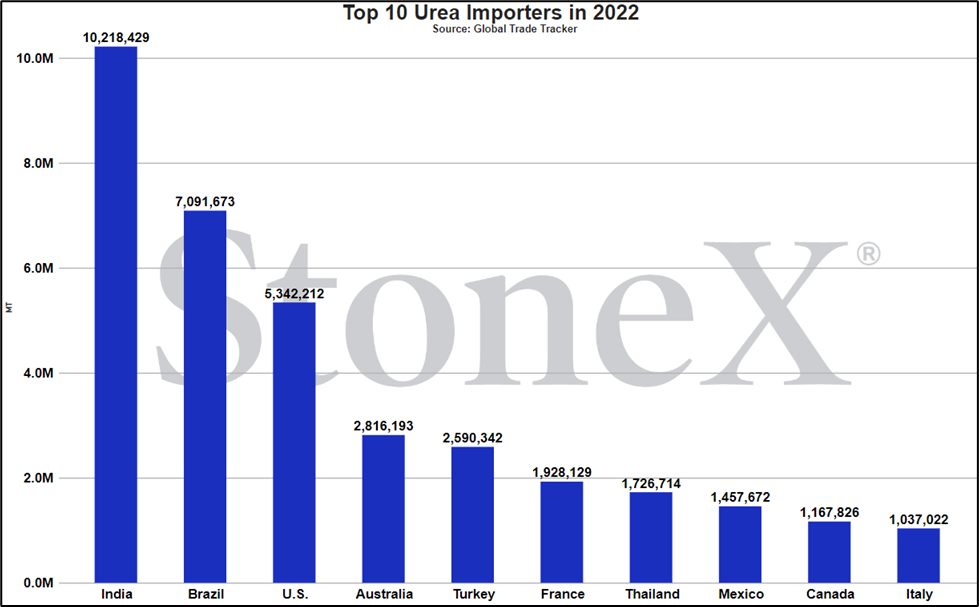
Number 3 global importer in 2022
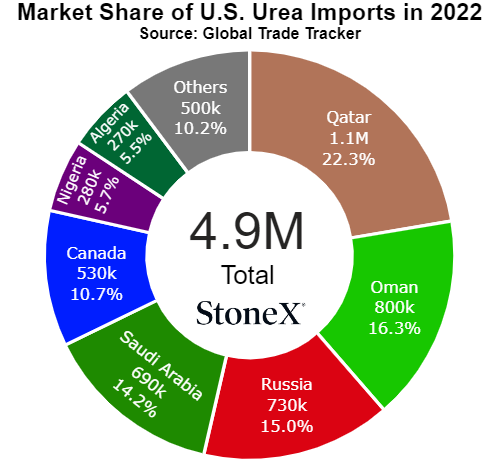
image 83787

Price comparisons

Vs 30 days ago - +14% or approximately $43 higher

Vs 90 days ago - -4% or approximately $15 lower

Vs 6 months ago - -5% or approximately $17 lower

Vs 1 year ago - -2% or approximately $7 lower
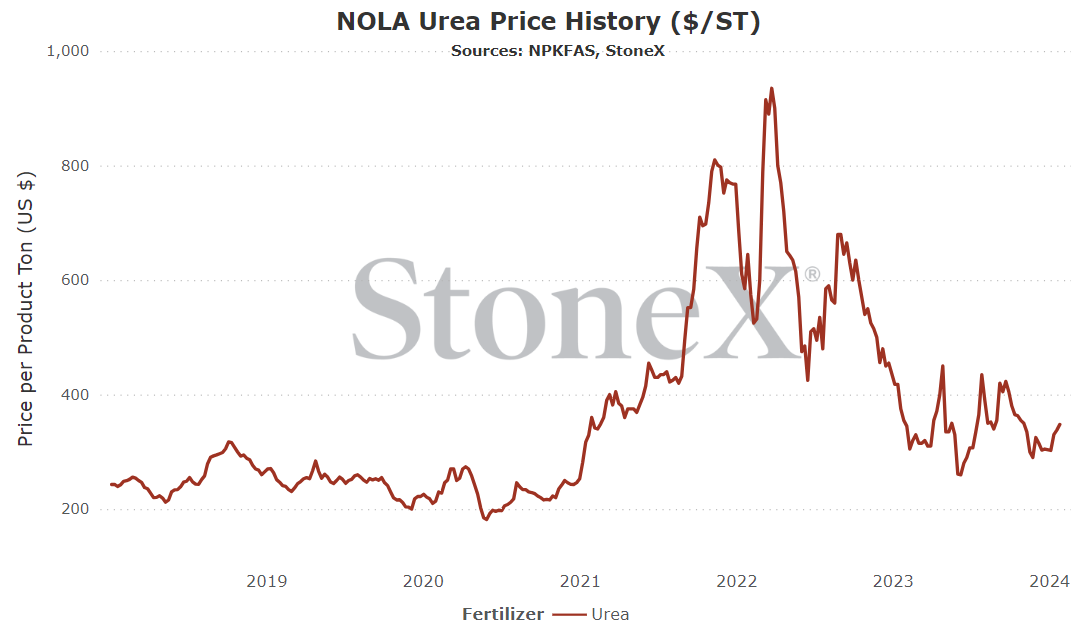
image 88690

U.S. Midwest Average

Vs 30 days ago - +6% or approximately $21 higher

Vs 90 days ago - -18% or approximately $82 lower

Vs 6 months ago - -12% or approximately $51 lower

Vs 1 year ago - -14% or approximately $61 lower


U.S. Southern Plains Average

Vs 30 days ago - +12% or approximately $43 higher

Vs 90 days ago - -11% or approximately $50 lower

Vs 6 months ago - +6% or approximately $23 higher

Vs 1 year ago - -9% or approximately $40 lower


U.S. Northern Plains Average

Vs 30 days ago - +2% or approximately $6 higher

Vs 90 days ago - -14% or approximately $63 lower

Vs 6 months ago - -2% or approximately $9 lower

Vs 1 year ago - -12% or approximately $55 lower


Middle East

Number 1 exporter (as a region, not as individual nations)
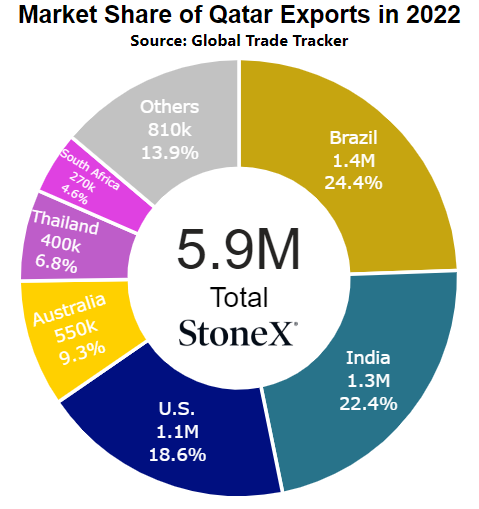
image 83722

image 83723

image 83724

image 83725

Vs 30 days ago - +13% or approximately $43 higher

Vs 90 days ago - -8% or approximately $33 lower

Vs 6 months ago - +5% or approximately $17 higher

Vs 1 year ago - -5% or approximately $20 lower
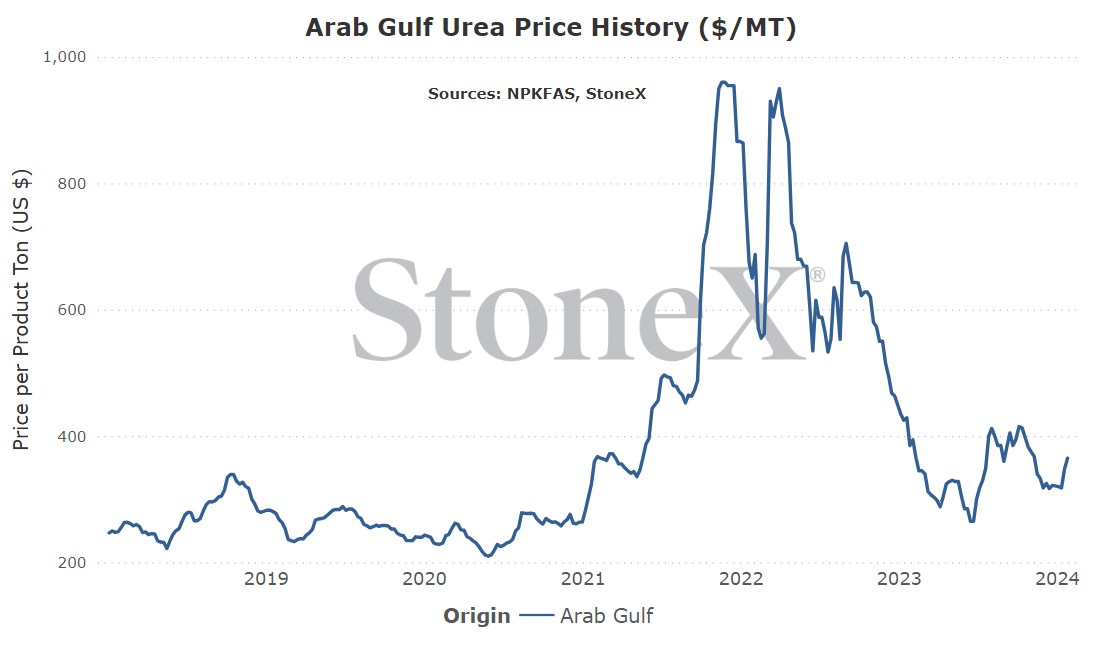
image 88691

Egypt

Number 4 global exporter in 2022
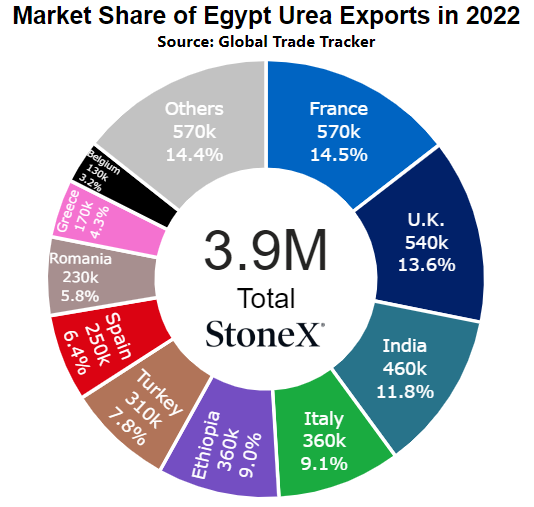
image 83726

Price comparisons

Vs 30 days ago - +15% or approximately $50 higher

Vs 90 days ago - -3% or approximately $14 lower

Vs 6 months ago - -3% or approximately $13 lower

Vs 1 year ago - -11% or approximately $50 lower
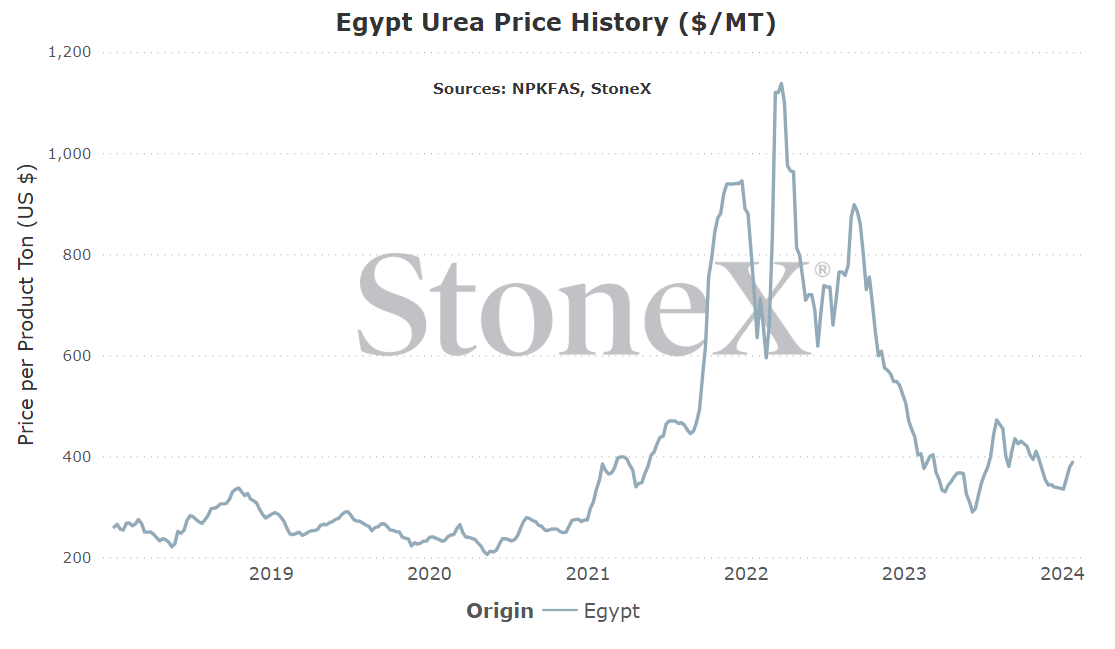
image 88692


Black Sea

Number 1 global exporter in 2022
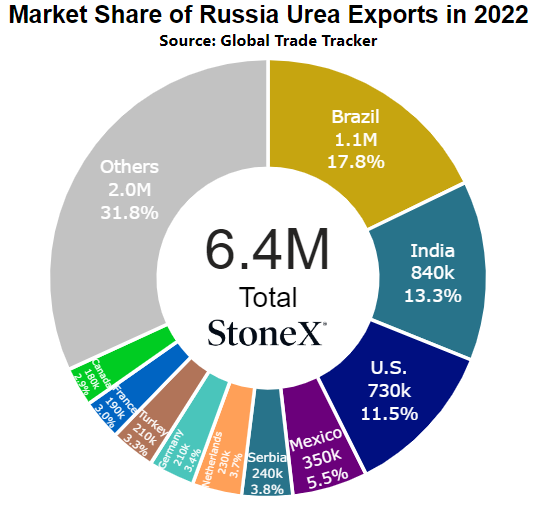
image 83727

Price comparisons

Vs 30 days ago - +14% or approximately $40 higher

Vs 90 days ago - -8% or approximately $28 lower

Vs 6 months ago - -7% or approximately $23 lower

Vs 1 year ago - -13% or approximately $50 lower
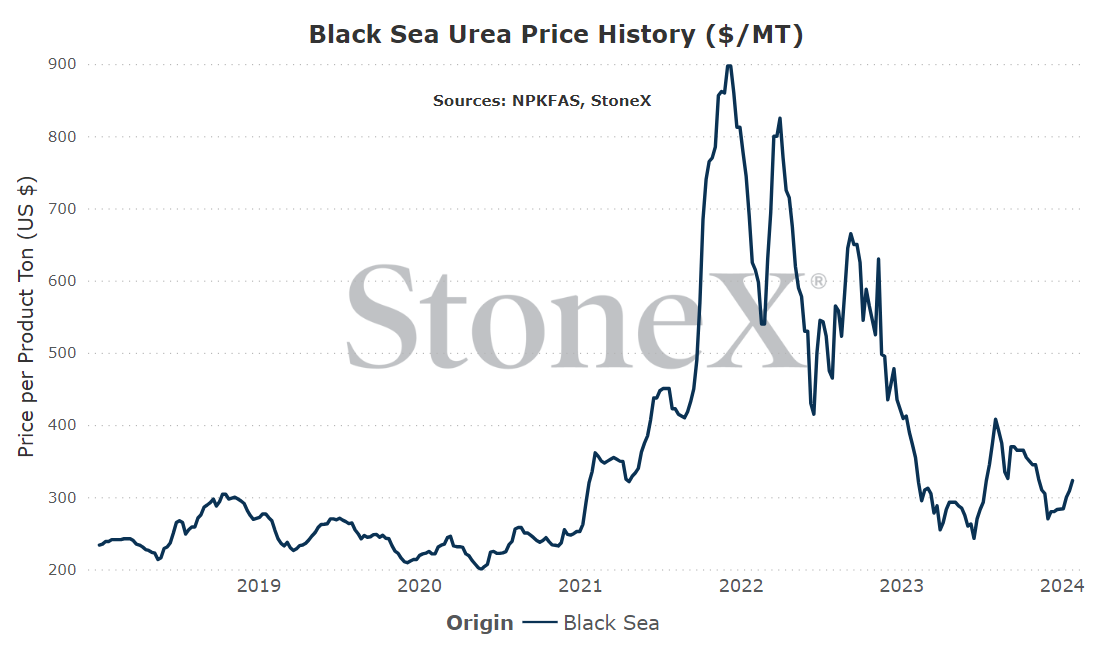
image 88693

China

Number 9 global exporter in 2022
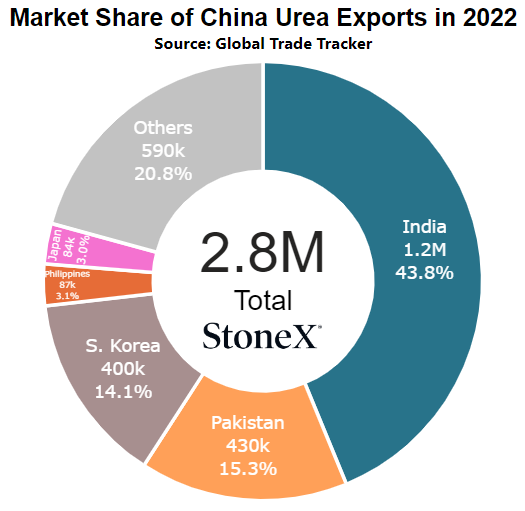
image 83729

Price comparisons

Vs 30 days ago - -3% or approximately $10 lower

Vs 90 days ago - -8% or approximately $33 lower

Vs 6 months ago - +4% or approximately $13 higher

Vs 1 year ago - -15% or approximately $65 lower
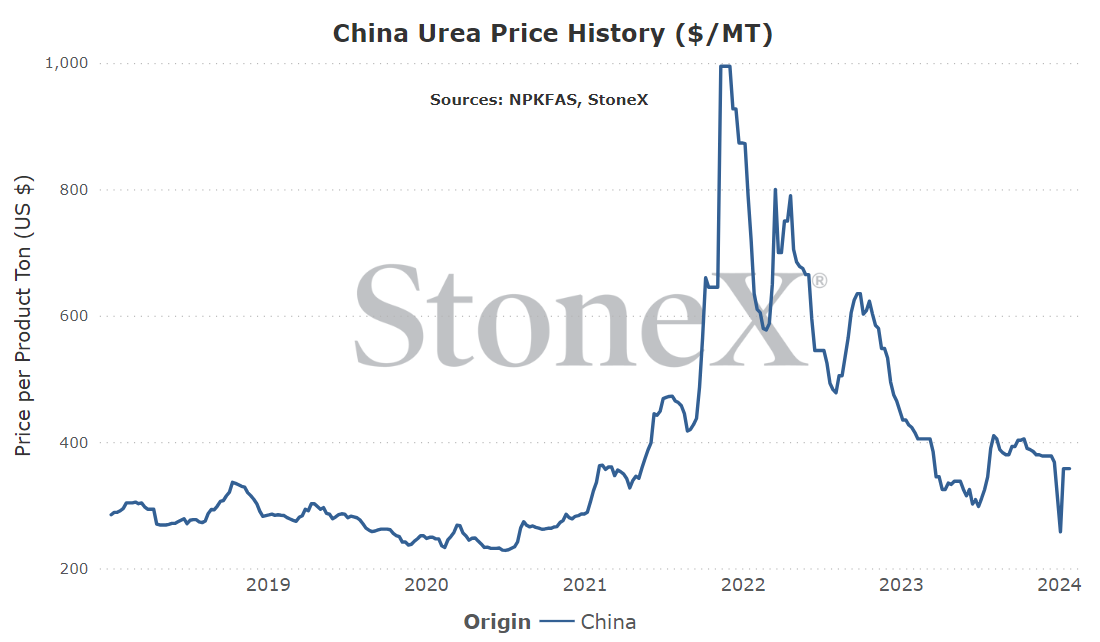
image 88694

Brazil

Number 2 global importer in 2022
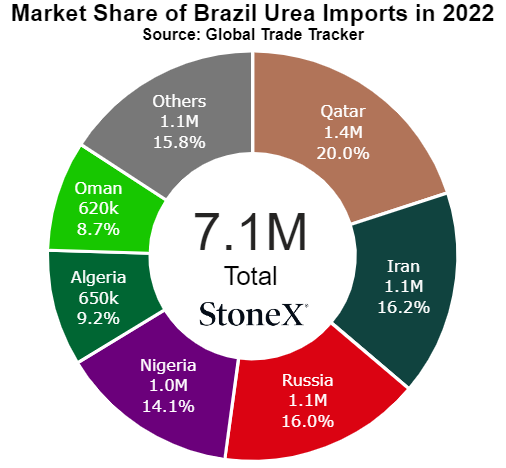
image 83788

Price comparisons

Vs 30 days ago - +16% or approximately $50 higher

Vs 90 days ago - -7% or approximately $30 lower

Vs 6 months ago - -2% or approximately $7 lower

Vs 1 year ago - -9% or approximately $35 lower
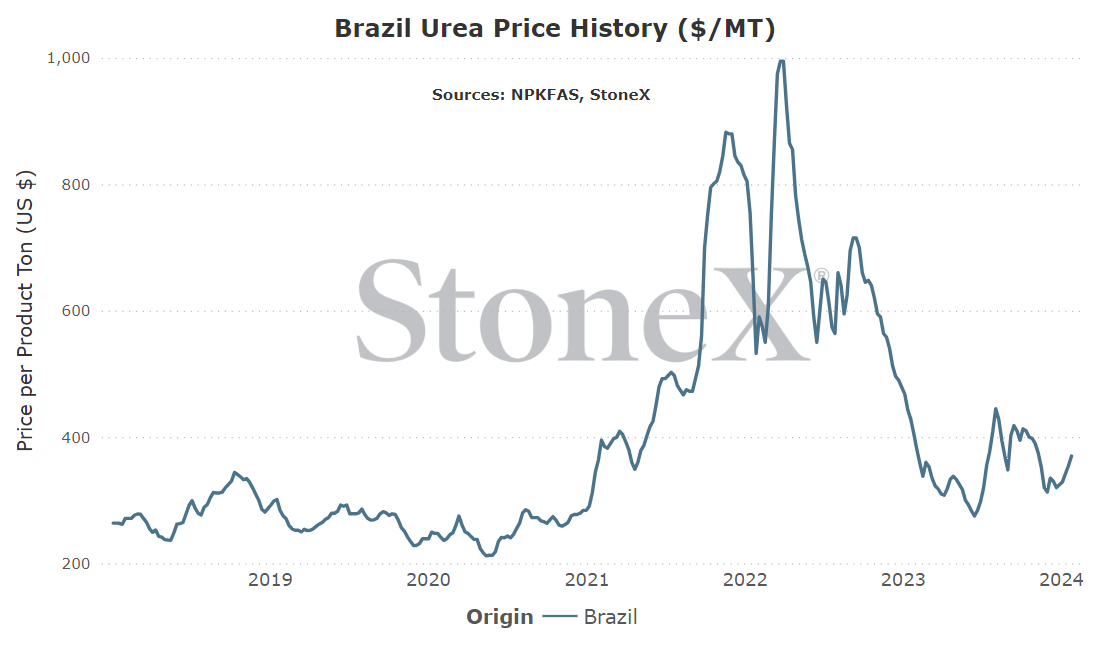
 

image 88695
Bull/Bear Factors
Because no market is ever guaranteed to go higher/lower, we try to consider the factors that can sway values so that we are able to act when they occur rather than react.
Bullish Factors
  • The Middle East ignites on recent attacks - unfortunately, it appears we are inching closer to war in the region following attacks on a U.S. base in Jordan which resulted in the death of 3 service members and dozens of other injuries.  The world is waiting with baited breath for the response.  If this turns into a regional conflict, Persian Gulf shipments could easily be slowed/stopped and there are literally millions of tons of urea exports that transit that stretch annually.
  • Red Sea attacks continue to hamper vessel transit - this is still more of a nuisance situation than a complete blockade as vessels are able to sail around the danger area.  However, this means higher freight rates and longer sail times which eventually flows down to the end user to bear the cost...
  • World demand remains front, center, and constant - a big reason for recent price gains is the near constant push to purchase product by certain areas.  Manufacturers are able to sell small blocks of tons, push the price up to test conviction of buyers, eventually sell that higher price and then rinse/repeat.  As long as buyers are willing to keep the torrid buying pace they have had, values should see support.
Bearish Factors
  • Buying could dry up quickly - we have seen this before.  Buyers continue to step forward daily...until they do not.  If/when the buying dries up and markets go quiet, fertilizer prices struggle to hold.   This seems less likely right now given how close we are to spring for the Northern Hemisphere as well as manufacturers appearing well sold, but it is still possible.
  • Fears of carrying product into summer could cause sellers to panic sell - at some point, position holders will want/need to make the decision to offload inventories as summer nears.  Light summer demand as well as price reset fears truly drive this.  If this emotion gets triggered, it becomes easier to lower a price idea to make a sale.  Get a few doing this, and you have a bearish marketplace.
  • European nitrogen plant restarts could add supply/reduce demand - hard to believe how improved the European picture has become.  Dutch TTF values have fallen firmly into single digits while global nitrogen/urea values are bullish.  If we see the remaining offline European plants restart (likely quietly), it would likely mean they have less need for imports.  That means more supply for the world.
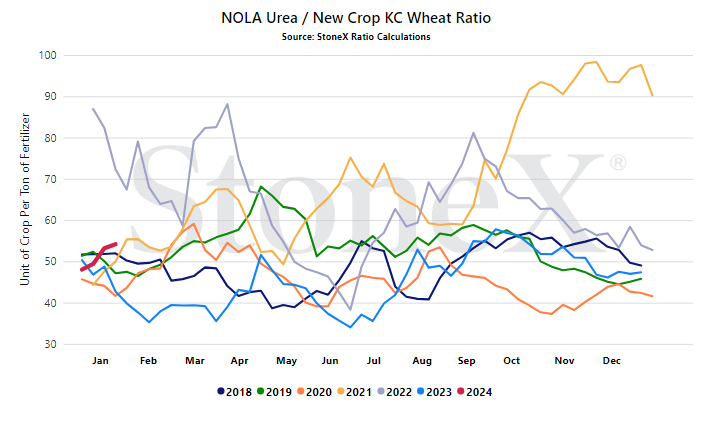
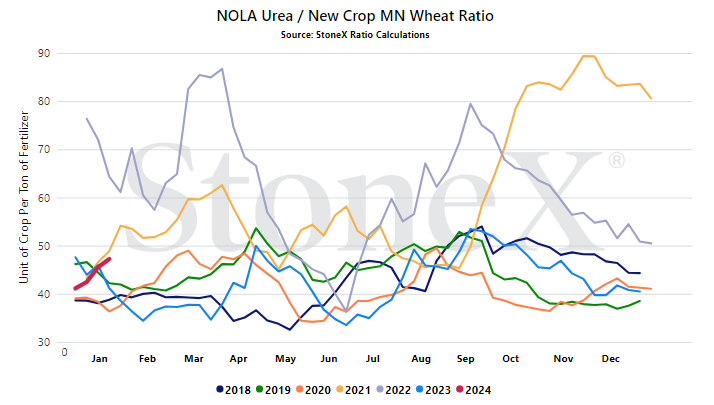
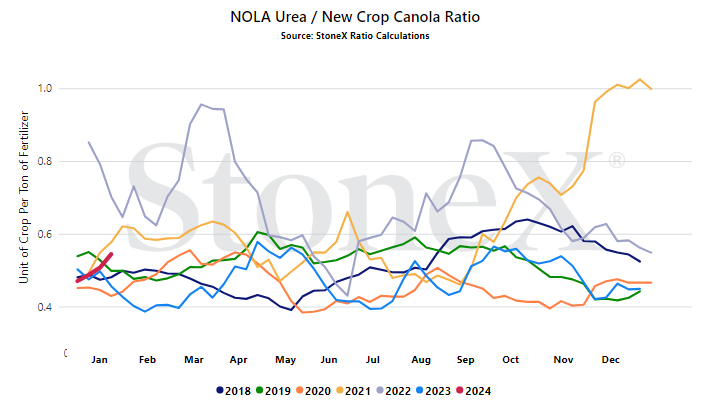
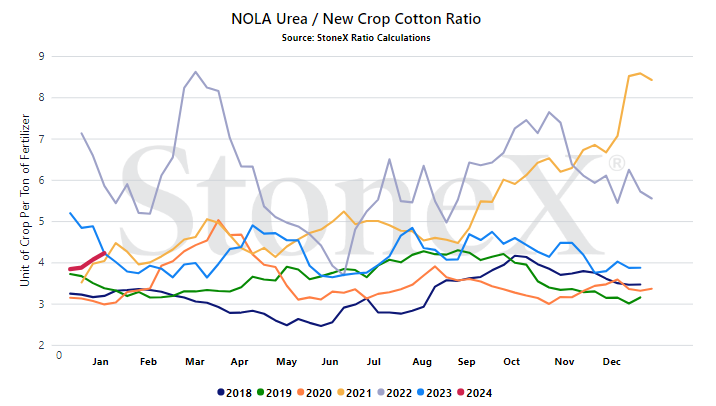
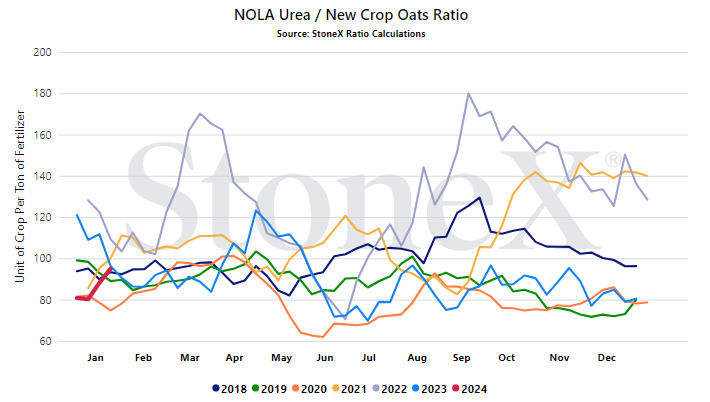
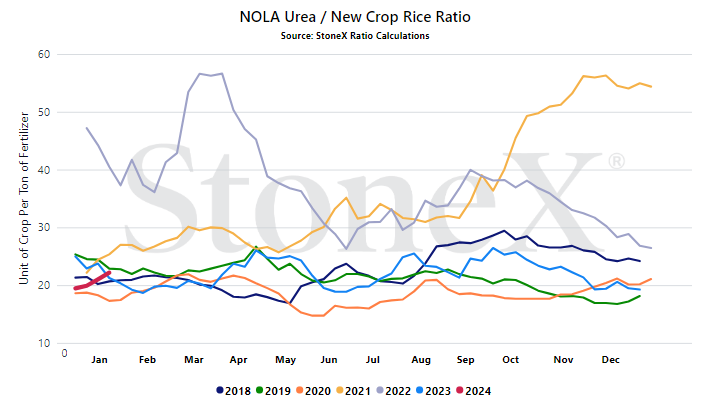
Where are the current urea/grain ratio values today

We believe that only looking at the flat price of either grains or fertilizer can be misleading:

  • Only selling grain can hurt you if fertilizer prices rise substantially
  • Only buying fertilizer can hurt you if grain prices fall

We look at the ratio "value" to get a better indication of where we are or how many bushels of X does it take to pay for 1 ton of fertilizer.

Would you rather:

  • Spend 135 bushels to pay for 1 ton of urea
  • Spend 55 bushels to pay for 1 ton of urea

When we compare the current ratio value against recent years, we start to see if we are high or low.

YOUR VALUES MAY LOOK DIFFERENT

This graph looks at the NOLA urea price vs the flat grain price. There are no logistics on either product. Your location will look different due to fertilizer logistical costs, grain basis, etc.
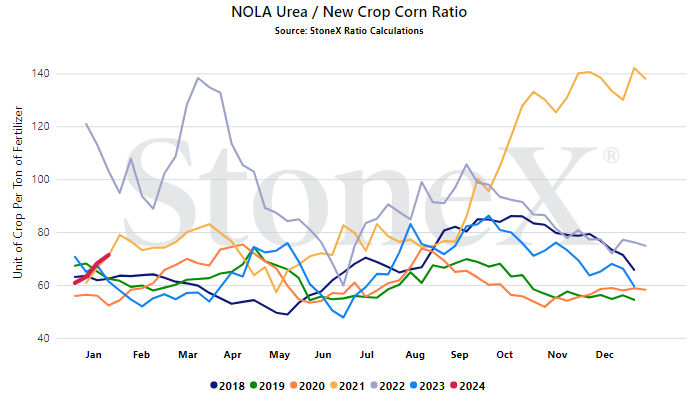
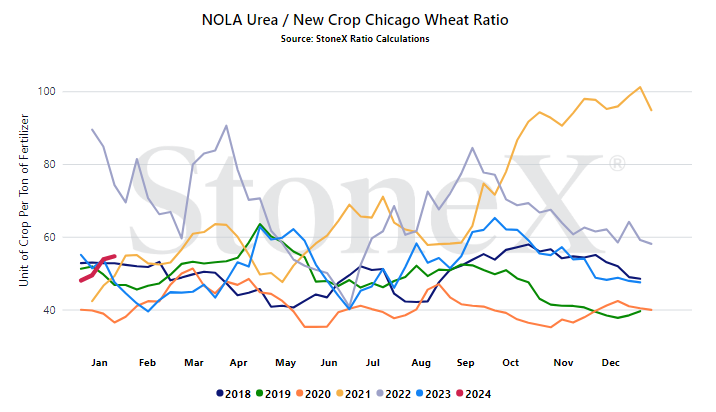
 

image 88696image 88697image 88698image 88699image 88700image 88701image 88702image 88703
 
Josh Linville’s Focal Points
  • Middle East - rather than list out all the different hot spots, I'm just saying the Middle East in general.  This is especially true because as I am writing this, we are waiting to see what the U.S. response will be to the recent death of military members in Jordan.  This has the potential to spiral out of control.  The difficulties following Red Sea attacks have been hard enough.  If we start having Iran play a direct role and we start talking about the Persian Gulf shipping capacity...urea will be a completely new marketplace.
  • N.A. imports before start of spring - July thru November, the U.S./N.A. has had a really solid start to urea imports.  There is still a ways to go but a good start.  However, we need December/January imports to be solid to help offset the shipping issues in the Red Sea and possibly in the Persian Gulf.


StoneX Ratio Calculation

The ratio calculation is derived from Bloomberg historical grains values as well as fertilizer values from StoneX, NPKFAS, and Argus.

The calculation is simply dividing the fertilizer price by each grain price.

All data was sourced from StoneX unless otherwise noted.

  • Fertilizers

This material should be construed as the solicitation of an account, order, and/or services and represents the opinions and viewpoints of the individual authors or presenters. It does not constitute an individualized recommendation or take into account the particular trading objectives, financial situations, or needs of individual customers.


The views are current only through the date stated and are subject to change at any time based upon market or other conditions, and StoneX Group Inc. (“SGI”) disclaims any responsibility to update such views. Actual results, performance, or achievements may differ materially from those expressed or implied. Information is based on data gathered from what we believe are reliable sources. Past performance does not guarantee future results.


The StoneX Group Inc. group of companies provides financial services worldwide through its subsidiaries, including physical commodities, securities, exchange-traded and over-the-counter derivatives, risk management, global payments and foreign exchange products in accordance with applicable law in the jurisdictions where services are provided.


References to certain OTC products or swaps are made on behalf of StoneX Markets, LLC (SXM), a member of the National Futures Association (NFA) and provisionally registered with the U.S. Commodity Futures Trading Commission (CFTC) as a swap dealer. SXM’s products are designed only for individuals or firms who qualify under CFTC rules as an ‘Eligible Contract Participant’ and who have been accepted as customers of SXM.


StoneX Financial Inc. (SFI) is a member of FINRA/NFA/SIPC and registered with the MSRB. SFI is registered with the U.S. Securities and Exchange Commission (SEC) as a Broker-Dealer and with the CFTC as a Futures Commission Merchant and Commodity Trading Advisor. StoneX Financial (Canada) Inc. (SFCI) is registered in Canada and is a member of CIRO and CIPF. References to certain securities trading are made on behalf of the BD Division of SFI and are intended only for an audience of institutional clients as defined by FINRA Rule 4512(c). References to certain exchange-traded futures and options are made on behalf of the FCM Division of SFI. Wealth Management is offered through SA Stone Wealth Management Inc., member FINRA/SIPC, and SA Stone Investment Advisors Inc., an SEC-registered investment advisor, both wholly owned subsidiaries of SGI.

R.J. O’Brien & Associates, LLC (RJO) is registered with the CFTC as a Futures Commission Merchant and is a member of NFA.


StoneX Financial Ltd (SFL) is registered in England and Wales, company no. 5616586. SFL is authorized and regulated by the Financial Conduct Authority (FCA) (registration number FRN:446717) to provide services to professional and eligible customers including: arrangement, execution and, where required, clearing derivative transactions in exchange traded futures and options. SFL is also authorized to engage in the arrangement and execution of transactions in certain OTC products, certain securities trading, precious metals trading and payment services to eligible customers. SFL is authorized and regulated by the FCA under the Payment Services Regulations 2017 for the provision of payment services. SFL is a category 1 ring-dealing member of the London Metal Exchange. In addition SFL also engages in other physically delivered commodities business and other general business activities which are unregulated and not required to be authorized by the FCA.


This communication is issued in the European Economic Area by StoneX Financial Europe GmbH (SFEG). StoneX is the trade name used by STONEX GROUP INC. and all its associated entities and subsidiaries. StoneX Financial Europe GmbH (“SFEG”) is a securities trading firm registered in Germany under Company No. HRB 80844.


StoneX Financial Pte Ltd (Co. Reg. No 201130598R) (“SFP”) is regulated by the Monetary Authority of Singapore and is a Capital Markets Service Licence holder (for dealing in capital market products), an Exempt Financial Adviser (for advising on investment products and issuing or promulgating analyses/ reports on investment products) and a Major Payment Institution (for domestic and cross-border money transfer services).


SFP may distribute analysis/report produced by its respective foreign affiliates within the StoneX Group of companies pursuant to an arrangement under Regulation 32C of the Financial Advisers Regulations Recipients should contact SFP at (65) 6309 1000 for any matters arising from, or in connection with, this webinar.


StoneX APAC Pte. Ltd. (“SAP”) (Co. Reg. No 200616676W) is regulated as a Dealer (PS20190001002) under the Precious Stones and Precious Metals (Prevention of Money Laundering and Terrorism Financing) Act 2019 for purposes of anti-money laundering and countering the financing of terrorism.


StoneX Financial (HK) Limited (CE No.: BCQ152) (“SHK”) is regulated by the Hong Kong Securities and Futures Commission for Dealing in Securities and Dealing in Futures Contracts.


StoneX Financial Pty Ltd (ACN 141 774 727) holds an Australian Financial Service License (AFSL: 345646) for Dealing in Securities, Exchange-Traded Derivatives Contracts, OTC Derivatives Contracts and Foreign Exchange Contracts, and is regulated by the Australian Securities and Investments Commission.


StoneX Securities Co., Ltd. (“SSJ”) (Co. Reg. No 010401047199) is regulated by the Japanese Financial Services Agency as a Type-I Financial Instruments Business Operator (Kanto Local Finance Bureau (FIBO)No.291’), is a member of the Financial Futures Association of Japan for dealing and broking FX and FX Option transactions, and is a member of the Japan Securities Dealers Association for dealing and broking stock indices and option transactions.


Trading swaps and over-the-counter derivatives, exchange-traded derivatives and options and securities involves substantial risk and is not suitable for all investors. Past performance of any futures or option is not indicative of future success. Indicators are not a trading system and are not published as a specific trade recommendation. The information herein is not a recommendation to trade nor investment research or an offer to buy or sell any derivative or security. It does not take into account your particular investment objectives, financial situation or needs and does not create a binding obligation on any of the StoneX group of companies to enter into any transaction with you. You are advised to perform an independent investigation of any transaction to determine whether any transaction is suitable for you. No part of this material may be copied, photocopied or duplicated in any form by any means or redistributed without the prior written consent of StoneX Group Inc.


The report/analysis herein is not directed to, or intended for distribution to or use by, any person or entity who is a citizen or resident of or located in any locality, state, country or other jurisdiction where such distribution, publication, availability or use would be contrary to law or regulation.


© 2026 StoneX Group Inc. All Rights Reserved.

Satellite view of Earth at night showing illuminated cities across Asia and the Middle East

Discover more insights

Our subscribers have access to comprehensive market analysis from StoneX spanning commodities, equities, currencies and more.

StoneX: We open markets

Our market expertise, advanced platforms, global reach, culture of full transparency and commitment to our clients’ success all set us apart in the financial marketplace.

Reach

With access to 40+ derivatives exchanges, 180+ foreign exchange markets, nearly every global securities marketplace and numerous bilateral liquidity venues, StoneX’s digital network and deep relationships can take clients anywhere they want to go.

Transparency

As a publicly traded company meeting the highest standards of regulatory compliance in the markets we serve, our financials and track record are matters of public record. StoneX’s commitment to “doing the right thing over the easy thing” sets us apart in the industry and helps us build respect, client trust and new partnerships.

Expertise

From our proprietary Market Intelligence platform to “boots-on-the-ground” expertise from award-winning traders and professionals, we connect our clients directly to actionable insights they can use to make more informed decisions and achieve their goals in the global markets.