Global
There really isn't much to say in terms of the global market outlook because nothing has really changed.
Near term, all the same things are in play. Global demand has been really solid, yet global prices have done nothing as a result. We haven't seen much change in exports/production/etc. Northern hemisphere demand is coming quick, yet nothing is changing the price.
Then look further out. There is more production coming to Canada. Russia is increasing flows. Chinese investments in Laos production should improve their rates. Belarus continues to improve their export flows after losing Lithuanian routes. If things are steady today, we could be discussing a near oversupplied market in the coming years.
Now, we do need to watch how manufacturers act. If prices stay low, it is certainly in the realm of possibilities that manufacturers start cutting back production to raise price ideas. I really dislike this approach, but it is their prerogative.
All in all, the global outlook appears steady...if not lower...in the coming months.
North America
If we were not discussing the possibility of a looming tariff war between Canada and the U.S., this would be a short piece. I would say that there is the possibility of prices jumping slightly in spring season as logistics get pushed, but otherwise it appears steady into spring and likely soft into summer.
However, that isn't the case.
I have had a lot of folks ask me what tariff's will do and the short answer is that I do not know. This is almost an academic question. If the U.S. was Canada's only buyer, then yes we would likely see Canada pay all the tariff. However, that isn't the case...but is it? With spring so near, it will be near impossible for U.S. buyers to shift to international tons. There just isn't enough calendar left to do so. In that case, we might see U.S. farmers paying the higher price. But then that doesn't account for the market rushing to get tons imported before any tariff's take place.
All in all, it continues to look pretty steady near term with a lean toward slightly higher prices thru March. Then, once the market gets into planting and potash focuses on the summer, I'm back to bearish.
ONE NOTE: LOOK AT THE POTASH/CORN RATIO. I'LL TALK MORE ABOUT IT DOWN BELOW BUT WE ARE CURRENTLY IN A SOLID RATIO VALUE OPPORTUNITY.
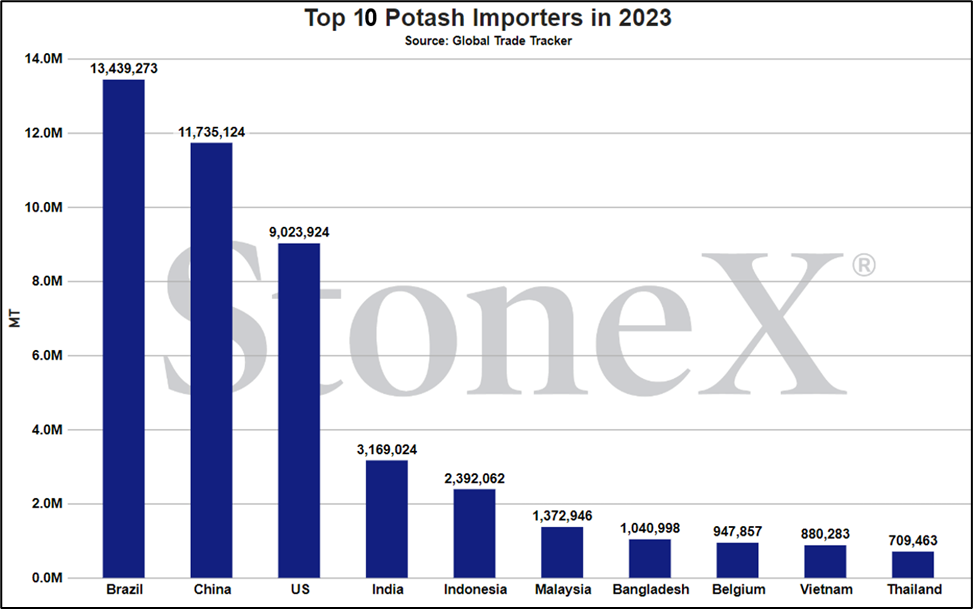
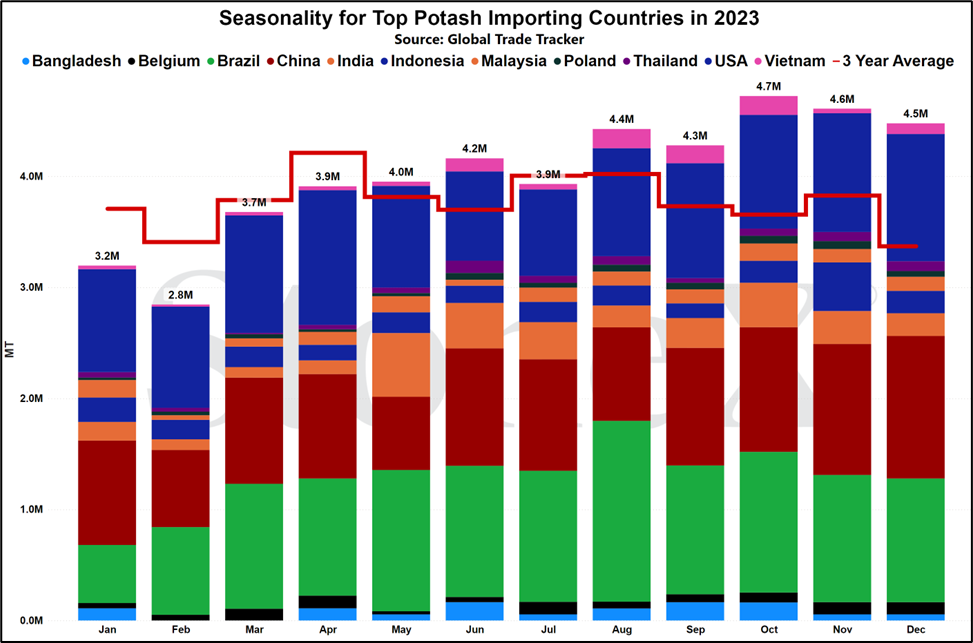

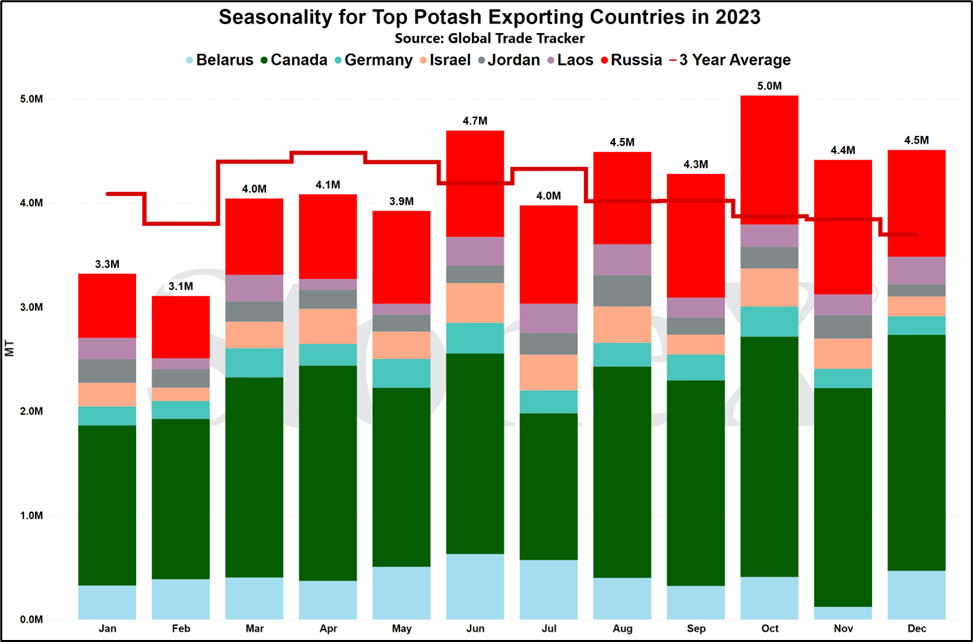
Global values remain flat in spite of high demand, signal well supplied market
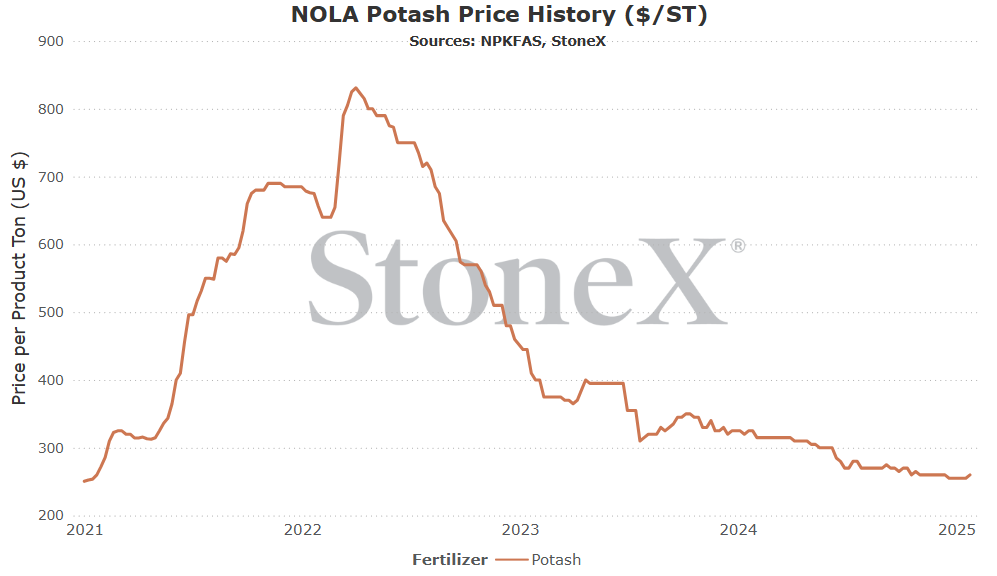
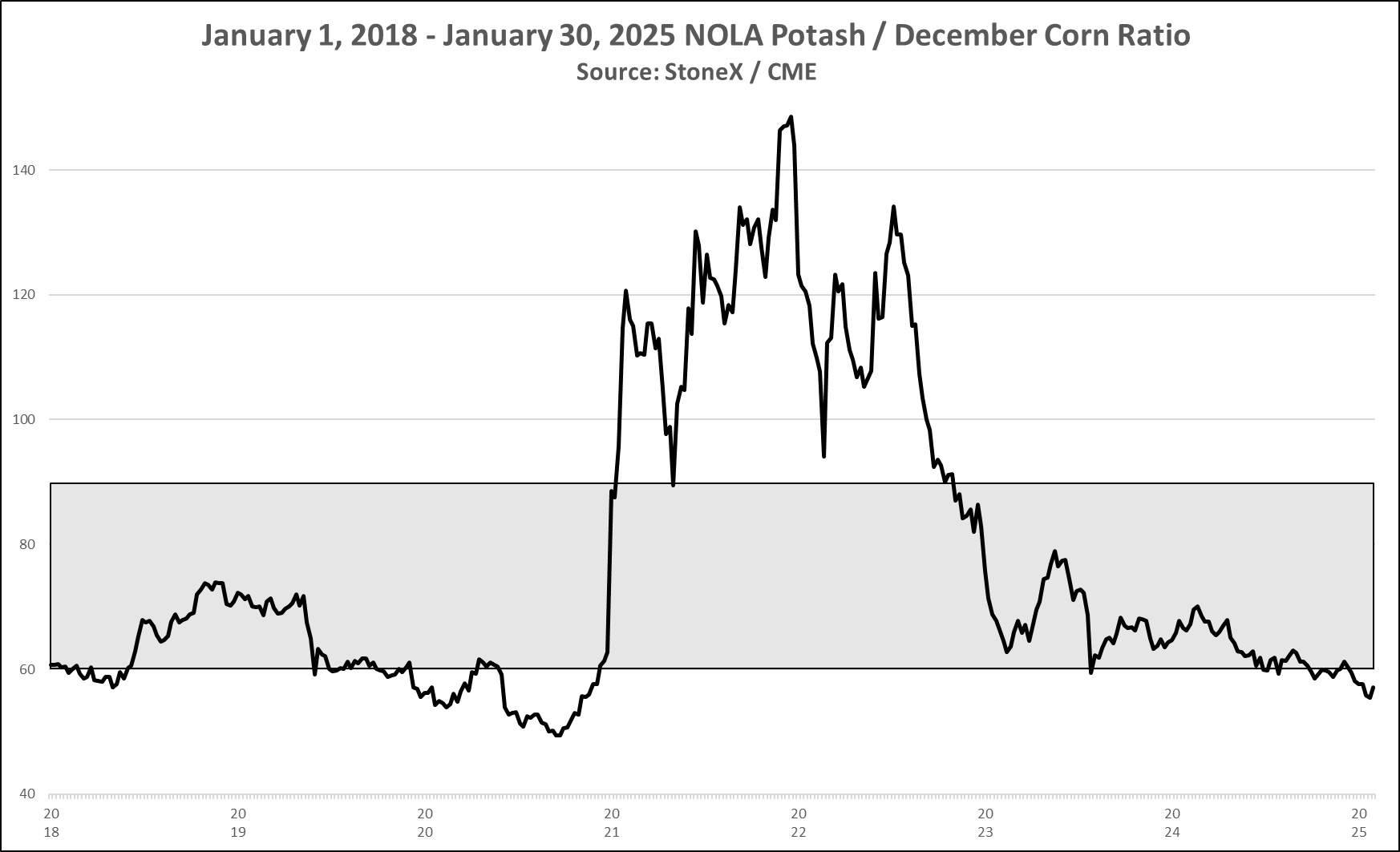
When looking at the price graph above and below, you should notice that potash prices, with the exception of a couple blips, have been trending lower near constantly since spiking in late 2021, early 2022. Our perspective is that this is indicative of a very well supplied marketplace.
That massive spike was a couple events coming together.
- The Russian invasion sent fertilizer markets across the board into a tizzy. Most of the world truly believed that this invasion would be followed by the majority of global buyers refusing to take their product which would result in losing the 2nd largest potash export country in the world. While this never became true, it was a serious concern.
- Belarus allowed Russia to use their land to invade Ukraine from the north. This was not looked kindly upon by western leaning countries and the potash world was quickly reminded that Belarus was land locked. Historically, Belarus would ship their product thru Lithuania, to their deep sea ports and out to sea. Lithuania is very much a western leaning country and they responded to Belarus by shutting their borders and ceasing Belarusian assets. Effectively, the world's 3rd largest exporter disappeared.
- Grain prices shot skyward. As a result, a lot of demand came forward at the same time and helped to rally price ideas. Prices rallying were followed by more buying...which was followed with more price increases.
Eventually, all fertilizer markets calmed down and corrected. Phosphate fell by half but have remained relatively high priced since then. Nitrogen markets fell by 2/3rds and have seen some intense volatility. However, potash fell...and fell...and fell...and well, you get the picture.
It is historically common for potash markets to be extremely slow on price movements. If you go further back on the price graph, you will have seen price trends that take months and sometimes years to complete. It is just a slow moving marketplace.
However, today is a bit different in that this lower/flat trend could continue for a while.
Our outlook continues to be that potash is already very well supplied which is keeping prices flat to lower, and that coming production will start a conversation about whether global potash markets are oversupplied. Increases are still expected from Canada, Russia, and Laos. To add to the mix, Belarus has been finding new supply routes that do not include Lithuania which have seen their export totals climbing once again.
All of this combines to a market that feels very well supplied today...and should get much better in the near future. That is great news for buyers.
What does this mean for farmers?
When markets are oversupplied, that puts the pressure on the manufacturer. In that scenario, the pressure causes sellers to justify being aggressive with their prices. If they miss the sale because someone undercut them, there may not be another opportunity short term and their unsold inventories will rise.
While this DOES NOT mean that prices cannot rise from time to time, the overarching story is one that has prices low which is a great thing for farmers.
U.S. concerns rise on Trump tariff threats against Canada
This has been THE story for fertilizer in the last month. If you are wondering why this is a bit later on being sent out than what I previously promised, it is because of this. I have been inundated with interview requests asking all sorts of questions about it and how it translates to fertilizer.
For potash, my response is that while a longer term tariff should see the U.S. and Canada "sharing" the cost of the duty, this spring will see U.S. farmers bearing the brunt.
"But that isn't how tariff's work. Canadian potash manufacturers/exporters have to pay the duty to the U.S. government."
If that is what went thru your mind, you are absolutely correct...on the surface. On the U.S. federal government level POV, that is how it works. A ton of potash valued at $400 crosses the border from Canada to the U.S. The exporter on record is then required to send funds to the U.S. government for an amount of $100. Easy peasy. Canada paid the price.
However, that isn't real world.
Again, this goes back to pressure and who needs who more.
Consider where we are on the calendar. It is February 1st as I write this (yes, working a Saturday to get this out on time!!!). For much of North America, spring potash application will begin in 30 - 60 days. That means U.S. farmers have few to no options to try and source potash from the rest of the world. If we start to approach other major exporters, those vessels will simply not arrive and be distributed fast enough to catch our application period. If we want to have product for the spring, and we need it to plant this crop, we absolutely have to have Canadian product.
On the other side, Canadian potash manufacturers need U.S. demand...but they will not suffer nearly as much. Sure, not shipping to the U.S. would likely cause unsold inventories to grow and show poorly on quarterly earnings reports, but they are not going to go bankrupt. After years of massive profits, they are very comfortable from a financial POV. They can likely withstand seeing demand lower for a time. So there is pressure, but it is nowhere near as large as the south.
That brings us to today. I have already been hearing that new contracts regarding Canadian potash being sold into the U.S. has new stipulations. The buyer may agree to pay $400, as we have been using in this example, but there is now an added clause that any tariff rate will also be paid by the buyer. It does not state what the amount is. It merely says any rate will be paid by the buyer.
So while the exporter on record may pay the duty to the U.S. government, they are paying that tariff with funds received from the U.S. buyer.
If these tariffs get put into place AND they stick around for a while, I would expect that we see U.S. buyers shift away from Canada and to other global exporters. While the supply routes will likely come with higher logistical costs, they will be weighing that against tariff rates. This will help push some, not all, of the pressure back to Canada who will not have demand backed into a corner like it does today.
Everything in the world comes down to pressure. Who has it. Who doesn't have it.
Today, that pressure is on the U.S.
What does this mean for farmers?
Unfortunately, it means higher prices short term.
We have already seen certain manufacturers trying to take advantage of the chaos by pushing their price ideas $25 higher. More concerning are the actual tariffs that will see U.S. values higher.
There is no guarantee that the tariffs will be put into place or that if they are, that they will be long term. My hope remains that this all gets resolved, but we have to consider and be prepared for a world where it doesn't.
For now, we have a global market that still looks flat to lower on adequate supplies but the U.S. may buck that trend.
Potash values VERY attractive vs grain values
I promised that the next time I saw any of the fertilizer/grain ratio values dip to low levels, I wasn't going to talk about it. I was going to preach. I was going to yell. I was going to make sure that anyone in the industry that was listening heard the message.
Buckle up. Potash is there.
If you have heard me present, you likely know that I take a bit of a different approach to farm marketing. This is not to say that I think anyone is doing anything wrong. That isn't my place. End of the day, you have to own your marketing decisions because if the banks ever come calling, they are ringing your phone. However, that doesn't mean there are not ways we can improve.
I am a big believer that prices illicit emotional decisions. Most have never seen a grain price high enough. Most have never seen a fertilizer price low enough. That isn't too say that the price isn't high or low, but you put your whole self into growing the crop, keeping your operation going, etc. You are damned proud of what you create as you should be. The downside is that pride/anger/etc. can cause us to miss opportunities staring us right in the face.
When I look at farm marketing, I look at it the same as I look at manufacturing industries. What I mean by that is if you talk to any manufacturers, those folks are not trying to sell the high/purchase the low. Rather, they watch the relationship between the two. When they get attractive, they lock it in. When it gets too wide, they wait. Watching for these opportunities helps them to maximize profits.
I think this is an extremely powerful tool for farmers. When it comes down to it, we are about inputs and outputs. In manufacturing, the input might be plastic and the output might be widgets. For farming, it is much the same:
- Inputs - fertilizer, diesel, chemical, seed
- Outputs - grain
When I give a presentation, I ask a simple question. "Would you rather spend 50 bushels of corn to pay for a ton of potash or 100 bushels of corn to pay for a ton of potash?" Without fail, most believe it is a trick question. I explain that it isn't and ask again. I have yet to have anyone get it wrong. They would rather spend less bushels.
This isn't to say that $8 corn isn't better for your overall operation than $3 corn. Everyone does better at $8.
Still, there are several inputs where the price is largely dictated to the farmer. Fertilizer is one input that sees volatility and provides opportunities from time to time.
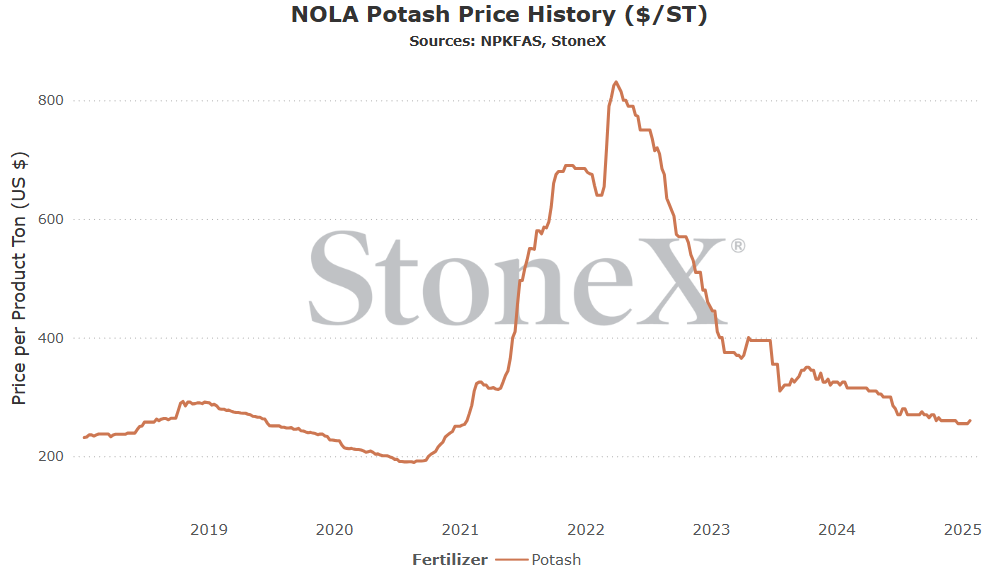
Take a look at the graph below. What that does is show the weekly relationship between NOLA potash and December corn going back to 2018. The formula is simple. Divide the potash price by the corn price. That gives you the ratio. The grey box is the range where 50% of all the weekly values have traded. So that means:
- Anything above the grey box is the top 25% of values - this is the WORST values for farmers. It means you are spending more bushels to pay for potash, not less. As a point, look at all the weeks it was above. Guess what, corn prices were pretty healthy during that period. High priced corn does not always translate to the best input/output relationship.
- Anything in the grey box is the middle 50%. This is "normal". Not too high. Not too low.
- Anything below the grey box is the bottom 25%. This is the opportunity. This means that since the start of 2018, you are locking up your potash for significantly less bushels.
So here we sit in the lowest 25%. How does this get secured? Well, first you have to be willing to sell ahead and I know that is a hurdle for some. I am not going to sit here and tell you that any trepidation is unfounded. For those willing to sell ahead, the purchase of potash is followed with an equal sale of corn. That secures the relationship. If you just buy potash, the corn price can go up and down making the value better or worse. If you just sell the corn, the potash price can move. Locking in both secures both sides and takes away the price risk.
Two points to leave with:
- You need to look at your local numbers - my graph looks at NOLA potash and Chicago corn. That is because I am speaking to a wide audience and this is the 30,000 foot level view. No one gets this graph at home. This graph needs to be created looking at your local historical values. This can be done by conversing with your local retailer/elevator.
- You can look at whatever corn price you want - I have what I think is a rather unique view of this. Today, any potash purchased is being locked up to be applied this spring to raise the 2025 crop. So that is why I use Dec '25 corn values to build the model. Come June 1, I will shift the corn to Dec 26 because we are past spring and now anything purchased will be for the 2026 crop. Some may argue spot corn values is what should be used. THAT IS YOUR CALL. Whatever your approach, just stay constant and look for the same opportunities.
Ultimately, potash deserves your attention. The value is very good. I will admit that I still think longer term potash values will go lower. However, with corn acre estimates rising as high as 96M acres in some circles, current corn prices might look really good in the future.
All I know is that the current value is solid. Have a think on it.
NOLA/New Orleans Louisiana
Vs 30 days ago - 2% or approximately $5 higher
Vs 90 days ago - unchanged vs 3 months earlier
Vs 6 months ago - -7% or approximately $20 lower
Vs 1 year ago - -20% or approximately $65 lower
U.S. Midwest Average (average of several points across the Midwest)
Vs 30 days ago - unchanged vs last month
Vs 90 days ago - -6% or approximately $19 lower
Vs 6 months ago - -13% or approximately $46 lower
Vs 1 year ago - -21% or approximately $83 lower
- U.S. implements tariff's on Canada, U.S. pays the price – for U.S. farmers, this is the biggest single factor today. President Trump is threatening tariff's on Canada starting February 1st. Where do the majority of potash tons into the U.S. come from? Canada. Now, some will argue that these tariffs will hurt Canada. I disagree. There is little time before spring application begins. There is not enough time to shift away from Canada and to other global manufacturers which means we are dependent on Canadian product. My POV is that U.S. farmers will pay the bulk of the tariff for spring. I hope it doesn't happen. I'll happily be wrong. I just do not think I am...
- Growing N.A. demand / limited calendar - as mentioned on all the other products, U.S. corn acre forecasts continue to grow. We started 2025 at 92M acres. Just before my Orlando vacation with the family, we moved it to 92.5M. I wasn't gone a week and we moved higher to 93.5M. Today, there are some speculating that 95 - 96M acres is a distinct possibility based on the corn/bean price ratio and feedback from seed companies. Every additional corn acre equals additional potash demand and with it already being February, there is little time to shift supplies to prepare.
- Manufacturers curtail production to offset low global values – this has been a long discussed factor that we haven't seen play out. However, it is still a possibility. The potash outlook from our POV is one that is already well supplied and getting more supply in the future. That keeps prices low. Manufacturers obviously do not like low prices. If we see enough companies/countries curtail production, that limits supplies and could push prices higher. It might only be a short term run up which would elicit production to resume and oversupply the market again, but it would have that effect.
- Tariff's do not get implemented – there is no guarantee that the tariff will happen. There has been a lot of talk/threat/etc., but it isn't written in stone. We could see both sides of the border come to an agreement and the threat of tariff's completely dropped. That would help to remove a lot of the fear that is based in the current marketplace.
- Global market outlook still oversupplied - our longer term outlook remains the same. Current global supplies still feel VERY good vs demand which is why values have been flat to lower for so long. There is more production coming. Even with 2024 demand higher than expected across some major country buyers, prices still didn't rally.
- Cash cost of production is low, still margin left in the market – while the price per ton of potash manufactured varies around the world, there is one commonality...it is relatively cheap. There still seems to be plenty of margin in today's marketplace meaning that prices can drop without production being forced to slow/stop.
Where are the current potash/grain ratio values today
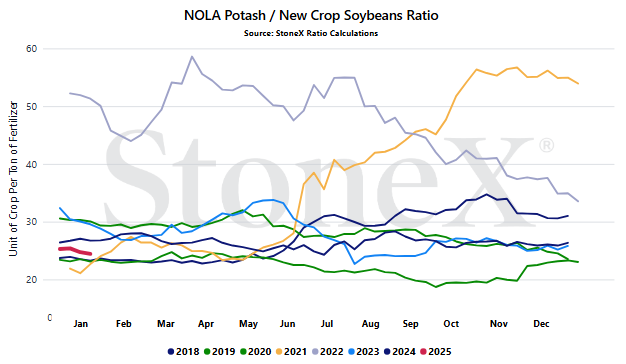
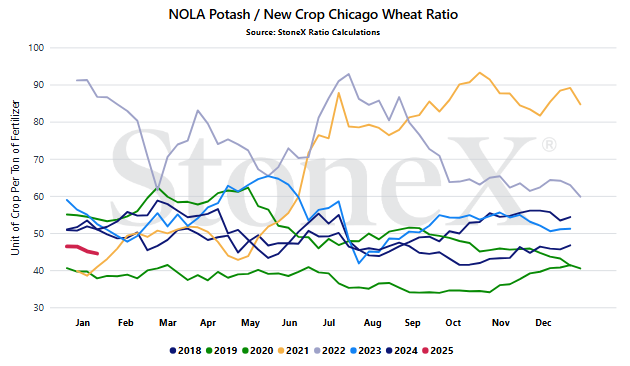
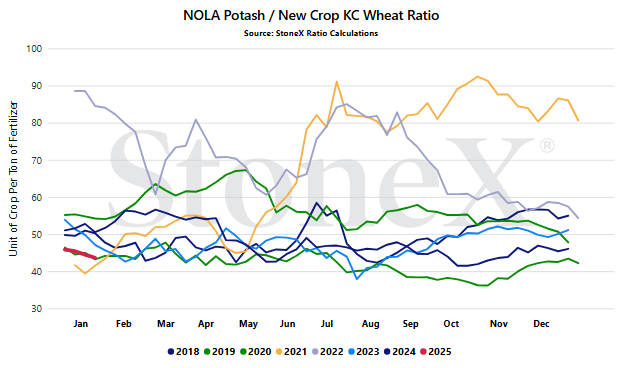
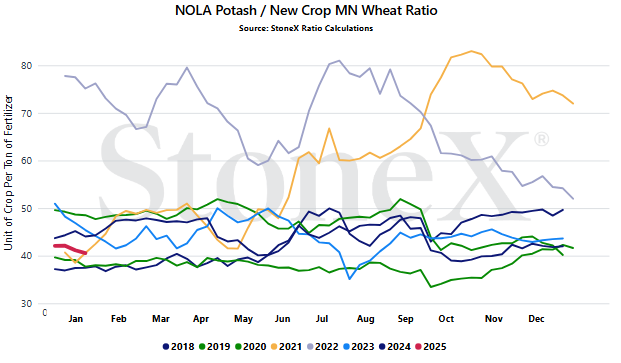
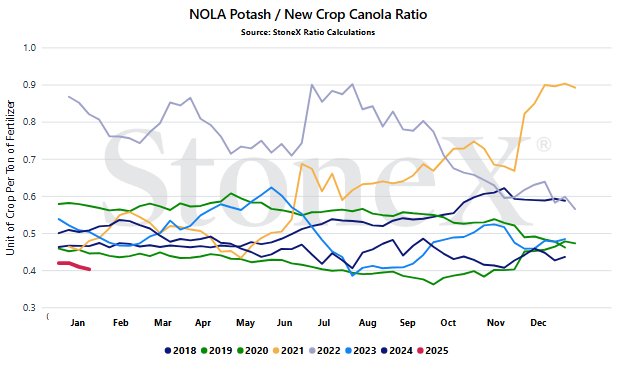
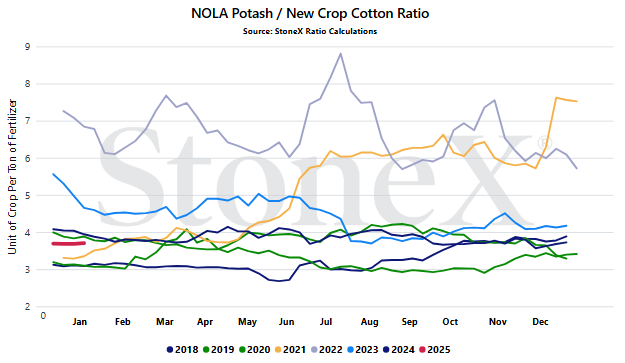
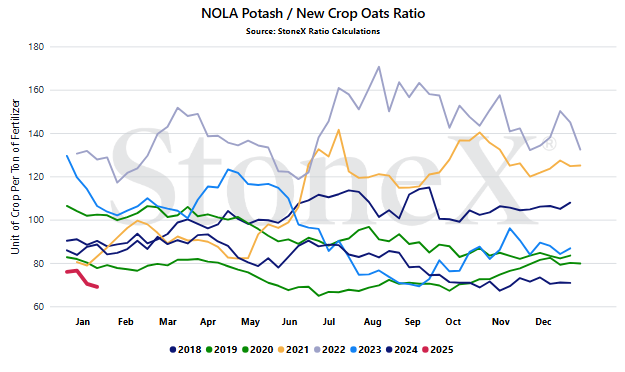
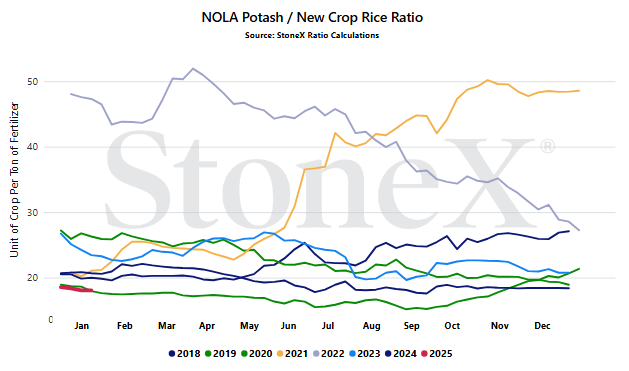
We believe that only looking at the flat price of either grains or fertilizer can be misleading:
-
Only selling grain can hurt you if fertilizer prices rise substantially
-
Only buying fertilizer can hurt you if grain prices fall
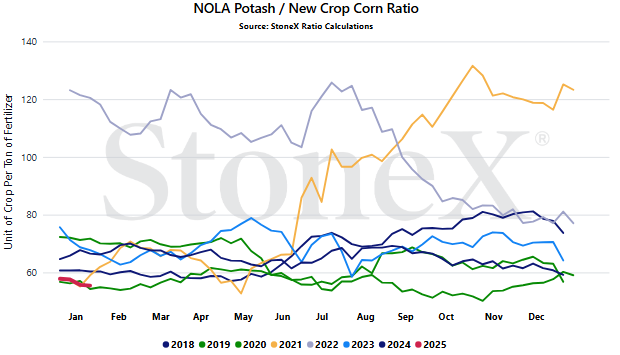
We look at the ratio "value" to get a better indication of where we are or how many bushels of X does it take to pay for 1 ton of fertilizer.
Would you rather:
-
Spend 120 bushels to pay for 1 ton of potash
-
Spend 60 bushels to pay for 1 ton of potash
When we compare the current ratio value against recent years, we start to see if we are high or low.
YOUR VALUES MAY LOOK DIFFERENT
This graph looks at the NOLA potash price vs the flat grain price. There are no logistics on either product. Your location will look different due to fertilizer logistical costs, grain basis, etc.
- Global manufacturers reaction to flat/falling prices - we have already seen the Belarusian president discuss lowering potash production rates as a result of lower prices. Fortunately, no one really paid attention. However, that will not always be the case. While it is relatively cheap to pull potash out of the ground and turn it into the product we know and love, it isn't free and these companies have had a taste of higher margins.
- New/increased production timing - there are plenty of new and increased production sites on the horizon that will add even more supply to an already very well supplied marketplace. As these tons come online, it should put even more pressure on the market. This is a good thing for farmers...eventually.
- Will farmers increase application rates at such low values? - I agree that we have seen lower potash values historically speaking, but it isn't often that we get this low a price with some of these solid grain values in relation. Take a look at the ratio graphs above. They are VERY attractive for those that will buy potash/sell grain and secure that value. In fact, these values are low enough that farmers should consider adding extra application if their soils will hold it. That is how solid it is...but will they?
StoneX Ratio Calculation
The ratio calculation is derived from Bloomberg historical grains values as well as fertilizer values from StoneX, NPKFAS, and Argus.
The calculation is simply dividing the fertilizer price by each grain price.
All data was sourced from StoneX unless otherwise noted.