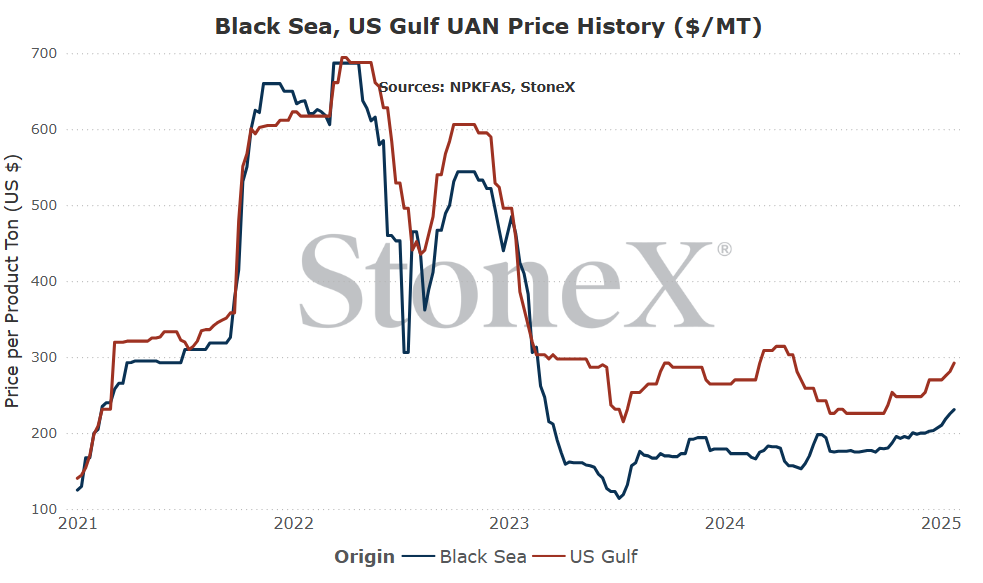
The intention of the below graphs are not to use to say "my price should be X based on this graph". These prices are derived from an FOB price point average. The intent is to show major global price movement trends. Your values will likely have significant basis difference (similar to your local grain price being different than the traded market price).
This graph is labeled as MT in USD currency.
Trump tariffs war could lower global UAN supplies
This is a headline that many of you may read and start scratching your head. It took me a while to think thru the global ramifications but this is where I've come to.
This statement is not regarding Canadian/U.S. tariffs. Instead, I am focusing the possibility that President Trump places tariffs on Russia.
We all know that Trump enjoys using tariffs as a negotiation/pressure took in global politics. Columbia refused to accept their citizens back by not allowing U.S. planes to land. Trump quickly threatened high percentage tariffs with the promise that more were coming. It wasn't a couple days and the Columbian leader not only reversed his course but offered to send their plane to get them going forward. When used correctly by a nation like the U.S., it can sway hearts and minds.
Right now, the big focus is whether Trump's February 1 tariff threat against Canada will happen. We will see over the weekend.
But let's look further out. The world is still incredibly unhappy with Russia regarding its invasion of Ukraine. Relationships as well as trade flows have been strained. There are some that believe that Trump will be able to find a resolution. He and Putin seem to have a much more cordial relationship than the Biden administration had. If peace is found, we could see the rest of the world loosen restrictions on Russian goods and trade flows return to normal. In this case, UAN production would likely rise with the advent of new demand and help boost the global S&D.
However, what if that doesn't happen?
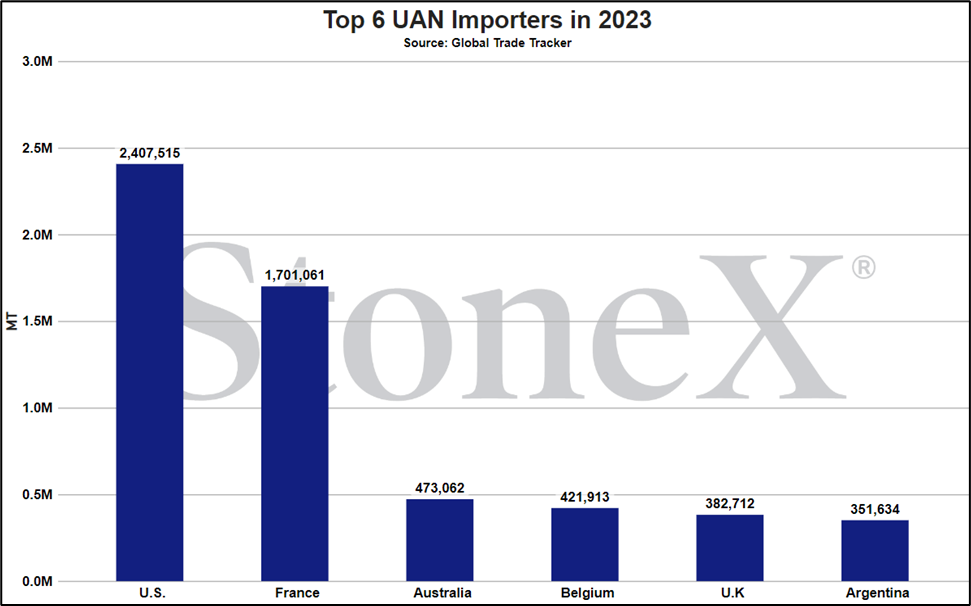
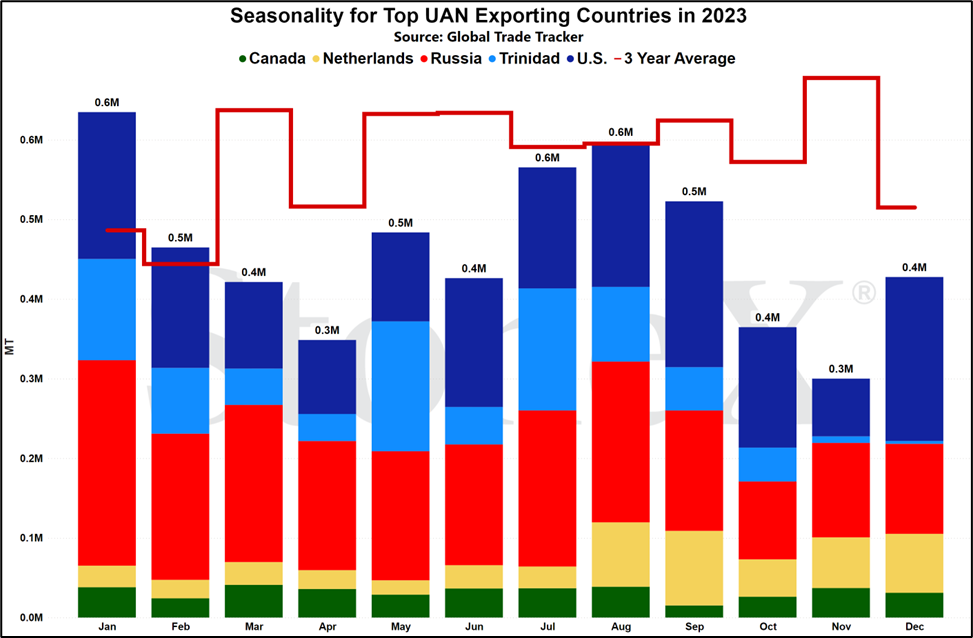
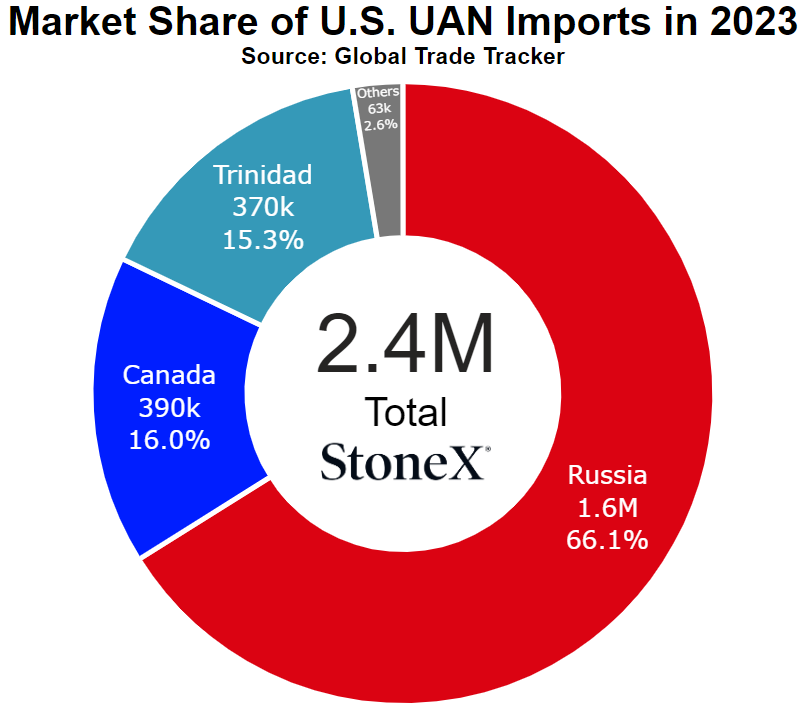
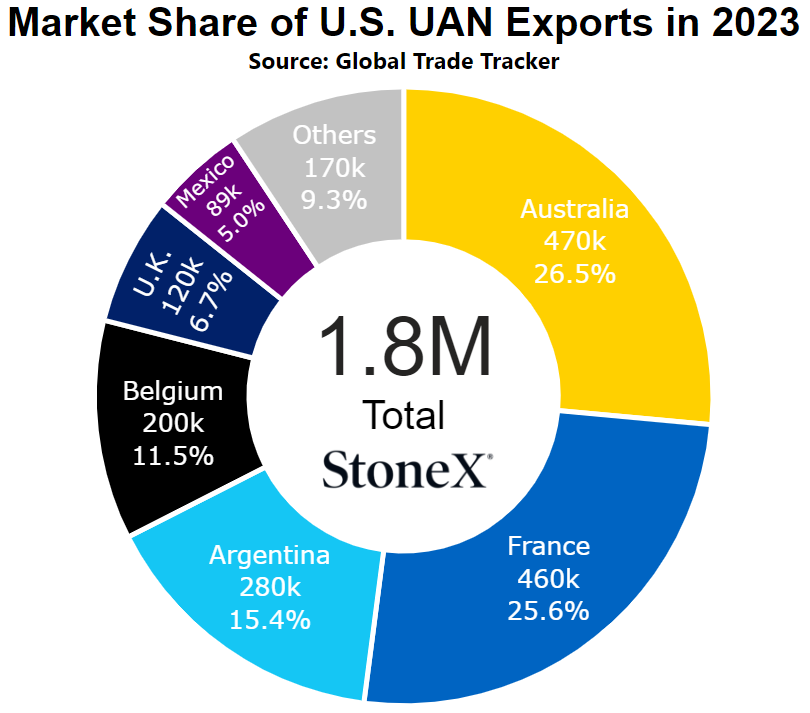
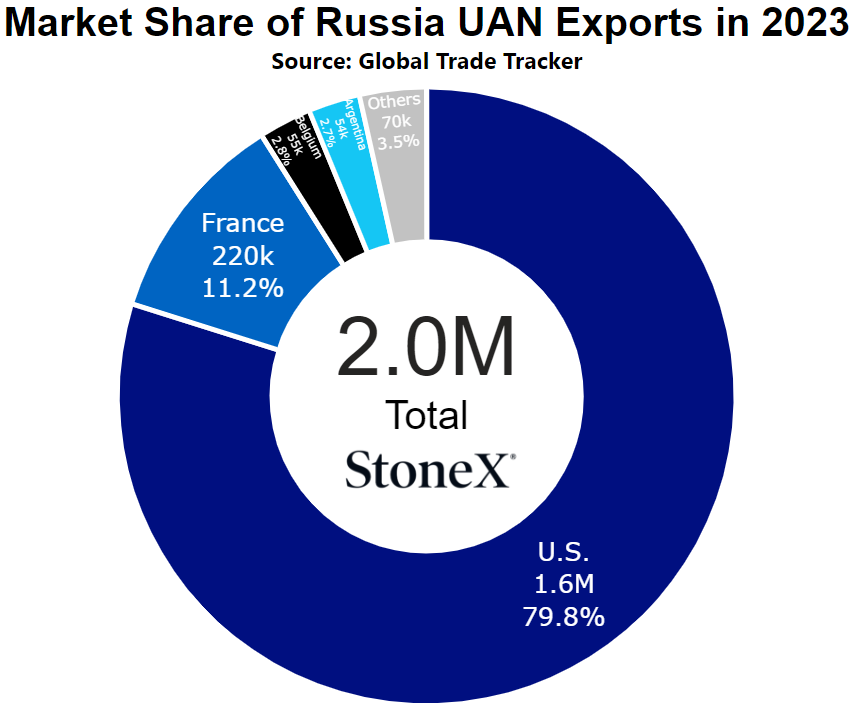
What if Trump attempts to find peace and Putin says absolutely not? In that case, there is a pretty high chance that wide reaching tariffs will be the next step. For U.S. farmers, this will hurt as Russian product has become the biggest competitor to N.A. manufacturers. If competition drops, it can allow prices to rally. For Russia, it would mean losing their last major demand destination. Global UAN demand is nowhere near as large as some other fertilizers. Look at the graph above. After the U.S. and France, demand levels fall way off.
This is where my fear that Russia could drop UAN production. It is mostly western countries that use UAN given how difficult it can be to transport and apply liquid products. The U.S. is one of the last western countries willing to take their product. If that avenue gets shut down, where will Russian product go? If there are few to no homes left, why would they produce UAN? If this path happens and they are forced to shut down UAN production, what does that do for global supplies? Right, they drop while demand remains steady.
Lower supplies + steady demand = higher prices
Now, this is connecting a lot of dots and if I had to choose, I would put this in the "low probability" bucket. But it is a very impactful situation that we can track. Hopefully this will be the last time we discuss this because if the story fades away, it means it didn't happen.
UAN prices do not need anymore help going higher...
What does this mean for farmers?
UAN values have already been rising with the help of urea prices increasing. The bright side is that supplies seemed to have somewhat stabilized as of late.
If this path gets followed and we suddenly lose Russian exports, it just makes a bad situation worse. Manufacturers have been vocal about making sure that UAN stays connected to urea on a price per pound of actual N basis. They fear making the same mistake from a couple winters ago. However, if Russia suddenly disappears, I could see that UAN/Urea connection disappearing as well. UAN could literally sit on its own island.
As stated earlier, this is a very low probability/high impact situation. I wouldn't bet much on the outcome, but we need to watch it.
Surging urea values dragging UAN prices higher
Nitrogen fertilizer products, while they do not move dollar for dollar together, do have a large amount of correlation. Typically speaking, urea sets that tone. It is the largest produced and used product directly in agriculture. It is produced by the most number of nations. It is produced by the most number of companies. Due to that, it is the most commodity like of all nitrogen sources so when I look for direction, I start there.
...and urea has been bullish.
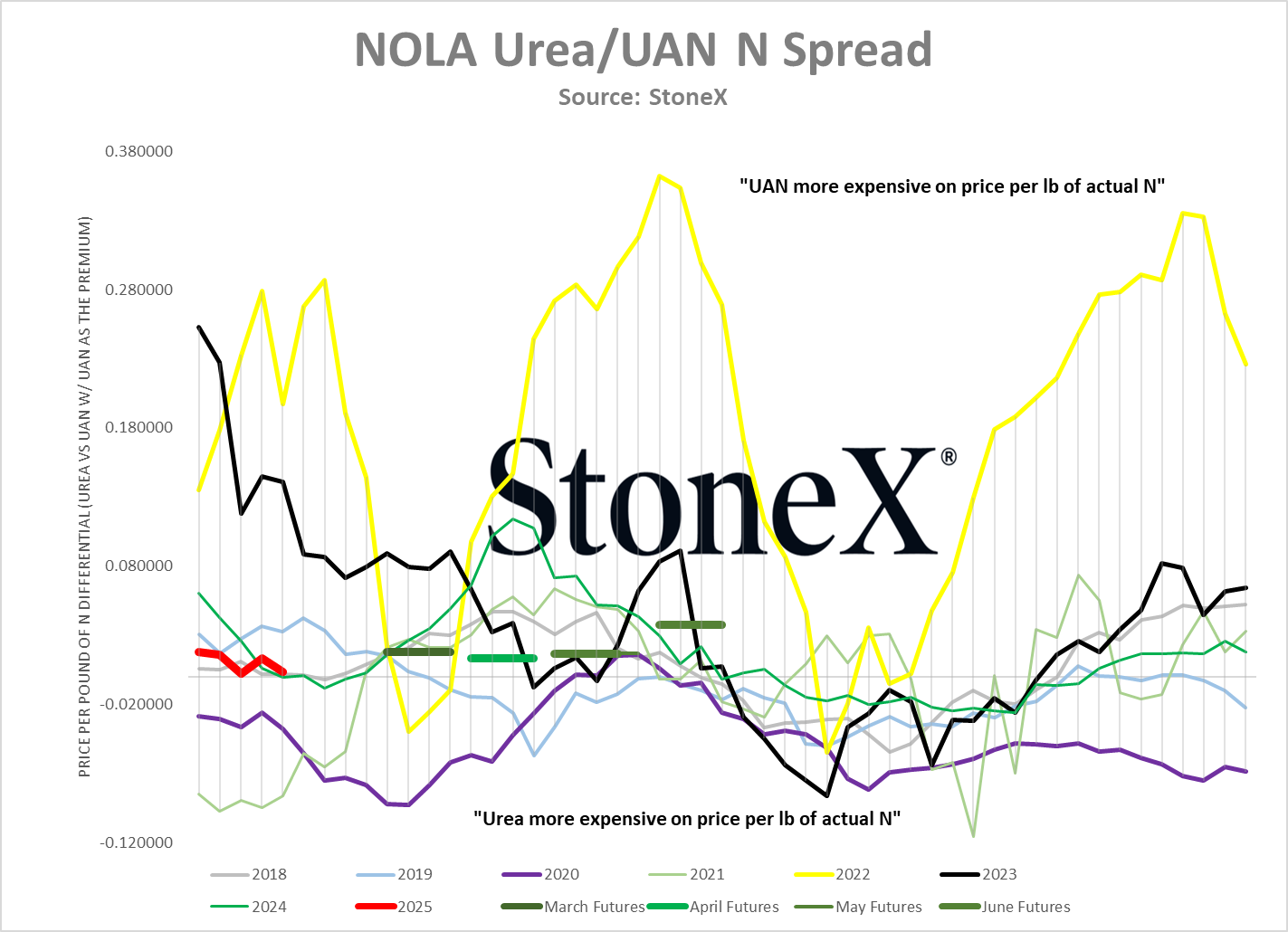
The graph below looks at the price relationship between urea and UAN. As always, I watch the NOLA (New Orleans, LA) price due to the fact that it is the most liquid and "easy to find" price in North America. Any inland storage/production site typically has prices relatively guarded to stay ahead of their competition. This graph also compares the prices on a price per pound of actual N...because that is what matters to you. You care about the nitrogen content.
So on this weekly price comparison chart, the horizontal line represents the values being the same price. Anything in the negative region means urea is more expensive than UAN. Anything in the positive region means UAN is more expensive than urea.
That yellow line is a big part of why UAN stays as connected to urea as it does today. Toward later 2022, urea prices started to fall but UAN manufacturers kept their price level high in hopes a rally would happen and given them fat margins. In the end, the rally didn't happen and they had to be aggressive with sales. Some speculate this costs certain companies 8-figures worth of profits. The result was statements that they would not allow these sorts of breakouts again. UAN would follow urea.
Today, that has continued to be the case. Both products are nearly equal priced for a while. This is important to note because neither product has seen its price stagnant. Urea values jump globally, NOLA urea values rise to match the strength, and then UAN follows. The result is a line that doesn't look like much has happened, but that couldn't be further from the truth.
The big question today is whether UAN can keep up with demand. Corn acre expectations are growing, increasing nitrogen demand with it. Inventories are already snug with some production hiccups. Exports from the U.S. have been large. There is a fleeting threat that we could lose Russian imports. If one of or a combination of these events happen, we could see manufacturers flee the "attachment" approach. If supplies are not enough to meet demand, it is very likely that UAN starts becoming a very premium product.
What does this mean for farmers?
While there is nothing "cheap" about it, UAN has at least remained attractive vs urea values. There is a possibility that will not be the case as we move into spring season.
We need to see how some of these events play out before we have a better POV on the future. However, I'm feeling pretty confident in my urea market outlook which continues to be bullish and with UAN in line with urea, very likely that any urea strength will be met with UAN strength.
U.S. imports slow/exports high, leaving N.A. with less tons
N.A. UAN has already been struggling a bit on its own. While we haven't seen a major production hiccup, there have been a few smaller ones which many believe have removed a couple hundred thousand tons from the S&D. To start 2025, demand has been jumping as corn acreage expectations continue to rise. Every added corn acre equates to more nitrogen demand. If this had been done earlier in the fertilizer year, there could have been more time to do the work to find more supplies but since it is already February, that time is rather narrow.
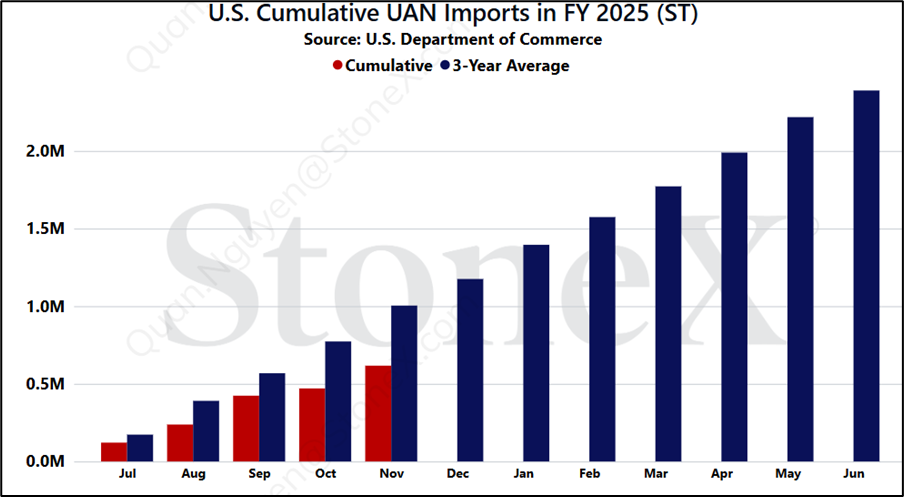
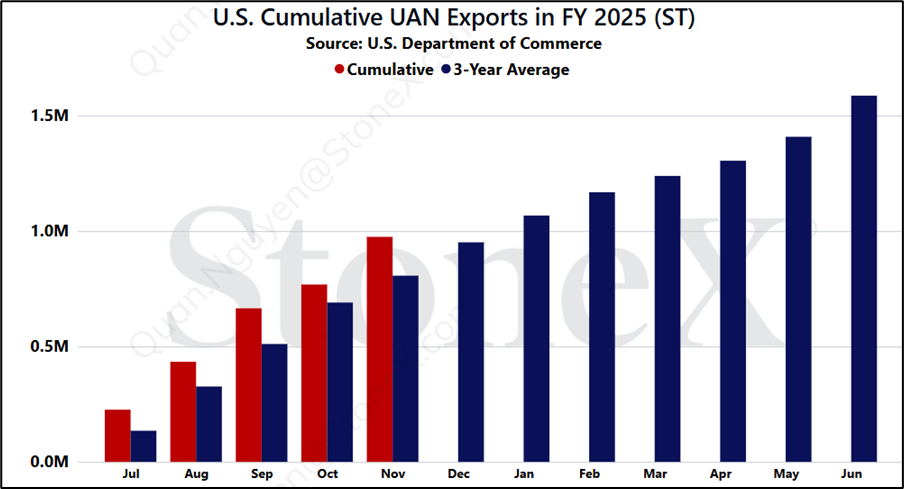
As we continue to get updated U.S. trade data, most recently updated thru November, we are finding that we are losing more tons on both imports and exports.
On the import side, FY25 is trending behind the 3-year average by several hundred thousand tons. Russian fears have made importing product from there a bit more dangerous than before.
On the export side, U.S. manufacturers have continued to take advantage of European production shortfalls due to high gas values. While we anticipated these exports, we did not foresee them at this high a level. Some production problems around the world created more demand that was unfulfilled and U.S. manufacturers were MORE than happy to oblige.
This is not the end of the world and is not creating a situation where there are going to be shortages. What it does do is put us further out on the razors edge where we are incredibly unprotected from further hiccups, regardless of what they might be. We simply do not have excess inventory as insurance.
More than likely, this helps to make sure that UAN prices continue to chase urea higher...if not starting to lead the charge in the near future.
What does this mean for farmers?
Please let me be clear. I am not forecasting shortages.
I am not saying you will not find product.
I am not saying that you need to rush and buy everything thru July.
I am merely pressing how tight supplies are. That makes a market much more susceptible to higher values in a very short time. Even as I write this, after urea prices rallied yesterday and today, some are watching for another $20 increase.
This situation will not last forever but it does look like it will be a story until we get done with this spring.
NOLA/New Orleans, Louisiana
Number 2 global importer in 2022
Number 1 global exporter in 2022
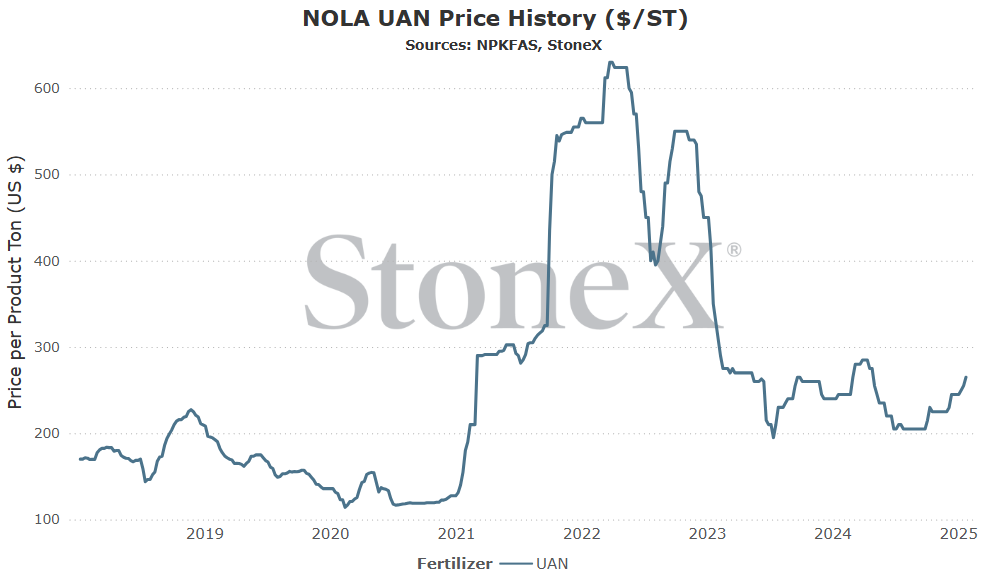
Price Comparisons
Vs 30 days ago - 8% or approximately $20 higher
Vs 90 days ago - 18% or approximately $40 higher
Vs 6 months ago - 26% or approximately $55 higher
Vs 1 year ago - 8% or approximately $20 higher
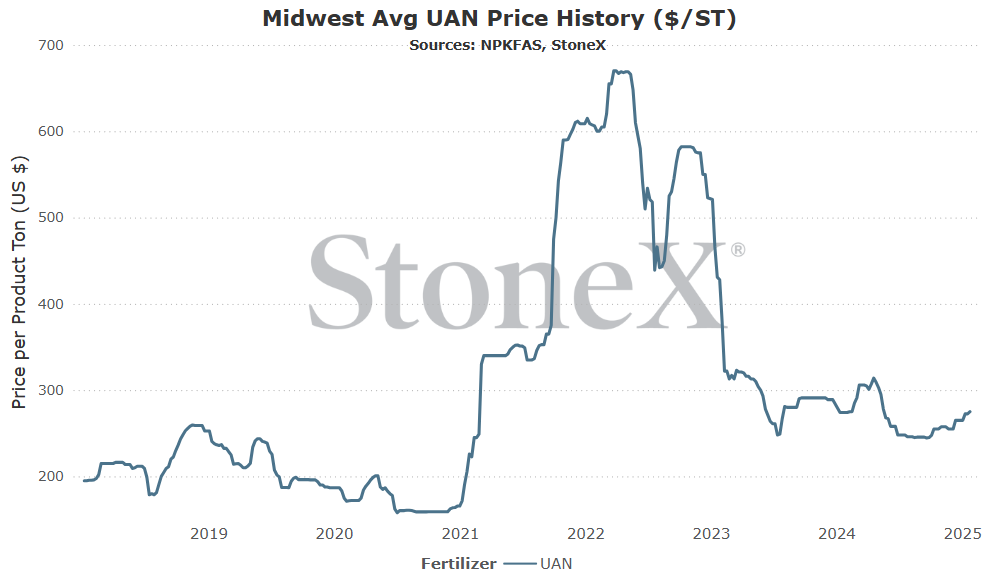
U.S. Midwest Average
Vs 30 days ago - 4% or approximately $10 higher
Vs 90 days ago - 8% or approximately $20 higher
Vs 6 months ago - 11% or approximately $27 higher
Vs 1 year ago - unchanged vs last year
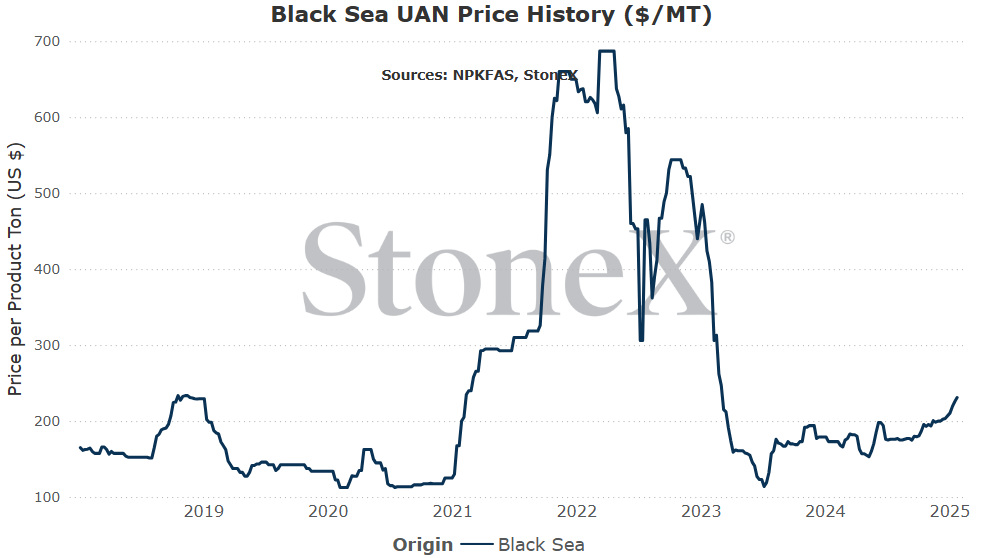
Black Sea (Russia)
Number 2 global exporter in 2022
Price comparisons
Vs 30 days ago - 9% or approximately $23 higher
Vs 90 days ago - 13% or approximately $33 higher
Vs 6 months ago - 14% or approximately $34 higher
Vs 1 year ago - 7% or approximately $19 higher
- Russian manufacturers slow/stop UAN production – if Russia continues with their invasion of Ukraine which results in even more tariff's and/or restrictions, that could include UAN and essentially shut their tons out of the global market. Russian manufacturers would be forced to slow/stop UAN production. While some would hail it as a win, it would mean less supply for the world. If supplies are down and demand is unchanged, prices should theoretically rally.
- Urea markets continue to rally – if urea prices rally, global markets will not be able to help themselves. Prices should move higher. If they didn't on their own, demand would switch from urea to UAN due to the price savings. That demand shift would then cause prices to rally. Nitrogen markets typically move together. It isn't always a perfect correlation, but it is a pretty high correlation.
- N.A. demand continues to rise – January continued to see U.S. corn acreage expectations rising. With every added acre, nitrogen demand rises as well. The biggest problem is the calendar. There just isn't much time for the market to shift. This close to spring application, NH3 can only handle so much of the added load. That puts it to urea and UAN. Well, urea imports so far are not filling us with confidence. That leaves it to UAN.
- Russia quits their invasion – if we suddenly see peace between Russia and Ukraine (it has been a talking point of President Trump), then we could see global relations return. That means more destinations available to Russian UAN tons and more than likely an increase in their UAN production rates. Not only would it be bearish for countries like Australia and Canada who stopped the shipments, but it would be bearish for the world with increased supplies.
- Global urea values start to fall – while it doesn't seem likely today, there is still a path where urea values around the world could start to stall and then slide. If we were to see both China and Iran back to normal, the world will take notice. If that happens, it will be extremely difficult for UAN markets to hold. It wasn't long ago that manufacturers tried to keep UAN prices high in the face of falling urea markets. They paid a hefty price by having to sell at the bottom of the market by spring. More than likely, they will not make that mistake again. They have kept UAN locked in with urea so if urea falls, so too should UAN.
- The market starts to focus on sidedress/Q3 – this is too early to already be thinking about, but I'm struggling with a 3rd factor!! I expect that the market is going to stay tight as it heads into sidedress season which should keep prices supported. However, we could be surprised by demand. If that happens and the fear of carrying tons into Q3 start to rise, we could see a sell off.
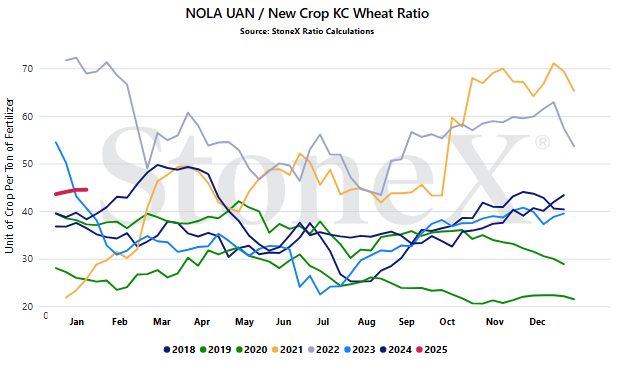
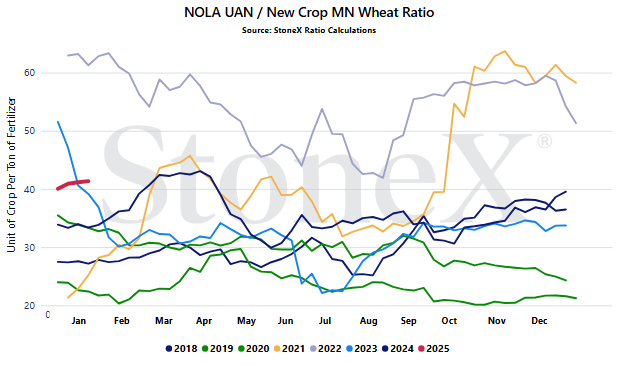
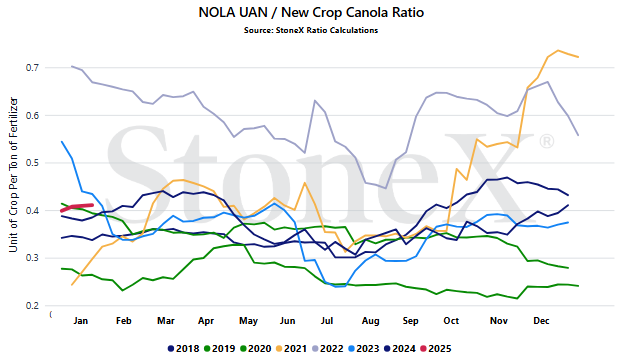
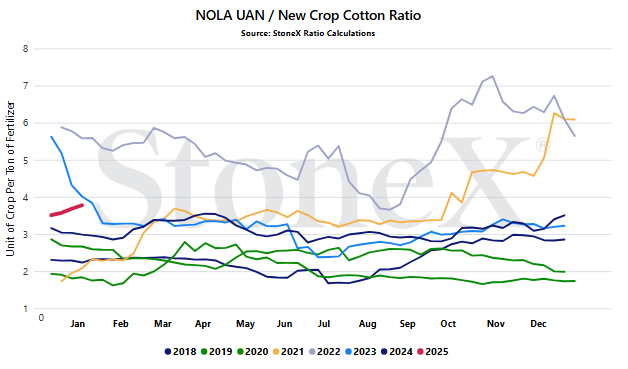
We believe that only looking at the flat price of either grains or fertilizer can be misleading:
-
Only selling grain can hurt you if fertilizer prices rise substantially
-
Only buying fertilizer can hurt you if grain prices fall
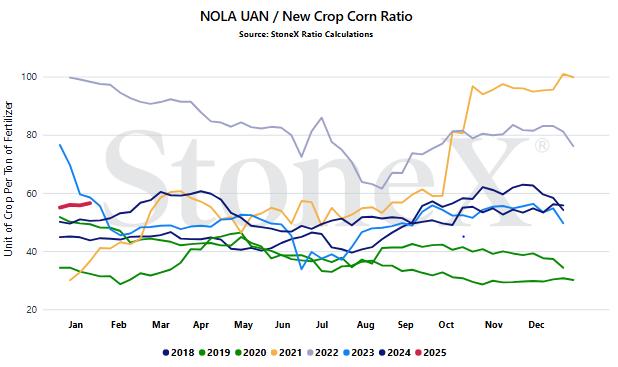
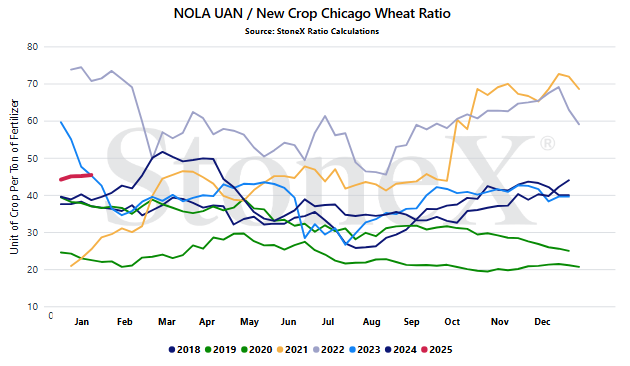
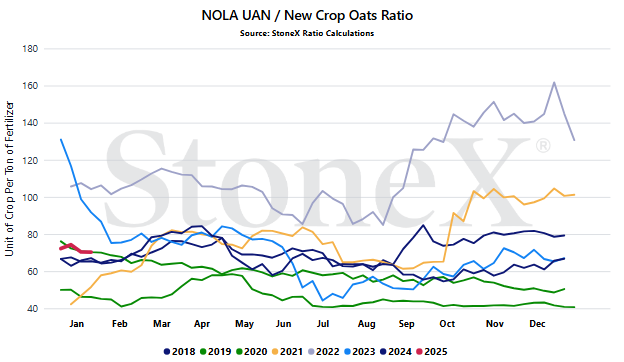
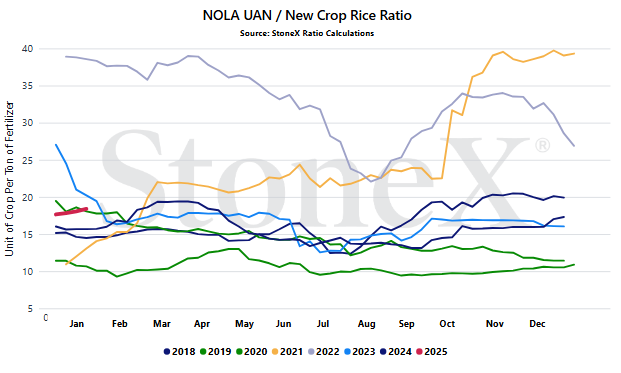
We look at the ratio "value" to get a better indication of where we are or how many bushels of X does it take to pay for 1 ton of fertilizer.
Would you rather:
-
Spend 100 bushels to pay for 1 ton of UAN
-
Spend 60 bushels to pay for 1 ton of UAN
When we compare the current ratio value against recent years, we start to see if we are high or low.
YOUR VALUES MAY LOOK DIFFERENT
This graph looks at the NOLA UAN price vs the flat grain price. There are no logistics on either product. Your location will look different due to fertilizer logistical costs, grain basis, etc.
- Russian production strategy - Russia may not change a single thing in regards to their UAN production. If Trump does not put tariffs on them, there is little reason for them to change. However, that is not certain. We could easily see Trump and Putin start getting into a tiff and we have seen how quickly Trump will place tariff's on a friendly nation like Canada. If Russia loses the U.S. as a destination and Russia starts cutting UAN production, global supplies go down and prices could rally as a result.
- Urea price movements - if urea goes up like it has, then it makes sense to believe that UAN will do the same. The problem is, UAN has been slow to react. Almost like manufacturers are afraid of doing too much too early. However, it is just a matter of time before they decide the price spread is enough or spring season is close enough.
- How N.A. tight supplies and growing demand change the outlook - while there hasn't been a major single production issue this fertilizer year, there have been several small ones. All those small ones have built into a few hundred thousand tons lost. Then we have to consider corn acres rising. There is only so much that NH3 can do so the excess demand gets shifted to urea and UAN. Well, urea isn't exactly being imported at a record pace. The UAN S&D could get out of sorts rather quickly if things continue like they are.
StoneX Ratio Calculation
The ratio calculation is derived from Bloomberg historical grains values as well as fertilizer values from StoneX, NPKFAS, and Argus.
The calculation is simply dividing the fertilizer price by each grain price.
All data was sourced from StoneX unless otherwise noted.