February '26 UAN
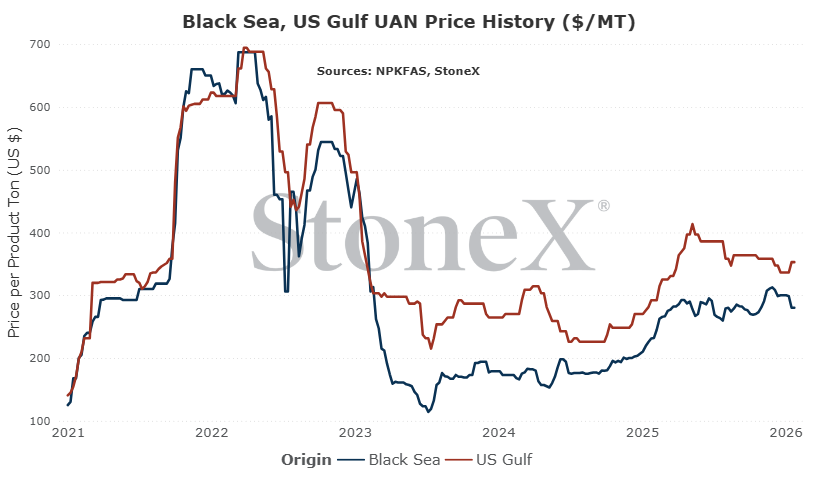
Major global UAN Export Location Price Graph
The intention of the below graphs are not to use to say "my price should be X based on this graph". These prices are derived from an FOB price point average. The intent is to show major global price movement trends. Your values will likely have significant basis difference (similar to your local grain price being different than the traded market price).
This graph is labeled as MT in USD currency.
What everyone wants to know first, what do we think will happen going forward?
GLOBAL
UAN is interesting to me right now.
- Russian exports remain low due to lack of demand destinations
- European production remains around 75% of normal (and any hopes of restarts are basically gone)
- Trinidad production continues to suffer
- N.A. production suffered due to short cold snap
- Urea values continue to skyrocket
All of these issues in a relatively small global market...yet Russian values dropped and N.A. values have not done much.
I continue to look at the global UAN market and scratch my head on why values have been mostly flat. However, that should start to rectify itself and see values higher as Northern Hemisphere spring nears. I am still watching for bullishness in the space.
NORTH AMERICA
I am going to parrot the points above and add:
- N.A. starting UAN inventories were low
- Production shortfalls due to planned downtime repairs and cold temperatures
Fortunately, my import fears (losing Russian imports) and export fears (bigger exports to Europe than last year) have not played out. However, that does not mean that I think UAN is going lower. I still think the market S&D is incredibly tight and will show itself closer to spring.
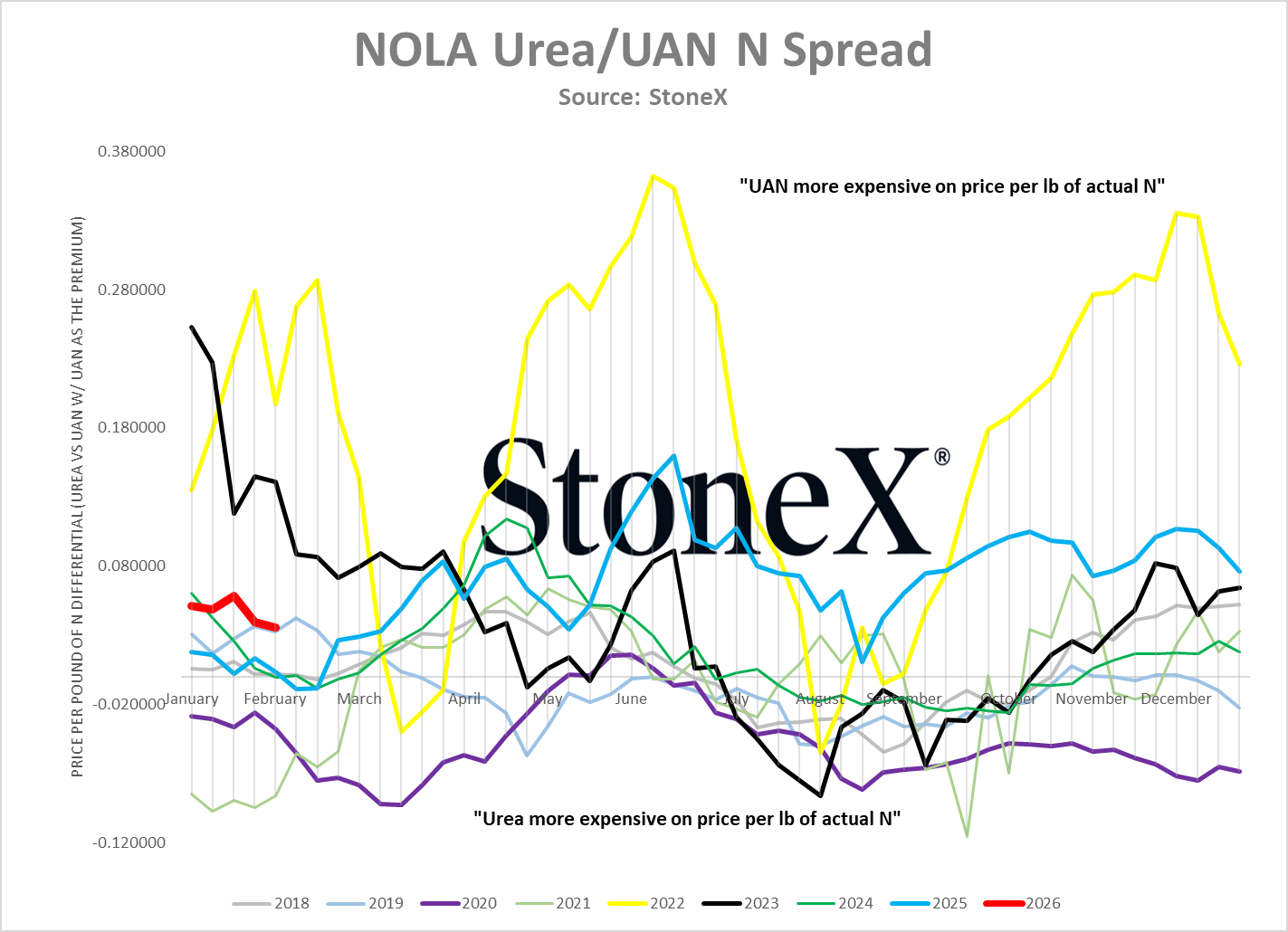
In fact, in the days leading up to writing this, we are already seeing/hearing of manufacturers doing small price increases ($5 - $10/ton). My guess is that rising urea values which have closed the NOLA price gap between urea/UAN to only 4-cents is giving them the confidence to make the push without a lot of demand.
As I keep watching the UAN market, I see a lot more roads to higher prices than I do lower...for preplant demand. Sidedress, that is a coin flip. I would be a lot more confident in saying I am expecting lower prices (due to poor farmer financials and an expectation that urea could fall by then) but after last spring supply debacle and a worse start to this year, I'm afraid we may not see relief as quick as we hope.
General global import/export UAN information
What has happened in the last 30 days
Small hopes of European nitrogen production restarts fade
If you guys wonder why I never let my hopes get up, Europe is a perfect example of why!
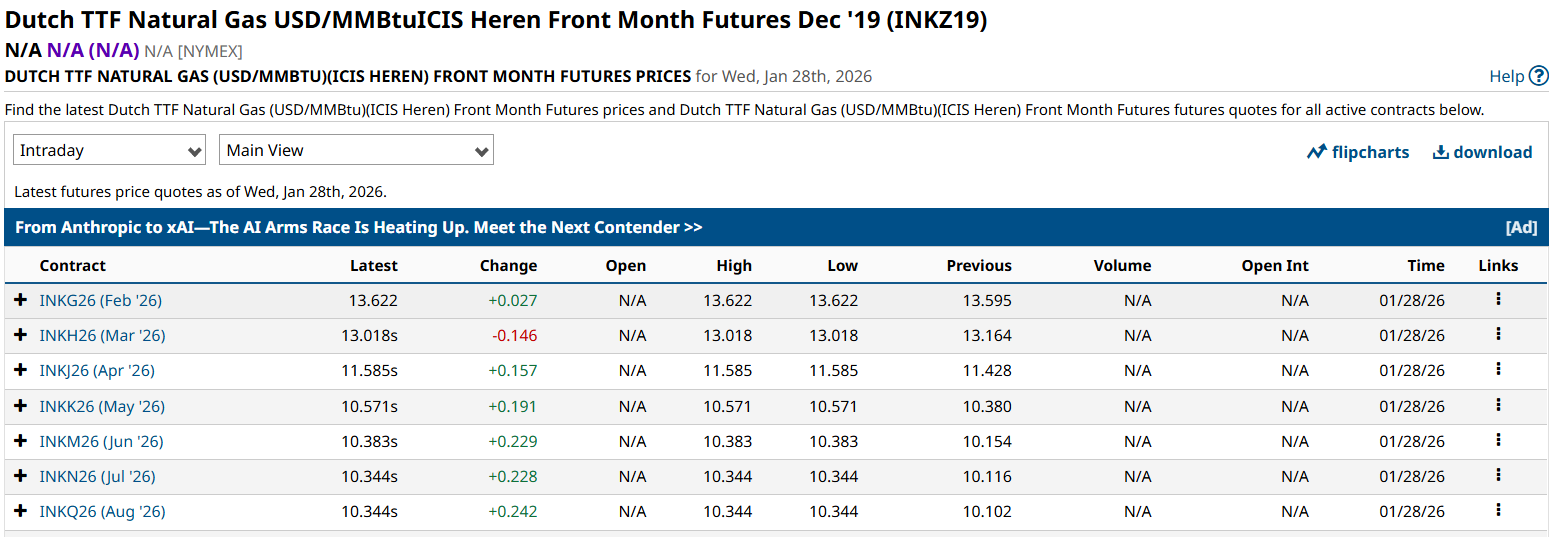
Last month, it looked like there was a growing, albeit still very small chance, that Europe's offline nitrogen production plants may consider restarts. The CBAM (carbon border adjustment mechanism) was becoming reality and really looked like it was going to drive domestic European nitrogen values higher. Dutch TTF values had fallen back to the upper $8/lower $9 MMbtu range. Demand has never faltered, but with spring coming around the bend, the calendar was working in favor of restarts.
So much for all of that.
Gas values in Europe have once again rebounded into the $10 - $13MMbtu range. There is still some uncertainty surrounding what the CBAM situation will do to domestic fertilizer values.
Unfortunately, that means one of the most supportive UAN global factors continues to remain in effect. 25% nitrogen production being offline means that those tons need to be sourced from elsewhere. Russia is not a good option given political tensions and trade blockades being in place. That then pushes demand to places like Trinidad...but they have been having their own gas supply/nitrogen production issues. Ultimately, it pushes a solid chunk of demand to U.S. produced tons. With a healthy export relief valve for times when demand is slow, it helps to hold/boost N.A. values.
Basically, the European story causes U.S. and Canadian farmers to fight European farmers for tons...the manufacturer is the only real winner there.
Source: www.barchart.com
Firm urea markets help to boost UAN market price outlook
If you have read my stuff or listened to my presentations in the past, you know that I talk a lot about how different nitrogen products can move independently from each other but ultimately they tend to flow higher/lower together. This is why we watch the NOLA urea and UAN nitrogen priced spread on a price per pound of N. When one or the other becomes over/under valued vs the other, we start to watch for signs of demand switching. A "blow out" to the high/low side can be seen as an indication of an unhealthy product.
That has been my POV on UAN.
When I look at the current UAN, there is a laundry list of problems. Low starting inventories. Big demand expected. More N.A. exports expected than what is considered normal. Several plants being offline for repairs and recent cold temps impacting production further. Even with all of that, we still saw first half December value dip ever so slightly. Why? Because urea prices had continued to fall and a lack of demand likely made manufacturers nervous.
Well, that no longer appears to be the case.
Urea values have been on a climb recently. Since the mid-December low's for NOLA urea ($350), values have climbed $90 (today trading $440). That has been a massive (and for me, unexpected) rally. UAN had been holding an 8 to 10-cent premium over urea. Today, that premium has dropped to "only" 4-cents...
...and that is where I start to get more bullish on UAN.
My fear is that:
1. We are already seeing early signs of UAN prices climbing with $5 to $10 increases being seen/heard.
2. UAN price increases will go into overdrive once demand starts showing up.
Ultimately, I have continued to be bullish UAN...but firm urea markets may do more than I expected.
Global supplies remain tight
Broken record time.
Global UAN supplies continue to struggle with multiple production problems around the world that keep a decently solid price floor on values.
- Europe - production rates remain forecasted around 75% of normal as gas values remain too high and political push back keep offline plants from restarting. That not only reduces supplies, but turns European farmers into unnatural buyers in the world market.
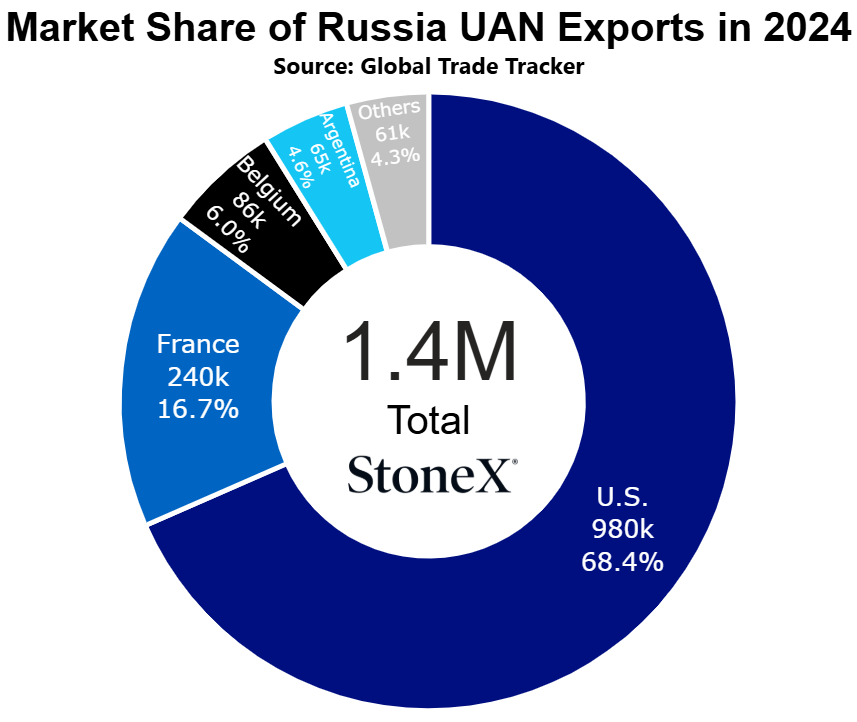
- Russia - exports have taken a hit. Nothing to do with production capabilities. It is all political. When they invaded Ukraine, they lost access to most UAN demand around the world. Canada shut their borders to Russian goods. Australia shut their borders to Russian goods. A big chunk of Europe did the same. That means that the only major demand point left for Russian UAN exports is the U.S. Production and exports have had to slow for lack of export options.
- Trinidad - production levels continue to suffer here for lack of reliable gas supplies. While it appears that Trinidad is now willing to allow gas production expansions into previously untouched waters surrounding the nations, these waters are close to Venezuela and the western world has not been willing to back that partnership.
- North America - a big spring '25 meant very little supply left to start the new fertilizer year. Several nitrogen production facilities had planned downtime due to repairs that were needed. These two events meant that produced tonnages were smaller during a time when more was needed.
Unfortunately, from my perspective, nothing has improved across all of these problem regions. Worse, global UAN markets are nowhere near as large as some think. It is a much smaller and condensed marketplace which means that this list is a much bigger problem than it might seem.
Ultimately, UAN still needs to trend higher and lower with other nitrogen products. Most notably urea. However, with global supplies still having this many problems, we continue to expect UAN to keep a high premium.
N.A. artic temperatures impacts nitrogen production...but doesn't seem as much as market thinks
Back in 2021 (I think that was the year), a huge artic blast swept across the U.S. Freezing temps reached their way to the U.S./Mexico border and lasted several days. The public struggled to heat their homes. Water lines froze. As expected, gas prices skyrocketed as the public demand spiked...and that caused an opportunity for nitrogen manufacturers.
If the manufacturing plant had hedged their coming gas needs and were sitting on cheap positions, the market provided them an opportunity to either reduce or stop production. By taking that step, they were able to sell their cheap contracts at significantly higher profits than what would have been made by producing fertilizer. Not only did they make bigger profits on the gas contracts, the reduced supplies helped to boost price ideas. Win/win.
Since then, the market feels to be on edge every winter out of fear the same thing happens.
It was given a reason to get excited in later January. Cold temperatures have once against plunged through the U.S. to the point that gas values jumped on the larger than normal demand. There have been stories of some nitrogen plants reducing production lines and even one in Texas that reportedly stopped production. However, it does not appear this even is anywhere near as large as the original.
The nitrogen markets have largely brushed off the event and kept values relatively stable with the only price movements being seen as a movement along with global prices. However, it is still only early February meaning there is still time for winter to raise its ugly head!!! Something to watch.
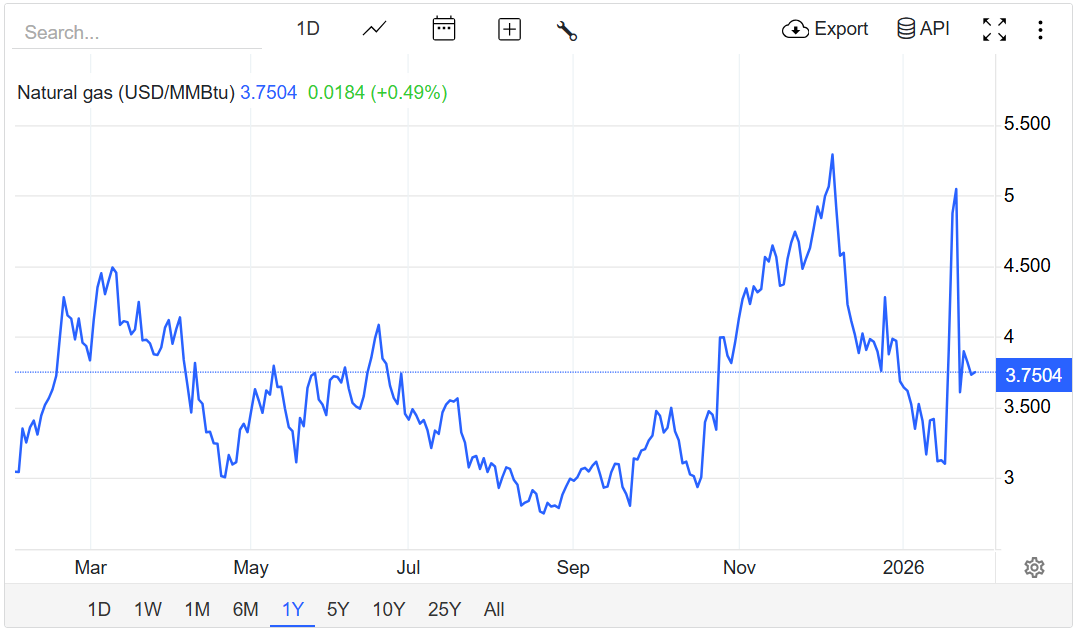
Source: www.tradingeconomics.com
Where are current values in relation to the past
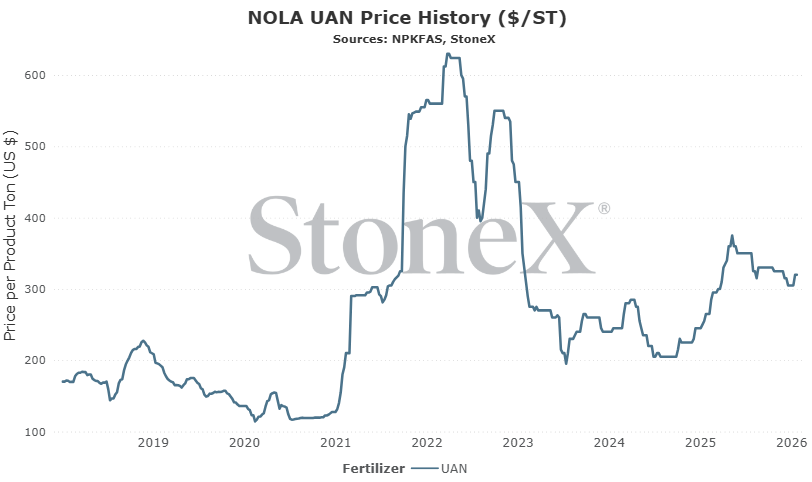
NOLA/New Orleans, Louisiana
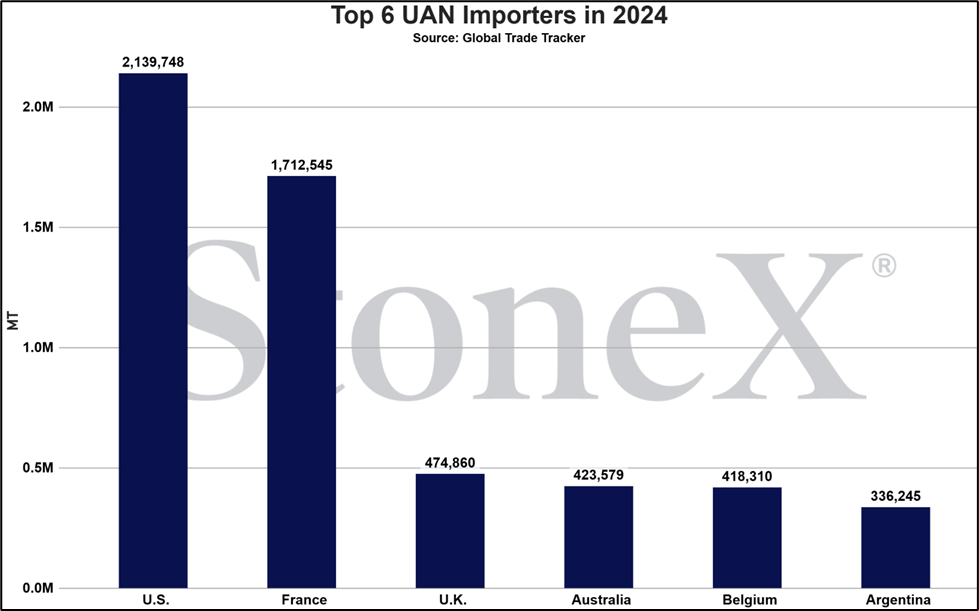
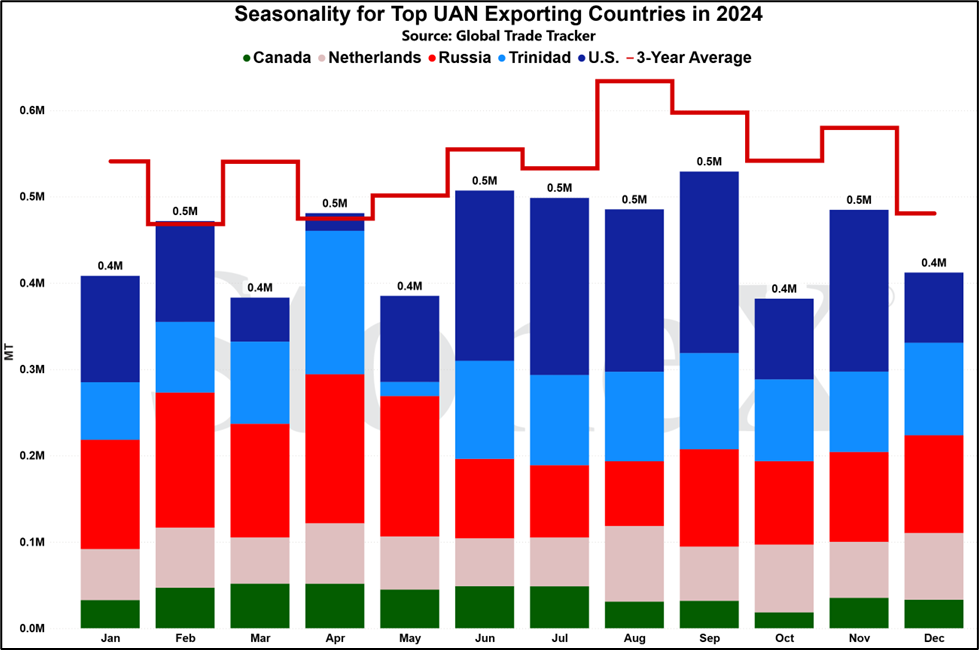
Number 1 global importer in 2024
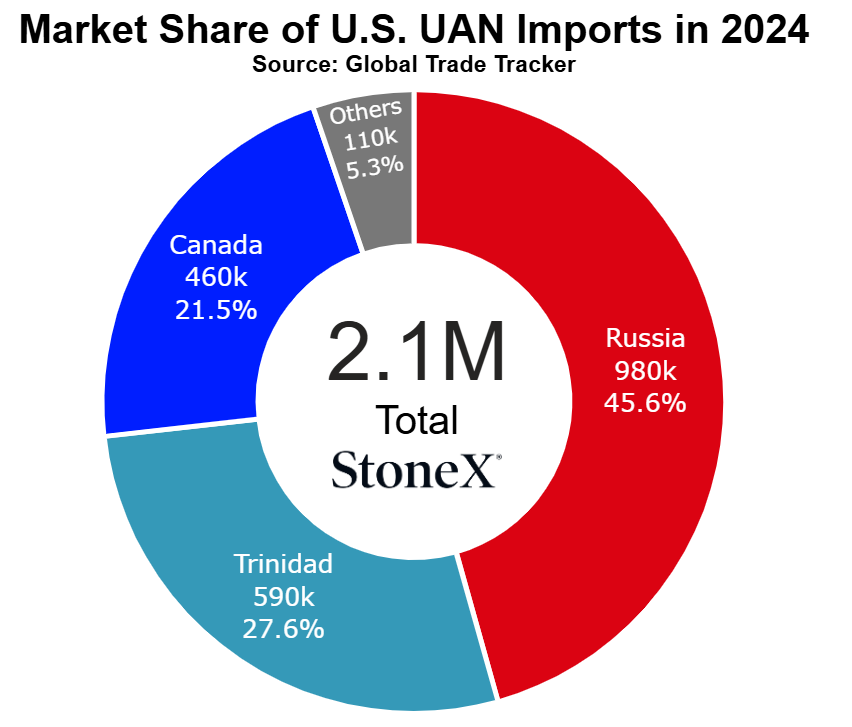
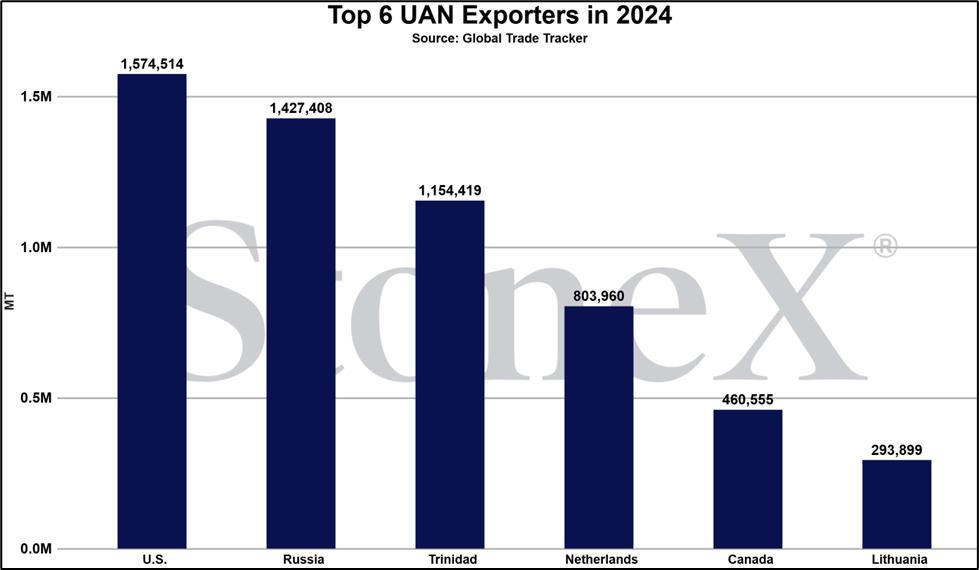
Number 2 global exporter in 2024
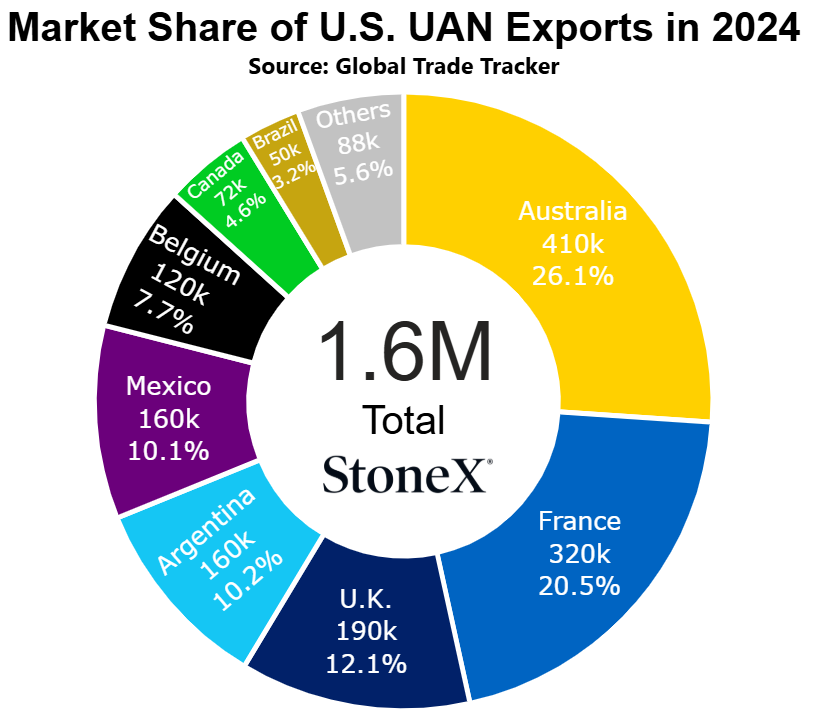
Price Comparisons
Vs 30 days ago - 5% or approximately $15 higher
Vs 90 days ago - -2% or approximately $5 lower
Vs 6 months ago - -9% or approximately $30 lower
Vs 1 year ago - 21% or approximately $55 higher
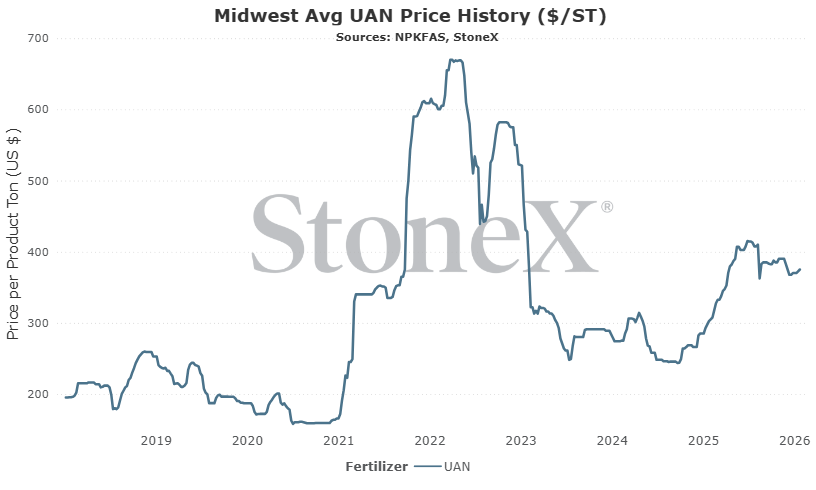
U.S. Midwest Average
Vs 30 days ago - 1% or approximately $5 higher
Vs 90 days ago - -3% or approximately $10 lower
Vs 6 months ago - -8% or approximately $33 lower
Vs 1 year ago - 23% or approximately $70 higher
Black Sea (Russia)
Number 1 global exporter in 2024
Price comparisons
Vs 30 days ago - -7% or approximately $20 lower
Vs 90 days ago - 3% or approximately $7 higher
Vs 6 months ago - 8% or approximately $21 higher
Vs 1 year ago - 21% or approximately $48 higher
Bull/Bear Factors
- Bullish Factors
- Russian/U.S. relations deteriorate – if relations between the U.S. and Russia deteriorated to the point that trade stopped, it would be bad for the global UAN market and worse for the N.A. UAN market. If trade stops, the U.S. (and N.A. by proxy) will lose its largest supplier of tons. If Russia loses access to the U.S., that means losing access to the last remaining large demand nation in the world. They would likely need to reduce UAN production and export flows. That would hurt global S&D. Every farmer that uses UAN would feel this.
- Trinidad production issues continue – it seems like there are more questions than answers regarding Trinidad nitrogen production. We are still not seeing reports of production returning to normal which hurts the UAN market the most. The global complex is already dealing with enough production issues, it doesn't need help from Trinidad. The longer they struggle, the more supply it removes and the more nervousness it brings to the market which typically pushes prices higher.
- Bullish urea markets continue supporting UAN prices – when urea values were falling first half December, we finally saw signs of UAN price weakness...that seems like so long ago. Since then, NOLA urea values are up $80 and it no longer seems a question of "if" UAN goes higher but "when". If urea continues to rally, UAN will see little reason not to do the same.
- Bearish Factors
- If EU CBAM story helps offline production restart – there are still a tremendous number of questions regarding the EU CBAM story. Right now, it seems like there is question of if they will hit on fertilizers as were previously stated. If going forward we find out that they are going into effect, that could have domestic EU nitrogen prices rallying higher. Eventually, that could have prices and margins high enough for offline EU regional plants to consider restarts. That would likely have a large bearish effect on global values as it boosts supplies and removes an "unnatural" buyer from the world.
- EU / U.S. relations continue to sour, turning off U.S. UAN exports to the region – I wish I were not sitting here writing about how EU / U.S. relations could sour, but in todays world anything is possible. If President Trump and EU leaders get into another pissing match, we could see big tariffs be put in place from both sides. Obviously, EU UAN buyers losing access to U.S. tons would be hurtful and would see domestic values rise. However, on the other side, if EU buyers were forced away, more U.S. produced tons would stay home which would help its S&D and likely put some bearishness in the market.
- Wide open early spring cycle allows fantastic NH3 applications – this is a stretch because I couldn't come up with a 3rd bearish factor. That is how bullish I am on the market. However, if N.A. weather improves and gives a wide open February/March application cycle, we could see a lot more NH3 applied than we currently expect. If enough is applied, it could start to chew into UAN demand which could weaken price resolve.
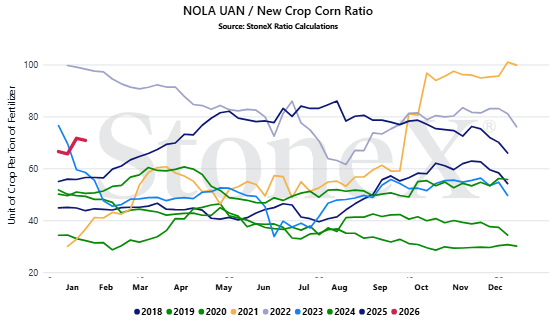
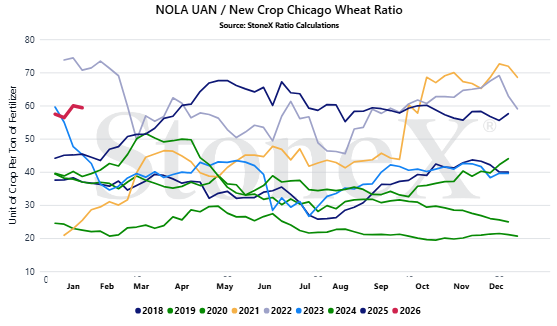
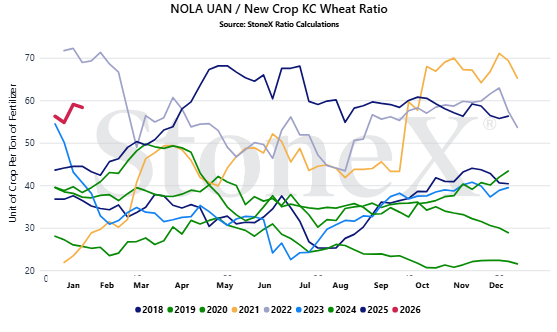
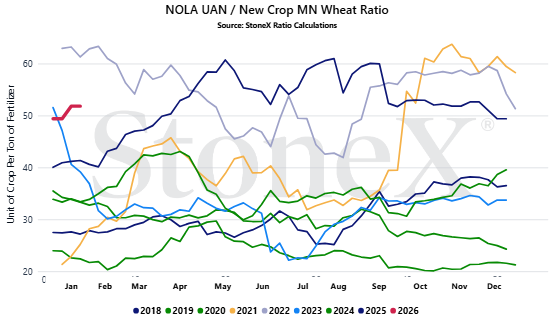
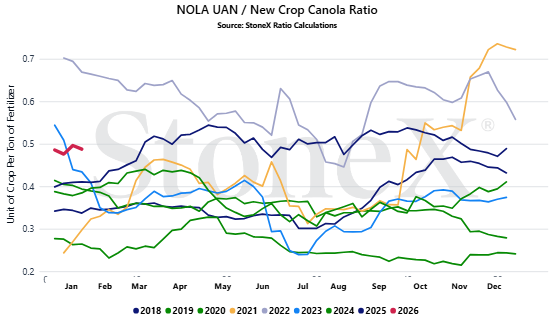
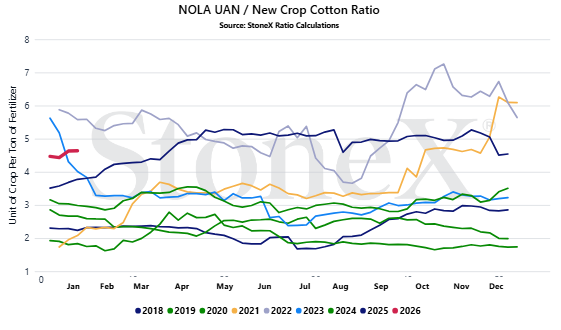
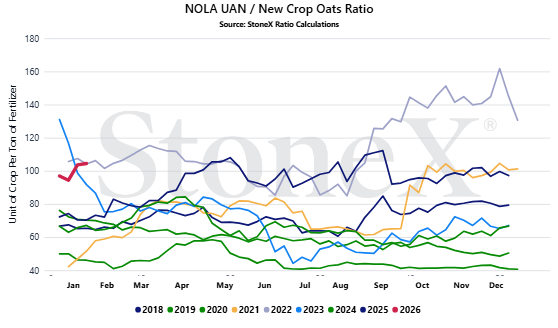
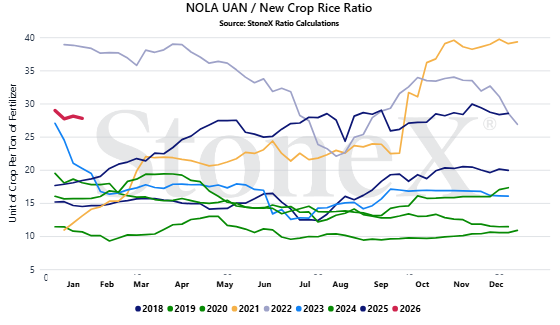
Where are the current UAN/grain ratio values today?
We believe that only looking at the flat price of either grains or fertilizer can be misleading:
We look at the ratio "value" to get a better indication of where we are or how many bushels of X does it take to pay for 1 ton of fertilizer.
Would you rather:
When we compare the current ratio value against recent years, we start to see if we are high or low.
YOUR VALUES MAY LOOK DIFFERENT
This graph looks at the NOLA UAN price vs the flat grain price. There are no logistics on either product. Your location will look different due to fertilizer logistical costs, grain basis, etc.
- Josh Linville’s Focal Points
- Russia/U.S. relations - in today's UAN world, the U.S./N.A. market is going to suffer dramatically if the U.S. were to cut off Russian goods. Likewise, Russian UAN exports would suffer dramatically is the U.S. were to shut its border to their goods. Neither nation has a secondary market that they can tap to replace the supply/demand. That is the bad. The worse if this trade flow was stopped is that the global S&D takes a hit as Russia is likely to drastically lower their exports while the U.S. scours the world for supply/stops any exports. I truly hope this does not happen, but have it on your radar.
- The global tariff war - there are a lot of threats being thrown around the world. Now it isn't even as simple as one country tariffing another. Now we have threats where if a nation does business with another nation that yet another nation does not like, then that nation gets tariffs. Lets make this very simple. Tariffs do not work like politicians think. If your country puts tariffs on another country that you get UAN from, it is extremely likely that your price is going to rally. The supplier country will pay the tariff...using your money.
- EU CBAM story - another story that I do not know what to think. At first, it looked like the EU was going to tariff every UAN supplier with hefty tariffs. That was going to effectively stop most imports and drive EU UAN values higher which in turn could help return European nitrogen production to full strength. While this would have been bad for Europe, it would have been good for the world. However, as in all things politics, there is a lot of back and forth of what it will actually be. Just know that if CBAM rates get put into effect, European farmers are going to hurt even worse than they already do.
- If urea continues to rally, how long before UAN pushes higher - in the first half of December, urea values were falling around the world to the point that UAN values were starting a surprise slide. That is no longer the case. Urea prices are up dramatically and as a result, UAN has gone from being very expensive to being in line with urea on a price per pound of actual N. If urea continues higher, it is just a matter of time before UAN moves in kind.
StoneX Ratio Calculation
The ratio calculation is derived from Bloomberg historical grains values as well as fertilizer values from StoneX, NPKFAS, and Argus.
The calculation is simply dividing the fertilizer price by each grain price.
All data was sourced from StoneX unless otherwise noted.
This material should be construed as the solicitation of an account, order, and/or services and represents the opinions and viewpoints of the individual authors or presenters. It does not constitute an individualized recommendation or take into account the particular trading objectives, financial situations, or needs of individual customers.
The views are current only through the date stated and are subject to change at any time based upon market or other conditions, and StoneX Group Inc. (“SGI”) disclaims any responsibility to update such views. Actual results, performance, or achievements may differ materially from those expressed or implied. Information is based on data gathered from what we believe are reliable sources. Past performance does not guarantee future results.
The StoneX Group Inc. group of companies provides financial services worldwide through its subsidiaries, including physical commodities, securities, exchange-traded and over-the-counter derivatives, risk management, global payments and foreign exchange products in accordance with applicable law in the jurisdictions where services are provided.
References to certain OTC products or swaps are made on behalf of StoneX Markets, LLC (SXM), a member of the National Futures Association (NFA) and provisionally registered with the U.S. Commodity Futures Trading Commission (CFTC) as a swap dealer. SXM’s products are designed only for individuals or firms who qualify under CFTC rules as an ‘Eligible Contract Participant’ and who have been accepted as customers of SXM.
StoneX Financial Inc. (SFI) is a member of FINRA/NFA/SIPC and registered with the MSRB. SFI is registered with the U.S. Securities and Exchange Commission (SEC) as a Broker-Dealer and with the CFTC as a Futures Commission Merchant and Commodity Trading Advisor. StoneX Financial (Canada) Inc. (SFCI) is registered in Canada and is a member of CIRO and CIPF. References to certain securities trading are made on behalf of the BD Division of SFI and are intended only for an audience of institutional clients as defined by FINRA Rule 4512(c). References to certain exchange-traded futures and options are made on behalf of the FCM Division of SFI. Wealth Management is offered through SA Stone Wealth Management Inc., member FINRA/SIPC, and SA Stone Investment Advisors Inc., an SEC-registered investment advisor, both wholly owned subsidiaries of SGI.
R.J. O’Brien & Associates, LLC (RJO) is registered with the CFTC as a Futures Commission Merchant and is a member of NFA.
StoneX Financial Ltd (SFL) is registered in England and Wales, company no. 5616586. SFL is authorized and regulated by the Financial Conduct Authority (FCA) (registration number FRN:446717) to provide services to professional and eligible customers including: arrangement, execution and, where required, clearing derivative transactions in exchange traded futures and options. SFL is also authorized to engage in the arrangement and execution of transactions in certain OTC products, certain securities trading, precious metals trading and payment services to eligible customers. SFL is authorized and regulated by the FCA under the Payment Services Regulations 2017 for the provision of payment services. SFL is a category 1 ring-dealing member of the London Metal Exchange. In addition SFL also engages in other physically delivered commodities business and other general business activities which are unregulated and not required to be authorized by the FCA.
This communication is issued in the European Economic Area by StoneX Financial Europe GmbH (SFEG). StoneX is the trade name used by STONEX GROUP INC. and all its associated entities and subsidiaries. StoneX Financial Europe GmbH (“SFEG”) is a securities trading firm registered in Germany under Company No. HRB 80844.
StoneX Financial Pte Ltd (Co. Reg. No 201130598R) (“SFP”) is regulated by the Monetary Authority of Singapore and is a Capital Markets Service Licence holder (for dealing in capital market products), an Exempt Financial Adviser (for advising on investment products and issuing or promulgating analyses/ reports on investment products) and a Major Payment Institution (for domestic and cross-border money transfer services).
SFP may distribute analysis/report produced by its respective foreign affiliates within the StoneX Group of companies pursuant to an arrangement under Regulation 32C of the Financial Advisers Regulations Recipients should contact SFP at (65) 6309 1000 for any matters arising from, or in connection with, this webinar.
StoneX APAC Pte. Ltd. (“SAP”) (Co. Reg. No 200616676W) is regulated as a Dealer (PS20190001002) under the Precious Stones and Precious Metals (Prevention of Money Laundering and Terrorism Financing) Act 2019 for purposes of anti-money laundering and countering the financing of terrorism.
StoneX Financial (HK) Limited (CE No.: BCQ152) (“SHK”) is regulated by the Hong Kong Securities and Futures Commission for Dealing in Securities and Dealing in Futures Contracts.
StoneX Financial Pty Ltd (ACN 141 774 727) holds an Australian Financial Service License (AFSL: 345646) for Dealing in Securities, Exchange-Traded Derivatives Contracts, OTC Derivatives Contracts and Foreign Exchange Contracts, and is regulated by the Australian Securities and Investments Commission.
StoneX Securities Co., Ltd. (“SSJ”) (Co. Reg. No 010401047199) is regulated by the Japanese Financial Services Agency as a Type-I Financial Instruments Business Operator (Kanto Local Finance Bureau (FIBO)No.291’), is a member of the Financial Futures Association of Japan for dealing and broking FX and FX Option transactions, and is a member of the Japan Securities Dealers Association for dealing and broking stock indices and option transactions.
Trading swaps and over-the-counter derivatives, exchange-traded derivatives and options and securities involves substantial risk and is not suitable for all investors. Past performance of any futures or option is not indicative of future success. Indicators are not a trading system and are not published as a specific trade recommendation. The information herein is not a recommendation to trade nor investment research or an offer to buy or sell any derivative or security. It does not take into account your particular investment objectives, financial situation or needs and does not create a binding obligation on any of the StoneX group of companies to enter into any transaction with you. You are advised to perform an independent investigation of any transaction to determine whether any transaction is suitable for you. No part of this material may be copied, photocopied or duplicated in any form by any means or redistributed without the prior written consent of StoneX Group Inc.
The report/analysis herein is not directed to, or intended for distribution to or use by, any person or entity who is a citizen or resident of or located in any locality, state, country or other jurisdiction where such distribution, publication, availability or use would be contrary to law or regulation.
© 2026 StoneX Group Inc. All Rights Reserved.