FX Weekly Overview: The week's main events
- Bearish factors
- A moderate increase in the American CPI should reinforce the perception of a "soft landing" for the American economy and foster the global appetite for risky assets, strengthening the BRL.
- Bullish factors
- Moderate growth of the IPCA and the IBC-Br may reduce bets on an increase in the basic interest rate (SELIC), harming the attraction of foreign capital and weakening the BRL.
- Chinese economic data is expected to reinforce the outlook of an economic slowdown in the country and harm the performance of risky assets, such as stocks, commodities, and currencies of emerging countries, such as the BRL.
The week in review
The week was marked by the global weakening of the dollar amid a perception of weakening in the American labor market. Although the data released during the week were mixed, they helped alleviate fears of a potential recession. In Brazil, stronger-than-expected GDP growth in the second half of the year reinforced expectations of a short-term increase in the basic interest rate (Selic), adding to concerns about the Central Bank's ability to stabilize prices
The USDBRL ended the week lower, with Friday’s session (06) closing at BRL 5.5895, a weekly variation of -0.8%, -0.8% for the month, and +15.2% for the year. The dollar index ended Friday at 101.2 points, reflecting a weekly and monthly decline of 0.5% and an annual drop of 0.2%.
USDBRL and Dollar Index (points)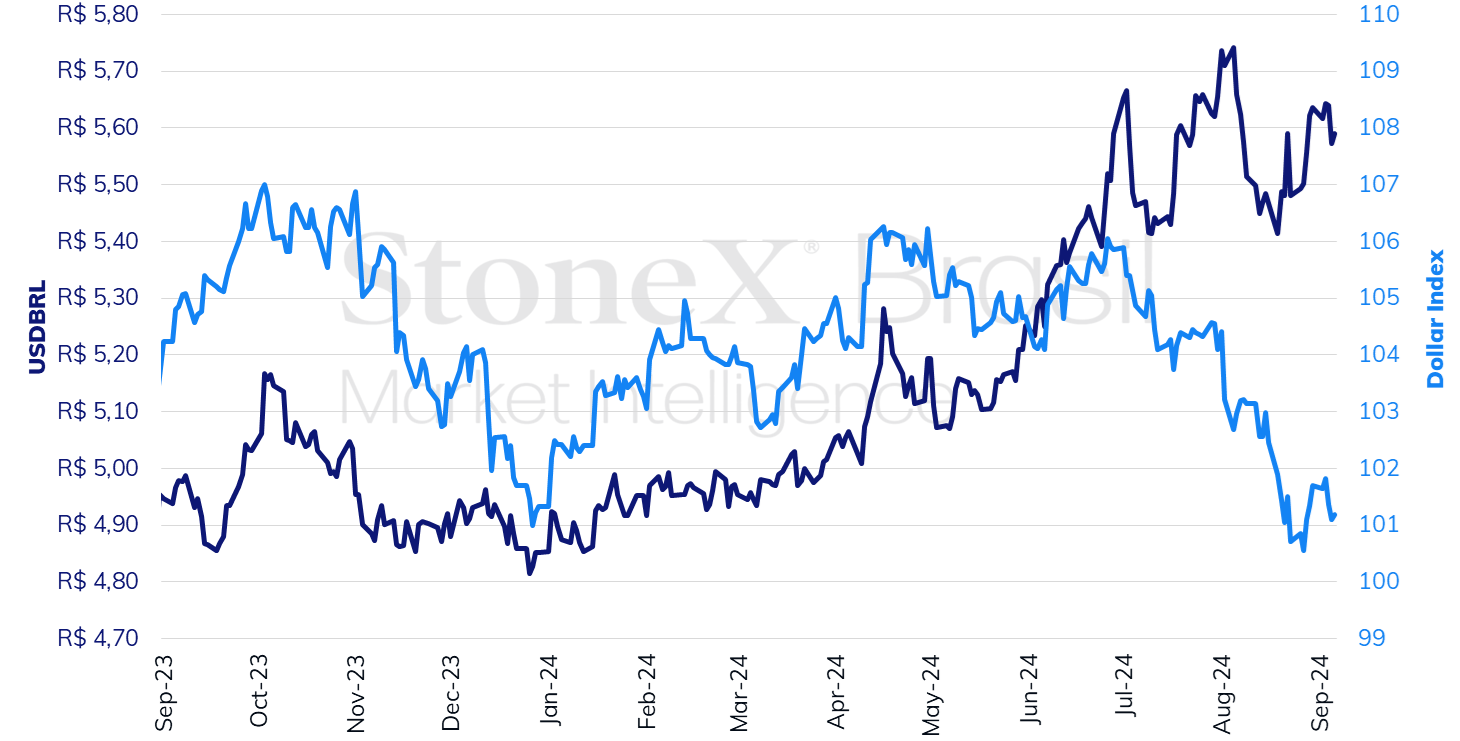
Source: StoneX cmdtyView. Design: StoneX.
KEY EVENT: US August CPI
Expected impact on USDBRL: bearish
The median estimate for the Consumer Price Index (CPI) in August suggests an identical increase to that of July, with both the headline index and its core (excluding volatile food and energy components) rising by 0.2%. After a brief inflationary uptick in the first quarter, there is growing consensus among analysts and Federal Reserve (Fed) officials that prices are gradually stabilizing. If these projections are confirmed, the CPI reading is expected to solidify expectations that the Fed will initiate a series of interest rate cuts during its September 18 decision.
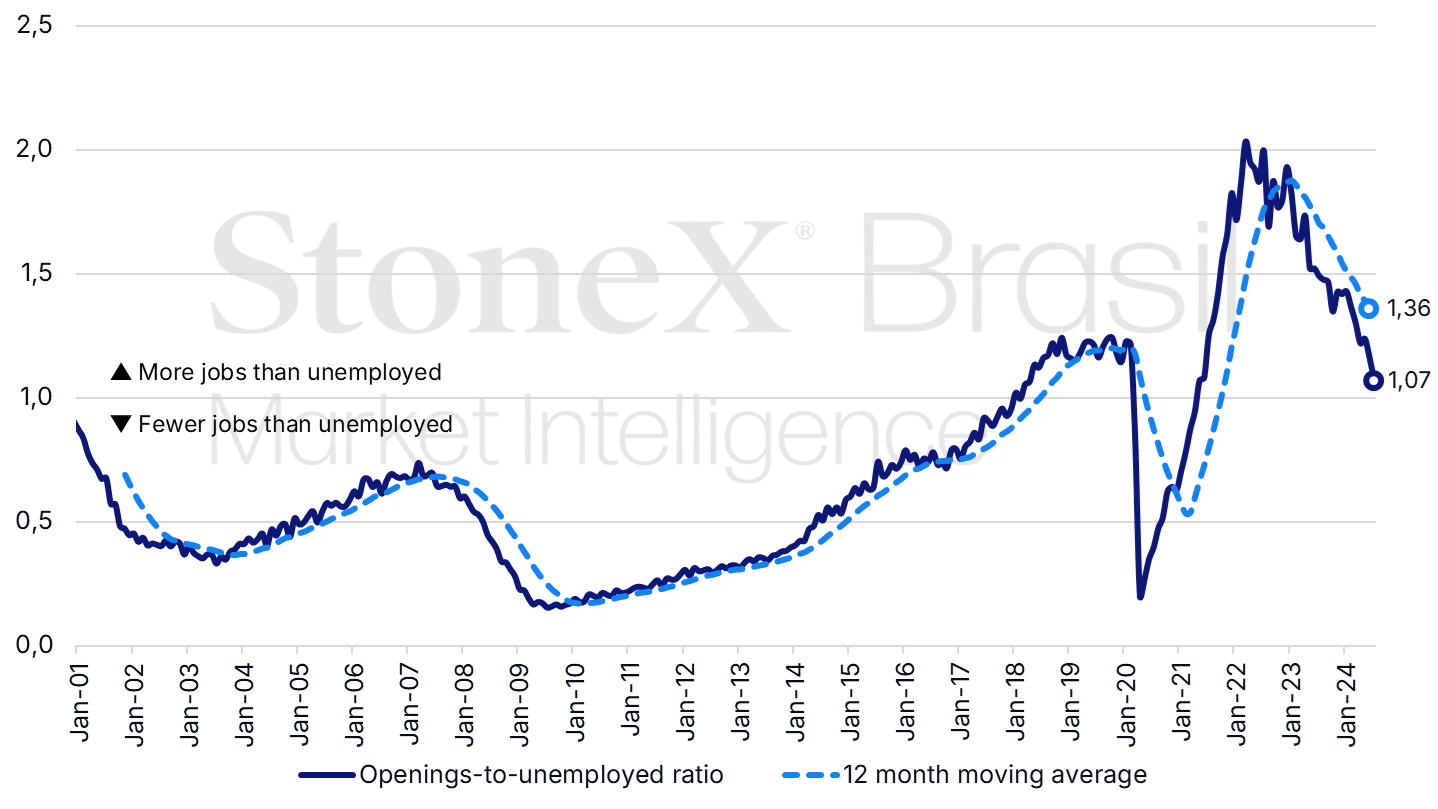
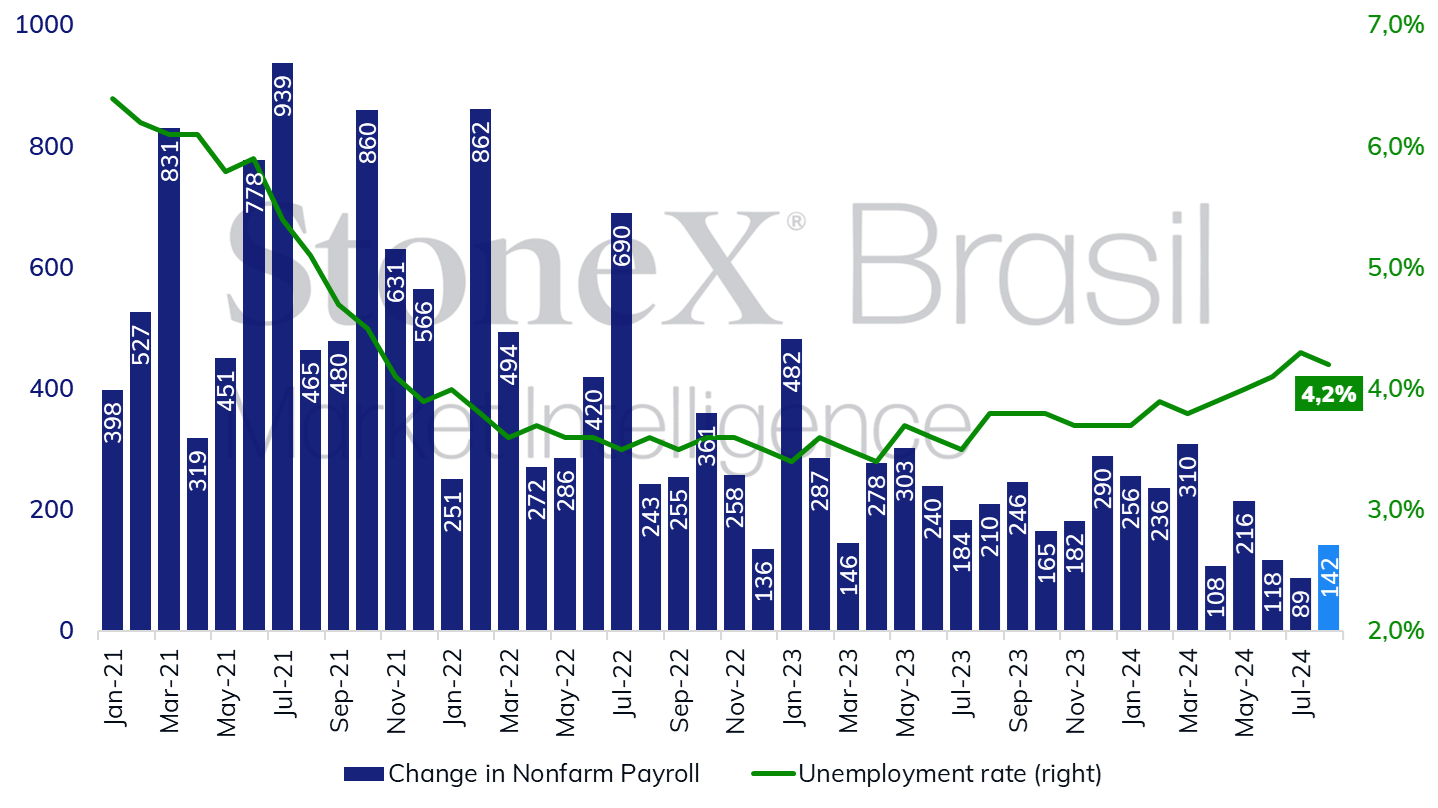
However, concerns about the strength of the labor market are increasing among investors and Fed members. For example, Fed Chair Jerome Powell stated in a recent speech that, 'it seems unlikely that the labor market will be a source of elevated inflationary pressures anytime soon.' He added, 'We do not seek or welcome further cooling in labor market conditions,' and noted that 'upside risks to inflation have diminished, while downside risks of unemployment have increased.' The data released last week were mixed. On one hand, the reduction in job openings in July, the downward revision of job creation figures for July, and the lower-than-expected jobs report for August all point to a gradual slowdown. On the other hand, other indicators, such as the expansion of jobs between July and August, the decrease in the unemployment rate from 4.3% to 4.2%, and the rise in average hourly wages, suggest the labor market remains healthy and resilient. Thus, the scenario of gradual price stabilization and a soft weakening of the labor market still points to a 'soft landing' for the US economy. Given this, the current market expectations of a 2.50 percentage point reduction in interest rates over the next year—equivalent to ten traditional 0.25 percentage point cuts across eight decisions—seem overly aggressive.
US: History and expectation for the interest rate - September 6, 2024
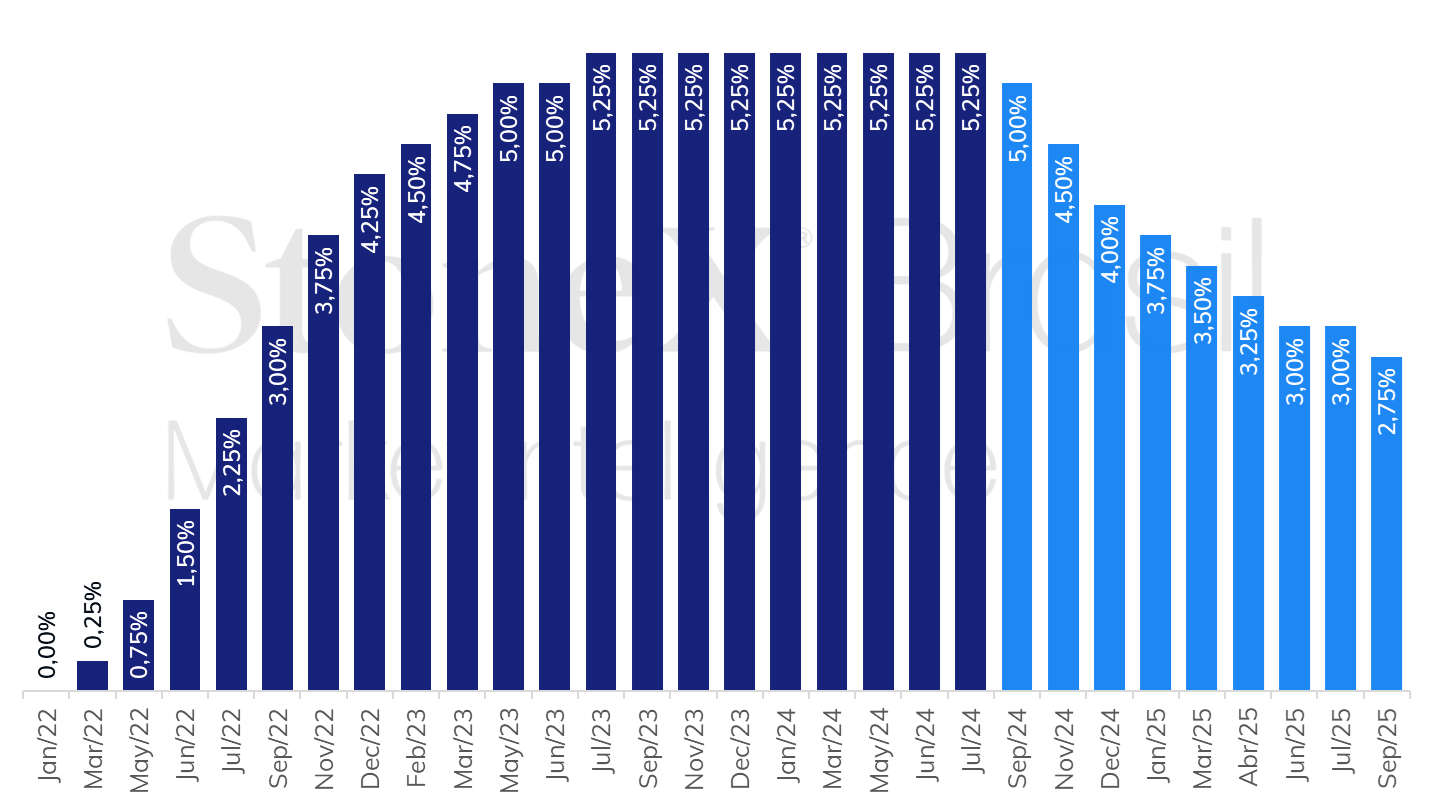
Source: CME FedWatch Tool. Design: StoneX. Refers to the bet with the highest probability in the future interest rate market on the indicated date.
Ratio between open positions and unemployed in the US
Source: US Bureau of Labor Statistics (BLS). Design: StoneX.
Change in total urban employment (in thousand people) and unemployment rate (%) in the United States
Source: US Bureau of Labor Statistics (BLS). Design: StoneX.
Inflation and growth in Brazil
Expected impact on USDBRL: bullish
In Brazil, the key event this week will be the release of the Broad National Consumer Price Index (IPCA) for August, as investors reassess their expectations for the country’s monetary policy trajectory. Following a significant increase of 0.38% in July for the overall index and 0.44% for its core, the IPCA is anticipated to ease to around 0.30%, driven by the rare likely combination of declining food and fuel prices. If confirmed, this result could alleviate some of the pressure on the Central Bank (BC) to raise the basic interest rate (SELIC) at its September 18 meeting. However, the 'discomfort' surrounding monetary policy is expected to persist, as economic activity and labor market data continue to surpass expectations, while inflation expectations among financial market participants rise. Central Bank President Roberto Campos Neto recently noted that the price stabilization process 'has lost some momentum.' In this context, the economic indicators to be released this week, including the Monthly Services and Trade Surveys by IBGE and the Central Bank’s Economic Activity Index (IBC-Br), gain heightened significance. The IBC-Br, which is used to gauge the country’s economic performance, is expected to show 0.6% growth in July, following a stronger-than-expected 1.4% expansion in June. Such figures could gently lower expectations for a SELIC hike, which in turn might narrow Brazil’s interest rate differential with the U.S., potentially reducing foreign capital inflows and weakening the BRL.
Economic data in China
Expected impact on USDBRL: bullish
This week will be packed with key economic indicators from China, including new data on inflation, the trade balance, manufacturing, and retail sales. Overall, these figures are likely to reinforce the perception of a slower growth trajectory for the country, driven by weakening domestic demand, while foreign sales are expected to show stronger results. However, even with better performance in exports and the industrial sector, it is unlikely to fully counterbalance the sluggishness in domestic activity. The continued slowdown in Chinese economic growth is expected to dampen expectations for commodity demand, which could negatively impact the currencies of major commodity-exporting countries, such as the BRL.

INDICATORS