FX Weekly Overview: The week's main events
- Bearish factors
- The Focus Report is expected to indicate higher estimates for the Selic basic interest rate, increasing the expectation for the Brazilian interest rate differential and attracting foreign capital, strengthening the Brazilian real.
- Bullish factors
- US employment data is expected to show moderate growth in September, reducing the likelihood of more aggressive cuts by the Federal Reserve, which could strengthen the global value of the dollar.
- The release of Brazil's fiscal numbers for August may reinforce investors' concerns about the country's public accounts, leading to a higher risk premium requirement and weakening the Brazilian real.
- After strong optimism about China's economic outlook, the September Purchasing Managers' Index (PMI) numbers are expected to reinforce the perception of a slowdown in the country's economic growth, negatively impacting risky assets and weakening the Brazilian real.
The week in review
The release of mild US inflation data for August and the more assertive stance of the Central Bank of Brazil in its latest monetary policy decision minutes and its quarterly inflation report increased expectations for the Brazilian interest rate differential, strengthening the real. Additionally, the announcement of a comprehensive economic stimulus package in China favored the performance of risky assets, such as stocks, commodities, and currencies of primary product-exporting countries, including Brazil.
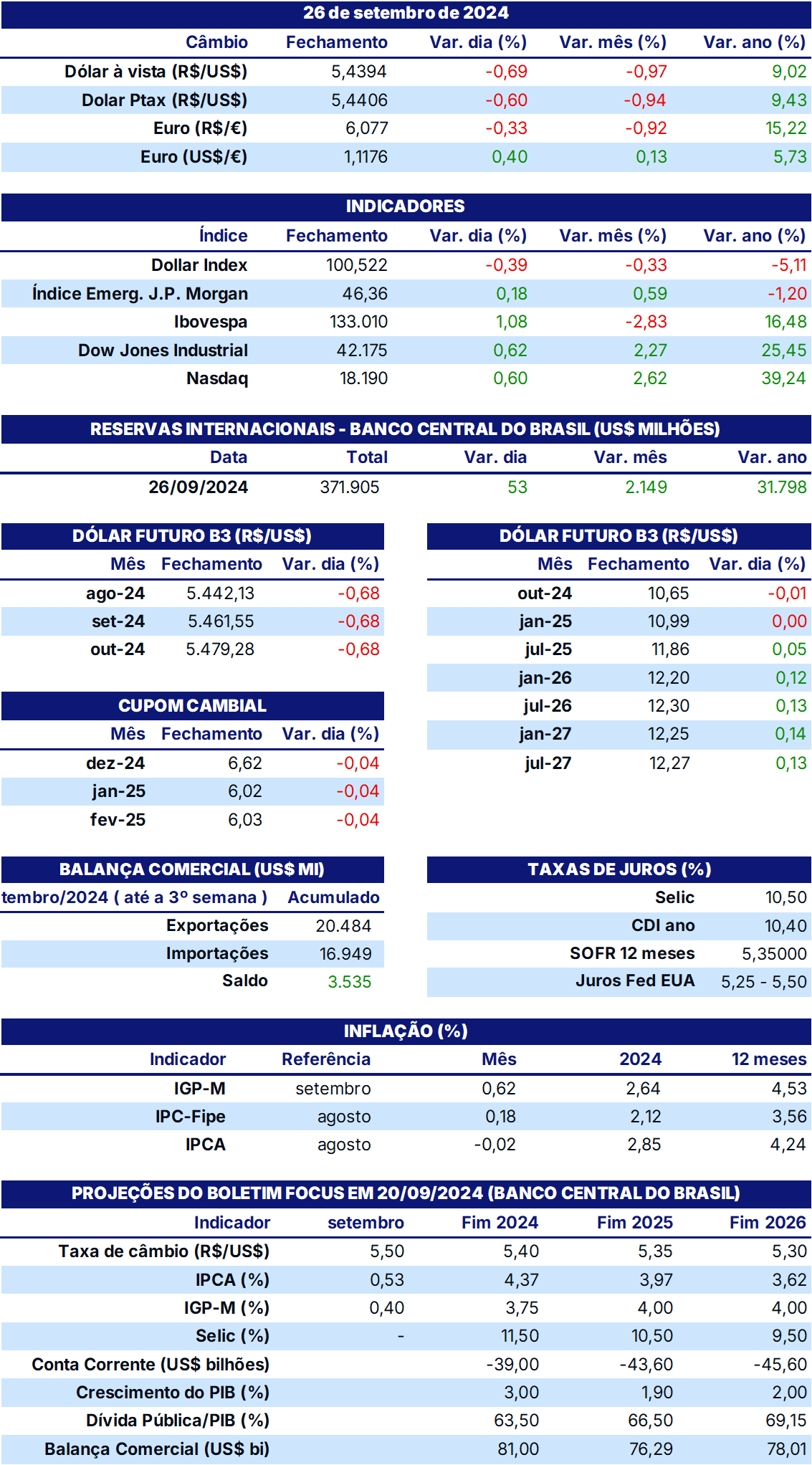
The USDBRL ended Friday's (27) session lower for the fourth consecutive week, quoted at BRL 5.4363, with a weekly variation of -1.5%, -3.5% for the month, and +12.0% for the year. Meanwhile, the dollar index closed Friday's session at 100.4 points, with a weekly drop of 0.3%, a monthly drop of 1.2%, and an annual drop of 0.9%.
USDBRL and Dollar Index (points)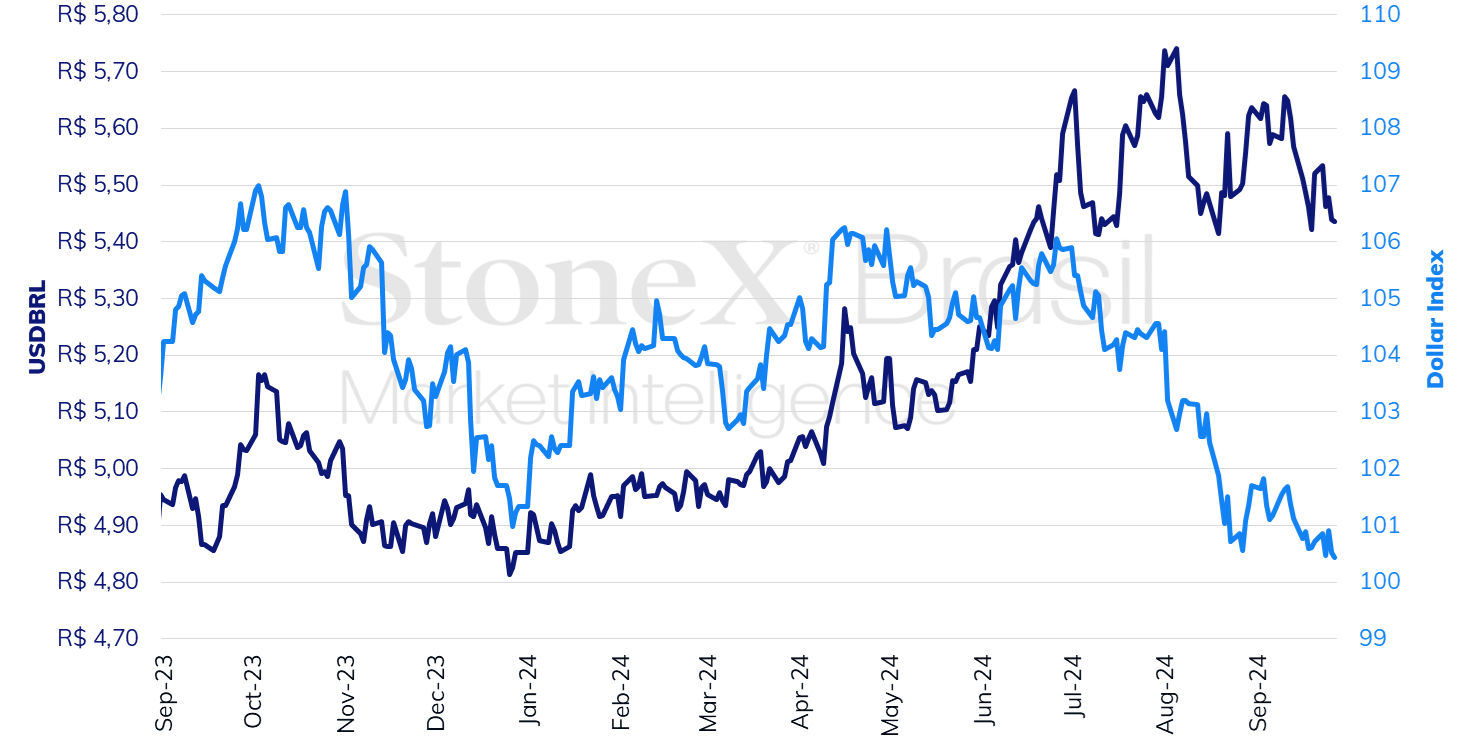
Source: StoneX cmdtyView. Design: StoneX.
KEY EVENT: US Labor Market
Expected Impact on USDBRL: Bullish
This week's Labor market data will carry increased importance, as investors perceive that the Federal Reserve showed significantly more concern about the weakening of the labor market than inflationary resilience in its September 18 policy decision. Thus, some analysts believe that the Federal Reserve may repeat a more aggressive interest rate cut of 0.50 percentage points if the employment creation numbers and the unemployment rate in the country continue to deteriorate.
However, despite evidence of labor market weakening, such as a reduction in the number of job openings, there is still no indication of an acceleration in worker layoffs, suggesting that the labor market remains resilient and is slowing down gradually. Therefore, the median projections of experts point to relative stability, with the net employment creation balance moving from 142,000 in August to 145,000 in September, while the unemployment rate would rise slightly during this period, from 4.2% to 4.3%. If these estimates are confirmed, they should provide the Federal Reserve with greater flexibility by reducing the impression that the economy is slowing down abruptly and that there is urgency to reduce the US interest rate level, which, in turn, could strengthen the dollar globally and weaken the real.
US: History and expected interest rate – September 27, 2024
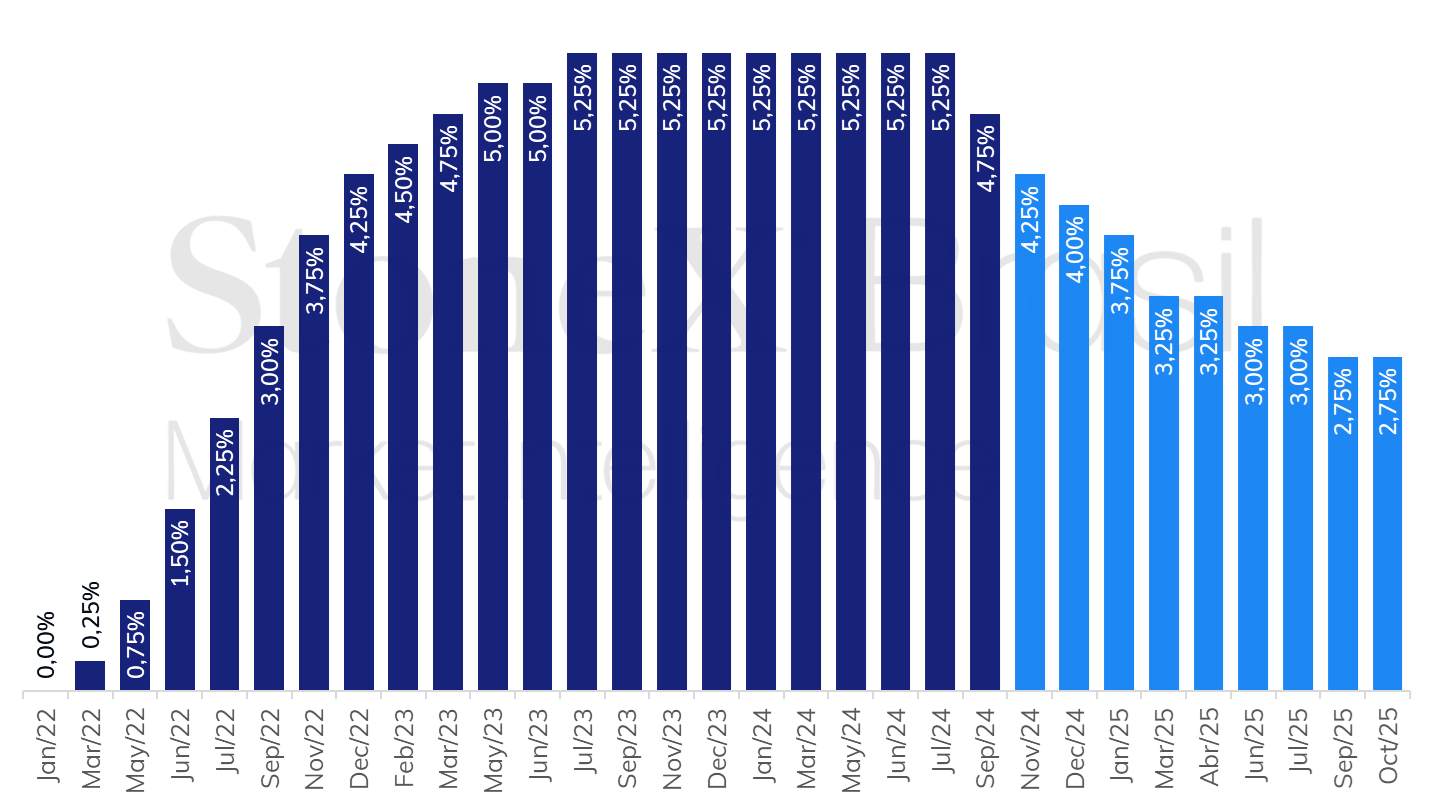 Source: CME FedWatch Tool. Design: StoneX. Refers to the market's highest probability bet on the indicated date.
Selic rate expectations
Expected impact on USDBRL: Bearish
The Focus Report to be released on Monday (30) is expected to reflect the Central Bank's (CB) firmer communication, which reinforced the message of a cycle of interest rate hikes (Selic) due to an asymmetric risk balance with an upward bias in its minutes from the Monetary Policy Committee (Copom) meeting and projected higher inflation above the target center (3.0%) through 2026 in its Quarterly Inflation Report, driven by stronger economic activity, currency depreciation, and unanchored inflation expectations. For example, the future interest rate market (DI) rates rose during the week and point to a 12.75% p.a. rate at the end of the tightening cycle. Therefore, the report on Monday is likely to anticipate a higher level for the Selic, which, in turn, should increase the perspective of the Brazilian interest rate differential, making domestic securities more profitable and attracting foreign investments, strengthening the real.
Brazil: History and expected interest rates – Focus Report September 20, 2024
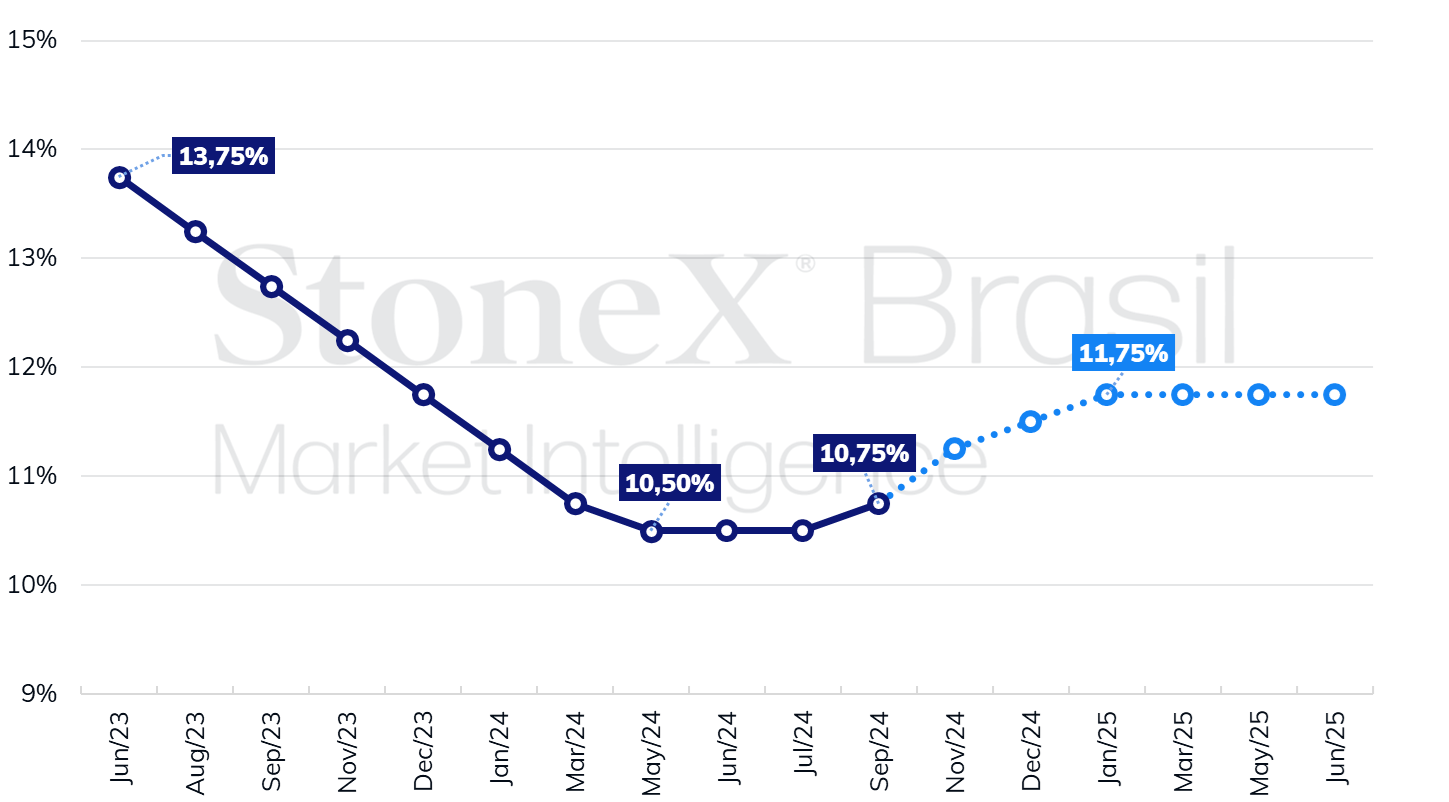
Source: Central Bank of Brazil. Design: StoneX. Refers to the median estimates indicated in the Focus Report on the mentioned date.
Fiscal data in Brazil
Expected impact on USDBRL: Bullish
Investors will also react to the release of fiscal numbers for the public sector in August, which is expected to show a new primary deficit of around BRL 20 billion, maintaining the primary result at 2.3% of the Gross Domestic Product (GDP) – still far from the tolerance limit for this year, of 0.25% of GDP. If the projection is confirmed, it may result in an elevated perception of fiscal risks for Brazilian assets, making it harder to attract external capital and weakening the real.
PMIs in China
Expected Impact on USDBRL: Bullish
Last week, China surprised the market by announcing a comprehensive economic stimulus package, including cuts to the one-year and five-year benchmark interest rates, the seven-day reverse repo rate, the required reserve ratio, and the average mortgage interest rate, along with the issuance of 2 trillion yuan (about US$ 283.43 billion) in debt to stimulate domestic demand and help local governments address over-indebtedness. Additionally, specialized media outlets reported that new fiscal stimuli should be announced soon. As a result, investors began to assess that Chinese authorities are determined to accelerate the country's economic growth, which has shown signs of weakening for months, resulting in a strong global appetite for risky assets, benefiting stocks, commodities, and currencies of primary product-exporting countries, like the real.
However, these economic stimuli are unlikely to be reflected in the economic indicators for 2024 due to the usual lag between implementing a stimulus and its impacts on economic activity. This lag is difficult to estimate and varies by instrument, but it is commonly considered to take between six and nine months for the effects of a policy to be fully transmitted to the economy. Therefore, next week's September PMI numbers in China, both the NBS and the S&P Global/Caixin versions, are expected to show results similar to August, indicating gradual growth in production activity, with better numbers for services than for industry, suggesting that the country may not meet its official 5% GDP growth target for the year. If these estimates are confirmed, recent investor optimism may reverse, increasing global risk aversion and harming the real.
Month-End Ptax Rate
Expected Impact on USDBRL: Undefined
After a 3.5% appreciation in September, the real's exchange rate is expected to see higher trading volumes and volatility next Monday (30), during the time slots used by the Central Bank to calculate the month-end Ptax rate, i.e., between 10:00 a.m. and 1:10 p.m (BRT). The Ptax is a reference rate published daily by the CB, and its month-end value is widely used in exchange rate contracts and derivatives. Therefore, market operators intensify their operations during these intervals, contesting its definition.

INDICATORS