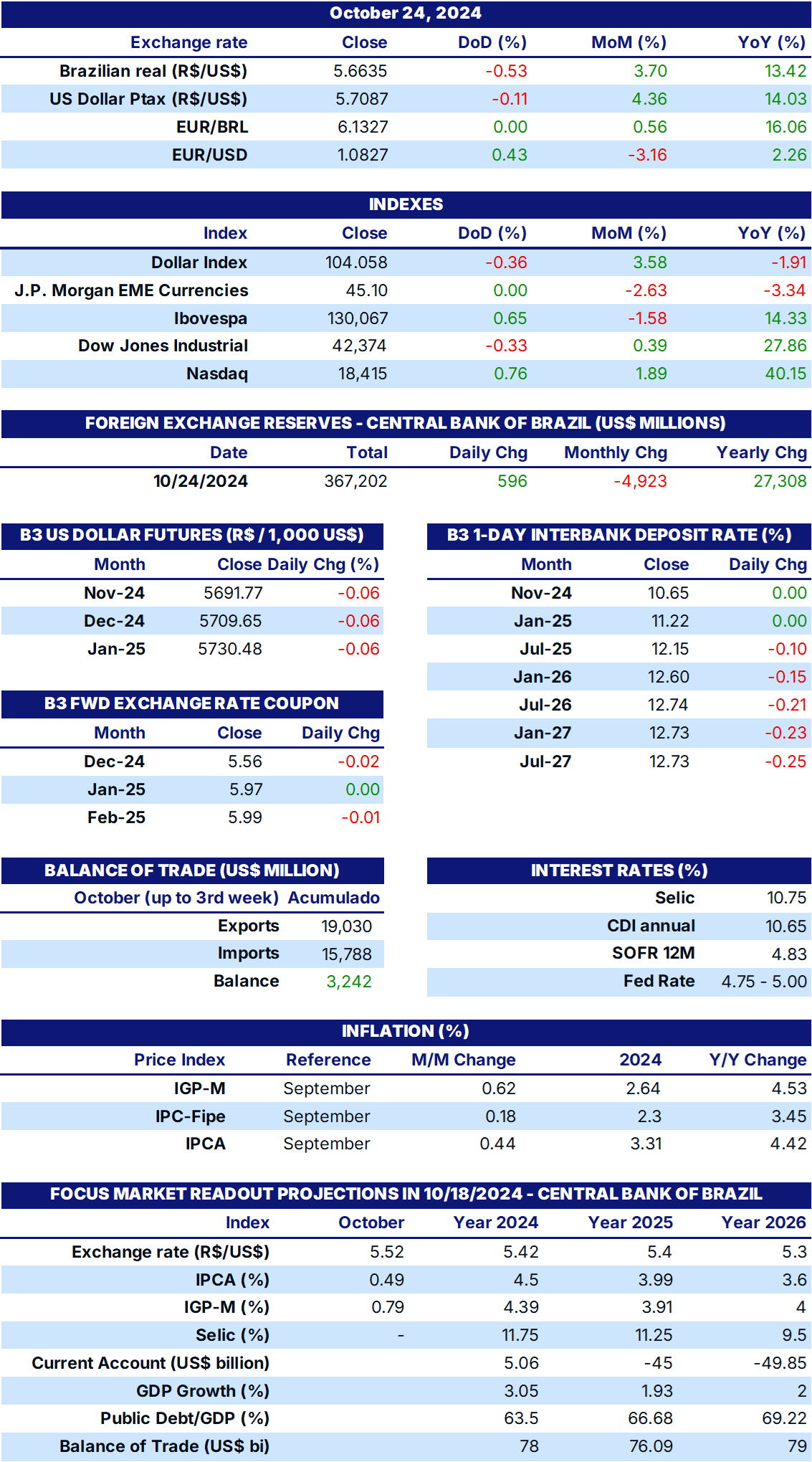
FX Weekly Overview: The week's main events
- Bearish Factors
- China's manufacturing and services PMI should slightly improve compared to September, raising investor expectations for the country’s economic growth and benefiting risk assets such as stocks, commodities, and currencies of emerging markets, like the real.
- Bullish Factors
- September fiscal statistics may worsen the perception of Brazilian assets, leading investors to demand higher risk premiums, which weakens the real.
- US economic data on activity, inflation, and the labor market are likely to decrease investor expectations for Fed rate cuts, strengthening the dollar.
- A tight and unpredictable US presidential election stimulates the search for safe assets, benefiting the dollar's performance.
The week in review
In a week with a pared-down agenda, the dollar strengthened globally for the fourth consecutive week, driven by reduced investor expectations for Fed rate cuts due to stronger economic data and anticipation of potential effects from a possible Donald Trump victory in the presidential election. In Brazil, market pessimism regarding public finances and economic authorities’ fiscal policy decisions caused volatility in the exchange rate.
The USDBRL closed Friday's (25) session up, at BRL5.7066, with a weekly increase of 0.1%, a monthly rise of 4.7%, and an annual increase of 17.6%. Meanwhile, the dollar index closed the session at 104.3 points, a weekly change of +0.8%, a monthly rise of 3.5%, and an annual increase of +3.0%.
USDBRL and Dollar Index (points)
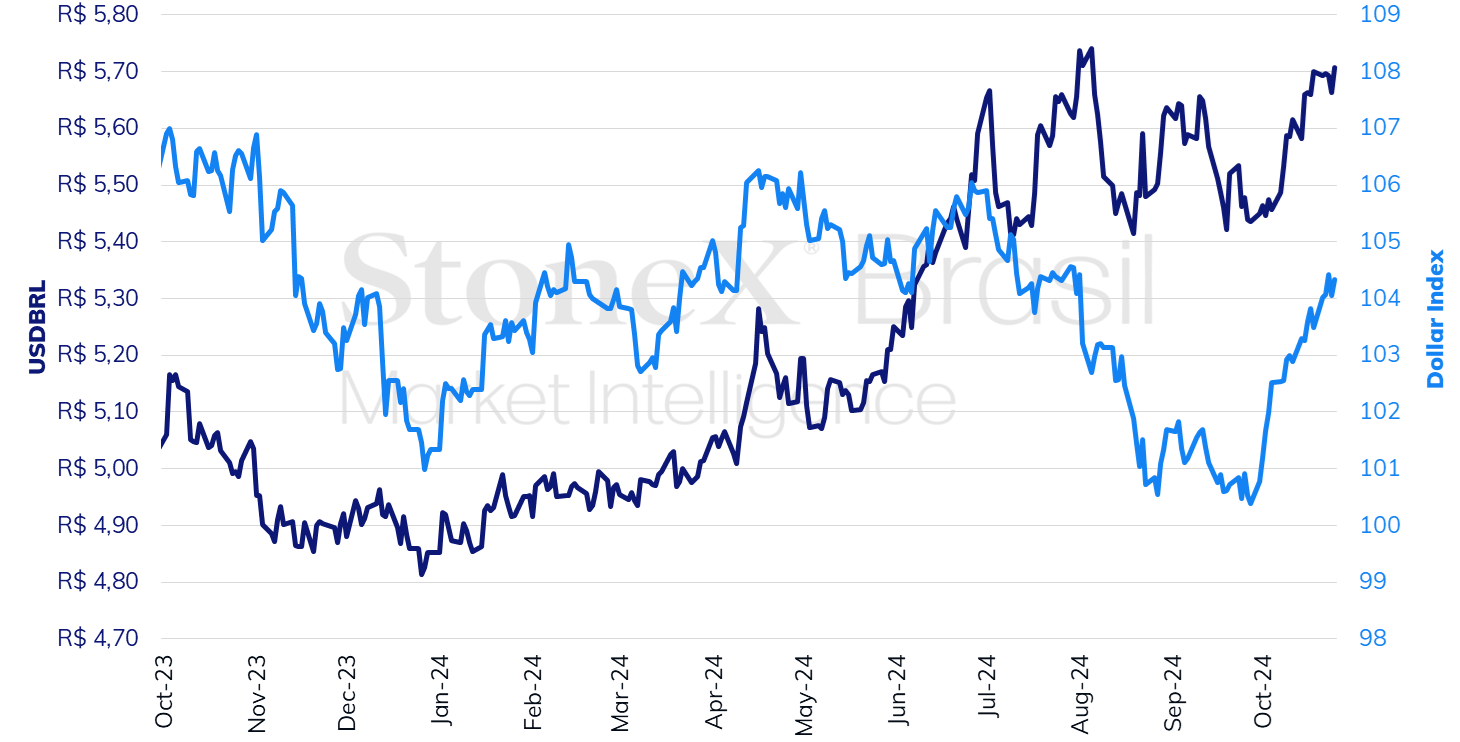
Source: StoneX cmdtyView. Prepared by: StoneX.
Key Factor: US Economic Data
Expected Impact on USDBRL: Bullish
In recent weeks, the dollar has strengthened globally due to a significant increase in US Treasury yields, which reflects reduced investor expectations for Fed rate cuts. One key reason for this tempered outlook is that economic data has been stronger than expected, indicating that the US economy remains robust, lessening the urgency for the Fed to ease monetary policy.
US: Interest Rate History and Expectations – October 25, 2024
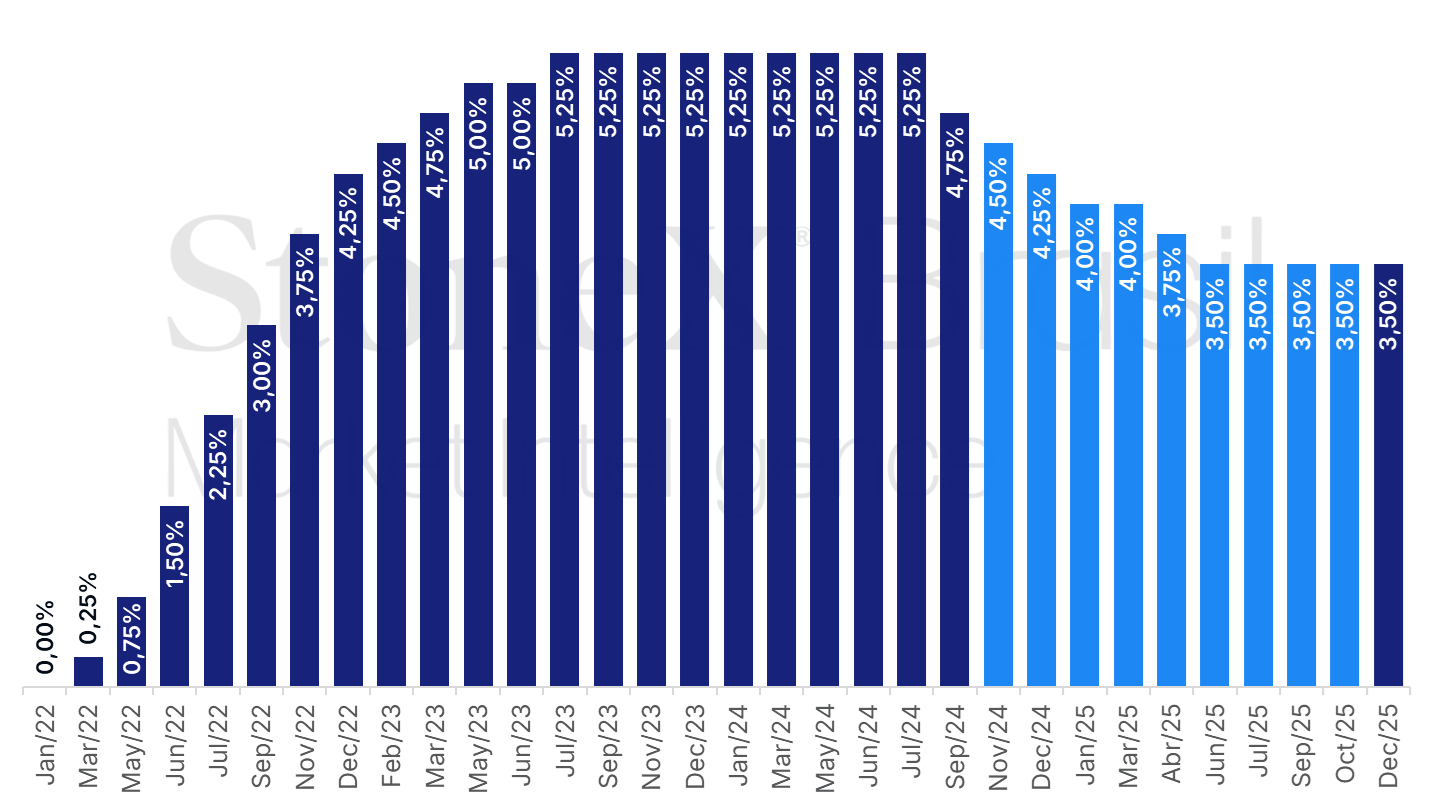
Source: CME FedWatch Tool. Prepared by: StoneX. Refers to the most probable market rate forecast on the specified date.
This week, new indicators should reinforce this perception of resilience in the US economy. The median projection for the first reading of Q3 GDP points to an annualized growth rate of 3.0%, driven by internal consumption growth. Additionally, the Personal Consumption Expenditures (PCE) Price Index, the Fed’s preferred inflation measure, is expected to pick up in October, mirroring trends in the Consumer Price Index (CPI) and Producer Price Index (PPI). The core PCE, which excludes volatile food and energy components, is projected to increase from 0.1% in September to around 0.3% in October, indicating a gradual pace in price stabilization in the US.
Meanwhile, the median job growth forecast for October suggests a net increase of 140,000 new jobs, representing the 46th consecutive month of employment growth. While this figure is lower than the net 254,000 increase in September, exceptional factors, such as two hurricanes in the South and a Boeing worker furlough, may reduce the employment total by 60,000 to 80,000 jobs. If confirmed, these estimates are likely to reinforce the perception that US rates will decrease slowly, supporting dollar-denominated securities and strengthening the dollar globally.
Uncertainty in the US Election
Expected Impact on USDBRL: Bullish
Another important factor is the uncertainty surrounding the outcome of the November 5 US presidential election, which remains highly competitive and unpredictable. In seven decisive states, the difference in voting intentions between Donald Trump and Kamala Harris is less than two percentage points, and in four of them, it is less than one percentage point. This scenario likely will persist until the election's end, increasing uncertainty over US economic policies and driving demand for safe-haven assets, like the dollar. Analysts believe investors are anticipating the impact of a Trump victory, who advocates for drastic tariff increases, 60% on China and 10% on other global economies, potentially driving up US inflation and limiting the Fed’s ability to cut rates.
Fiscal Concerns in Brazil
Expected Impact on USDBRL: Bullish
Investor skepticism and pessimism about Brazil's fiscal consolidation process have remained high despite repeated promises from economic authorities to introduce "structural adjustments" in public spending after the second round of municipal elections. The release of fiscal statistics for September is expected to reinforce concerns that the primary deficit trajectory is misaligned with the target, affecting Brazilian assets and weakening the real.
Brazil: DI Rate for January 2029 (% p.a.)
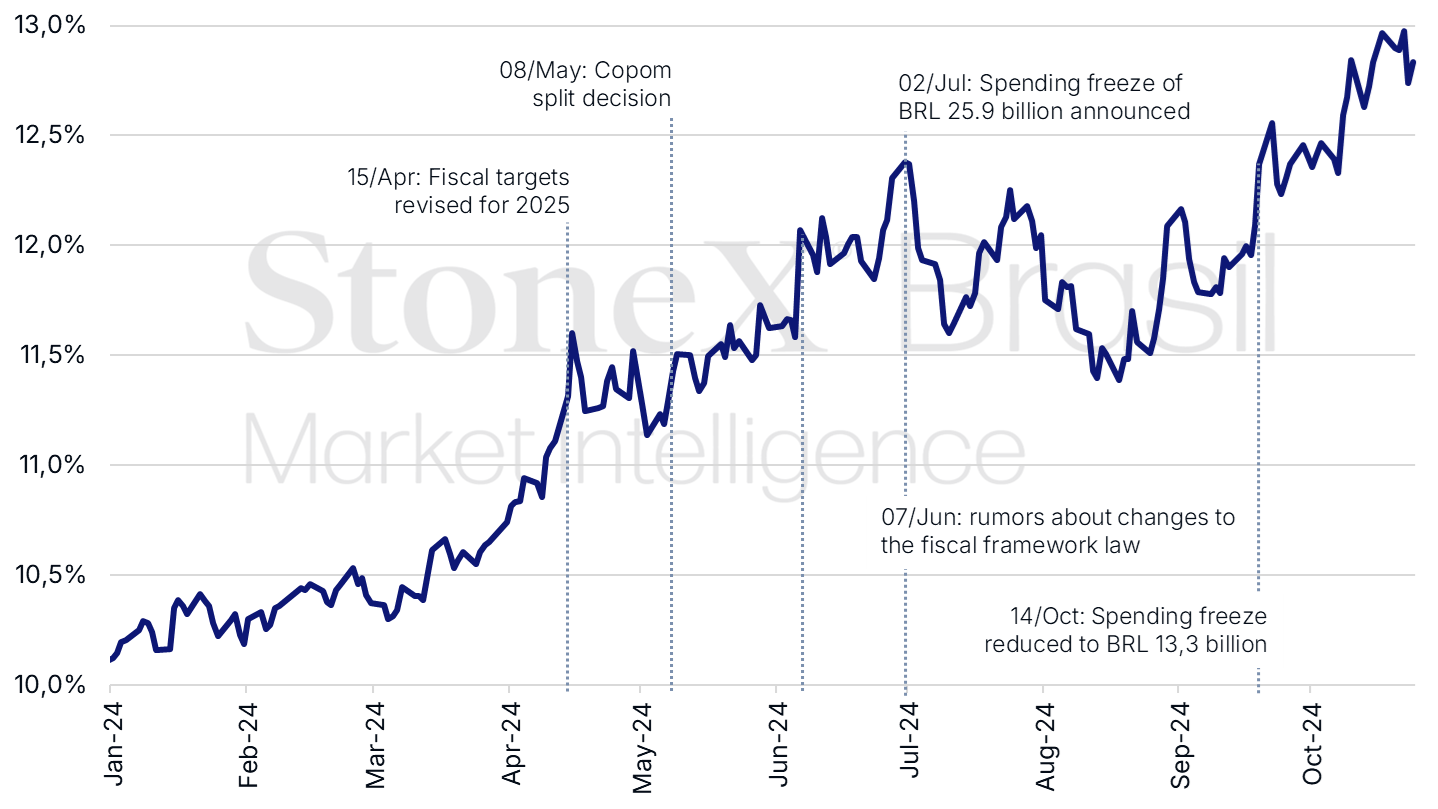
Source: Refinitiv. Prepared by: StoneX.
China's PMI
Expected Impact on USDBRL: Bearish
China's PMI releases for October will be closely watched by investors monitoring the country's economic health and awaiting new fiscal stimulus measures. A slight improvement is expected for both manufacturing and services PMIs over September, tied largely to the stock market and financial services sector recovery seen since mid-September due to stimulus measures from the Chinese government.
INDICATORS