FX Weekly Overview: The week's main events
- Bearish Factors
- The FOMC is expected to lower its interest rate by 0.25%, reducing the yield potential for dollar-denominated bonds, which could weaken the U.S. dollar.
- The Copom is expected to increase the Selic rate by 0.50%, improving Brazil's interest differential and attracting foreign capital, strengthening the real.
- An acceleration in October’s IPCA may boost expectations for a strict cycle of Selic rate hikes, attracting foreign investment and strengthening the real.
- Bullish Factors
- A tight and unpredictable U.S. presidential election may drive demand for safe-haven assets, boosting the dollar.
- A credibility crisis in Brazilian fiscal policy may worsen risk perception of Brazilian assets, leading investors to demand higher risk premiums and weakening the real.
- China's trade balance could reinforce concerns about slowing domestic demand, which could negatively impact risky assets like commodities and the currencies of primary product exporters, such as the real.
Last week in review
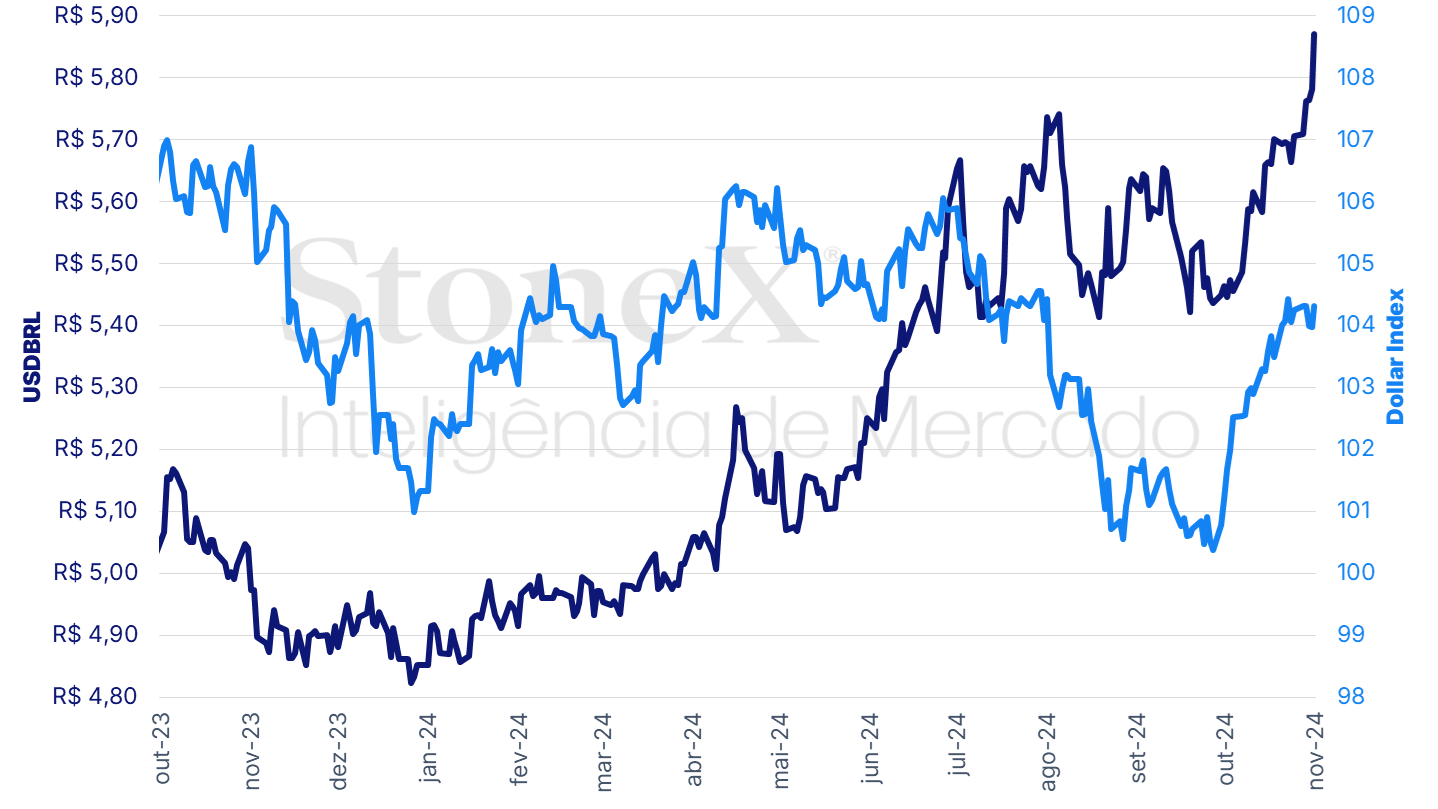
The Brazilian real weakened for the fifth consecutive week, pressured by investor pessimism and skepticism over fiscal policy management and public debt sustainability in Brazil, as well as a global risk-averse environment driven by the approaching U.S. presidential election, which remains tight and unpredictable.
The USDBRL closed last Friday's session (01) higher at R$5.8699, marking a weekly gain of 2.9%, a monthly gain of 1.5%, and an annual gain of 21.0%. Meanwhile, the dollar index closed last Friday's session at 104.3 points, with a weekly change of +0.1%, monthly change of 0.3%, and annual change of +3.0%.
USDBRL and Dollar Index (points)
Source: StoneX cmdtyView. Prepared by StoneX.
Key event: U.S. Presidential Election
Expected Impact on USDBRL: Bullish
In recent weeks, global investors have maintained a reduced appetite for risk as they await the U.S. presidential election, which concludes on November 5 and is expected to be one of the closest races in decades. With only a few days remaining, polling remains nearly tied, leaving the outcome unpredictable. Six potentially decisive U.S. states show a difference in voting intentions between Donald Trump and Kamala Harris of less than two percentage points, with three of these states showing a difference of less than one percentage point. Given the anticipated narrow margin, the confirmation of the election result could take several days, as it will likely be necessary to wait for all states to finish counting and, possibly, for the results of audits and recounts in states where the vote is very close. This prolonged uncertainty about the U.S. political landscape and, consequently, the direction of the country’s economic policies over the next four years is expected to sustain a risk-averse business environment, driving demand for safe-haven assets that are less volatile and more liquid, like the U.S. dollar.
Brazilian Fiscal Policy Credibility Crisis
Expected Impact on USDBRL: Bullish
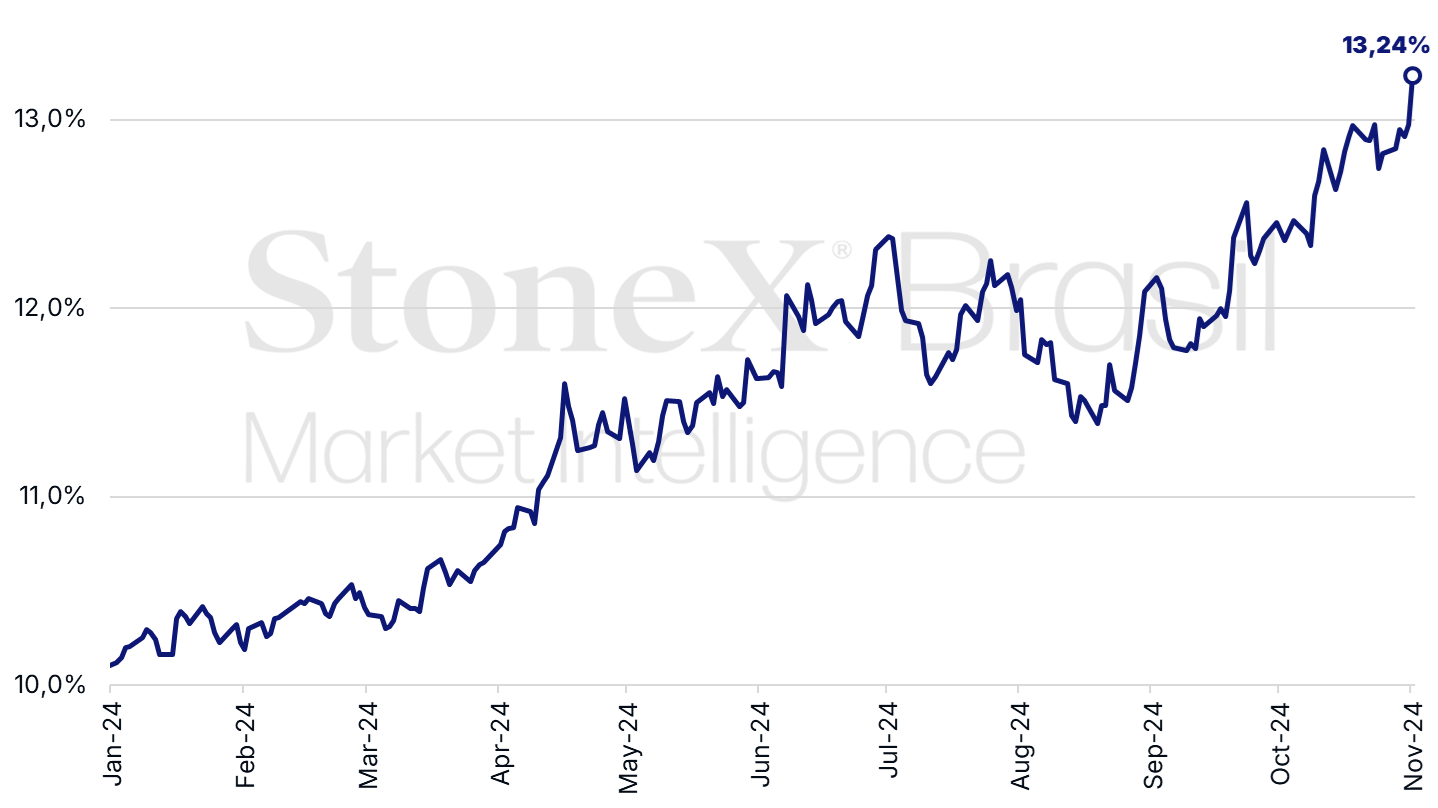
In recent weeks, a deep crisis of investor confidence regarding the management of Brazil’s fiscal policy has negatively impacted the performance of Brazilian assets, such as the exchange rate of the real and the interest rate on futures contracts (DI). Last Friday (01), the USDBRL closed at its highest level since May 13, 2020 (5.9012), while the DI rate for January 2029 broke through the 13% p.a. threshold for the first time since March 16 of last year. Although the federal government has repeatedly promised “structural adjustments” to public spending, financial market players generally perceive that the presidential office demonstrates little urgency and importance regarding this issue, fueling a growing pessimism about the Executive’s ability to adjust public spending levels. Consequently, the demand for risk premiums continues to rise, further weakening the real—a trend likely to persist without concrete federal measures to alleviate fiscal concerns, which is improbable this week due to Finance Minister Fernando Haddad’s trip abroad.
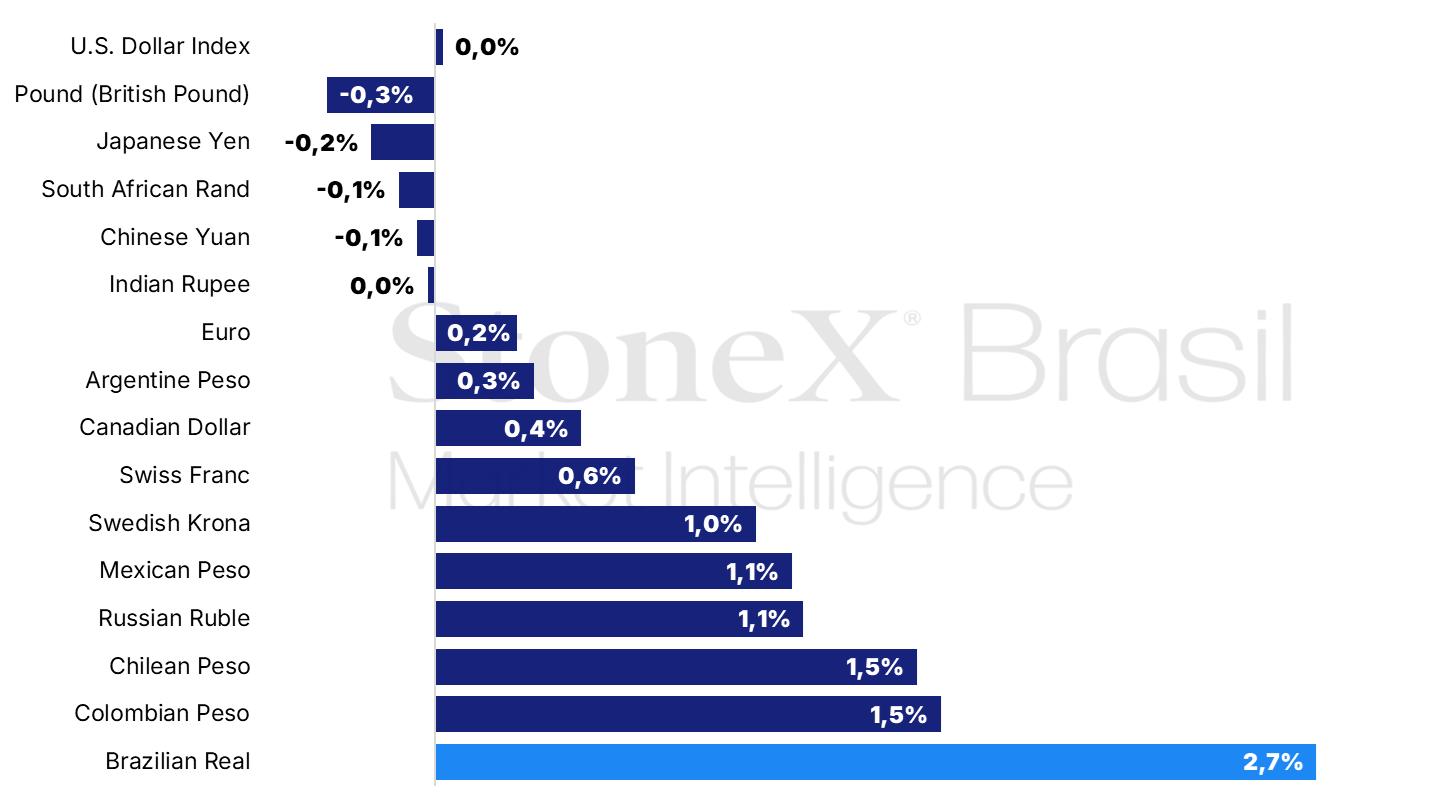
Weekly changes of selected currencies against the USD
Source: Refinitiv. Prepared by StoneX.
Brazil: Interbank Deposit Rate (DI) for January 2029 (% p.a.)
Source: Refinitiv. Prepared by StoneX.
FOMC Rate Decision
Expected Impact on USDBRL: Bearish
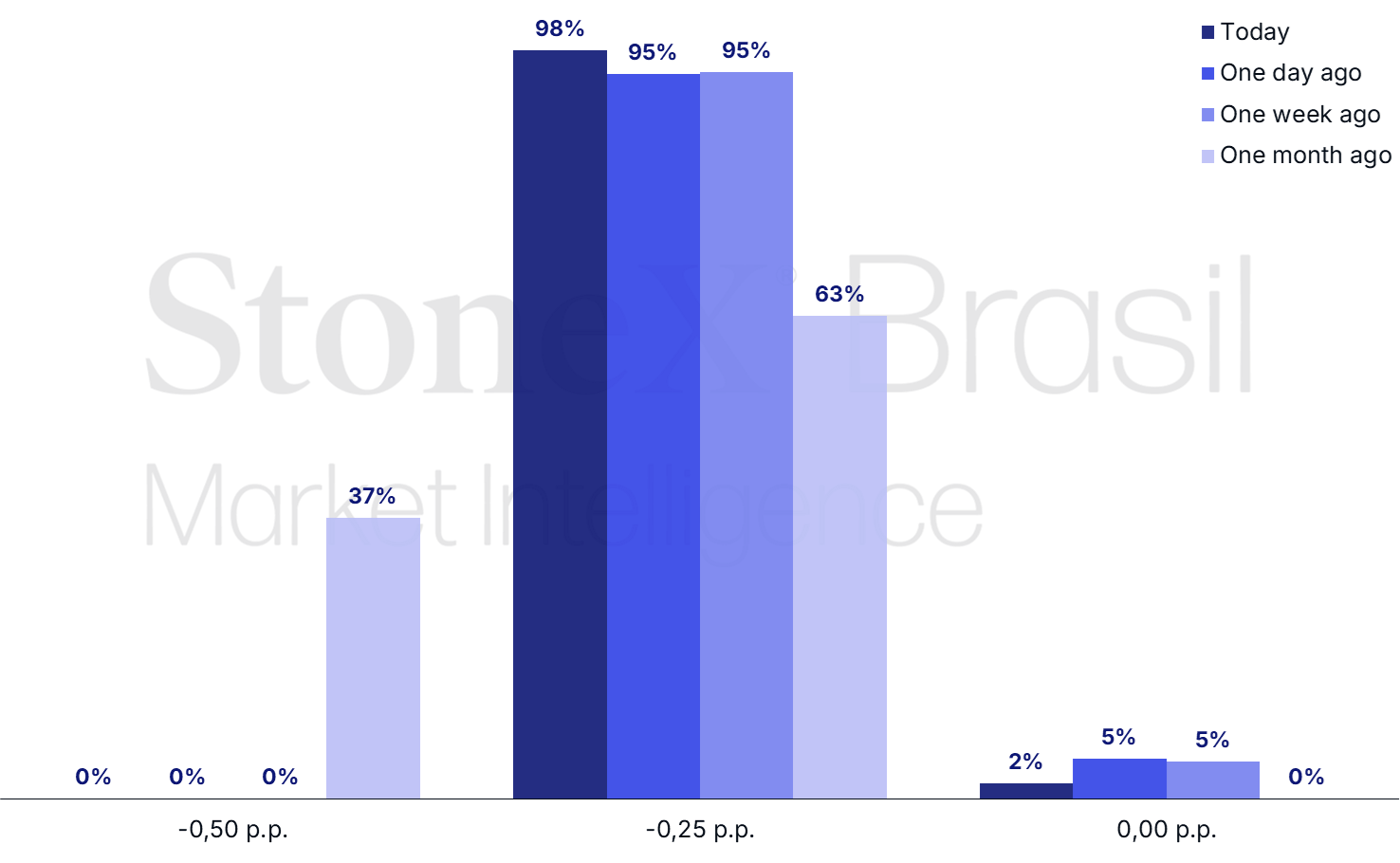
There is near consensus among analysts that the Federal Open Market Committee (FOMC) of the Federal Reserve (Fed) is likely to reduce the U.S. benchmark interest rate by 0.25 percentage points, from the 4.75%-5.00% range to the 4.50%-4.75% range. Following the Committee’s unexpected 0.50 percentage point rate cut in September, most economic indicators in the United States have performed above expectations, suggesting that the economy remains resilient and that inflation stabilization may take longer than anticipated. Thus, there are no apparent reasons for the FOMC to repeat a more aggressive rate cut. On the other hand, there is still a perception that the country is experiencing a gradual slowdown and that the risks of a renewed inflationary acceleration appear lower than the risks of a sharp economic downturn, justifying another 0.25 percentage point rate cut. Finally, investors will focus on the statement accompanying the decision and on the press conference held by Federal Reserve Chair Jerome Powell, seeking greater clarity on the future direction of U.S. monetary policy.
Federal Reserve Rate Decision Projections for November 7
Source: CME FedWatch Tool. Prepared by StoneX.
USA: History and Expected Interest Rate – November 1, 2024
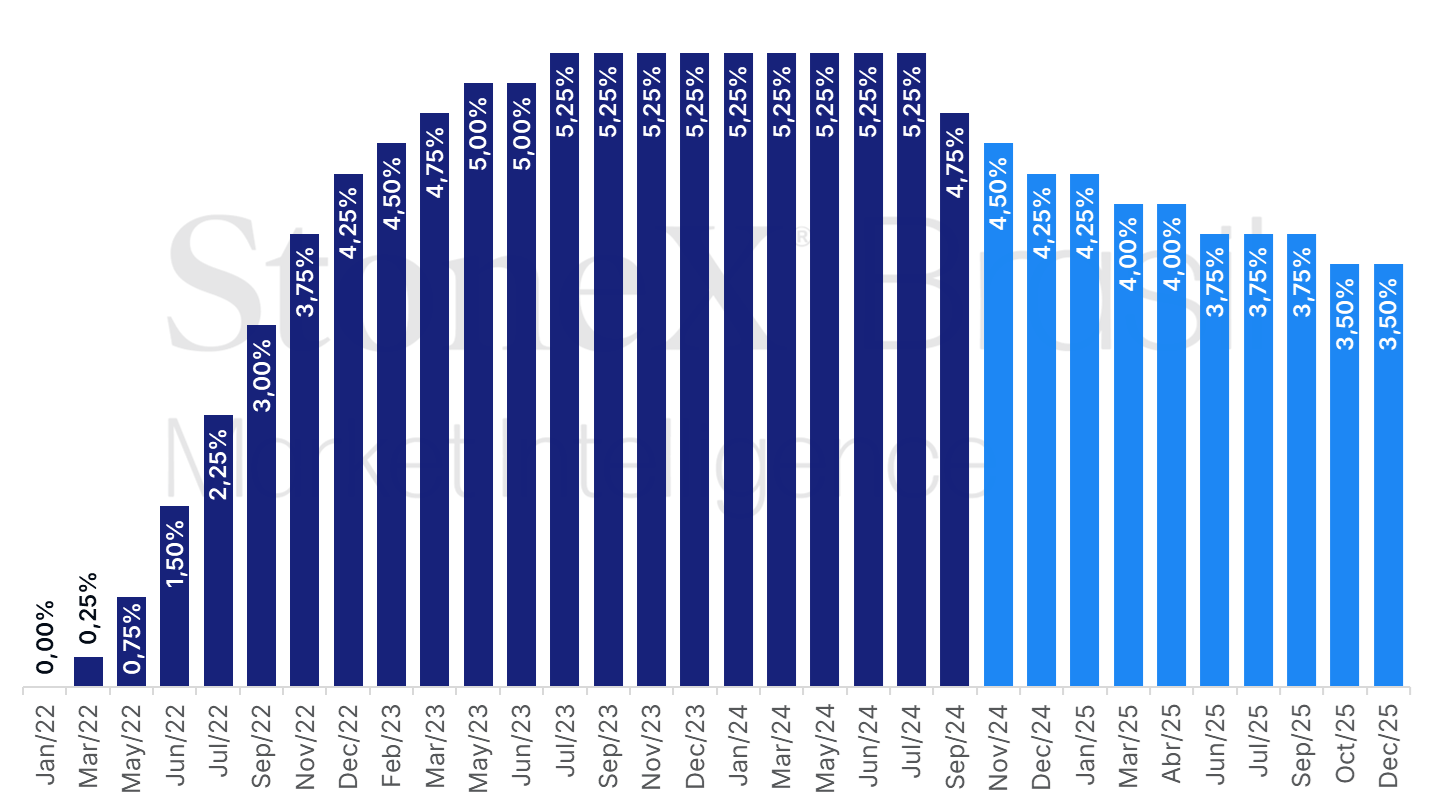
Source: CME FedWatch Tool. Prepared by StoneX. Refers to the highest probability forecast in the interest rate futures market on the indicated date.
Copom Rate Decision
Expected Impact on USDBRL: Bearish
Amid a scenario of cumulative worsening in the perception of fiscal risks associated with Brazilian assets, the Central Bank’s Monetary Policy Committee (Copom) is expected to raise the benchmark interest rate (Selic) for the second consecutive decision. The median forecast indicates a 0.50 percentage point increase, from 10.75% to 11.25% per year, with additional hikes anticipated, potentially reaching 12.00% per year. In its latest decision, Copom reiterated its “firm commitment to converge inflation to the target,” adopting a stricter stance on the need for a more restrictive monetary policy to address an asymmetrical and upward-biased inflation risk balance, “characterized by economic resilience, labor market pressures, a positive output gap, rising inflation forecasts, and unanchored expectations.” The Central Bank’s firm position and the expectation of further Selic hikes, while the Federal Reserve is entering a rate-cutting cycle, increase the outlook for Brazil’s interest rate differential. This makes domestic bonds more attractive and supports foreign investment inflows, strengthening the real.
October IPCA
Expected Impact on USDBRL: Bearish
Two days after the Monetary Policy Committee's decision, October's Broad Consumer Price Index (IPCA) is expected to rise from 0.44% in September to around 0.50% in October, driven by increases in food and electricity prices. If the projection is confirmed, the index would accumulate a 4.50% increase over 12 months, reaching the upper tolerance limit of the Central Bank's inflation target. This data could heighten concerns that price stabilization in the country is weakening (the Central Bank projected a 36% risk in September that the IPCA would exceed the maximum limit this year) and reinforce expectations of a strict cycle of Selic rate hikes by Copom, which could support expectations for an expanded Brazilian interest rate differential and attract foreign capital, strengthening the real.
China's Trade Balance
Expected Impact on USDBRL: Bullish
In recent months, China’s export figures have shown stronger performance than domestic demand data, driven by the chip and electric vehicle sectors. Accordingly, the median projection for annual export growth has risen from +2.4% in September to around +5.5% in October, while the median estimate for annual import growth has declined from +0.3% to -0.3% over the same period. If confirmed, these data could worsen investor expectations for Chinese economic growth, thereby reducing prospects for commodity demand growth from the world’s second-largest economy and negatively affecting the performance of currencies from primary product-exporting countries, such as the real.

INDICATORS