FX Weekly Overview: Key Events of the Week
- Bearish Factors
- Potential easing of the high-risk premium associated with domestic assets before Congress's approval of the fiscal package in late 2024.
- Bullish Factors
- Robust US economic data and minutes from the last FOMC rate decision may reinforce perceptions of economic resilience and reduce bets on quicker rate cuts by the Fed.
- December IPCA and new Brazilian economic activity data for November may intensify concerns about inflation risks in the country, increasing risk premium demands for domestic assets.
FX Summary: 2024
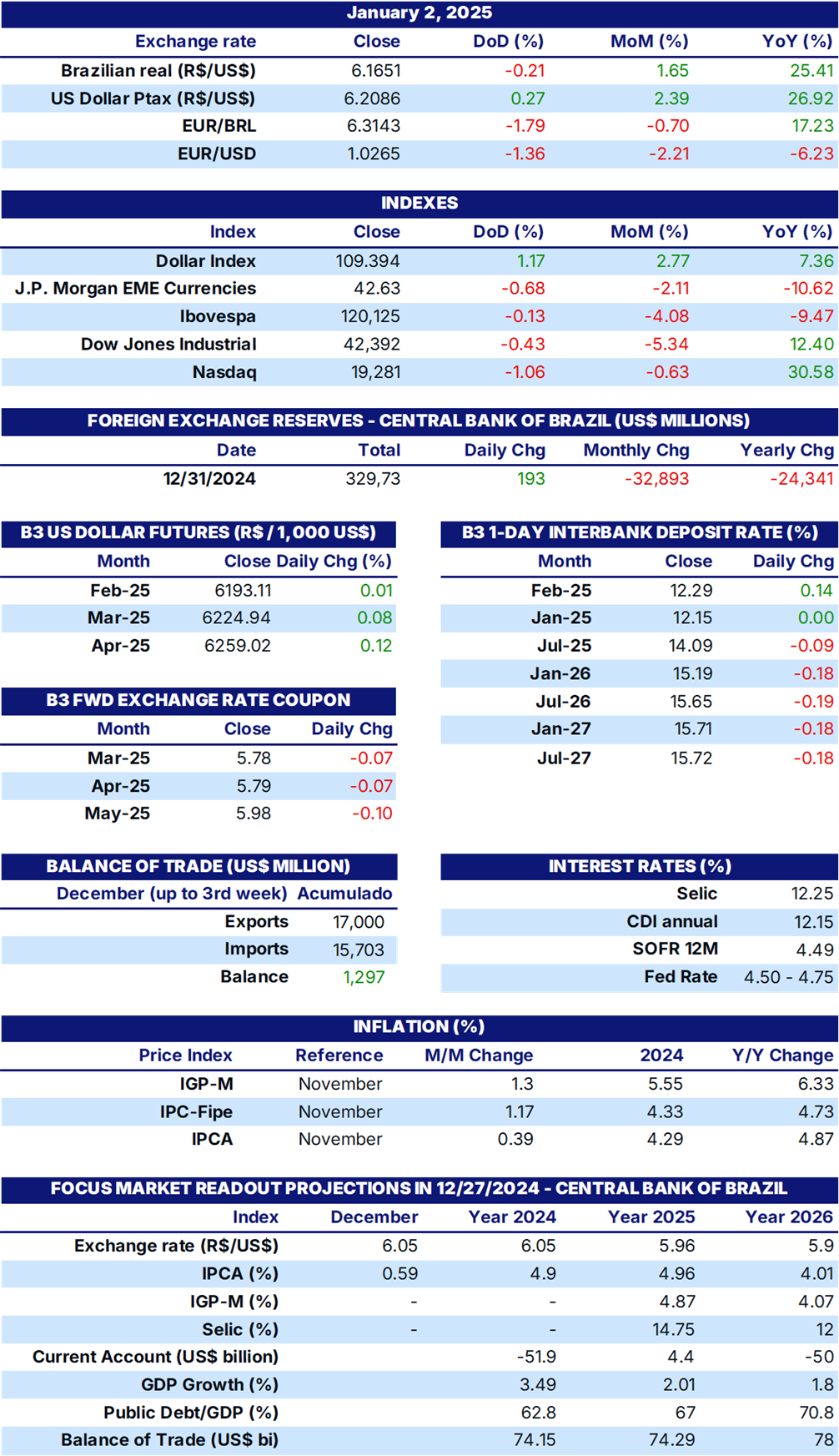
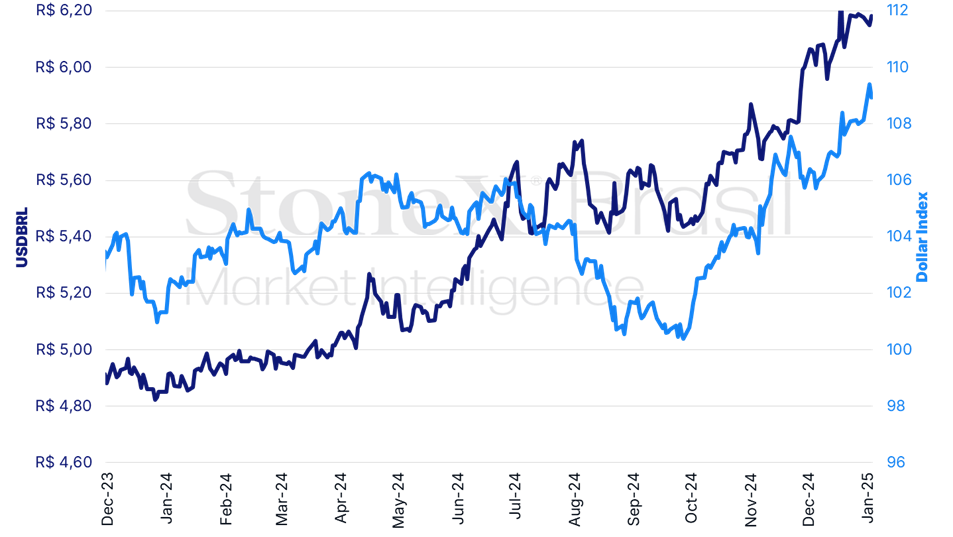
The USDBRL closed 2024 near its historical nominal peak, quoted at BRL 6.179. For the year, the exchange rate saw a substantial annual rise of 27.2%—its highest variation since 2020, when it gained 29%. This placed the Brazilian real among the most depreciated currencies last year. The global strengthening of the US dollar, which also recorded double-digit gains against the Argentine peso (27.5%), Mexican peso (21.9%), Colombian peso (13.7%), and Chilean peso (12.3%), coupled with concerns over the sustainability of Lula’s fiscal policies, were key drivers of this trend.
Throughout the year, the dollar index appreciated by 6.8%, nearing its two-year high at 108.5 points. Strong US economic activity and labor market data, suggesting the Federal Reserve has less room for rate cuts compared to other advanced economies, have supported the dollar’s strength. Among its peers, the Japanese yen (10.9%), Swedish krona (10.3%), Canadian dollar (8.5%), and Swiss franc (7.0%) were the biggest losers in 2024.
The recent depreciation of the Brazilian real, exacerbated in recent months after exceeding BRL6.00, sharply contrasts with the stability observed in Q1 2024. Between January and March, the USDBRL displayed its lowest historical volatility, reaching nearly 6.5% over 30 days, trading between BRL4.85 and BRL5.03. This relative steadiness was supported by surplus trade and financial currency flows and expectations of a US interest rate cut amidst slower Selic rate reductions.
However, uncertainties about meeting the fiscal framework’s targets were a recurring theme throughout 2024, increasing the risk premium for Brazilian assets, particularly for exchange rates and futures interest contracts. Despite the government’s ad-hoc spending cut measures, approved with some “adjustments” by Congress, the market remains unconvinced about the long-term sustainability of public accounts adjustments and their sufficiency to stabilize Brazil’s debt trajectory. The prospects of slower growth in 2025, reducing tax revenue potential, and the elevated Selic rate, currently at 12.25% and projected to end the year at 14.75%, suggest a persistent primary deficit and faster debt growth.
On the global front, discrepancies between growth outlooks among global powers—with signs of slowdown in China and the European Union versus resilient US economic performance—escalating conflicts in the Middle East, and risks of a tariff war proposed by US President-elect Donald Trump favored dollar appreciation last year. These factors are expected to remain on the radar in early 2025 and may keep the US dollar strong for an extended period.
The week in review
The real/dollar pair ended Friday’s (03) session quoted at BRL6.183, down 0.1% for the week, up 2.0% for the month, and up 25.8% for the year. Meanwhile, the dollar index closed Friday at 108.92 points, up 0.9% weekly, 2.5% monthly, and 7.5% annually.
USDBRL and Dollar Index (points)
Source: StoneX cmdtyView. Prepared by: StoneX.
KEY EVENT: FOMC Decision Minutes and “Payroll”
Expected Impact on USDBRL: Bullish
For many specialists, the year closes with a predominantly optimistic outlook for the U.S. economy. Throughout 2024, growth and productivity remained relatively strong, the dollar appreciated against most global currencies, and inflation showed its first signs of deceleration, despite remaining resilient. During this period, the main source of market volatility was tied to expectations regarding the start of the Federal Reserve's (Fed) monetary easing cycle. Contrary to initial projections, the Fed adopted a more cautious stance throughout the year, postponing rate cuts until surprising the market in September with a 0.50 percentage point reduction, driven by substantially weaker economic indicators released in the preceding weeks. Since then, economic data indicates a more heated environment, with a lower likelihood of labor market weakening and inflation still above the Fed's target. Despite significant uncertainties, the underlying strength of the economy suggests limited room for further substantial rate cuts, which ended the year with a cumulative reduction of 1.00 percentage point.
In this context, one of next week's highlights is the release of the minutes from the latest Federal Open Market Committee (FOMC) meeting held on December 18. During the meeting, the Federal Reserve decided to cut the interest rate by 0.25 percentage points, setting it in the range of 4.25% to 4.50% annually. Despite the new cut, the central bank signaled a pause in the easing cycle, leaving the committee's next steps open. The minutes are particularly relevant as they reveal the discussions leading to the cut, especially since the Summary of Economic Projections released alongside the statement indicated dissent among policymakers. The decision was tighter than usual, with four members voting to keep rates unchanged—a rare event that reflects divergence within the committee. In this context, the market will closely monitor the arguments presented by those who opposed the decision and look for clues regarding the criteria that could guide future rate cuts. Another point of interest is the committee's view on the potential economic impacts of Donald Trump's new administration, which will take office on January 20. During the press conference following the meeting, Fed Chair Jerome Powell acknowledged that policymakers had begun a preliminary assessment of the possible effects of the president-elect's proposed policies, such as increased tariffs, tax cuts, and changes to immigration policies.
Finally, the upcoming week is commonly referred to as “jobs week,” during which the main U.S. employment indicators are released. The highlight will be the Employment Situation Report, or “Payroll,” for December. Median projections point to the creation of approximately 150,000 new jobs, extending the robust pace seen in November, when 227,000 jobs were added. Since then, preliminary indicators suggest that the labor market continues to strengthen, potentially boosted by typical seasonal hiring at the end of the year, particularly in retail and services sectors. During the December rate decision press conference, Federal Reserve Chair Jerome Powell described the rate cut as "a more difficult decision," explaining that the cut was considered "the best way to meet both objectives: employment and inflation." In this scenario, labor market data remains a focal point for investors looking to adjust expectations regarding the path of interest rates in the country. Stronger-than-expected numbers are likely to reduce the prospect of accelerated rate cuts, which, in turn, could push up Treasury yields and strengthen the dollar.
U.S.: Historical and Expected Interest Rate Trends – January 3, 2025
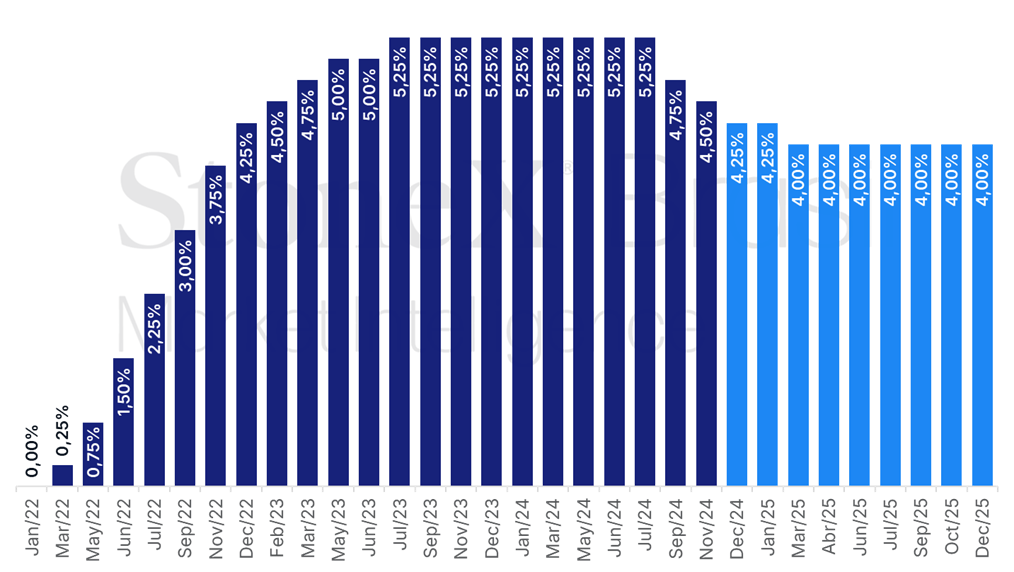
Source: CME FedWatch Tool. Prepared by StoneX. Refers to the market's most probable interest rate futures bet as of the indicated date.
IPCA and Economic Activity Indicators in Brazil
Expected Impact on USDBRL: Bullish
In Brazil, the main event of the week will be the release of December’s Broad Consumer Price Index (IPCA), which consolidates the official inflation rate for 2024. The latest Focus Bulletin forecast for the indicator shows that price acceleration is expected to settle at 0.59% month-over-month in December, closing 2024 at 4.90%, above the 4.5% upper target limit. If confirmed, exceeding the target will require Central Bank President Gabriel Galípolo to send a letter to the Finance Ministry explaining the failure to meet the objective. Within the index composition, food and service prices are expected to account for a significant share of the monthly increase, partly reflecting heated economic activity at the end of the year and the recent depreciation of the real. Conversely, some relief is anticipated in electricity prices: after the yellow tariff in November, a significant improvement in energy generation conditions driven by increased rainfall allowed for the adoption of the green tariff in December.
In addition to the IPCA, the IBGE will also release industrial production and retail sales data for November next week. If these indicators reinforce the perception of Brazil's economic resilience, they may heighten concerns about the risk of more persistent inflation amid a scenario of robust domestic demand.

INDICATORS