FX Weekly Overview: Key Events of the Week
- Bearish Factors
- A sharp acceleration of the IPCA-15 could solidify expectations for strong increases in the basic interest rate (Selic), which helps attract foreign investment and tends to strengthen the real.
- Bullish Factors
- Uncertainties regarding the application of import tariffs by the US government and the peace negotiation process between Russia and Ukraine could lead to increased risk aversion, which tends to strengthen the dollar globally.
- The PCE Index may reinforce the perception of more persistent inflation in the US, potentially increasing bets that American interest rates will remain high for longer, strengthening the dollar globally.
The week in review
The week was marked by volatility in currency markets, amid new import tariff threats by US President Donald Trump and geopolitical tensions after the US and Russia met to discuss the Ukraine conflict without its participation.
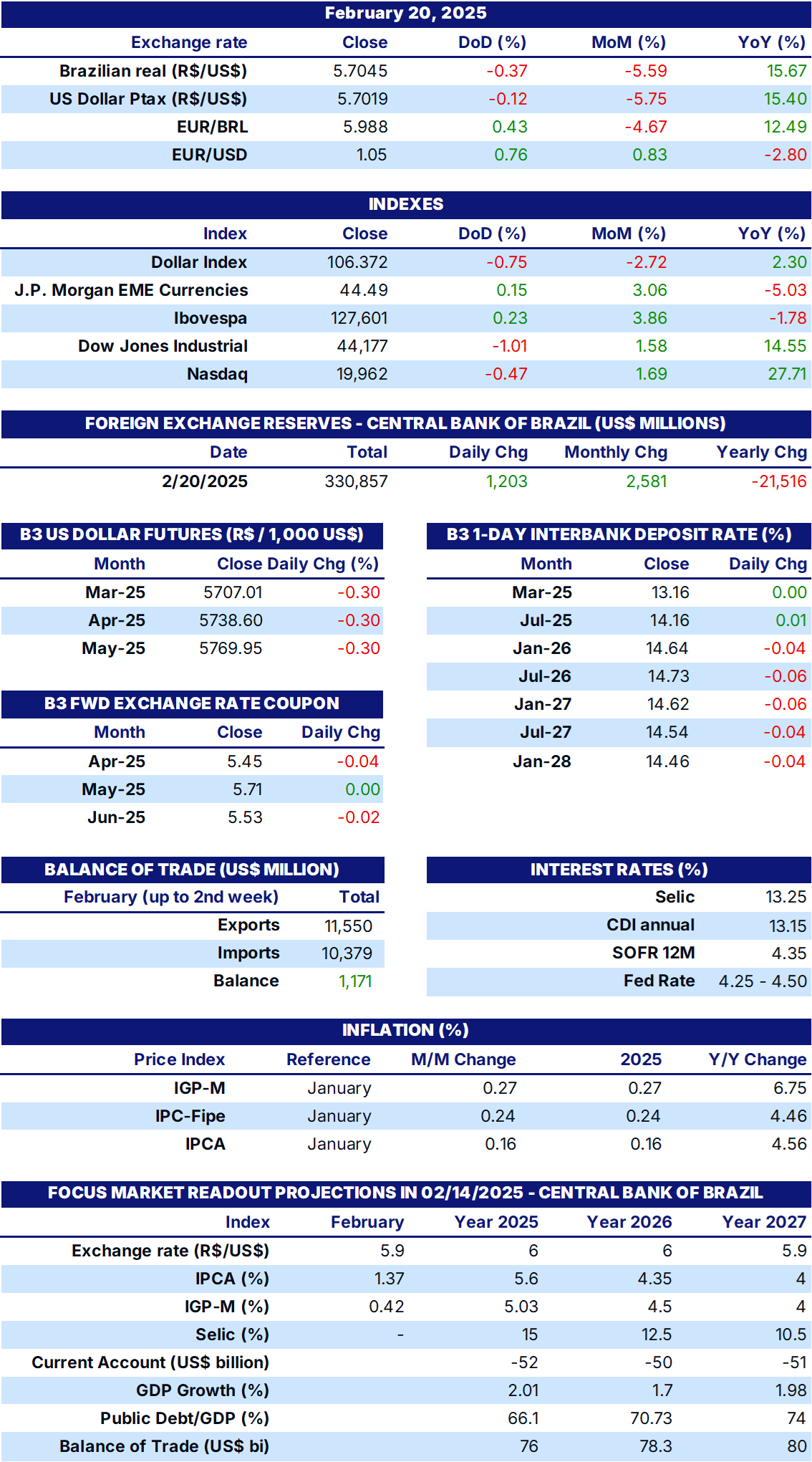
The USDBRL ended Friday’s (21st) session at BRL 5.7302, with a +0.6% variation for the week, -1.8% for the month, and -7.2% for the year. Meanwhile, the Dollar Index closed Friday’s session at 106.6 points, with a weekly decline of 0.1%, a monthly drop of 1.7%, and a yearly decrease of 1.4%.
USD/BRL and Dollar Index (points)
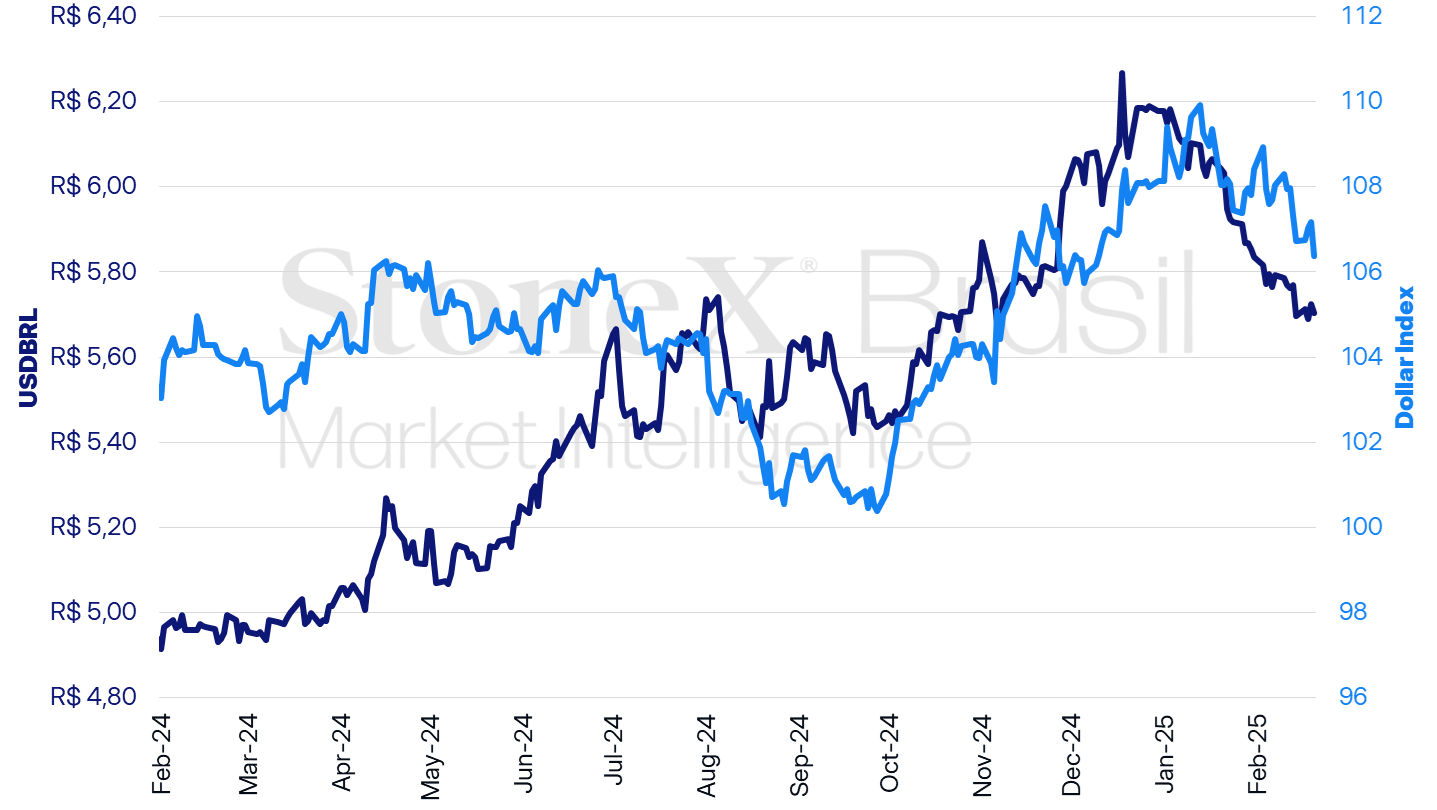
Source: StoneX cmdtyView. Design: StoneX.
KEY EVENT: Volatility and Unpredictability of the US Under Trump
Expected Impact on USDBRL: Bullish
In recent weeks, the perception that US President Donald Trump is taking a softer stance than anticipated on the application of import tariffs on other economies has led to broad weakening of the US dollar. Investors interpret Trump’s tariff threats as a negotiation tool to obtain concessions from other countries on key issues for the new administration, not necessarily linked to trade relations. For this reason, last week’s threats of imposing approximately 25% tariffs on imports of automobiles, semiconductors, pharmaceuticals, wood, and forest products starting in April had little effect on investors, who seem to believe these tariffs will be eased, restricted, or suspended before taking effect. Nonetheless, high uncertainty remains regarding the evolution of US trade policy in the coming weeks, and at least some of these tariffs are likely to be implemented, which tends to negatively impact risky assets such as stocks, commodities, and emerging market currencies.
Additionally, Donald Trump's government heightened geopolitical risk perceptions last week due to tensions and conflicts with allies in handling peace negotiations between Russia and Ukraine. First, high-level diplomats from Russia and the US met in Saudi Arabia to discuss the issue without Ukraine’s participation and without informing key allied leaders, such as those in Europe. Subsequently, the US president accused Ukraine of starting the war, labeled its president, Volodymyr Zelensky, as a “dictator without elections,” and stated that he “does not consider it very important that [Zelensky] be present at the negotiations [for peace]” because “he has done a terrible job negotiating so far.” Investors perceive that the US is attempting to force Ukraine into accepting a rushed deal, which increases concerns about the geopolitical stability of such a Washington-led agreement. This, in turn, favors safe-haven assets such as the US dollar.
US Inflation
Expected Impact on USDBRL: Bullish
The median forecast for the Personal Consumption Expenditures (PCE) Price Index indicates a 0.3% increase in January, repeating December’s increase, for both the headline and core index (which excludes volatile food and energy components), which had previously risen 0.2% in December. If these projections hold, they would reinforce the perception that US inflation remained elevated in January, potentially signaling the end of price stabilization efforts in the country. However, since the COVID-19 pandemic, US inflation has shown stronger seasonal pressures in Q1 of each year, an effect that has not persisted into later months. Thus, investors may refrain from reacting strongly to this data and instead wait for additional indicators to provide a clearer macroeconomic outlook for 2025, particularly given the mixed signals observed in January.
US: Historical and Expected Interest Rate Path – February 21, 2025
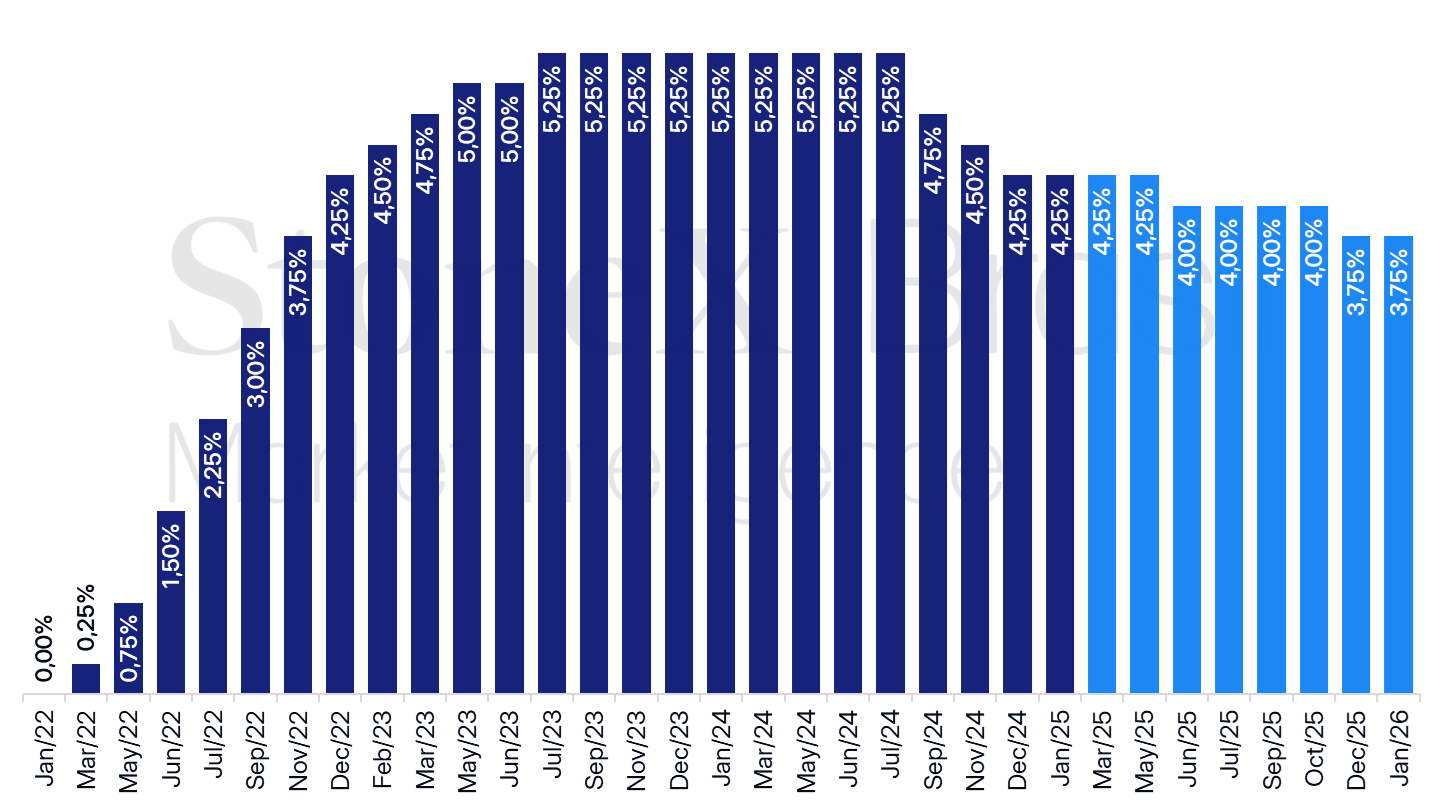
Source: CME FedWatch Tool. Design: StoneX. (Represents the most probable futures market bet for interest rates on the specified date.)
IPCA-15 and Employment Data in Brazil
Expected Impact on USDBRL: Bearish
In Brazil, the highlight of the week will be the Consumer Price Index – 15 (IPCA-15) for February, which has a median forecast of a 1.38% increase—a significant acceleration compared to the 0.11% increase recorded in January. However, last month’s moderate reading was partially influenced by one-off factors, particularly the “Itaipu energy bonus”. The 0.67% rise in the core index (excluding volatile food and energy components) and the 0.81% increase in service prices had already pointed to stronger inflationary pressures in January. Therefore, if the February forecast is confirmed, the IPCA-15 could worsen inflation expectations for 2025 and reinforce the outlook for higher Selic interest rates. This, in turn, enhances the profitability of Brazilian bonds, potentially attracting foreign capital and strengthening the real.

INDICATORS