FX Overview: Key events of the week
- Bearish Factors
- Increased uncertainty in the management of US economic policies raises concerns about a slowdown in American economic growth, which could increase bets on Federal Reserve interest rate cuts and weaken the dollar.
- A moderate rise in US inflation may reinforce the perception of a "soft landing" for the American economy, increasing bets on Federal Reserve interest rate cuts and weakening the dollar.
- A sharp acceleration in February's IPCA may consolidate expectations for firm increases in the basic interest rate (Selic), which helps attract foreign investment and strengthen the Brazilian real.
- Expectations of a "radical fiscal change" in Germany boost the country's growth prospects and support the performance of the euro, which tends to indirectly weaken the dollar.
- Bullish Factors
The week in review
The week was marked by a significant decline in the dollar amid concerns about American economic growth and the inconsistency, uncertainty, and unpredictability of the country's trade policy after the US imposed a 25% import tariff on Mexico and Canada and suspended most of these tariffs after two days.
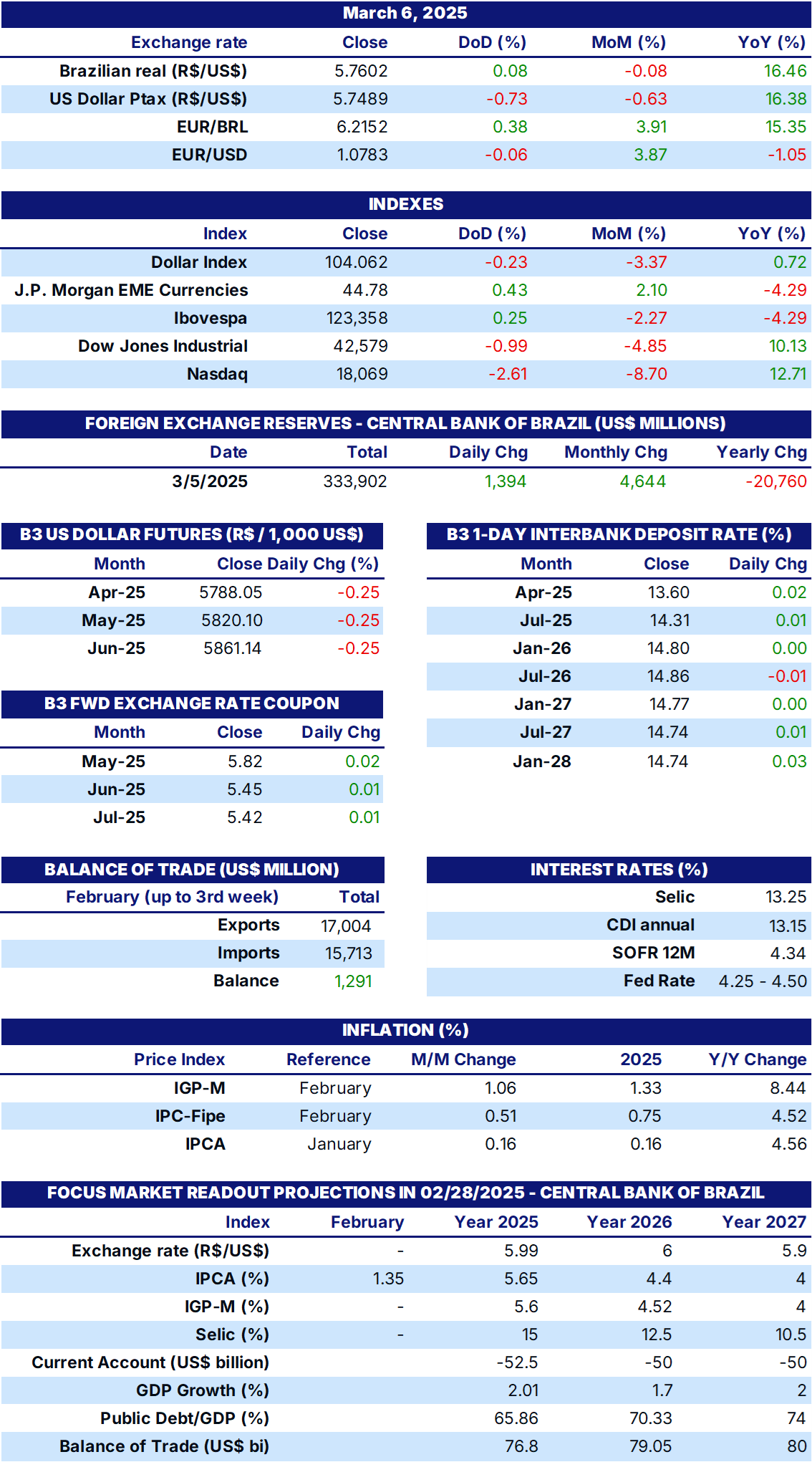
The USDBRL ended Friday's (07) session at 5.7892, a weekly decline of 2.1%, a monthly decline of 2.1%, and an annual decline of 6.3%. Meanwhile, the dollar index closed Friday's session at 103.8 points, with a variation of -3.5% for the week, -3.5% for the month, and -4.0% for the year.
USDBRL and Dollar Index (points)
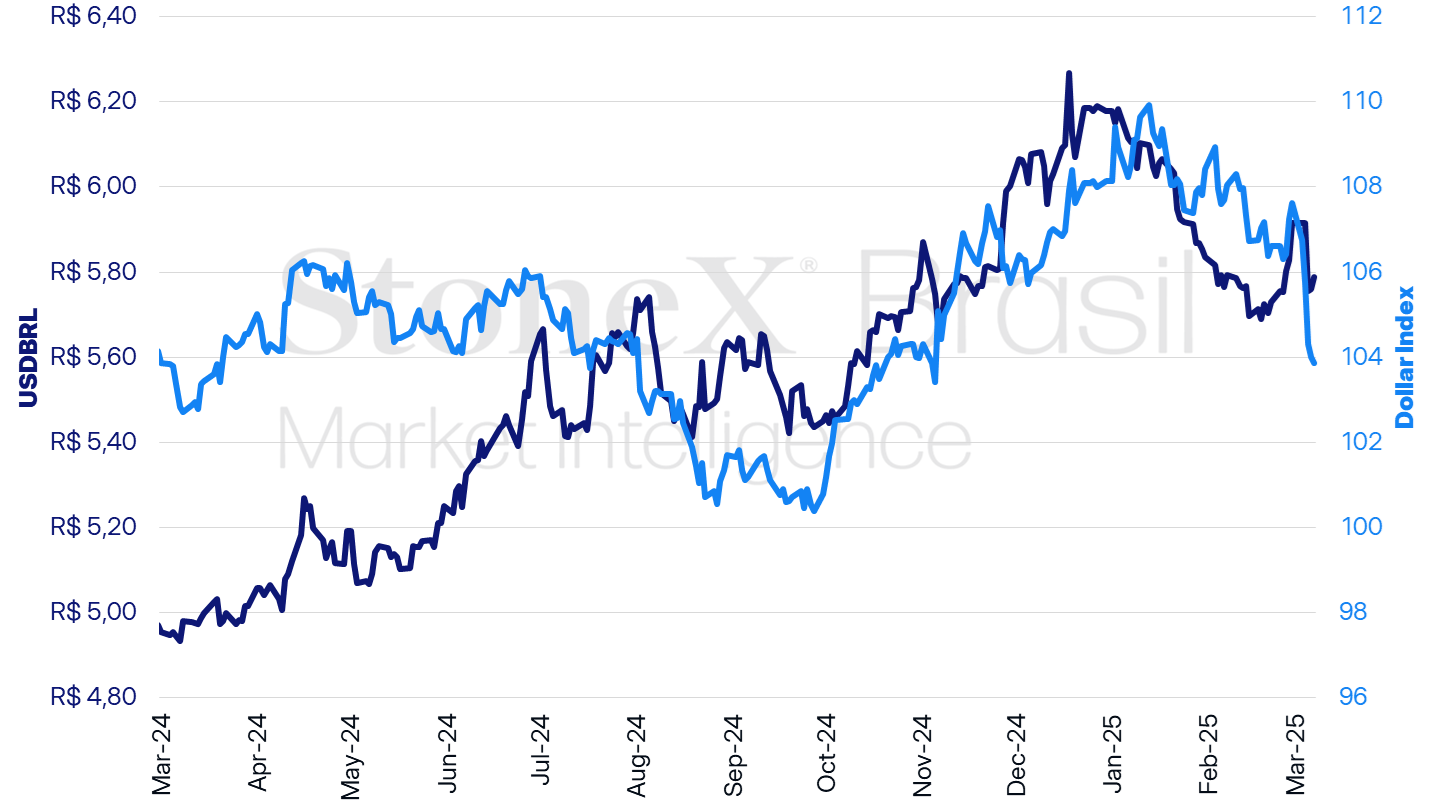
Source: StoneX cmdtyView. Prepared by: StoneX.
KEY EVENT: Volatility and Unpredictability in the US under Trump
Expected impact on USDBRL: bearish
Since Donald Trump's inauguration as US president, global financial markets have experienced significant volatility due to high uncertainty regarding the management of the country's economic policies and abrupt shifts in the new government's approach. For example, the government removed from its website a list of 440 federal properties it intended to close or sell for not being essential to public sector operations one day after its publication, ended the use of military aircraft for deporting immigrants after only one month, and attempted to rehire hundreds of federal employees who had been mass laid off from programs in nuclear arms management, disease prevention, and public health and safety.
Amid this chaotic environment, investors exhibited strong stress and pessimism last week, particularly due to the high unpredictability and uncertainty regarding which import tariffs would come into effect in the US. On Tuesday (04), the dollar broadly declined after the US government carried out its threat to apply a 25% surcharge on imports from Mexico and Canada—which had initially been suspended for 30 days—as well as doubling tariffs on imports from China from 10% to 20%. On Wednesday (05), the dollar once again broadly declined after the government once more suspended the application of tariffs on Mexico and Canada until April 2. Additionally, there is concern that this environment of high uncertainty will reduce the confidence of consumers and businesses, leading to reduced spending on consumption and investment, thereby harming the country's economic performance.
Additionally, Trump promised tariffs of 25% on all imports of steel and aluminum starting March 12 and on all imports of copper, automobiles, semiconductors, pharmaceutical products, wood, and forest products starting April 2—the same date on which "reciprocity tariffs" on other countries would be adopted and the suspension of the tariffs on Mexico and Canada would end. Even if a significant portion of these surcharges do not come into effect, it still seems likely that some of them will be applied for a considerable period, fueling fears that they will harm both American economic growth and that of the affected countries and sectors, as well as potentially result in higher inflationary pressures in the short term.
Thus, the current scenario produces two contradictory effects on the exchange rate of the real. On one hand, the high unpredictability and uncertainty in the American business environment tends to favor the performance of assets considered "safe havens," such as gold, the Swiss franc, and the Japanese yen, which, in theory, harms the performance of the real. On the other hand, fears that the country's economic growth will slow down increase bets on interest rate cuts by the Federal Reserve, which tends to weaken the dollar globally and, in theory, favor the performance of the real. At this time, the trend appears to be a strengthening of the Brazilian currency against the US dollar.
Inflation in the US
Expected impact on USDBRL: bearish
The median projections for the Consumer Price Index (CPI) indicate another moderate rise, with a monthly increase of 0.3% for both the overall indicator and its core, which excludes the volatile food and energy components. Should this estimate be confirmed, the 12‑month cumulative increase would slightly drop from 3.3% to 3.2%, but it would still be too high to allow new interest rate cuts by the Federal Reserve, with an average 3‑month annualized increase of 3.9%. Nonetheless, this projection could contribute to a "soft landing" interpretation for the American economy, which would increase bets on Federal Reserve rate cuts in 2025 and, thereby, weaken the dollar globally.
USA: Historical Overview and Interest Rate Outlook – updated on March 07, 2025
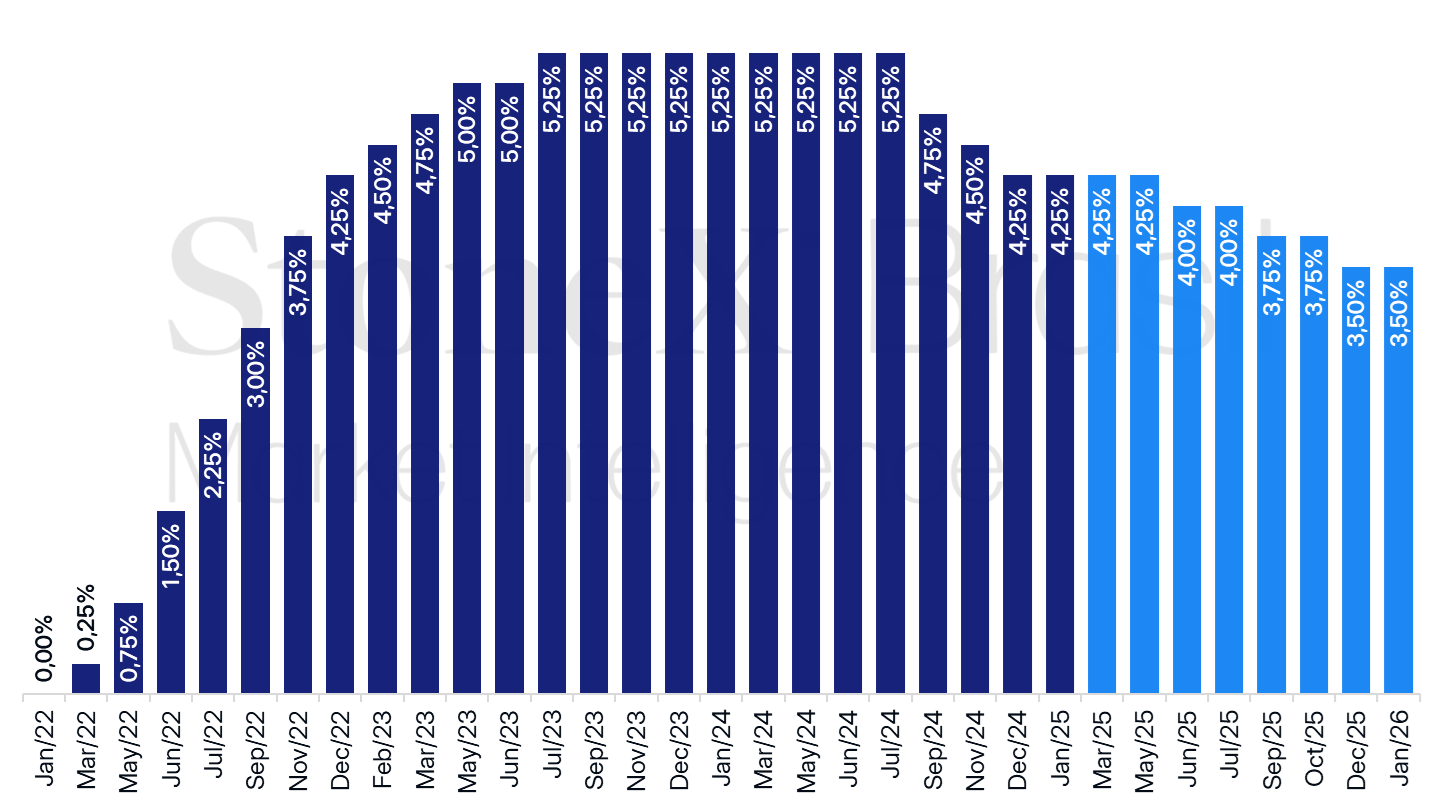
Source: CME FedWatch Tool. Prepared by: StoneX. Refers to the most likely bet in the interest rate futures market on the indicated date.
Inflation and Productive Activity in Brazil
Expected impact on USDBRL: bearish
The median projections for the Broad Consumer Price Index (IPCA) for February indicate an increase of 1.35%, a significant acceleration compared to the 0.16% rise observed in January. This acceleration is largely expected to result from the end of temporary factors that had contained inflation in the previous month, particularly Itaipu's "energy bonus." In January, even with a more moderate figure for the full index, the core indicator—which excludes the volatile food and energy components—increased by 0.67%, and service prices rose by 0.81%. If confirmed, the advance in February should worsen inflation expectations for 2025 and reinforce the outlook for firm increases in the basic interest rate (Selic), which, in turn, improves the yield of Brazilian bonds and may help attract foreign capital, thereby strengthening the real.
It is worth noting, however, that such an interpretation may be limited if this week's economic activity surveys reinforce the perception of an economic slowdown observed in recent data. This week, the notion of a slowdown in activity gained strength following the release of the fourth quarter 2024 Gross Domestic Product (GDP), which showed slower expansion than expected. A more modest growth pace could reduce inflationary pressures by dampening demand, which might lead the Central Bank to adopt a more cautious stance regarding increases in the Selic rate—both in light of a less adverse inflation scenario and to avoid a more pronounced economic slowdown. Thus, the combined reading of February's IPCA and upcoming activity indicators should be especially relevant for the Central Bank's risk assessment in its future decisions.
Fiscal Expansion in Germany
Expected impact on USDBRL: bearish
Finally, it is worth mentioning that investors should monitor news regarding Germany's defense spending expansion after the country's future prime minister, Friedrich Merz, surprised last week with an announcement of a "radical fiscal change" aimed at increasing investments in infrastructure and revitalizing the armed forces. Merz, from the CDU party, reached an agreement with the party of the current prime minister, the SPD, to form a coalition and approve these changes before the new Parliament is sworn in on March 25, following a worsening of geopolitical tensions caused by US President Donald Trump's disputes with his European allies, especially Ukraine. As a result, the trend of euro strengthening is expected to persist in the coming weeks, indirectly contributing to a weakening of the US dollar.

INDICATORS